
The Sentio (ST) ecosystem is a cutting-edge DePIN (Decentralized Physical Infrastructure Network) project designed to solve the plumbing problems of blockchain development. While blockchain data is public, it is notoriously fragmented and difficult to query at scale. Launched as a centralized observability platform in 2022 by a team of ex-Google and LinkedIn engineers, Sentio transitioned in early 2026 to a fully decentralized network architecture. By decoupling computation from storage, Sentio offers a modular, high-speed alternative to traditional indexers like The Graph.
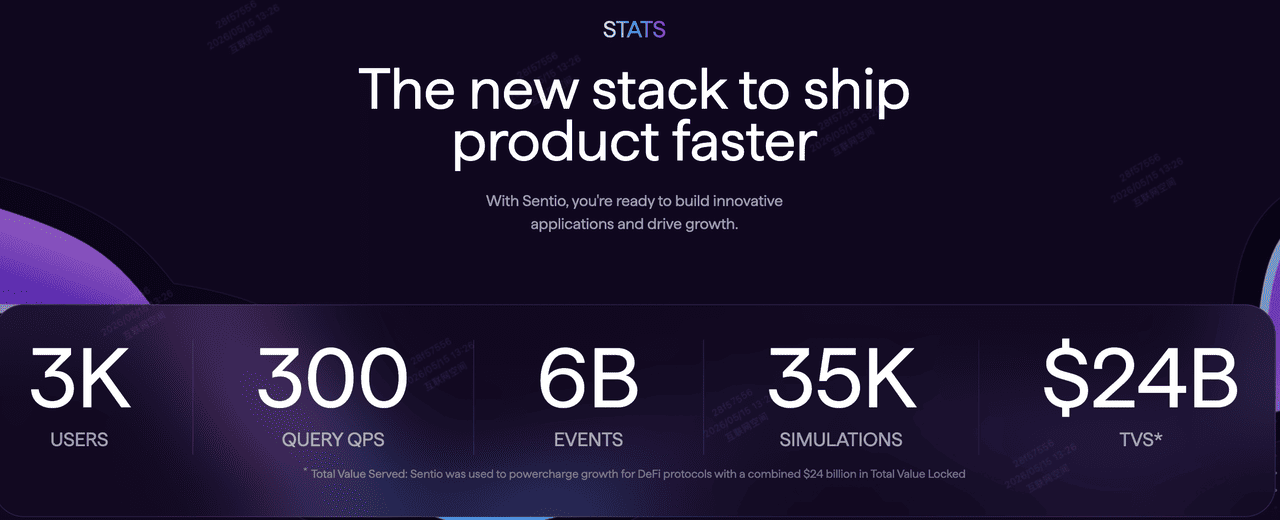
Sentio's stats as of May 2026 | Source: Sentio
As of May 2026, Sentio has processed over 6 billion events and serves protocols with a combined $24 billion in Total Value Locked (TVL). Unlike legacy data tools that require manual configuration, Sentio utilizes a Developer-First, AI-Powered approach. With the recent launch of its AI Skills service, developers can now generate complex data processors and SQL dashboards using natural language, effectively removing the technical barriers to blockchain analysis.
This article explores the technical architecture of the Sentio Network, the utility of the $ST token, its AI-driven capabilities, and how you can participate in the decentralized data revolution by trading ST on the BingX spot and futures markets.
What Is Sentio (ST)?
Sentio is a decentralized infrastructure layer that allows developers to monitor, analyze, and diagnose smart contracts across multiple chains, including Ethereum, Solana, Aptos, and Sui. It addresses three critical bottlenecks in the Web3 data space:
- Complexity: Raw blockchain logs are hard to read. Sentio’s SDK auto-generates TypeScript typings, making data human-readable instantly.
- Latency: Traditional indexers can be slow. Sentio’s parallelized Compute Network is designed to be up to 100x faster than standard frameworks.
- Fragility: Centralized data providers represent a single point of failure. Sentio’s decentralized node network ensures data remains verifiable and censorship-resistant.
Sentio’s Industry-First Features
- AI-Native Observability: Through the Model Context Protocol (MCP), Sentio integrates LLMs like GPT-4 and Claude directly into the workflow to generate code and SQL queries from plain English.
- Multi-Chain Unified Indexing: Developers can track assets flowing across different blockchains within a single project dashboard.
- Transaction Simulation: A powerful debugger that allows security engineers to preview fund flows and verify vulnerabilities before transactions are even signed.
How Does the Sentio Network Work?
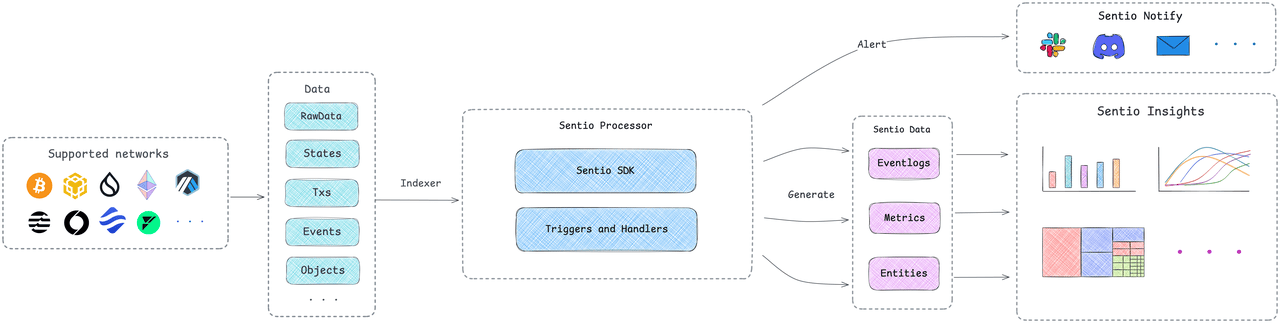
How Sentio works | Source: Sentio docs
The protocol operates through a modular design where independent layers scale to meet the demands of modern dApps.
1. The Processor Layer
At the heart of Sentio is the Processor, a user-defined program. Developers write logic in TypeScript to define which smart contracts to watch and how to transform raw data into actionable metrics like TVL, volume, or active users.
2. Decentralized Compute and Storage
The network distributes tasks across three specialized layers:
- Compute Network: Executes processors for real-time computation and alerting.
- Storage Network: Hosts the indexed data, making it searchable via high-performance APIs.
- Sentio EVM: Built on the OP Stack, this layer handles the settlement of Sentio Units (SU), staking, and node reputation.
3. AI-Driven Insights
Sentio’s AI agent acts as a co-pilot for developers. If a user asks, "Show me the top 10 traders on Hyperliquid last week," the AI automatically identifies the relevant tables, generates the optimized SQL query, and renders a visualization in seconds.
What Is Sentio (ST) Tokenomics: Powering the Data Economy
The $ST token is the utility and governance engine of the network, designed to align the interests of developers, node operators, and stakers.
ST Token Utility
- Sentio Units (SU): To consume data or run indexers, users pay in $ST. This creates a direct link between network usage and token demand.
- Node Operator Incentives: Operators earn $ST for every compute or storage job they successfully serve. Malicious or underperforming nodes face reputation loss and slashing.
- Staking & Delegation: Holders can stake $ST to secure the network. In return, they receive a portion of the protocol fees generated from data services, creating a sustainable, usage-driven yield.
ST Token Allocation
The Sentio ($ST) token has a fixed maximum supply of 1,000,000,000 tokens, designed with a multi-year vesting schedule to ensure long-term ecosystem alignment.
- Ecosystem (35%): 350 million tokens dedicated to community growth and platform development, with 3-month cliff, 60-month vesting.
- Airdrop & Marketing (18.9%): 189 million tokens for user acquisition and rewards, with 7.2% unlocked at TGE.
- Early Investors (17%): 170 million tokens allocated to seed and private rounds, with 12-month cliff, 24-month vesting.
- Team (15%): 150 million tokens for core contributors and founders, with 12-month cliff, 24-month vesting.
- Network Incentives (10%): 100 million tokens to reward node operators and stakers, with 3-month cliff, 36-month vesting.
- Liquidity (4.1%): 41 million tokens, 100% unlocked at TGE to ensure stable market depth.
Sentio vs. Traditional Indexers: Key Differences
|
Feature |
Sentio ($ST) |
Traditional Indexers |
|
Speed |
Up to 100x faster (Parallelized) |
Sequential (Often Slower) |
|
Logic |
Custom TypeScript Processors |
Limited Subgraph Mappings |
|
AI Integration |
Built-in AI Code & SQL Gen |
Manual Coding Only |
|
Debugging |
Real-time Simulator & Logs |
Post-mortem Analysis |
|
Deployment |
Fully Managed Decentralized Infra |
Often requires self-hosting |
Unlike traditional indexers that often rely on sequential, single-threaded processing, leading to significant lag during high-traffic events, Sentio utilizes a parallelized Compute Network designed to be up to 100x faster. While legacy solutions typically require developers to write rigid subgraph mappings that struggle with complex logic, Sentio’s TypeScript SDK allows for custom, high-performance Processors. These processors enable developers to handle advanced data transformations, such as real-time cross-chain aggregation and multi-versioning, without the no-code limitations that often hinder sophisticated DeFi or AI-agent applications.
From a practical maintenance perspective, Sentio shifts the burden from infrastructure management to automated observability. Traditional workflows require manual debugging through raw logs and external tools, whereas Sentio integrates built-in transaction simulators and AI-native SQL generation.
This allows developers to query data using natural language, e.g., "Show me daily active users on Sui," and instantly preview contract execution paths. By moving away from the black-box nature of centralized providers toward a decentralized, verifiable data layer, Sentio provides the high-fidelity metrics and security-first debugging tools essential for the speed and scale of the 2026 Web3 market.
How to Trade Sentio (ST) on BingX
As a premier platform for high-growth DePIN and AI assets, BingX provides the tools needed to trade $ST with institutional precision. To maximize your strategy, you can utilize BingX AI, an integrated analyst tool that provides real-time technical summaries, sentiment analysis, and price trend forecasting specifically for emerging tokens like $ST.
Buy and Hold $ST on the Spot Market
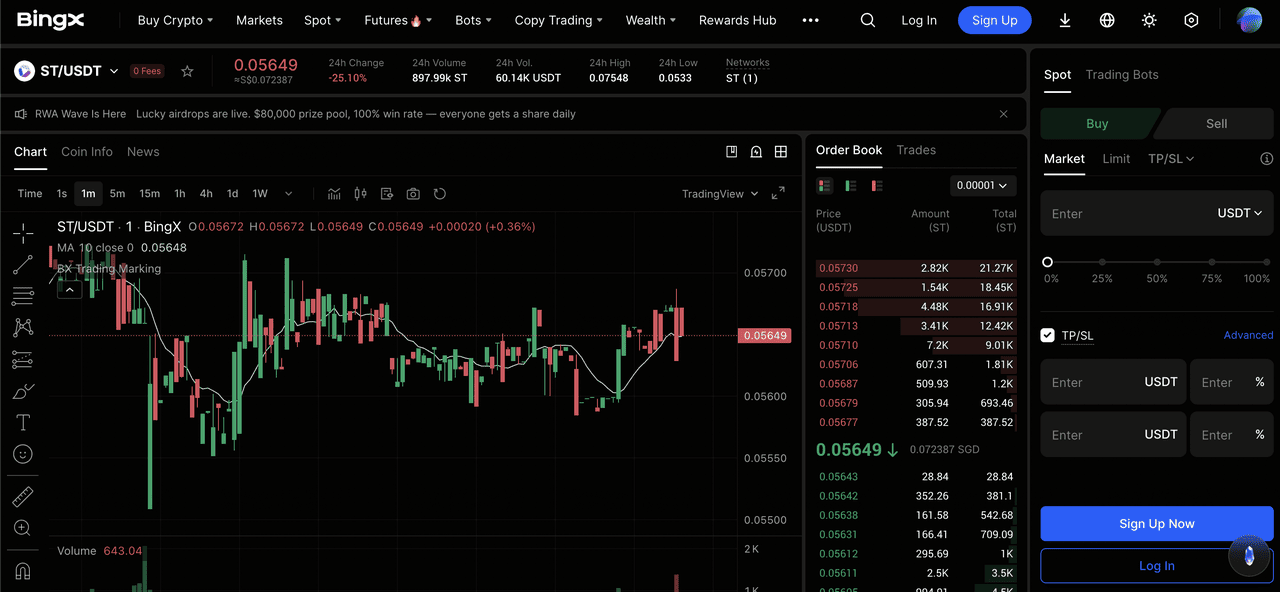
ST/USDT trading pair on BingX spot market
If you want to own the underlying asset for long-term staking or ecosystem participation, the Spot market is the most direct route.
- Find the Pair: Navigate to the Spot section and search for the ST/USDT trading pair.
- Analyze with BingX AI: Check the AI-generated insights to see if $ST is currently in an accumulation zone or overbought territory.
- Place Your Order: Select Market Order for instant execution or Limit Order to specify the price at which you want to buy.
- Storage: Once purchased, your tokens will appear in your Spot account, ready for transfer to a Sentio-compatible wallet for Testnet participation.
Long or Short ST Perpetuals on the Futures Market
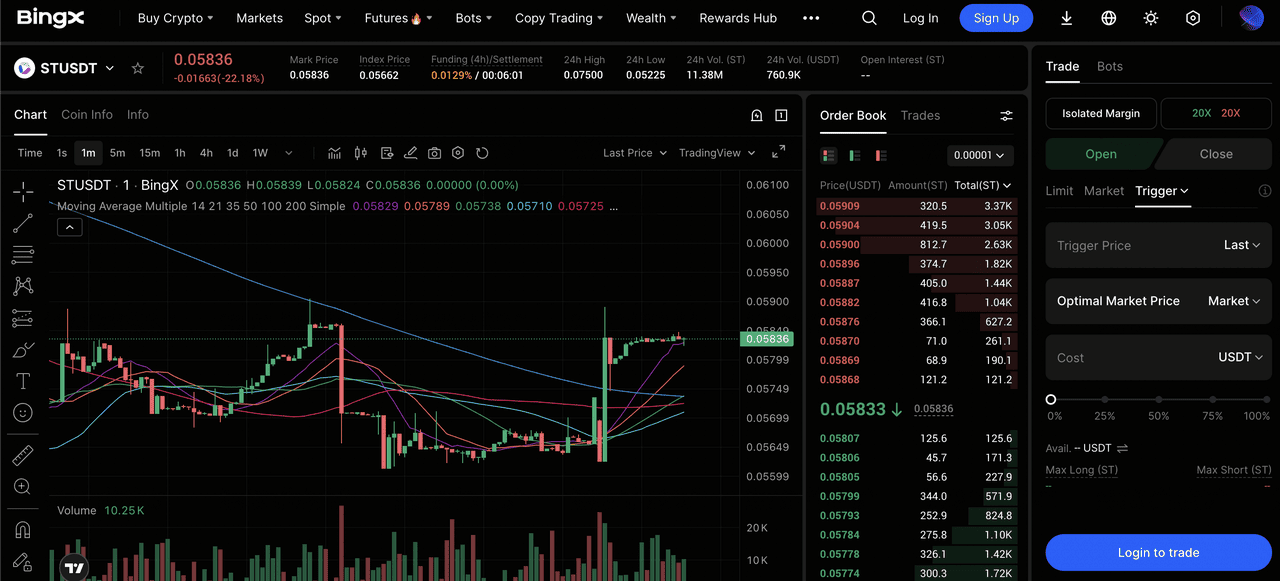
ST/USDT perpetuals on the BingX futures market
For traders looking to capitalize on price volatility or hedge their holdings, the Futures market offers flexible leverage options.
- Access Perpetuals: Go to the Futures section and search for the ST/USDT perpetual contract.
- Configure Leverage: Choose between Isolated or Cross Margin modes and set your preferred leverage.
- Use BingX AI Analyst: Leverage the built-in BingX AI tool to scan technical indicators for $ST before opening a position.
- Execute: Select Open Long if you anticipate a breakout or Open Short to hedge against market volatility.
5 Key Considerations Before Using Sentio
Before integrating Sentio into your workflow or investment portfolio, it is essential to evaluate the technical nuances and market dynamics of its decentralized infrastructure.
- Mainnet Transition: While the Testnet is live as of May 2026, the full migration of all legacy services to the decentralized runtime is slated for Q4 2026.
- Vesting Schedule: The ST token's initial circulating supply is low at 5.6%; be aware of future unlocks for the team and early investors starting in 2027.
- Developer Learning Curve: While the AI helps, a basic understanding of TypeScript is beneficial for creating complex custom processors.
- Network Fees: Costs are denominated in Sentio Units (SU); high network activity can lead to fluctuating costs for data consumption.
- Multi-chain Reliability: While Sentio supports 15+ chains, performance can vary depending on the underlying stability of the specific blockchain being indexed.
Final Thoughts: The Role of Sentio in the 2026 Data Economy
Sentio ($ST) serves as a functional bridge between raw blockchain complexity and actionable intelligence, positioning itself as a critical utility layer for the next phase of decentralized finance. By merging decentralized compute with AI-native tools, the protocol moves beyond simple indexing to provide a comprehensive observability stack. For developers, the practical value lies in the immediate reduction of infrastructure debt, while for the broader market, it establishes a verifiable standard for on-chain data integrity.
As autonomous agents and high-frequency DeFi protocols increasingly dominate network activity, the demand for low-latency, structured data will likely transition from a luxury to a technical requirement. Whether Sentio achieves Google-level ubiquity depends on the successful execution of its Q4 2026 Mainnet migration and the continued adoption of its decentralized node network. In the current landscape, it remains a foundational project for those prioritizing transparency and developer ergonomics in the Web3 ecosystem.
Risk Reminder: DePIN and AI-related investments involve technical risks and market volatility. Always perform your own due diligence. BingX is not responsible for investment losses.
Related Reading
- What Is Dolphin (POD) Decentralized AI Inference and How to Buy on BingX?
- What Is Quack AI (Q) AI-Powered DAO Governance and How to Trade It On BingX?
- What Is intellifi (INTE) Intelligent Onchain Finance and How Does It Work?
- What Is Gensyn (AI)? Discover Decentralised Protocol for AI and How To Trade It On BingX
- What Is SKYAI? MCP-Powered AI Data and How to Buy It On BingX
