Choosing between Cross Margin and Isolated Margin is the most consequential decision a futures trader makes after selecting an asset. This choice dictates how your collateral is allocated, how much of your account is at risk, and how far your liquidation cushion extends.
On BingX futures, these margin modes aren't just technical settings but are also strategic tools. Whether you are a high-leverage scalper or a diversified hedger, understanding these mechanics is essential for surviving the volatile 2026 market landscape. With the introduction of Separate Isolated Margin and Multi-Asset Mode, BingX offers a level of granular risk control that traditional exchanges cannot match.
What Is Margin in Futures Trading and How Does It Work?
In futures trading, margin is the foundational collateral required to initiate and sustain a leveraged futures position. Rather than paying the full face value of a contract, you provide a good faith security deposit, typically a small fraction of the total trade size, which allows you to borrow the remaining capital from the exchange.
This collateral acts as a buffer against potential losses; as long as the market value of your position remains within a safe distance of this deposit, your trade stays active. However, if the market moves against you and your equity (collateral plus unrealized profit/loss) drops below a specific threshold known as the Maintenance Margin, the exchange may trigger liquidation to prevent a negative balance.
How Margin Works When Trading Futures on BingX
The functionality of your margin is further defined by how you choose to collateralize your account. In Single-Asset Mode, you use a stablecoin like USDT or USDC to back your trades, providing a clear and non-volatile baseline for your risk. In the more advanced Multi-Asset Mode, BingX allows you to use a basket of holdings, such as BTC, ETH, and USDT, simultaneously. In this setup, the platform applies a haircut or LTV (Loan-to-Value) discount to the more volatile assets, ensuring that even if BTC drops in value, the combined strength of your diversified collateral pool can still support your open positions.
Ultimately, margin is the engine of Leverage. For example, by providing $1,000 as margin at 10x leverage, you are effectively controlling a $10,000 position. This amplifies your purchasing power, allowing for institutional-grade market exposure with retail-level capital, but it also means that a 10% move against you can wipe out your entire $1,000 deposit. The Margin Mode you then select, Cross or Isolated, governs whether this engine is compartmentalized to protect the rest of your wallet or integrated to maximize your capital's survival through shared support.
Read more: Perpetual Futures | Isolated Margin Mode and Cross Margin Mode
What Is Isolated Margin, the Risk Firewall, and How Does It Work?
Isolated Margin functions as a structural barrier between your individual trades and your total savings. When you open a position in this mode, you lock a specific portion of your capital into that trade’s vault. The exchange views this collateral as the absolute limit of your liability; if the market moves against you to the point of liquidation, the firewall holds, and the system is prohibited from touching a single cent of your remaining account balance.
Practically, this mode requires more manual oversight but offers maximum peace of mind. Because the liquidation price is fixed based on the specific margin you allocated, you always know exactly where your exit is. If a position nears its breaking point, you must manually inject more funds into that specific trade to save it. This granular control makes it impossible for one disastrous trade to trigger a chain reaction across your entire portfolio.
When to Use Isolated Margin Mode in Futures
- High-Volatility Gems: When trading assets prone to flash crashes or scam wicks.
- Hard Risk Limits: When you want to treat each trade like a set and forget bet with a defined maximum loss.
- Beginner Training: While learning the ropes, it prevents a single fat-finger error from draining your wallet.
How to Use Isolated Margin Mode: The Locked Vault
You have $5,000 in your BingX Futures account. You decide to take a high-risk long on a volatile meme coin using $500 at 10x leverage. You set it to Isolated Margin. Overnight, the coin crashes by 95%. Your $500 position is liquidated and lost entirely, but your remaining $4,500 stays perfectly safe and available for other trades.
Read more: How to Adjust Margin (with Isolated Margin Mode)
What Is Cross Margin, the Unified Pool, and How Does It Work?
Cross Margin treats your entire futures account as a single, living organism. Instead of compartmentalizing funds, every open position breathes from the same pool of oxygen or your total available balance. This mode prioritizes capital efficiency; as long as your total account equity, including the unrealized profits from your winning trades, stays above the required maintenance margin, all your positions remain alive and active.
The practical advantage here is automatic survival. If one position enters a temporary drawdown, the excess funds in your wallet automatically act as a buffer, pushing the liquidation price further away without you needing to lift a finger. However, this is a double-edged sword: in a catastrophic market-wide sell-off where all your assets drop at once, the shared pool can be drained rapidly, potentially leading to the liquidation of every single open position simultaneously.
When to Use Cross Margin Mode When Trading Futures
- Hedging Strategies: When you are Long on one asset and Short on another to offset risk.
- Institutional-Style Trend Trading: When you have a large balance and want to survive short-term market noise.
- High Capital Efficiency: When you want your winning trades to actively support and collateralize your new entries.
How to Use Cross Margin Mode: The Shared Lifeboat
You have $2,000 total balance. You are Long on BTC (currently losing $200) and Long on ETH (currently winning $300). In Cross Margin, the $300 profit from ETH is automatically added to your available margin pool, effectively covering the $200 loss from BTC. Your account remains healthy, and your BTC liquidation price actually moves further away because your ETH is performing well.
BingX Exclusive: Separate Isolated Margin
A BingX 2026 innovation, Separate Isolated Margin solves the merging problem found on traditional exchanges. In standard modes, if you buy BTC at $60,000 and then buy more at $62,000, the exchange averages your price and combines them into one giant blob. Separate Isolated Margin keeps these orders strictly independent. Each order exists as its own line item with a unique entry price, its own margin firewall, and its own dedicated Take-Profit and Stop-Loss triggers.
This mode is designed for the high-performance trader who views a single asset through multiple lenses. It allows you to mathematically separate your long-term moon bag from your 5-minute scalp. Because each trade is isolated from the other, even if they are both Longs on the same coin, a stop-loss hit on your scalp won't affect the entry price or the technical setup of your long-term swing position.
When to Use Separate Isolated Margin Mode on BingX Futures
- Multi-Timeframe Trading: When you want to scalp the 5-minute chart while holding a 4-hour trend on the same pair.
- Grid-Style Manual Trading: When you want to enter at multiple price levels without averaging up your initial entry price.
- Complex Risk Management: When you need a guaranteed Stop-Loss (GTD) on a specific high-leverage entry without closing your entire position.
How to Use Separate Isolated Margin Mode: The Multi-Strategy Example
You are bullish on BTC at $75,000. You open a Swing Long with $1,000 at 5x leverage. An hour later, you see a quick 1-minute dip to $74,500 and decide to Scalp Long with $500 at 50x leverage. In Separate Isolated Mode, these stay as two distinct trades. If the scalp hits its Stop-Loss due to high leverage, it closes out instantly, but your original Swing Long remains active at its original $75,000 entry, unaffected by the scalp's volatility.
Cross vs. Isolated vs. Separate Isolated Margin Modes: A Comparison
|
Feature |
Isolated Margin |
Cross Margin |
Separate Isolated |
|
Collateral Source |
Specific to position |
Entire account balance |
Specific to individual order |
|
Max Loss |
Limited to position margin |
Entire account balance |
Limited to order margin |
|
Liquidation Price |
Fixed (unless manual add) |
Dynamic (fluctuates with PnL) |
Fixed per order |
|
PnL Offsetting |
No |
Yes (Winners support losers) |
No |
|
Ideal For |
High-risk speculation |
Hedging & Trend trading |
Multi-strategy precision |
Choosing the right margin mode on BingX is a strategic trade-off between capital efficiency and risk containment. Cross Margin acts as a unified shared lifeboat, pooling your entire account balance to support all open positions; it is highly effective for hedged strategies or long-term trend trading because winning trades automatically subsidize losing ones, preventing premature liquidations during market noise. However, this efficiency comes with all-or-nothing risk, where a single catastrophic move in a correlated market can drain your entire wallet.
In contrast, Isolated and Separate Isolated modes act as risk firewalls. Standard Isolated Margin locks a fixed collateral amount into a single position, ensuring that a liquidation event is strictly contained and cannot touch your remaining funds, ideal for high-leverage scalping or volatile altcoins. BingX’s Separate Isolated Margin evolves this further by preventing position merging; it allows you to run multiple independent strategies on the same asset (like a short-term scalp and a long-term swing) as distinct line items, each with its own dedicated margin, liquidation price, and TP/SL triggers for surgical precision in risk management.
How to Switch Margin Modes
Selecting the correct margin mode is a vital prerequisite to every trade, as it defines your risk boundaries before you ever enter the market.
On BingX Web
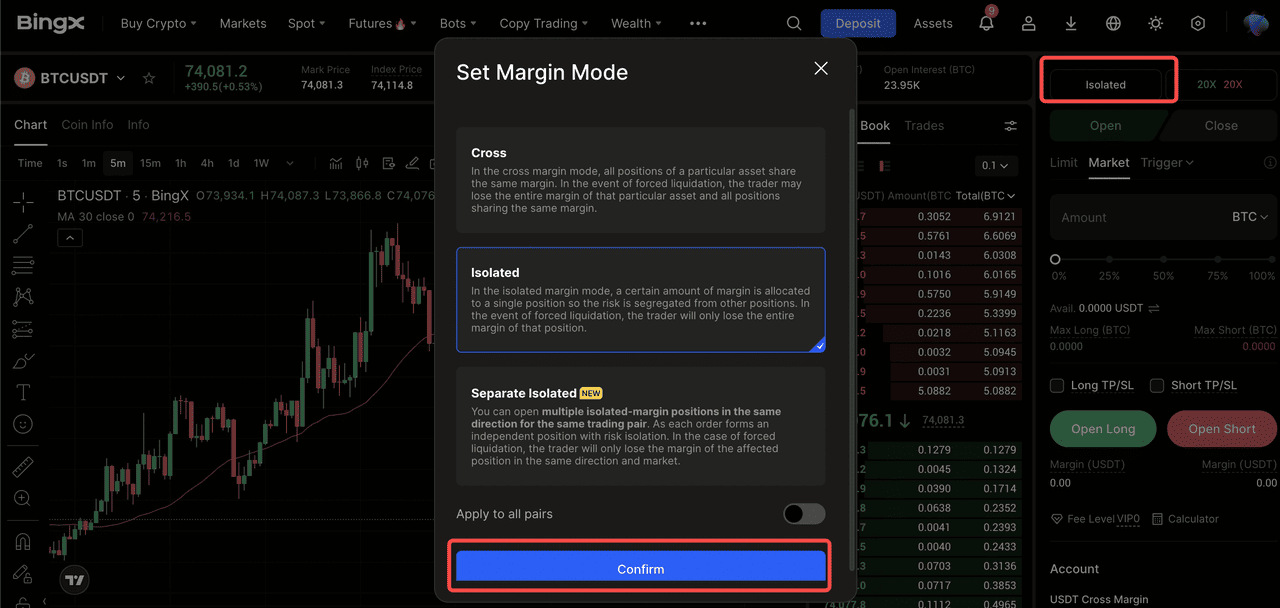
- Open the Perpetual Futures trading interface.
- On the right-hand side panel, locate the margin toggle (defaulting to Cross or Isolated).
- Click the toggle to select your preferred mode.
Note: You cannot change the margin mode for a position that is already open.
On BingX App
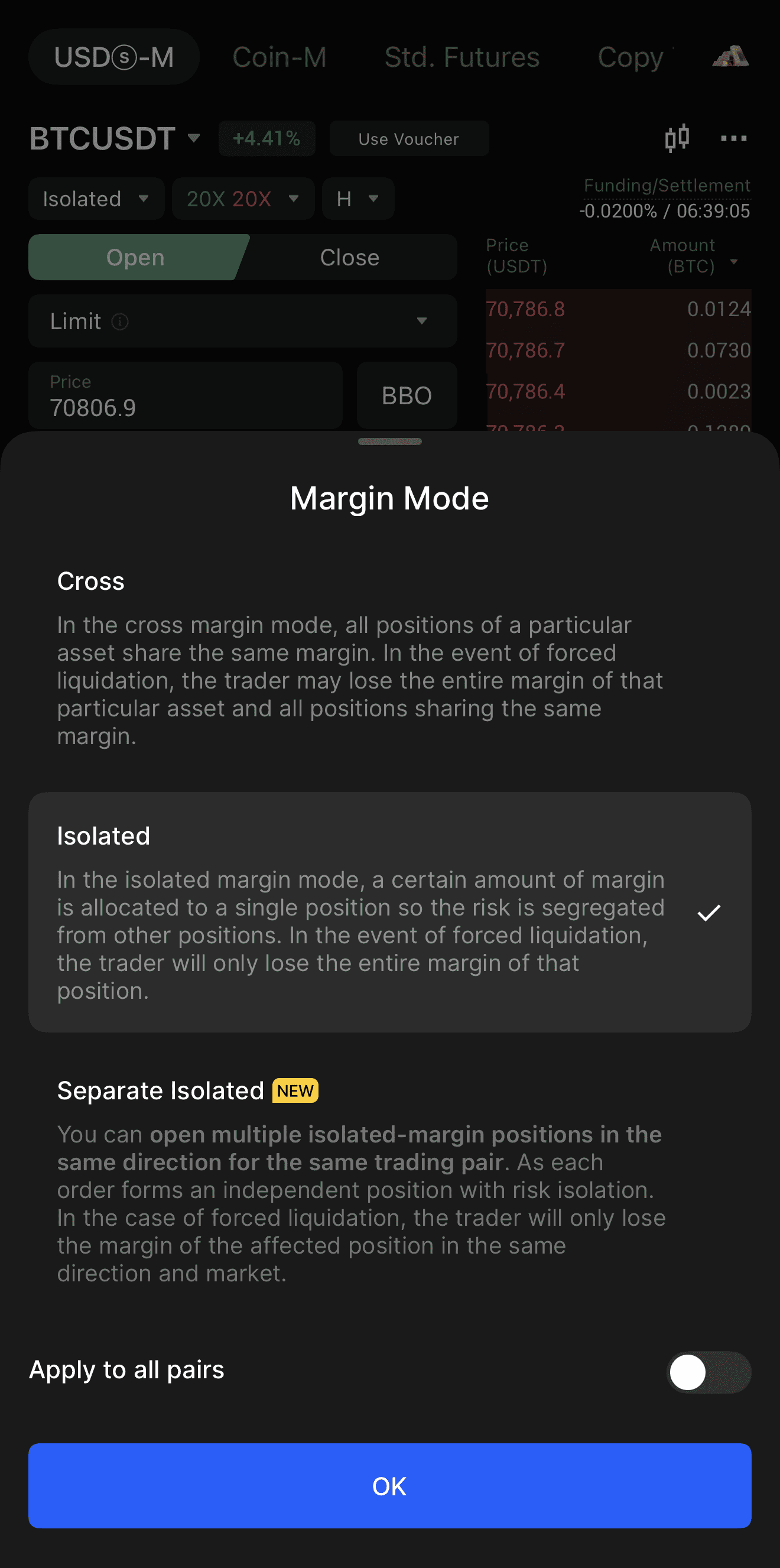
- Tap the Futures icon at the bottom.
- At the top right of the order entry screen, tap the current margin mode, e.g., Isolated 10x.
- Select your desired mode and confirm.
Essential 2026 Risk Management Checklist When Using Margin Modes
To trade effectively on BingX, follow these institutional-grade rules for margin management:
- Monitor Your LTV (Loan-to-Value): In Multi-Asset Mode, BingX applies a Risk Discount to volatile collateral like BTC. Ensure your LTV stays below 80% to avoid automatic conversions or liquidations.
- Use the Calculator: Before clicking Open, use the BingX Calculator icon to find your exact liquidation price.
- The Stop-Loss Rule: Never let a trade reach liquidation. Set your Stop-Loss at least 10–20% above your liquidation price to avoid the extra fees associated with the liquidation engine.
- Watch the Funding Clock: In Cross Margin, high funding rates can slowly drain your available balance, bringing your liquidation price closer over time.
Conclusion: Isolated or Cross Margin, Which Mode Should You Use?
Choosing between Isolated, Cross, and Separate Isolated margin is not about finding a superior mode, but about matching your collateral structure to your specific trading objective. For the precision trader, Isolated and Separate Isolated modes serve as essential risk firewalls, allowing you to test high-leverage ideas or run multiple strategies on a single asset without the threat of a portfolio-wide wipeout. These modes turn risk management into a surgical process, where the failure of one trade is mathematically incapable of impacting the rest of your capital.
Conversely, Cross Margin is a strategic tool for those managing complex, correlated portfolios or multi-asset hedges. By pooling your balance, you allow your winning positions to actively collateralize your drawdowns, creating a shared lifeboat that can survive the volatile market noise of 2026. Ultimately, the most effective approach often involves a hybrid strategy: utilizing Cross Margin for stable, long-term trend following and switching to Separate Isolated Margin for high-velocity scalps where containment is your primary goal.
Risk Reminder: Regardless of the mode selected, futures trading involves significant leverage which amplifies both potential profits and losses. No margin mode can eliminate the risk of total capital loss. Always use the BingX Calculator to determine your liquidation price and ensure a stop-loss is in place before executing any trade.
Ready to deploy your strategy? Head over to the BingX Perpetual Futures Terminal and choose the mode that fits your risk appetite.
Related Reading
- BingX Tutorial | How to Get Started With Futures Trading
- 8 Best Crypto Futures Platform for Beginners in 2026
- How to Get Started with Trading Futures on BingX: Beginner’s Guide
- How to Get Started with Perpetual Futures Trading on BingX: A 2026 Beginner's Guide
- How to Start Standard Futures on BingX: Your 2026 Guide to Simple, High-Leverage Trading
- What Are the Different Order Types Supported on BingX Futures and How to Use Them?
FAQs on Margin Modes on BingX Futures Trading
1. Can I switch from Isolated to Cross margin while a trade is open?
No. On BingX, the margin mode is locked once the position is executed. To change modes, you must close the current position and open a new one.
2. Does Cross Margin mode make me more money?
Not directly. Cross Margin improves position sustainability, meaning you can stay in a trade longer during volatility. However, it also exposes your entire balance to risk, which can lead to larger total losses if the market doesn't reverse.
3. Why did my liquidation price move in Cross Margin?
In Cross Margin, your liquidation price is dynamic. It changes based on the unrealized profit or loss of your other open positions and any changes to your available account balance, like paying funding fees.
4. What happens to my margin in Separate Isolated Mode?
Each order creates a"mini-position. If you open three different Long orders on BTC, they will appear as three separate lines in your position tab, each with its own margin and liquidation point.
