
Artificial intelligence (AI) infrastructure has entered a high-stakes operational phase, prompting an unprecedented reallocation of global silicon wafer capacity. By mid-2026, the primary constraint throttling the shipment of next-generation AI accelerators is no longer chip architecture or advanced foundry packaging, but the acute structural shortage of High-Bandwidth Memory (HBM).
To feed dense data into high-performance graphics processing units (GPUs) without latency bottlenecks, tech giants and cloud hyperscalers are expected to drive AI infrastructure capital expenditures past $650 billion this year alone. Because producing a single gigabyte of advanced HBM3E or HBM4 consumes roughly three times the raw silicon wafer capacity of standard DDR5 memory, a massive capacity scramble has broken out.
As the memory sector commands a larger share of the tech industry's total valuation, traditional access boundaries are breaking down. Through tokenized stocks, digital assets that mirror real-world equities 1:1 on public blockchains, and USDT-collateralized stock futures on BingX TradFi, crypto-native investors can access fractional exposure to global memory leaders 24/7. This framework bridges digital asset liquidity directly into the core hardware layer powering the AI economy.
The Global HBM Market Overview in 2026: Key Structural Trends
The memory market has evolved from a historically volatile, consumer-driven commodity cycle into a highly concentrated, tech-growth oligopoly. The 2026 HBM supercycle is defined by four foundational structural trends:
1. The Migration of the AI Hardware Bottleneck
Throughout 2024 and 2025, TSMC’s Chip-on-Wafer-on-Substrate (CoWoS) advanced packaging capacity was the primary chokepoint for AI accelerators. In mid-2026, CoWoS supply constraints are steadily easing, with monthly wafer output projected to scale to 120,000 by year-end. The bottleneck has officially migrated to memory. Next-generation architectures demand massive HBM configurations; for instance, Nvidia's B300 GPU utilizes 288 gigabytes of ultra-fast HBM3E per chip, more than doubling the footprint of its predecessor.
2. Extreme Capacity Concentration and Pre-Sold Order Books
The global HBM market is effectively controlled by an exclusive three-player oligopoly: SK Hynix, Samsung Electronics, and Micron Technology. Driven by a relentless data center buildout, all three manufacturers have completely pre-sold their entire 2026 HBM production capacities under rigid long-term allocation contracts, with order visibility stretching deep into 2027.
3. The Cannibalization of Consumer DRAM
Because the big three memory producers are redirecting up to 80% of their advanced fabrication lines toward high-margin AI memory, the supply of general-purpose DRAM for PCs and smartphones has sharply compressed. Driven by this structural supply crunch, conventional DRAM contract prices surged an unprecedented 90% to 95% quarter-over-quarter in early 2026.
Gartner projects that combined memory and SSD costs will skyrocket 130% by year-end, driving up average PC retail prices by 17% and effectively eliminating the sub-$500 entry-level computer segment from global retail channels by 2028.
4. Rapid Generational Ramps to HBM4 and HCB Technology
Technological roadmaps are accelerating rapidly in response to hyperscaler power constraints. While high-yield HBM3E serves as the high-volume operational baseline for mid-2026, the industry is aggressively transitioning to mass production of HBM4 nodes featuring a wider 2,048-bit interface. Leading-edge designs are also deploying innovative Hybrid Copper Bonding (HCB), which enables chip stacks of 16 layers and above while slashing structural thermal resistance by more than 20%.
What Are the Best High-Bandwidth Memory (HBM) Stocks to Watch in 2026?
The following directory highlights the direct memory producers, strategic exchange-traded funds (ETFs), and key downstream enablers dominating the global HBM supply chain in the second half of 2026.
1. Micron Technology (MU)
- 2026 Valuation Benchmark: $1.04 Trillion Market Cap
- Core Role: Premier US-Listed Pure-Play Memory Producer
Micron Technology has completed a historic structural transformation, stepping away from low-margin consumer segments to focus its resources entirely on premium enterprise data centers. As the sole major memory producer headquartered in the United States, Micron has emerged as a primary beneficiary of geographic onshoring trends and domestic CHIPS Act funding.
Micron's highly power-efficient 24GB and 36GB HBM3E stacks, which consume roughly 30% less power than competing legacy architectures, are fully integrated into premier GPU platforms. Supported by an explosive yield ramp on its advanced 1-gamma DRAM nodes and a jaw-dropping gross margin print of 74.4% in its recent fiscal quarter, Micron's stock has advanced over 140% year-to-date, briefly pushing the domestic manufacturer past the coveted $1 trillion market cap milestone.
Read more: Micron (MU) Stock Price Forecast 2026: Can AI Memory and DRAM Demand Push MU to $500?
2. SK Hynix (000660.KS)
- 2026 Valuation Benchmark: ₩166 Trillion Market Cap ($1.2 Trillion)
- Core Role: Dominant Global HBM Market Share Leader
South Korea’s SK Hynix remains the undisputed titan of the high-bandwidth memory landscape, commanding a dominant 57% share of the global HBM market. Deeply integrated as the primary and high-yield memory supplier for Nvidia's computing architectures, SK Hynix has secured roughly two-thirds of all upcoming Rubin-generation HBM4 allocations alongside exclusive supply contracts for custom hyperscaler infrastructure.
The structural supply deficit has handed SK Hynix unprecedented pricing power. Backed by projections of a triple-digit year-over-year surge in average DRAM selling prices, the company’s operating margins have soared past 70% with a record-breaking return on equity (ROE) tracking above 80%, keeping its valuation highly resilient despite aggressive capacity expansion pushes from regional peers.
3. Samsung Electronics (005930.KS)
- 2026 Valuation Benchmark: ₩2,012 Trillion Market Cap ($1.5 Trillion)
- Core Role: Diversified Semiconductor Giant with Full-Stack Packaging Integration
Samsung Electronics is deploying its massive capital reserves and extensive manufacturing infrastructure to rapidly narrow the technical gap in the advanced HBM race. To stabilize market allocation, Samsung is leading an industry-wide transition away from volatile quarterly contract signings toward multi-year long-term allocation structures.
Technologically, Samsung made waves by shipping the industry's first 12-layer HBM4E memory samples capable of reaching speeds up to 16 Gigabits-per-second with an expanded 48GB capacity. Furthermore, Samsung has locked in a major strategic memorandum of understanding to serve as the primary HBM4 supplier for AMD’s next-generation Instinct MI455X accelerators. Samsung's long-term competitive defense is its unique "one-stop shop" operational model, which combines memory fabrication, advanced foundry nodes, and in-house logic packaging under a single corporate umbrella.
4. Roundhill Memory ETF (DRAM)
- 2026 Valuation Benchmark: $11.6 Billion Assets Under Management (AUM)
- Core Role: Concentrated Global Memory Ecosystem Basket
Launched in early April 2026, the Roundhill Memory ETF (Ticker: DRAM) has shattered records as the fastest-growing thematic ETF in financial history, pulling in billions in capital to hit $11.6 billion in AUM in just 43 trading days. The fund provides direct, streamlined access to the memory supercycle by packaging global memory leaders into a single U.S.-listed vehicle.
This structured diversification is highly valuable for retail market participants, as it offers immediate exposure to the South Korean memory duopoly (SK Hynix and Samsung) without requiring specialized international brokerage configurations. Roughly 74% of the ETF's weight is concentrated across the top three memory giants, supplemented by peripheral storage and NAND leaders like SanDisk and Western Digital.
Structural Risk Alert: Investors must note that roughly 9% of the DRAM ETF's exposure to underlying assets like Micron is sustained through total return swaps and leveraged derivative contracts. While this synthetic architecture amplifies capital efficiency during a prolonged structural bull run, it will significantly exacerbate downside drawdowns during market-wide corrections.
Read more: Roundhill Memory ETF (DRAM) Forecast 2026: $1.5B AI Supercycle or 'RAMmageddon' Trap?
5. Advanced Micro Devices (AMD)
- Core Role: High-Performance AI Chip Designer and Dominant Downstream HBM Consumer
While direct memory manufacturers capture immediate pricing power, Advanced Micro Devices (AMD) represents the most compelling downstream consumer play in the HBM ecosystem. AMD does not manufacture physical memory; instead, its growth potential relies heavily on its ability to capture data center market share from Nvidia by prioritizing massive memory capacity and density.
AMD's chiplet-based Instinct accelerator architecture is deliberately engineered to maximize high-bandwidth storage capacity to excel at scaled operational AI inference workloads. Under the leadership of CEO Lisa Su, AMD has executed extensive supply diplomacy to protect its pipeline against intense market competition. This includes securing a landmark strategic partnership with Samsung to serve as the primary supplier of advanced HBM4 configurations for its next-generation Instinct MI455X graphics processing units (GPUs) and 1c DRAM for its sixth-generation EPYC central processing units (CPUs), codenamed Venice.
While AMD's data center segment has surged to generate more than half of its total corporate revenue, this heavy reliance on memory comes with structural trade-offs. The historic price increases across the global DRAM landscape have introduced severe cost pressures inside AMD’s consumer gaming and client segments, proving that even the hardware designers driving the HBM wave must carefully navigate its economic side effects.
Read more: AMD Price Prediction 2026: $525 AI Sovereignty or $300 Valuation Trap?
Comparison of Leading High-Bandwidth Memory (HBM) Investments
Based on updated mid-2026 market data, financial disclosures, and structural supply chain positions, here is a scannable cross-reference of the top HBM ecosystem plays:
|
Ticker / Symbol |
Primary Supply Role |
Core Architectural Catalyst |
2026 Financial & Structural Outlook |
|
Micron (MU) |
Direct US Producer |
High-efficiency HBM3E; upcoming 1-gamma HBM4 nodes |
Gross margins clear 74.4%; 2026 capacity 100% pre-sold; massive New York/Idaho fab buildouts. |
|
SK Hynix (000660.KS) |
Global Market Leader |
Exclusive Rubin-generation HBM4 allocations; Nvidia partnership |
Controls 57% global HBM share; operating margins track over 70% amid severe supply deficits. |
|
Samsung (005930.KS) |
Diversified Titan |
12-layer 48GB HBM4E nodes; primary AMD Instinct supplier |
Massive $73B capital push; leverages unique full-stack foundry, packaging, and memory integration. |
|
DRAM (ETF) |
Diversified Asset Basket |
Synthetically packages U.S., South Korean, and Japanese memory assets |
World's fastest-growing ETF; utilizes ~9% derivative swap overlay to maximize capital efficiency. |
|
AMD (AMD) |
Downstream Consumer |
Chiplet GPU architectures; high-capacity HBM4 integration |
Data center revenue surges past 50%; secures primary Samsung HBM4 allocation for Instinct MI455X. |
How to Trade High-Bandwidth Memory Stocks on BingX
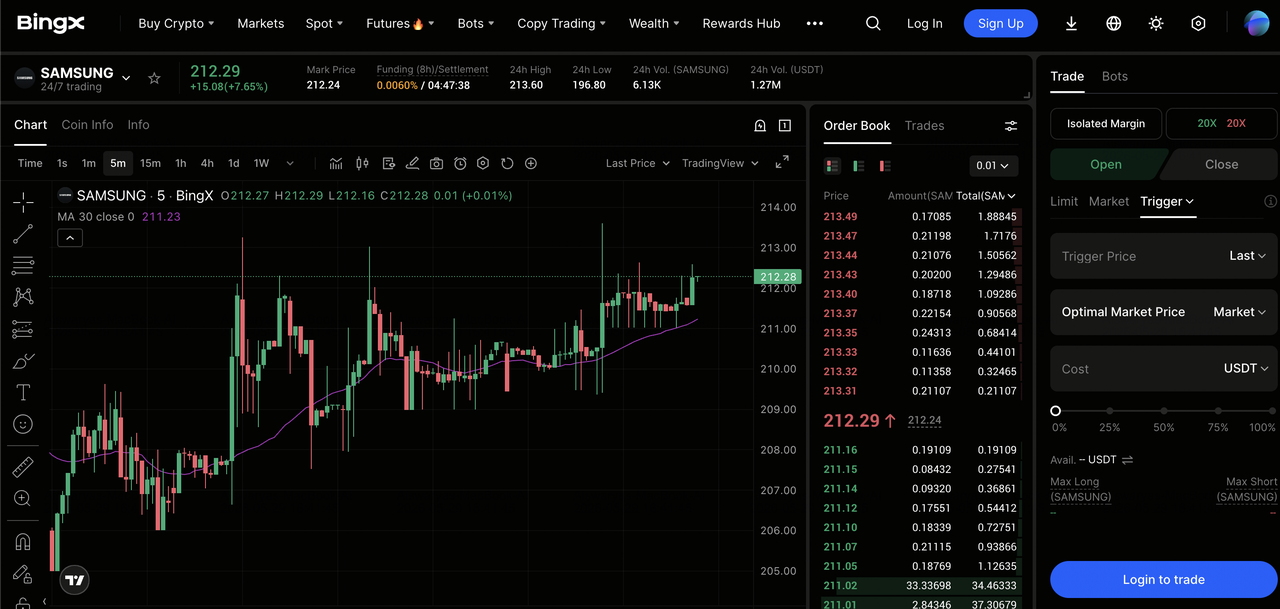
SAMSUNG-USDT perpetual contract on BingX futures market
BingX equips global market participants with highly optimized, institutional-grade tools to gain price exposure to the booming HBM and semiconductor infrastructure ecosystem using unified, crypto-native rails.
Trade HBM Stock and ETF Futures with USDT on BingX TradFi
For active traders looking to hedge physical technology portfolios, implement tactical short strategies, or deploy capital efficiency through leverage, the BingX TradFi portal provides deep liquidity via USDT-settled perpetual contracts mirroring premier U.S. equities.
- Navigate to the BingX TradFi portal and select the Stocks list.
- Transfer your desired volume of working capital from your standard Spot Account over to your Futures Account in USDT.
- Select your desired asset contract from a robust directory of technology pairs, such as MU-USDT, AMDUS-USDT, SAMSUNG-USDT, or DRAM-USDT.
- Formulate your macro direction: execute Open Long to capitalize on multi-year data center allocation trends, or Open Short to trade near-term tech sector pullbacks. Set your leverage parameters defensively in alignment with your capital preservation rules.
- Set up precise Take-Profit (TP) and Stop-Loss (SL) boundary orders to insulate your account against sudden intraday volatility. Confirm and execute the contract; real-time PnL will adjust dynamically inside your futures wallet.
Risks and Key Considerations When Trading HBM Stocks
While the AI-driven memory supercycle presents an extraordinary macro tailwind, market participants must manage capital against several critical risk vectors:
- Macro Economic Cyclicality: Memory has historically been one of the most cyclical, boom-and-bust segments in tech. While current AI data center commitments provide strong near-term visibility, aggressive capacity expansions by Samsung, SK Hynix, and Micron could result in a severe supply overshoot by late 2027 or 2028, compressing average selling prices and margins.
- Software-Driven Demand Disruption: The software ecosystem moves significantly faster than physical fabrication timelines. For example, Google’s recent disclosure of TurboQuant, a compression architecture capable of reducing the memory footprint required to run large language models by up to six times, demonstrates that algorithm breakthroughs can suddenly alter structural hardware demand profiles.
- Concentrated Fund Counterparty Risks: The unprecedented asset inflows into concentrated vehicles like the Roundhill Memory ETF (DRAM) create high structural crowding. Because these funds utilize internal derivative swap contracts, sudden systemic liquidity shocks or unexpected earnings misses can trigger cascade liquidations that decouple from fundamental valuations.
- Tokenized Asset Frameworks: Tokenized equity pairs function exclusively as precise price-tracking vehicles engineered for global capital efficiency. They mirror 1:1 real-world economic price action but do not convey corporate voting architecture, cash dividend collections, or traditional shareholder legal rights.
Final Thoughts: How to Navigate the 2026 Memory Supercycle with BingX
The mid-2026 technology landscape features an undeniable reality: while consumer electronics are facing severe margin compression due to rising component expenses, the infrastructure bottlenecks supplying the AI revolution are generating massive, highly visible cash flows today.
Strategic capital allocation across distinct layers of the HBM ecosystem, ranging from pure-play producers like Micron to full-stack giants like Samsung and global baskets like the DRAM ETF, offers a robust blueprint for capturing this multi-year tech boom. Utilizing the secure, flexible tokenized spot and futures rails on BingX TradFi allows global traders to capture these structural trends seamlessly using unified, stablecoin-driven capital.
However, trading high-beta semiconductor assets demands absolute portfolio discipline. Investors must implement stringent risk mitigation protocols, monitor ongoing yield developments, and approach the HBM supercycle as a volatile, high-growth component within a broader, globally diversified trading strategy.
Related Reading
- Top AI Compute and GPU Stocks to Buy in 2026: The Shift to Inference and Custom Silicon
- Top 10 AI Infrastructure Stocks to Buy in 2026: Chip Manufacturing and Design Leaders
- Top AI Semiconductor Stocks to Buy in 2026: AI Chips and Supply Chain Complete Guide
- Top AI Data Center Stocks to Buy in 2026: Cloud, Servers, and AI Compute Infrastructure
