


Netflix (NFLX) entered late July 2026 trading at levels last seen in September 2024. On July 16, the company reported second-quarter revenue of $12.56 billion, narrowly below the $12.58 billion consensus, with diluted EPS of $0.80 beating the $0.79 estimate. The stock fell nearly 9% after hours to a fresh 52-week low near $65, extending a decline of more than 44% across twelve months. All figures reflect the 10-for-1 stock split completed in November 2025.
The results were not the problem. Revenue grew 13.4% with double-digit growth in every region, operating income reached $4.2 billion, and Netflix executed its largest-ever quarterly buyback at $4.7 billion. What unsettled the market was the forward look. Q3 revenue guidance of $12.86 billion implies 11.7% growth against a consensus near $13 billion, full-year guidance was narrowed to $51.0 to $51.4 billion, and management announced it will publish its viewing-hours report annually from 2027 rather than semi-annually, reducing engagement visibility at exactly the moment investors are questioning it.
The NFLX stock forecast for 2026 now centers on two competing views:
- The monetization case: Bulls expect an advertising business on track for roughly $3 billion in 2026, a live sports slate including the 2027 FIFA Women's World Cup and expanded NFL, and record buybacks to reset a stock trading far below its own history, with targets running as high as $136.
- The engagement case: Bears see decelerating revenue growth, view hours up only 2% in the first half, short-form platforms taking attention, and reduced disclosure as a signal rather than a simplification.
This guide breaks down the NFLX stock forecast, 2026 price scenarios, key risks, and research from JPMorgan, BofA, Bernstein, Baird, Seaport and Pivotal Research, drawing on the July 16 shareholder letter and the Q2 investor call, plus how to trade NFLX stock futures on BingX TradFi with USDT collateral.
Top 5 Things for Netflix Investors to Know in July 2026
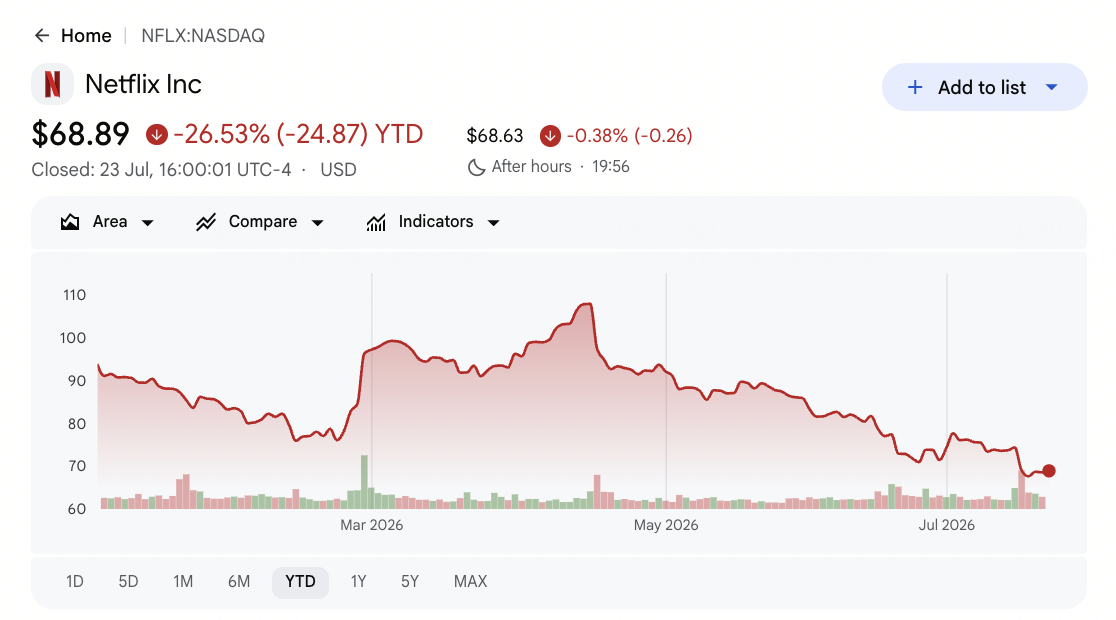
- Q2 revenue of $12.56 billion narrowly missed while EPS beat: Revenue grew 13.4% year over year against a $12.58 billion consensus, while diluted EPS of $0.80 topped the $0.79 estimate and rose 11% from $0.72. Net income reached $3.40 billion.
- Q3 guidance came in below the Street: Management guided Q3 revenue to $12.86 billion, implying 11.7% growth against a consensus near $13 billion, with EPS guidance of roughly $0.82 versus $0.84 expected and an operating margin of 33.2%.
- The stock hit a 52-week low near $65: Shares fell nearly 9% after hours to levels last seen in September 2024, down more than 44% over twelve months and well below the 200-day moving average near $94.
- Viewing-hours reporting is being cut to once a year: From 2027, the "What We Watched" report moves to annual publication in the first quarter. Management framed this as keeping focus on financial metrics, but it removes the primary engagement disclosure.
- Buybacks hit a record $4.7 billion in the quarter: The largest quarterly repurchase in company history, with $5.9 billion completed across the first half and $27 billion of authorization remaining, funded partly by a $2.8 billion termination fee from the cancelled Warner Bros. Discovery transaction.
What Is Netflix (NFLX)?

Netflix is the world's largest subscription streaming entertainment service, with more than 300 million paid memberships across over 190 countries. The company operates a single global platform delivering series, films, games, live events and, increasingly, advertising, with revenue split across four regions: UCAN, EMEA, LATAM and APAC.
The business model has shifted from pure subscription growth to monetization of an existing base. Netflix stopped reporting quarterly subscriber numbers and now directs investors to revenue and operating margin as its primary metrics. Three levers drive growth: pricing, with a second U.S. increase in a little over a year implemented across all three plans; advertising, where the ad-supported tier reaches more than 250 million monthly active viewers and management targets roughly $3 billion of ad revenue in 2026; and engagement, where live programming has become a deliberate acquisition tool. Live events account for just over 5% of content spend and roughly 1% of view hours, yet delivered six of the top ten new member sign-up days over the past five years. The upcoming slate includes the 2027 FIFA Women's World Cup, an expanded NFL package, WWE and MLB events. Q2 revenue passed $4.0 billion in EMEA and $1.5 billion in each of LATAM and APAC.
Netflix (NFLX) Q2 2026 Earnings: What Drove the Revenue Miss and the 52-Week Low
- Revenue growth held but decelerated. Q2 grew 13.4% with double-digit growth in all four regions, yet UCAN grew only 10% because the recent price increase contributed just a partial quarter.
- Q3 guidance signalled further slowing. Guidance of $12.86 billion implies 11.7% growth, a step down from 13.4%, and landed roughly $140 million below the Street's expectation.
- Margins compressed on content amortization timing. Operating margin of 33.4% fell from 34.1% a year earlier as content amortization ran heavier in the first half. Management expects it to grow more slowly in the second half and rise roughly 10% for the full year.
- Engagement grew only modestly. View hours rose 2% across the first half, an incremental 1.5 billion hours, which management characterized as a slight acceleration from 2025 but which the market read as thin given the content investment behind it.
- Free cash flow fell on tax and termination items. Cash flow declined roughly 33% year over year on higher cash tax payments and costs associated with the cancelled Warner Bros. Discovery transaction, even as the $2.8 billion termination fee boosted other income.
Netflix Q2 2026 Financial and Consensus Profile: Revenue, EPS and Margins
Netflix's Q2 print was a narrow miss on revenue and a narrow beat on earnings, which in isolation would be unremarkable. The reaction was driven entirely by the guidance and the disclosure change.
|
Financial Metric |
Consensus Estimate |
Reported / Actual |
Surprise |
|
Q2 2026 Revenue |
~$12.58 billion |
$12.56 billion |
Narrow miss; up 13.4% year over year |
|
Q2 2026 Diluted EPS |
~$0.79 |
$0.80 |
Beat; up 11% from $0.72 |
|
Q2 2026 Net Income |
— |
$3.40 billion |
Slightly ahead of internal forecast |
|
Q2 2026 Operating Income |
— |
$4.2 billion |
Up 11%; margin 33.4% versus 34.1% a year ago |
|
Q2 2026 Share Repurchase |
— |
$4.7 billion |
Largest quarterly buyback in company history |
|
H1 2026 Revenue |
— |
$24.81 billion |
Up 15% year over year; net income $8.68 billion |
|
H1 2026 View Hours |
— |
Up 2% |
An incremental 1.5 billion hours year over year |
|
Q3 2026 Revenue Guidance |
~$13.0 billion |
$12.86 billion |
Below Street; implies 11.7% growth, margin 33.2% |
|
FY2026 Revenue Guidance |
$50.7 to $51.7 billion prior |
$51.0 to $51.4 billion |
Narrowed by $300 million on both ends |
For context, Q1 2026 delivered $12.25 billion of revenue, up 16%, and prompted Netflix to raise full-year free cash flow guidance to $12.5 billion and double its 2026 advertising revenue target to $3 billion on a 70% increase in advertisers. The board also approved a new $25 billion repurchase authorization expanding on the prior $15 billion. Cash and short-term investments stood at $9.13 billion at June 30. Management maintains full-year reported revenue growth guidance of 13% to 14%, or 12% on a foreign exchange neutral basis, and says U.S. upfront advertising negotiations are in advanced stages with commitments expected to close within weeks.
Netflix (NFLX) 2026 Investment Outlook: $136 Bull Case vs. $65 Bear Case
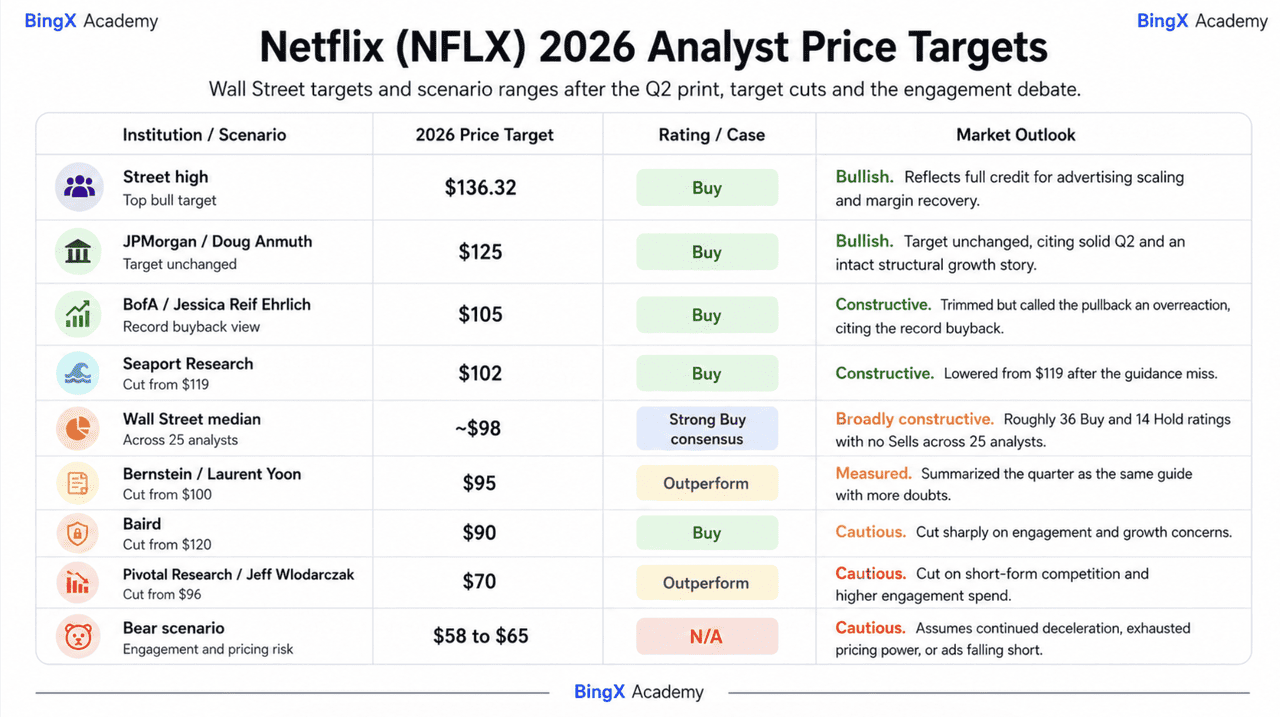
Netflix's outlook for the rest of 2026 depends on one central question: whether decelerating growth reflects a maturing subscription business that advertising and live events can re-accelerate, or a structural loss of attention to short-form platforms.
The Bull Case: Ads Growth and Live Sports Push NFLX Toward $125
The bull case is that Netflix’s operating momentum remains stronger than the share price suggests. Revenue grew 13.4%, every region delivered double-digit growth, advertising expanded into a roughly $3 billion business, and management repurchased a record $4.7 billion of stock in one quarter. That level of buyback activity suggests Netflix sees meaningful value at current prices.
A stronger second-half content slate, rising upfront ad commitments, and a broader live sports schedule could support another leg of growth. Live programming still accounts for only a small share of content spending and viewing hours, yet it has already produced several of Netflix’s strongest member sign-up days. If revenue holds, ad monetization improves, and content amortization slows, NFLX could recover toward $125.
The Base Case: Stable Guidance and Buybacks Keep NFLX Between $65 and $95
The base case is that Netflix delivers its narrowed outlook without quickly regaining its former valuation. Full-year revenue reaches $51.0 billion to $51.4 billion, advertising approaches $3 billion, and the stock rebuilds gradually from its 52-week low.
Reduced engagement disclosure keeps investors cautious because the market loses a key measure of audience momentum just as viewing trends are under scrutiny. The 200-day moving average near $94 remains the main recovery test, while the $65 area provides support. A remaining $27 billion buyback authorization should help cushion downside, but NFLX may stay between $65 and $95 until revenue growth and engagement improve more clearly.
The Bear Case: Slower Engagement and Revenue Growth Pull NFLX Toward $58
The bear case is that audience attention continues shifting toward short-form platforms, forcing Netflix to spend more to defend engagement. Revenue growth has already slowed from 16% in Q1 to 13.4% in Q2, with 11.7% guided for Q3, creating a clear deceleration pattern.
Viewing hours rose only 2% in the first half despite heavier content spending and a larger live-event slate. If pricing power weakens, subscriber growth slows, and advertising cannot offset softer engagement, the market could cut both earnings expectations and the valuation multiple. Under that scenario, NFLX could continue falling toward the high $50s.
NFLX Stock Price Forecasts for 2026 By Wall Street Analysts
Wall Street broadly cut targets after the print while overwhelmingly maintaining Buy ratings, an unusual combination that reflects analysts lowering near-term expectations without abandoning the long-term thesis.
|
Institution |
2026 Price Target |
Rating |
Market Outlook |
|
Street high |
$136.32 |
Buy |
Bullish. Reflects full credit for advertising scaling and margin recovery. |
|
JPMorgan / Doug Anmuth |
$125 |
Buy |
Bullish. Target unchanged, citing solid Q2 and an intact structural growth story. |
|
BofA / Jessica Reif Ehrlich |
$105 |
Buy |
Constructive. Trimmed but called the pullback an overreaction, citing the record buyback. |
|
Seaport Research |
$102 |
Buy |
Constructive. Lowered from $119 after the guidance miss. |
|
Wall Street median |
~$98 |
Strong Buy consensus |
Broadly constructive. Roughly 36 Buy and 14 Hold ratings with no Sells across 25 analysts. |
|
Bernstein / Laurent Yoon |
$95 |
Outperform |
Measured. Cut from $100, summarizing the quarter as the same guide with more doubts. |
|
Baird |
$90 |
Buy |
Cautious. Cut sharply from $120 on engagement and growth concerns. |
|
Pivotal Research / Jeff Wlodarczak |
$70 |
Outperform |
Cautious. Cut from $96 on short-form competition and higher engagement spend. |
|
Bear scenario |
$58 to $65 |
N/A |
Cautious. Assumes continued deceleration, exhausted pricing power, or ads falling short. |
How to Trade Netflix (NFLX) Stock on BingX
Navigate the volatility of Netflix's earnings cycle using BingX TradFi and BingX AI tools. By leveraging AI-driven predictive analytics, you can better anticipate market sentiment shifts and price action around quarterly releases.
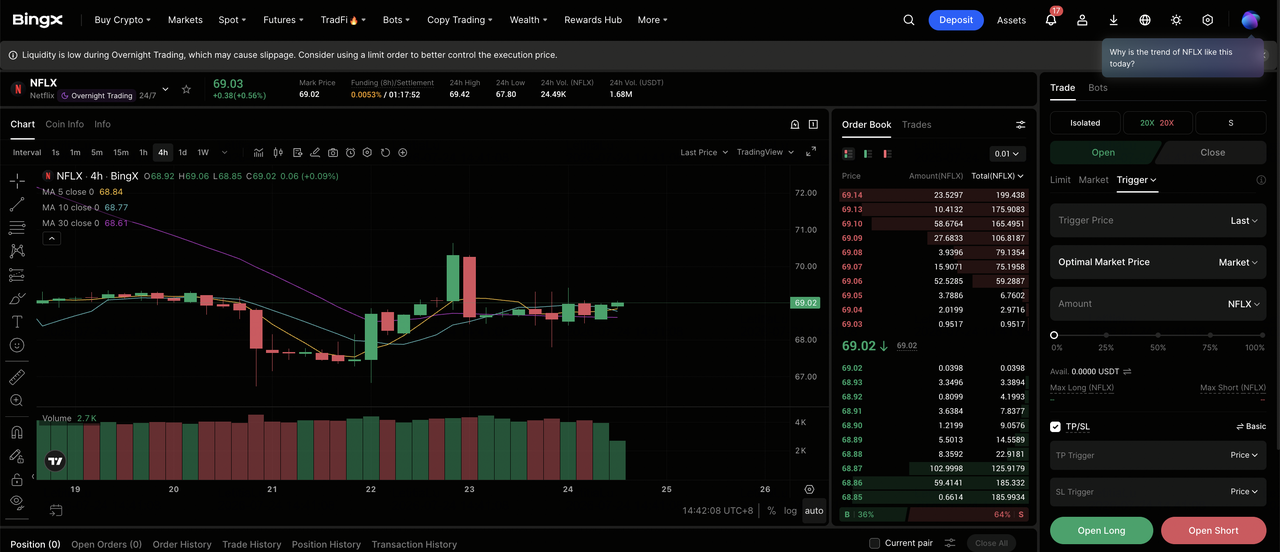
Step 1: Access BingX TradFi. Sign up and navigate to the specialized TradFi section on the main BingX exchange dashboard.
Step 2: Select Netflix (NFLX). Search for and select the NFLX-USDT perpetual futures contract.
Step 3: Choose your direction. Select Open Long if you expect the ads business to reach the $3 billion target, the live sports slate to lift sign-ups, and record buybacks to support a stock at a 52-week low. Select Open Short if you expect revenue growth to keep decelerating past 11.7%, engagement to erode against short-form platforms, or pricing power to be exhausted after two increases in a year.
Step 4: Select leverage and margin mode. Choose Isolated or Cross-Margin based on your risk tolerance. Because NFLX fell nearly 9% within an hour of the Q2 release despite an EPS beat, conservative leverage and clear position sizing are important.
Step 5: Execute strict risk protocols. Set Take-Profit and Stop-Loss (TP/SL) levels before or immediately after entering the trade. NFLX can react quickly to quarterly earnings and guidance, advertising upfront commitments, live sports rights announcements, price increase decisions, competitor content slates, and buyback disclosures.
Top 5 Risks to Watch for Netflix Investors in 2026
To navigate the second half of 2026, investors must weigh Netflix's monetization levers against these five structural and competitive headwinds.
- Revenue growth is decelerating on a consistent path: From 16% in Q1 to 13.4% in Q2 to 11.7% guided for Q3. Three consecutive steps down in the same direction is the pattern that concerns the market, not any single number.
- Engagement visibility is being reduced: Moving viewing-hours reporting to annual publication from 2027 removes the primary independent engagement metric at the moment it is most contested, forcing investors to take management's word.
- Short-form platforms compete for the same hours: TikTok, YouTube Shorts, Instagram and Snap compete for attention rather than subscriptions, which means Netflix can retain subscribers while still losing the viewing time that justifies price increases.
- Pricing power may be nearing its limit: Q2 reflected the second U.S. price increase in little over a year. Each subsequent increase raises churn risk, and UCAN grew only 10% even with a partial-quarter contribution from the change.
- Live sports is expensive and unproven at scale: Live programming already accounts for just over 5% of content spend for about 1% of view hours. Rights costs for the FIFA Women's World Cup and expanded NFL raise that ratio before any offsetting revenue arrives.
Final Thoughts: Should You Invest in Netflix in 2026?
Following its July 16 report, Netflix remains a profitable, growing business whose stock is pricing in much greater weakness. Revenue rose 13.4%, all four regions delivered double-digit growth, operating income reached $4.2 billion, EPS beat expectations, advertising moved toward a $3 billion business, and quarterly buybacks hit a record. The main debate is whether 11.7% guided growth, just 2% growth in viewing hours, and reduced engagement disclosure point to a mature but healthy platform or a deeper loss of audience attention.
The bull case is that a stock down more than 44% over the past year has fallen too far relative to first-half revenue growth of 15%, while advertising and live sports still offer meaningful upside. The bear case is that short-form video is taking share from streaming and forcing Netflix to spend more to defend engagement. Investors confident in ads and live events may view the 52-week low as an attractive entry, while more cautious traders may wait for revenue growth to stabilize, using $65 as support and the 200-day moving average near $94 as the main recovery test.
Risk Reminder: Trading and investing in equities like NFLX involves a high risk of capital loss. Netflix is exposed to content cost inflation, competitive shifts in viewing behaviour, subscriber churn on price increases and currency movements, any of which can move the stock independently of its earnings. Conduct independent research before allocating capital.
Related Reading
- Alphabet (GOOGL) Stock Outlook 2026: Can Gemini and Google Cloud AI Drive GOOGL Cross $420?
- Meta (META) Stock Price Prediction 2026: Can AI Efficiency and Custom Silicon Drive META to $900?
- Reddit (RDDT) Price Outlook for 2026: Can AI Data Licensing Drive RDDT Back to $200?
- Figma (FIG) Price Prediction 2026: $36.00 AI Launchpad or Overvalued Post-IPO Hangover Trap?
- Coinbase (COIN) Stock Forecast for 2026: Can the Everything Exchange Take COIN Back to $300?
- Robinhood Stock Forecast 2026: $130 Hyper-Growth or Valuation Correction?
