



Rocket Lab (RKLB) is a space technology company spanning launch services, satellites, spacecraft components, and defense programs. Electron and HASTE serve small-launch and national-security missions, while Space Systems supplies satellite platforms, solar products, avionics, and other spacecraft hardware. That broader model gives Rocket Lab multiple revenue streams beyond launch, but the stock remains highly sensitive to Neutron execution, contract timing, and capital requirements.
Rocket Lab Q2 revenue reached $234.07 million, up 62% year over year, while backlog increased 137% to $2.36 billion and product revenue nearly doubled. Rocket Lab still reported a $49.26 million GAAP net loss, showing that rapid scale has not yet translated into consistent profitability. For investors, the key question is whether Neutron, defense contracts, and Space Systems growth can improve margins fast enough to justify continued investment.
The RKLB stock forecast for 2026 now centers on two competing views:
- The space and defense growth case: A timely Neutron debut, stronger national-security awards, and continued Space Systems expansion could establish Rocket Lab as a larger end-to-end space contractor.
- The execution and cash-burn case: Launch delays, acquisition spending, and continued losses could extend cash burn and increase financing or dilution risk.
This guide breaks down the RKLB stock forecast, 2026 price scenarios, key risks and analyst outlooks, drawing on Rocket Lab’s August 10 Q2 2026 earnings release, quarterly filing and market data through September 8, plus how to trade RKLB stock futures on BingX TradFi with USDT collateral.
Top 5 Things for Rocket Lab Investors to Know in September 2026
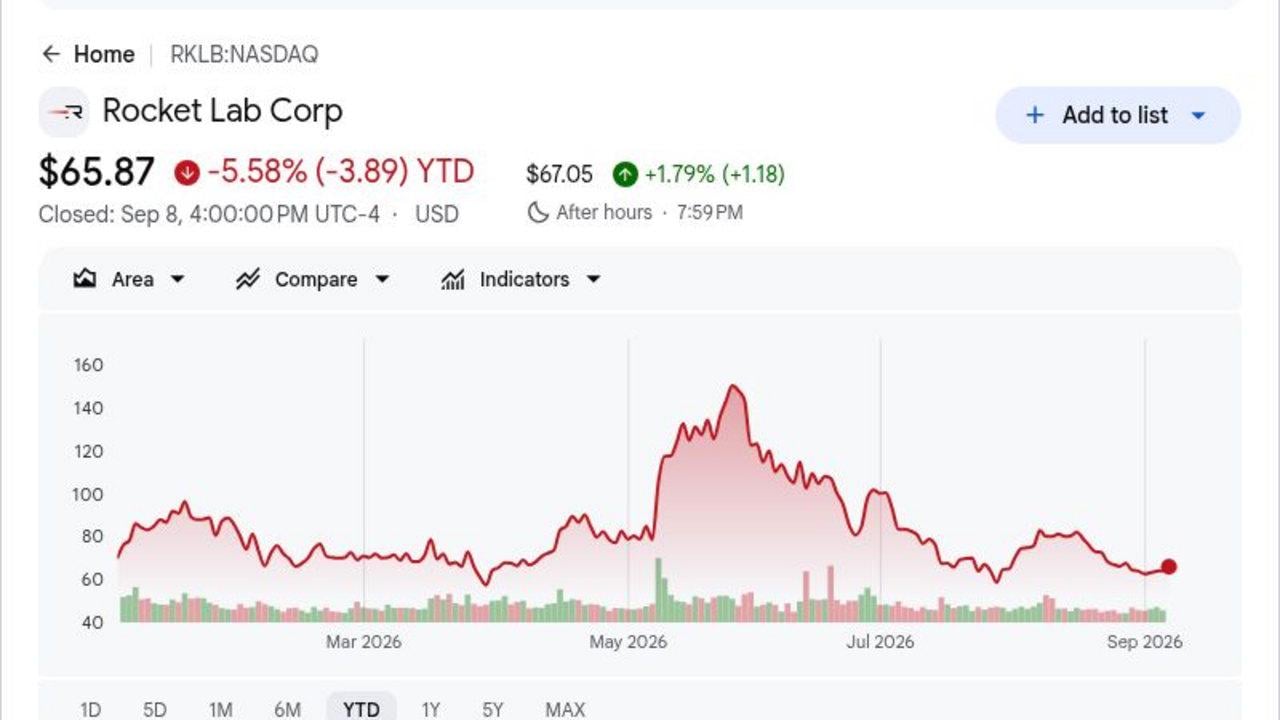
- RKLB closed at $65.87 on September 8 and remained 5.58% lower for 2026: Shares were more than 56% below the $150.23 May closing high, showing how quickly expectations can reset. The pullback creates upside to Street targets, though backlog growth has not removed execution risk.
- Q2 revenue reached $234.07 million and rose 62% year over year: Sales exceeded the $231.62 million consensus by $2.45 million and added $34 million sequentially. The growth confirms that Rocket Lab is scaling products and launches together.
- Backlog climbed 137% to $2.36 billion: Rocket Lab also disclosed more than $1 billion of subsequent launch and Space Systems contracts, including options. The larger base improves visibility, though delivery schedules and program profitability determine how bookings convert into value.
- Q3 revenue guidance of $250 million to $265 million implies another record: The $257.5 million midpoint was 7% above the $240.6 million Street estimate. GAAP gross-margin guidance of 29% to 31% shows that acquisition mix may constrain conversion.
- Defense awards include $397 million for satellites and $266 million for launches: SB-AMTI makes Rocket Lab one of two vendors delivering launch plus spacecraft, while the July agreement covers up to 18 missions. Both wins broaden the case beyond commercial demand.
What Is Rocket Lab (RKLB)?
Rocket Lab is an aerospace company serving commercial, civil and national-security customers. Launch Services operates the Electron orbital rocket and HASTE suborbital vehicle, while Neutron targets reusable medium lift. Space Systems designs satellites and sells solar cells, reaction wheels, flight software and separation hardware. Revenue comes from launch contracts, spacecraft programs, products and mission services, spanning manufacturing through on-orbit operations.
Rocket Lab's long-term strategy is to design, build, launch and operate complete constellations. Electron established its launch base after the first orbital mission in 2018, while Neutron extends the platform into medium lift. Acquisitions including SolAero, Mynaric and Motiv added solar power, optical communications and robotics, and the proposed Iridium deal would add a global communications network. Multi-year U.S. defense programs further connect the platform to national-security demand.
Read More: Top Space Stocks to Buy Ahead of SpaceX IPO
Rocket Lab (RKLB) Q2 2026 Earnings Overview: Record Revenue, Backlog and Q3 Guidance
Rocket Lab delivered $234.07 million of Q2 revenue versus a $231.62 million consensus, with sales rising 62% year over year as product revenue expanded to $181.35 million. GAAP loss per share was $0.08 versus a $0.06 loss estimate, though net loss narrowed to $49.26 million from $66.41 million. Backlog reached $2.36 billion, and the $257.5 million midpoint of Q3 revenue guidance stood about 7% above the Street estimate. The quarter strengthened the demand case, though gross-margin guidance and continued losses keep profitability central to the debate.
Read More: Rocket Lab (RKLB) Q2 2026 Earnings Overview: Record $234M Revenue Offset by 29% to 31% Margin Guide
|
Financial Metric |
Guidance / Consensus |
Reported / Actual |
Surprise |
|
Q2 2026 revenue |
$231.62M consensus |
$234.07M |
Beat. $2.45M above consensus; up 62% YoY. |
|
Q2 GAAP diluted loss per share |
$0.06 loss consensus |
$0.08 loss |
Missed. Loss was $0.02 wider than consensus. |
|
Q2 GAAP gross profit |
$46.39M in Q2 2025 |
$84.58M |
Expanded. Gross profit increased 82% YoY. |
|
Q2 adjusted EBITDA |
$27.58M loss in Q2 2025 |
$8.83M loss |
Improved. Loss narrowed by $18.75M YoY. |
|
Q2 ending backlog |
Up 137% YoY |
$2.36B |
Record. Backlog more than doubled YoY. |
|
Q3 2026 revenue outlook |
$240.6M Street estimate |
$250M to $265M |
Raised. $257.5M midpoint was 7% above consensus. |
- Revenue of $234.07 million exceeded consensus by $2.45 million and grew 62%: The third consecutive revenue record added $34 million sequentially. That cadence shows product deliveries and launch activity scaling together rather than depending on one unusually large mission.
- The $0.08 GAAP loss per share was $0.02 wider than expected: Net loss narrowed by $17.16 million to $49.26 million as gross profit improved. Scale is helping, though acquisitions and development investment still delay clean earnings conversion.
- Product revenue nearly doubled to $181.35 million: Service revenue increased 1.8% to $52.72 million, so products generated most of the $89.57 million sales increase. That mix supports Space Systems growth, though product-heavy contracts create uneven margins and working-capital needs.
- Gross profit rose 82% to $84.58 million as adjusted EBITDA loss narrowed to $8.83 million: The prior-year loss was $27.58 million. Q3 gross-margin guidance of 29% to 31% warns that acquisitions and program mix can interrupt improvement.
- The $257.5 million Q3 revenue midpoint stood 7% above the Street view: Guidance included a $17 million to $23 million adjusted EBITDA loss and $121 million to $127 million of non-GAAP operating expense, keeping spending discipline central to backlog conversion.
Rocket Lab (RKLB) 2026 Investment Outlook: $150 Bull Case vs. $50 Bear Case
The central test is whether Rocket Lab can convert record demand into a credible medium-lift, defense and communications platform without letting delays or capital intensity outrun operating progress.
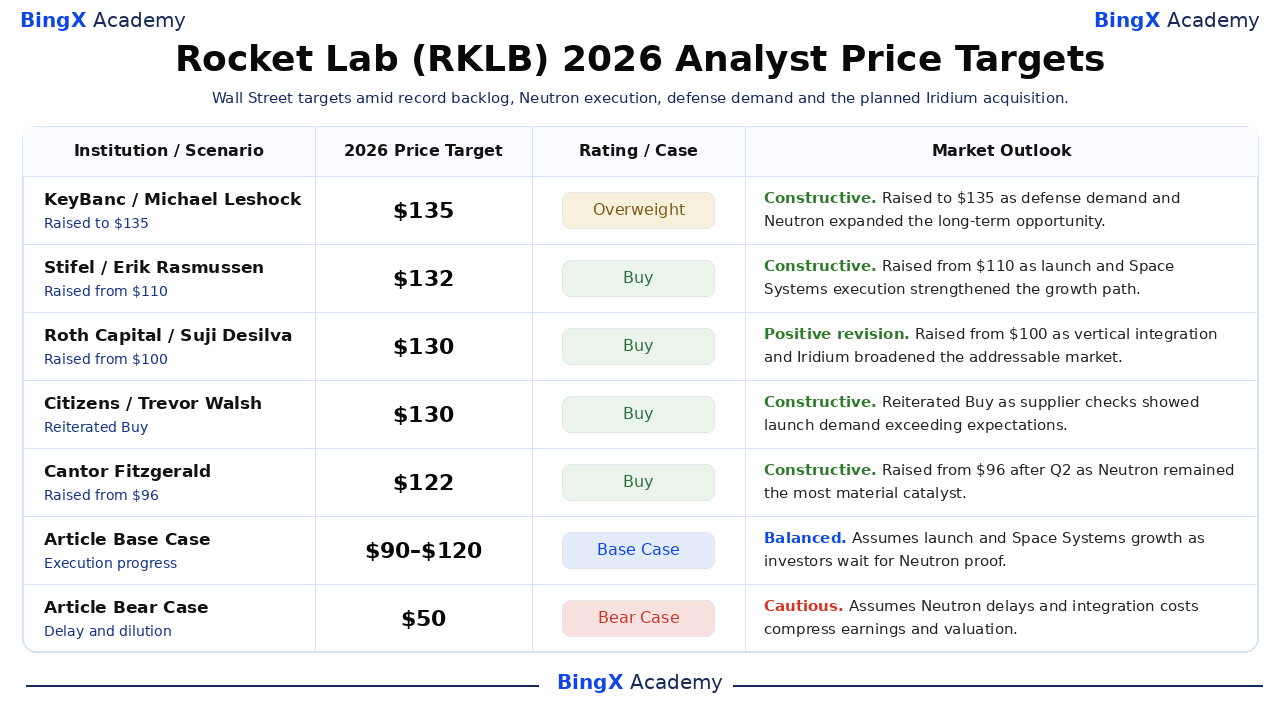
The Bull Case: Neutron and Defense Growth Push RKLB Toward $150
The Bull Case assumes Neutron reaches the pad and opens a viable reusable medium-lift business. Electron and HASTE maintain launch cadence, the $2.36 billion backlog converts, and the $397 million SB-AMTI award plus $266 million launch contract deepen national-security revenue.
A move toward $150 would require successful Neutron milestones, Q3 revenue at or above the $250 million to $265 million range, and improving gross margin. More launch-plus-spacecraft awards and progress toward the Iridium closing would provide the clearest confirmation.
Read More: Top Defense Stocks to Buy in 2026: Primes, Missiles, Drones, Space, and AI-Enabled Warfare
The Base Case: Steady Backlog Growth Keeps RKLB Between $90 and $120
The Base Case assumes Electron, HASTE, and Space Systems continue growing while Neutron advances with manageable schedule risk. Defense contracts provide multi-year visibility, but adjusted EBITDA losses and uncertain medium-lift economics limit further re-rating.
Under this scenario, RKLB could trade mainly between $90 and $120. Q3 revenue near the midpoint, backlog above $2 billion, and improving gross profit would support the range, while rising cash use or a material Neutron delay would weaken it.
The Bear Case: Launch Delays and Dilution Pull RKLB Toward $50
The Bear Case assumes Neutron slips, integration costs rise, and government programs convert more slowly. Rocket Lab used $134.41 million of first-half operating cash and raised $1.53 billion through ATM offerings, showing how heavy investment can increase dilution even with $2.13 billion of cash.
A move toward $50 would become more likely if Q3 revenue falls below $250 million, gross margin drops under 29%, or major launch milestones move out. A launch failure, delayed Iridium closing, or weaker defense funding would add further pressure.
RKLB Stock Price Forecasts for 2026 By Wall Street Analysts
Wall Street remains broadly constructive, though the dated targets span different assumptions about Neutron, defense growth, the Iridium transaction and dilution. These named actions are third-party reference points rather than a single promised outcome, while the final two rows are clearly labeled editorial scenarios.
|
Institution / Scenario |
2026 Price Target |
Rating / Case |
Market Outlook |
|
KeyBanc / Michael Leshock |
$135 |
Overweight |
Constructive. June 15: raised to $135 as defense demand, launch growth and Neutron expanded the long-term opportunity. |
|
Stifel / Erik Rasmussen |
$132 |
Buy |
Constructive. June 4: raised from $110 after execution across launch and Space Systems strengthened confidence in the growth path. |
|
Roth Capital / Suji Desilva |
$130 |
Buy |
Positive revision. June 29: raised from $100 as vertical integration and the proposed Iridium combination broadened the addressable market. |
|
Citizens / Trevor Walsh |
$130 |
Buy |
Constructive. June 30: reiterated Buy as supplier checks pointed to launch demand exceeding expectations and Rocket Lab remained well positioned. |
|
Cantor Fitzgerald / Andres Sheppard |
$122 |
Buy |
Constructive. August 11: raised from $96 after Q2 and identified Neutron as the most material catalyst for growth and profitability. |
|
BofA Securities / Ronald Epstein |
$110 |
Buy |
Measured. August 31: cut from $115 for the higher share count while retaining a positive long-term view of launch, satellites and space services. |
|
Article Base Case |
$90 to $120 |
Base Case |
Balanced. Assumes launch and Space Systems growth continues as investors wait for Neutron proof. |
|
Article Bear Case |
$50 |
Bear Case |
Cautious. Assumes Neutron delays and integration costs compress earnings and valuation. |
How to Trade Rocket Lab (RKLB) Stock on BingX
Trade Rocket Lab's Neutron-development, defense-contract and backlog-conversion outlook using BingX TradFi and BingX AI tools. Because RKLB can react sharply to launch milestones, government awards and financing updates, traders should define both the catalyst and risk limits before entering a position.
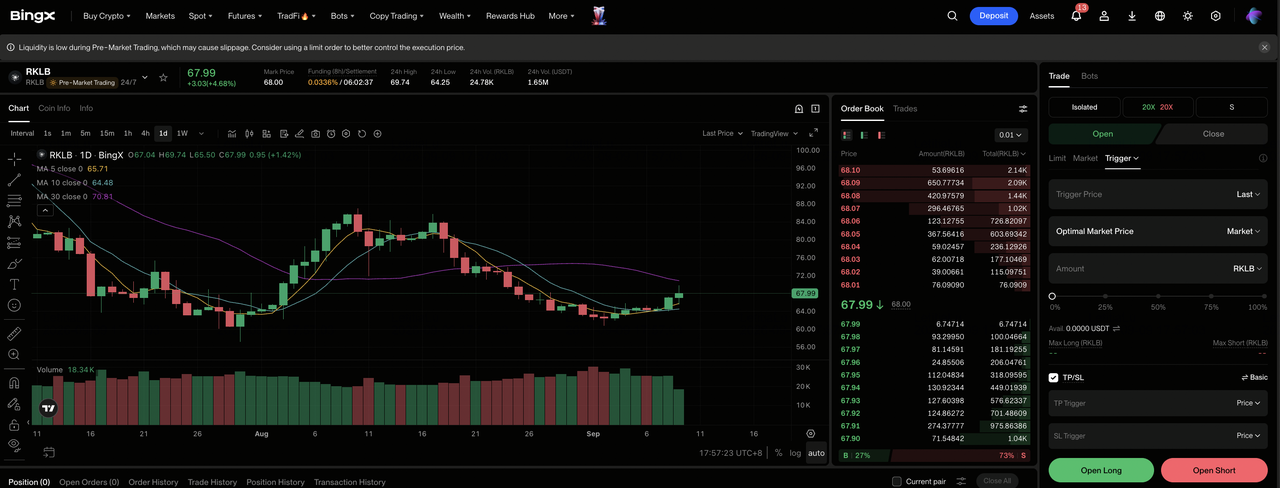
Step 1: Access BingX TradFi. Sign up and navigate to the specialized TradFi section on the BingX exchange dashboard.
Step 2: Select Rocket Lab (RKLB). Search for and select the RKLB-USDT perpetual futures contract.
Step 3: Choose your direction. Select Open Long if Neutron milestones remain on schedule, defense awards convert and margins improve. Select Open Short if launch delays, integration costs or dilution weaken per-share economics.
Step 4: Select leverage and margin mode. Choose Isolated or Cross-Margin based on your risk tolerance. The decline of more than 56% from RKLB's May closing high shows why conservative leverage and clear position sizing are important.
Step 5: Execute strict risk protocols. Set Take-Profit and Stop-Loss (TP/SL) levels before or immediately after entering the trade. RKLB can react quickly to Neutron tests, launch outcomes, contract awards, guidance and Iridium transaction updates.
Top 5 Risks to Watch for Rocket Lab Investors in 2026
Rocket Lab’s growth spans launch, satellites, communications, and defense, but each area adds execution, financing, and contract-conversion risk.
- Neutron delays could weaken the medium-lift growth case: Neutron is central to Rocket Lab’s next stage of expansion. A schedule slip or test failure would delay revenue, extend development spending, and reduce confidence in future launch economics.
- The Iridium deal could raise financing and integration pressure: Adding a global communications network would broaden recurring revenue, but also increase operational complexity and capital needs. Higher financing costs or slower synergies could reduce expected returns.
- Cash burn and dilution can offset business growth: First-half operating cash use reached $134.41 million, while ATM offerings raised $1.53 billion. Further equity issuance could fund expansion but reduce each shareholder’s claim on future earnings.
- Government contracts can convert unevenly into revenue: The $397 million SB-AMTI program, $266 million launch contract, and other defense awards depend on milestones, budgets, and customer approvals. Delays can shift revenue and cash receipts into later periods.
- Launch or manufacturing failures could damage demand: Rocket Lab depends on mission reliability across rockets, satellites, and components. A major failure could trigger investigations, schedule disruption, lower launch cadence, and weaker customer confidence.
Final Thoughts: Should You Invest in Rocket Lab in 2026?
Rocket Lab's $234.07 million quarterly revenue, $2.36 billion backlog and defense awards show scale beyond small launch. Product revenue, satellites and components provide several operating engines before Neutron contributes. The proposed Iridium transaction could add an owned network and recurring services, though closing and integration still require disciplined financing.
The Bull Case requires launch milestones and backlog conversion to improve margins, supporting a path toward $150. The Bear Case reflects losses, dilution and project delays that could pull shares toward $50. Conservative traders may wait for Neutron progress, revenue above the $250 million Q3 floor and evidence that acquisition mix is stabilizing gross margin.
Risk Reminder: Trading and investing in equities like RKLB involves a high risk of capital loss. Launch failures, development delays, government procurement changes, acquisition integration, cash burn and dilution can move the stock sharply. Conduct independent research before allocating capital.
Related Reading
- Top Space Stocks to Buy Ahead of SpaceX IPO
- Top Defense Stocks to Buy in 2026: Primes, Missiles, Drones, Space, and AI-Enabled Warfare
- Lockheed Martin (LMT) Price Prediction 2026: Can Record Backlog Push LMT Toward $700?
- Redwire Price Prediction 2026: Can Space and Defense Momentum Help RDW Extend Its 220% Rally?
- Sidus Space Stock Price Prediction 2026: $10 Satellite Boom or Dilution Trap?
- GE Aerospace (GE) Price Prediction 2026: Can the $190B Backlog Defy Valuation Fears?
