Elon Musk’s aerospace and telecommunications behemoth, SpaceX (Space Exploration Technologies Corp.), has shattered private market records to become the world’s most dominant off-planet infrastructure company. Following its official S-1 registration filing with the SEC on May 20, 2026, and a subsequent detailed amendment on June 1, 2026, the company is on the verge of executing the largest Initial Public Offering (IPO) in global financial history.
Targeting a massive $1.75 trillion valuation to raise between $75 billion and $80 billion, SpaceX is scheduled to finalize its official share pricing on June 11, 2026, and debut on the Nasdaq and Nasdaq Texas exchanges under the ticker symbol SPCX as early as Friday, June 12, 2026.
Historically, participating in an elite, mega-cap asset before its public listing was strictly reserved for institutional venture capital firms and ultra-high-net-worth individuals. Today, retail market participants are asking pressing questions on the SpaceX IPO, pros and cons, how to participate, and if SpaceX IPO is a good investment. BingX takes a deep dive into this landscape by offering everyday investors secure, high-liquidity pathways to trade and gain exposure to SpaceX's valuation metrics ahead of its historic opening bell.
What Is the SpaceX IPO and When Is SpaceX Going Public?
The upcoming listing represents a paradigm shift where Elon Musk’s rocket, satellite connectivity, and artificial intelligence businesses transition into the public equity markets. For investors wondering when the SpaceX IPO is, the accelerated timeline is officially locked in. Following an intensive institutional roadshow from June 4 to June 8, 2026, the firm plans to freeze its listing price, with public trading slated to begin as early as Friday, June 12, 2026.
What Will the SpaceX IPO Price Be?
Uniquely structured to capture massive retail demand, the question has received an unconventional answer. Upending Wall Street tradition, SpaceX told underwriting banks it won't budge from its fixed price of $135 per share. Furthermore, the deal structures a massive 30% allocation tranche directly to ordinary retail investors, allowing retail brokers to provide allocations directly through their user platforms.
Because updated exchange frameworks allow mega-caps of this scale to bypass standard multi-month seasoning rules, passive index tracking funds will face mandatory structural buying pressure to include SPCX within just 15 trading days of listing. This compressed index inclusion timeline creates an immediate, high-liquidity window for traders to position capital.
What Are the Pros and Cons of the SpaceX (SPCX) IPO?
To determine whether you should participate in the upcoming listing, investors must carefully weigh the company's multi-platform growth drivers against its extreme valuation metrics and massive operational cash burn.
Core Advantages of SpaceX (SPCX) Stock
- Unmatched Structural Moat: SpaceX commands a near-monopoly on global orbital payload delivery, executing more successful launches annually than all other global commercial and state entities combined. Its mature flight heritage and booster recovery systems put it years ahead of competitors.
- Diversified Cash Generation: While deep-space rocket development is incredibly capital-intensive, Starlink’s high-margin subscription base effectively subsidizes ongoing R&D. Operating approximately 9,600 LEO satellites serving over 10 million subscribers, Starlink generated the lion's share of SpaceX's $18.7 billion FY2025 revenue at an exceptional 62.9% adjusted EBITDA margin.
- Planetary AI and Data Center Synergies: SpaceX is pitching itself as a combined space and AI infrastructure powerhouse. Following its structural merger with Elon Musk's xAI and the Grok chatbot, the firm secured an extraordinary cloud/compute arrangement with Anthropic yielding a $1.25 billion per month contract through mid-2029, utilizing a massive cluster of 325,000 Nvidia GPUs.
Read more: Top Space Stocks to Buy Ahead of SpaceX IPO
Emerging Challenges and Criticisms to Consider Before Investing in the SpaceX IPO
- Aggressive Valuation Multiples: At a $1.75 trillion valuation against $18.7 billion in FY2025 revenue, SpaceX is entering the public market at an aggressive 94x price-to-sales (P/S) ratio. Prominent independent research firms like Morningstar suggest the IPO is priced for perfection, issuing a cautious $780 billion fair value estimate, roughly 55% below the IPO target.
- Deep Financial Resource Burn: Due to hardware scaling, massive GPU procurement, and Starship development, SpaceX reported a steep firmwide net loss between $2.59 billion and $4.94 billion for FY2025. Its AI and xAI segments alone recorded a massive $6.4 billion operating loss in 2025.
- Key Person and Corporate Governance Risks: The dual-class share structure ensures that Elon Musk retains roughly 82% to 85.1% of total voting power, giving public shareholders minimal governance control. Furthermore, complex cross-holdings between xAI, Grok, and X (formerly Twitter) present continuous regulatory and administrative transparency challenges.
How to Buy SpaceX Shares Before the IPO on BingX
Historically, learning how to invest in SpaceX pre-IPO required passing strict regulatory accredited investor hurdles, e.g., a net worth exceeding $1 million, and executing steep $50,000 minimum transactions on private secondary markets like Forge Global or EquityZen.
BingX completely democratizes this process, allowing retail traders to gain fractional exposure with zero accredited hurdles using three flexible paths:
1. SpaceX Venture Token SPACEX(VNTL)-USDT
SpaceX Venture Token is a synthetic Real-World Asset (RWA) derivative hosted within the BingX Futures ecosystem. It tracks the private secondary market valuation trends of SpaceX equity, allowing users to trade with leverage and fractionally with as little as 10 USDT.
2. SPACEX(PreStocks) Stock Futures
SpaceX PreStocks futures is a high-performance stock futures instrument that mirrors the economic price action of SpaceX's private valuation before listing. It enables active traders to long or short private market sentiment shifts dynamically.
3. SpaceX SPCX-USDT Pre-IPO Market Asset
Located directly within the specialized BingX Pre-IPO Zone, SpaceX (SPCX) directly tracks the upcoming Nasdaq listing vehicle under its officially registered symbol. It is the premier tool for trading fast-moving news surrounding the June roadshow, pricing expectations, and immediate index inclusion updates.
How to Participate in SpaceX IPO Trading on BingX: Step-by-Step Guide
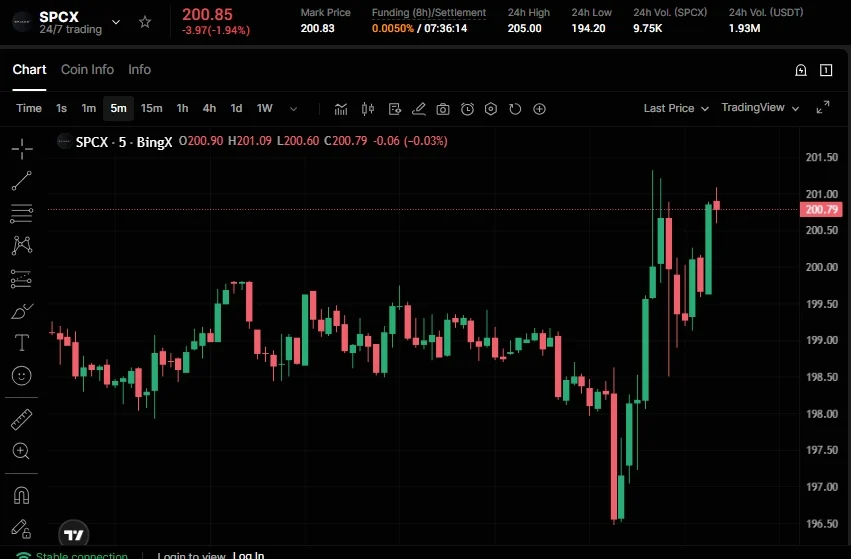
SpaceX (SPCX) perpetual futures on BingX pre-IPO
If you are looking to long or short SpaceX ahead of its June 11 pricing and June 12 trading debut, follow this step-by-step framework:
Step 1: Locate Your Preferred Ticker Symbol
Log in to your verified BingX account via the mobile app or desktop terminal. Navigate to the Futures Market or the dedicated Pre-IPO Zone. Input your target ticker based on your strategy:
- Search SpaceX(VNTL) or SpaceX(PreStocks) for stock futures exposure.
- Search SPCX-USDT perpetual futures for direct tracking of the upcoming Nasdaq public listing vehicle.
Step 2: Fund Your Pre-IPO Account
Ensure you have sufficient stablecoin collateral in your wallet. Use the internal Transfer interface to instantly move your USDT from your main Spot wallet into your Perpetual Futures or Pre-IPO trading wallet.
Step 3: Configure Margin and Leverage Parameters
- Isolated Margin Mode: Best for risk-managed strategies, limiting your absolute downside exposure exclusively to the collateral assigned to that specific trade.
- Cross Margin Mode: Pools your broader wallet balance to act as a cushion against extreme short-term volatility and prevent unwanted liquidations.
- Leverage Sizing: Select a highly conservative leverage multiplier, e.g., 2x to 5x. Pre-IPO assets are highly speculative and subject to extreme intraday price swings based on listing rumors.
Step 4: Execute Your Market Position
- Buy / Long: If you believe that intense institutional index-fund accumulation, multi-billion-dollar compute contracts with Anthropic, and structural retail demand will spark an explosive post-listing rally.
- Sell / Short: If you calculate that the premium 94x price-to-sales multiple, severe annual net losses, and key-person dependencies will lead to a post-IPO correction.
Step 5: Apply Take-Profit and Stop-Loss Protections
Pre-IPO derivative contracts operate independently of standard crypto assets and respond sharply to regulatory updates, launch milestones, and underwriting leaks. Always deploy precise Take-Profit (TP) and Stop-Loss (SL) orders immediately upon position execution to insulate your trading capital from abrupt capital leakage.
SpaceX IPO vs. Anthropic IPO: The Trillion-Dollar Mega-Cycle in 2026
The 2026 public market landscape is defined by an unprecedented liquidity wave, led by concurrent filings from SpaceX (SPCX) and frontier AI developer Anthropic. This monumental shift requires investors to balance completely different financial profiles, comparing a hardware-heavy aerospace monopoly with a hyperscaling software ecosystem.
|
Valuation & Operational Metric |
SpaceX (SPCX) |
Anthropic |
|
Target Public Valuation |
$1.75 Trillion |
$965 Billion – $1.0 Trillion |
|
Filing Status & Window |
Public S-1 filed; Listing ~June 12, 2026 |
Confidential S-1 filed; Expected Q4 2026 |
|
Annualized Revenue Run-Rate |
$18.7 Billion (FY2025 actual) |
$47 Billion (as of May 2026) |
|
Implied Revenue Multiple |
~94x 2025 Sales (Premium / Frothy) |
~20.5x May Run-Rate (Frontier Normal) |
|
Current Profitability Profile |
Net loss of $4.94 Billion (Heavy Capex) |
Target Q2 2026 Operating Profit (+$559M) |
|
Core Cash Flow Engine |
Starlink global subscription tiers |
Enterprise Claude API & "Claude Code" |
|
Primary Structural Advantage |
Sovereign orbital launch monopoly |
Leading enterprise LLM revenue share (31.4%) |
Which Is Better, SpaceX or Anthropic IPO? Strategic Investment Thesis
Choosing the superior asset depends on whether you value unassailable infrastructure moats or hyper-velocity cash flow compounding. SpaceX is a multi-platform defense, telecom, and planetary launch utility that operates an undisputed monopoly, yet it trades at an extraordinary 94x trailing sales multiple while swallowing billions in hardware-centric capital expenditure. Concurrently, Anthropic represents a much purer, high-margin software scaling vehicle. Driven by massive corporate adoption of Claude Code, Anthropic has seen its annualized revenue run-rate rocket to a staggering $47 billion, allowing it to project near-term operating profitability at a far more reasonable 20x revenue multiple.
For short-term momentum and index-inclusion buying pressure, SpaceX offers an immediate catalyst; however, for long-term fundamental value and superior revenue scaling metrics, Anthropic presents the more highly optimized software profile for a diversified tech portfolio.
Final Thoughts: Should You Trade SpaceX Pre-IPO?
The upcoming SpaceX public listing is undoubtedly the landmark financial spectacle of 2026, seamlessly fusing planetary-scale aerospace dominance with heavy AI infrastructure execution. While the core operational margins of Starlink remain exceptionally robust, the unprecedented valuation premium leaves virtually no margin for operational errors.
By leveraging the BingX Stock Futures and Pre-IPO Zones, retail market participants have been handed an institutional-grade toolkit to actively trade, hedge, and position themselves before the opening bell rings on June 12. Trade cautiously, monitor the final SEC pricing releases on June 11, and manage your portfolio risk strictly.
Related Reading
- How to Trade SpaceX Pre-IPO on BingX Pre-IPO: SPACEX (VNTL), SPACEX (PreStocks), and SPCX
- SpaceX Will File for Historic $75 Billion IPO at $1.75 Trillion Valuation on June 12, 2026
- What Is Anthropic Pre-IPO and How to Trade It on BingX?
- Top Space Stocks to Buy Ahead of SpaceX IPO
- Top 10 Things to Know About the SpaceX IPO: Pricing, Valuation, and How to Trade It
- How the June 12 SpaceX IPO Could Propel Elon Musk Beyond the $1 Trillion Net Worth Milestone
- What Is SpaceX Tokenized Stock (SPCXB) and How to Buy It?
FAQs on the SpaceX IPO
1. What will the official SpaceX ticker symbol be?
SpaceX has filed to list its shares on the Nasdaq and Nasdaq Texas exchanges under the ticker symbol SPCX.
2. Can unaccredited retail investors buy into the SpaceX IPO?
Yes. While traditional pre-IPO channels required accredited verification, SpaceX has allocated a massive 30% of its initial float directly to retail investors, which will be accessible via major retail brokerages. Alternatively, users can trade 24/7 pre-market exposure via the Pre-IPO Zone on BingX.
3. Does the SpaceX IPO have a lockup period?
Yes. Standard institutional and private secondary market shares are subject to strict post-IPO lockup structures to prevent market flooding. Furthermore, Elon Musk is bound by a mandatory 366-day insider holding requirement during which he cannot sell his public shares.
4. Why is SpaceX going public in 2026?
While Starlink generates substantial positive cash flow, SpaceX requires massive capital injection to fund its ambitious long-term scaling initiatives. This includes heavy infrastructure spending on its Starship megarocket, satellite constellation expansion, and the immense $1 billion per month cash burn associated with scaling its newly acquired xAI computing infrastructure.
