
Ouster (OUST) develops sensing and perception technology for machines operating in the physical world. Its platform combines digital lidar, stereo cameras, AI compute, sensor fusion, perception software and trained models for industrial automation, robotics, automotive systems and smart infrastructure. This wider Physical AI position gives Ouster more routes to growth, though the stock remains sensitive to customer deployment cycles, hardware pricing and the cost of integrating acquired technology.
The latest quarter showed that scale and profitability are improving together, though the business still reports losses. Ouster Q2 2026 revenue reached $54.6 million, up 56% year over year, as Ouster shipped more than 17,000 lidar and camera sensors. GAAP gross margin expanded to 49%, yet the company still recorded an $18.1 million net loss, leaving sustained operating leverage as the key investment test.
The OUST stock forecast for 2026 now centers on two competing views:
- The Physical AI platform case: Rev8 demand, stereo-vision adoption and expanding perception software could sustain revenue growth above 30% and move adjusted EBITDA into positive territory.
- The adoption and profitability case: slower customer rollouts, acquisition integration costs and pricing pressure could extend losses and prevent the higher revenue base from supporting a durable re-rating.
This guide breaks down the OUST stock forecast, 2026 price scenarios, key risks and analyst outlooks, drawing on Ouster's August 6 Q2 2026 earnings release, quarterly filing and market data through September 11, plus how to trade OUST stock futures on BingX TradFi with USDT collateral.
Top 5 Things for Ouster Investors to Know in September 2026
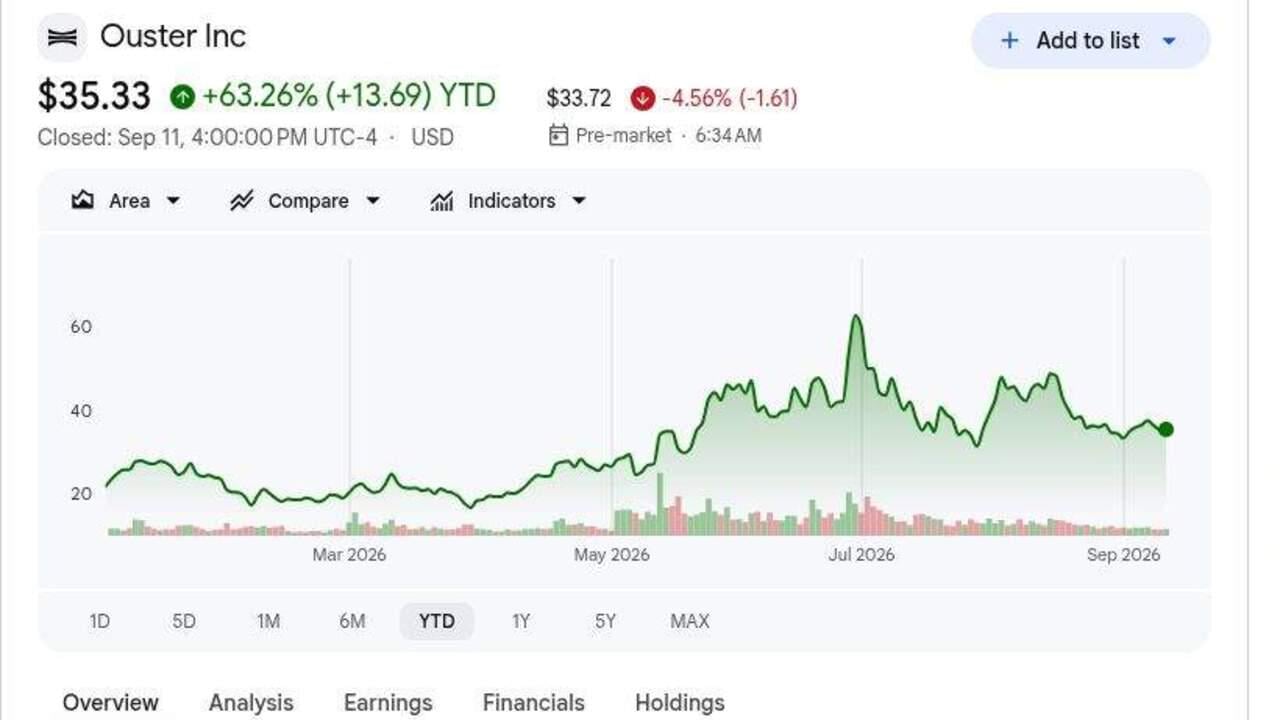
- OUST closed at $35.33 on September 11 and was up 63.26% YTD: The rally reflects stronger shipments, improving margins and enthusiasm around Physical AI. Shares remain below the $61.25 average target, though further upside depends on converting growth into durable cash flow.
- Q2 revenue reached $54.6 million, up 56% year over year: Sales beat the roughly $51 million consensus by about $3.6 million and rose 12% sequentially. Growth across industrial and smart-infrastructure customers reduces reliance on one adoption cycle.
- Sensor shipments exceeded 17,000 units: Lidar contributed about 53% of the total, with cameras making up the balance after the Stereolabs acquisition. The broader mix creates more entry points for customers across hardware, compute and software.
- GAAP gross margin expanded 400 basis points to 49%: Non-GAAP gross margin reached 53%, up 700 basis points sequentially. Better volume and efficiency are improving unit economics and narrowing the path from the $4 million adjusted EBITDA loss.
- Q3 revenue guidance of $54.5 million to $57.5 million implies further growth: The $56 million midpoint is about 3% above Q2. Rev8 demand and Stereolabs products must offset normal project timing to reach the upper end.
What Is Ouster (OUST)?
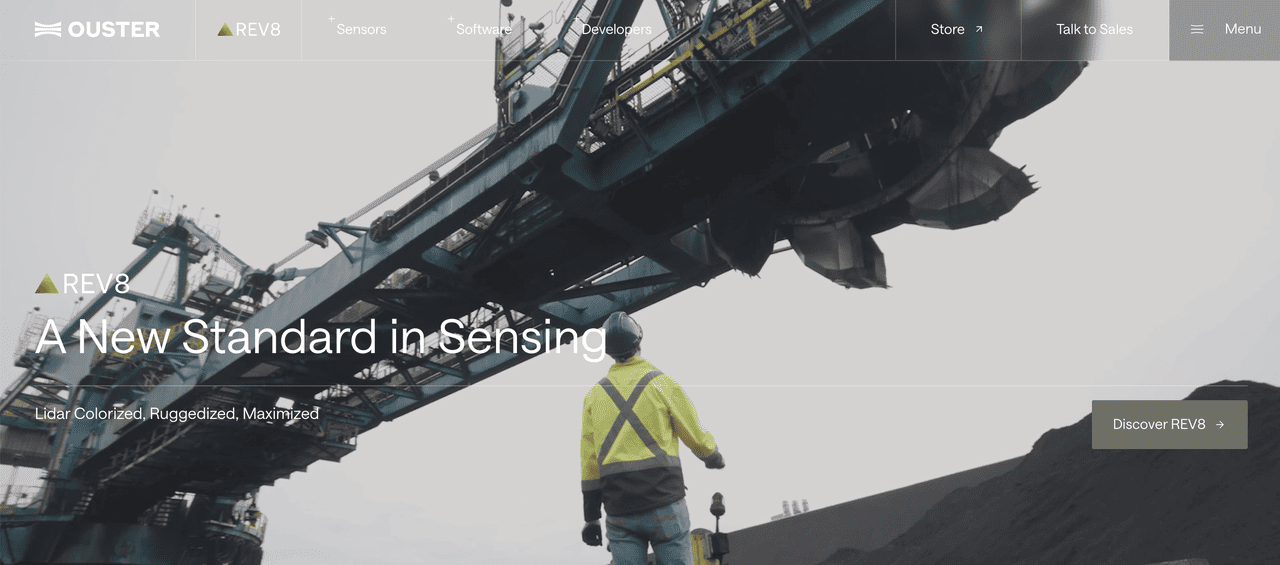
Ouster is a sensing and perception company that designs hardware and software allowing machines to map and understand three-dimensional environments. Its digital lidar sensors generate high-resolution spatial data, while cameras, embedded compute and perception software turn that data into usable information for autonomous equipment and intelligent infrastructure. Customers operate across warehouse automation, yard logistics, mining, agriculture, traffic management, security, mapping and robotics. Revenue comes mainly from product shipments, supplemented by royalties and software-related opportunities as deployments scale.
Ouster's long-term direction centers on a unified Physical AI platform rather than a standalone lidar component. The Stereolabs acquisition added stereo cameras, AI compute and vision models, including the ZED X Nano product, whose April launch became the strongest in Stereolabs' history. Rev8 adds native color to digital lidar, and partners including Flyability, GeoCue and John Deere subsidiary GUSS Automation are evaluating or deploying Ouster sensors in industrial inspection, aerial mapping and precision agriculture. This ecosystem can broaden demand and shorten integration time across thousands of customers.
Read More: Top AI Compute and GPU Stocks to Buy in 2026: The Shift to Inference and Custom Silicon
Ouster (OUST) Q2 2026 Earnings Overview: Revenue Growth, Sensor Shipments and Margin Expansion
Ouster reported Q2 revenue of $54.6 million versus roughly $51 million expected, up 56% year over year and 12% sequentially, while GAAP loss per share of $0.27 was about $0.03 narrower than consensus. Product revenue rose 51% to $52.8 million as shipments exceeded 17,000 sensors, and GAAP gross margin expanded to 49% from 45% a year earlier. Adjusted EBITDA remained a $4 million loss, while Q3 guidance of $54.5 million to $57.5 million kept the growth path intact.
Read More: Ouster (OUST) Q2 FY2026 Earnings Overview: $54.6M Revenue Record Triggers a 4.78% Price Selloff
|
Financial Metric |
Guidance / Consensus |
Reported / Actual |
Surprise |
|
Q2 2026 revenue |
$51M consensus |
$54.6M |
Beat. About $3.6M above consensus; up 56% YoY. |
|
Q2 GAAP loss per share |
$0.30 loss consensus |
$0.27 loss |
Beat. Loss was $0.03 narrower than expected. |
|
Q2 product revenue |
$35.0M in Q2 2025 |
$52.8M |
Grew. Up 51% YoY and 9% sequentially. |
|
Q2 GAAP gross margin |
45% in Q2 2025 |
49% |
Expanded. Improved 400 basis points YoY. |
|
Q2 non-GAAP gross margin |
52% in Q2 2025 |
53% |
Expanded. Improved 100 basis points YoY. |
|
Q2 GAAP net loss |
$20.6M loss in Q2 2025 |
$18.1M loss |
Improved. Loss narrowed by $2.5M YoY. |
|
Q2 adjusted EBITDA |
$5M loss in Q2 2025 |
$4M loss |
Improved. Loss narrowed by $1M YoY. |
|
Q2 sensor shipments |
— |
More than 17,000 |
Scaled. Lidar represented about 53% of units. |
|
Cash and short-term investments |
— |
$263M |
Available. Supports product and integration investment. |
|
Q3 2026 revenue outlook |
$54.6M Q2 actual |
$54.5M–$57.5M |
Raised. Midpoint implies about 3% sequential growth. |
- Revenue of $54.6 million grew 56% and beat consensus by $3.6 million: Industrial and smart-infrastructure demand led the quarter across warehouse automation, yard logistics and transportation. These markets can scale independently of passenger-vehicle autonomy.
- The $0.27 loss per share was $0.03 narrower than expected: Net loss improved to $18.1 million from $20.6 million a year earlier. Revenue growth is reaching the bottom line, though $46.7 million of operating expenses still keep Ouster unprofitable.
- Product revenue rose 51% to $52.8 million: More than 17,000 sensors shipped, including roughly 9,000 lidar units and a substantial camera contribution. Higher volumes can improve manufacturing efficiency as the product mix expands.
- GAAP gross margin increased from 45% to 49%: Non-GAAP gross margin reached 53%, up seven points sequentially. Sustaining these levels would shorten the path toward EBITDA break-even.
- Q3 guidance of $54.5 million to $57.5 million extends the growth test: The $56 million midpoint implies modest sequential growth after Q2's 12% increase. Rev8, repeat industrial orders and Stereolabs demand must offset uneven project timing.
Ouster (OUST) 2026 Investment Outlook: $75 Bull Case vs. $25 Bear Case
The central test is whether Ouster can turn sensor growth and a broader Physical AI platform into positive adjusted EBITDA without sacrificing the 49% GAAP gross margin.
The Bull Case: Physical AI Adoption Pushes OUST Toward $75
The Bull Case assumes Rev8 becomes a preferred sensor for industrial automation, smart infrastructure and robotics, while Stereolabs cameras and compute expand the value sold into each deployment. Revenue growth remains above 30%, gross margin holds near or above 50%, and the $4 million adjusted EBITDA loss turns into sustainable profit.
A move toward $75 requires repeated quarterly revenue above the $56 million Q3 midpoint, continued shipment growth beyond 17,000 units and visible cross-selling across lidar, cameras and software. Positive adjusted EBITDA, stable pricing and new large deployments with partners such as GUSS Automation or Flyability would provide the clearest confirmation.
The Base Case: Industrial Growth Keeps OUST Between $40 and $55
The Base Case assumes industrial and intelligent-infrastructure deployments remain healthy, Rev8 receives repeat orders and the Stereolabs portfolio adds revenue. Acquisition integration and continued research spending absorb part of the gross-profit gain, leaving adjusted EBITDA near break-even rather than clearly positive.
OUST could trade mainly between $40 and $55 under these conditions. Revenue within the $54.5 million to $57.5 million Q3 range and gross margin in the high 40s would support the range. A return to sequential contraction or margin below 45% would weaken the upper end.
The Bear Case: Adoption Delays Pull OUST Toward $25
The Bear Case assumes automation projects lengthen, customers delay fleet deployments and competitors pressure sensor prices. Lower volume would reduce manufacturing absorption, while integration and product-development costs keep operating expenses near the Q2 level, extending net losses and cash consumption.
A move toward $25 becomes more likely if revenue falls below $54.5 million, gross margin retreats toward the 43% recorded in Q1, or adjusted EBITDA losses widen from $4 million. Weak repeat orders for Rev8 or limited camera cross-selling would also reduce the valuation assigned to the unified platform.
OUST Stock Price Forecasts for 2026 By Wall Street Analysts
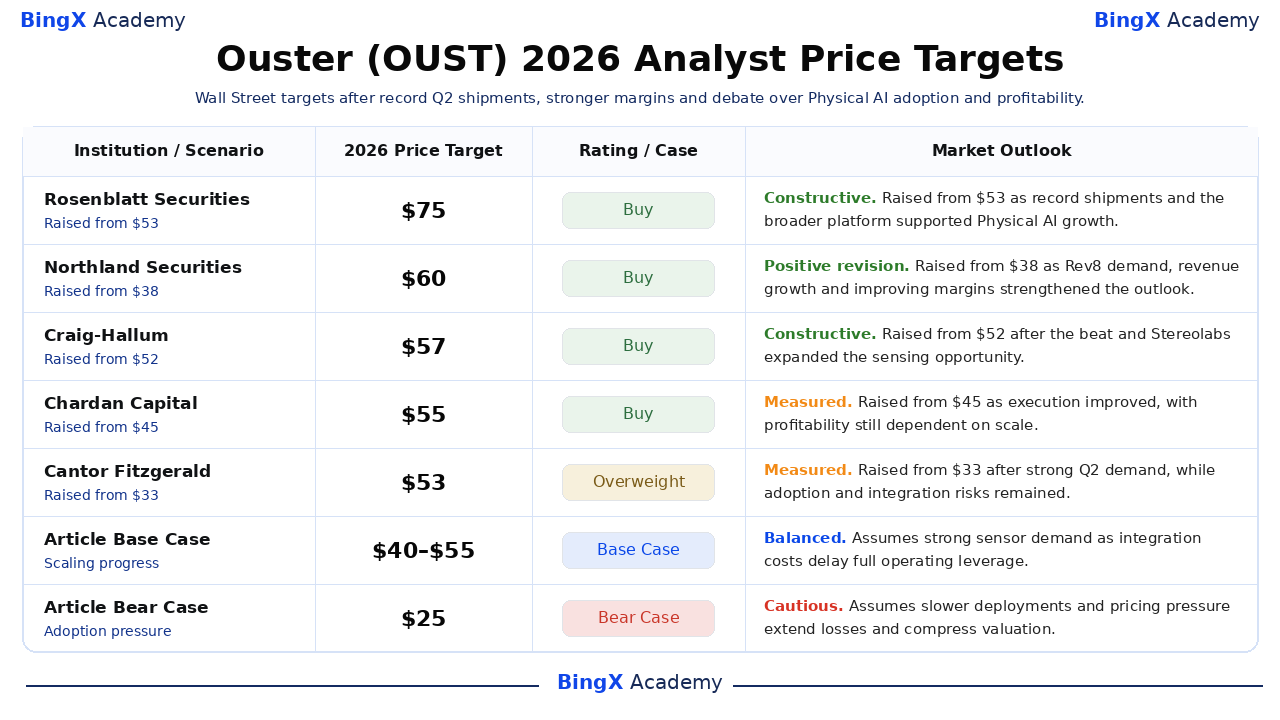
These dated analyst actions span $53 to $75 and reflect different assumptions about Physical AI adoption, margin expansion and Stereolabs integration. They are third-party reference points rather than a single consensus forecast. The final Base and Bear rows are BingX Academy editorial scenarios and remain clearly separate.
|
Institution / Scenario |
2026 Price Target |
Rating / Case |
Market Outlook |
|
Rosenblatt Securities / Kevin Cassidy |
$75 |
Buy |
Constructive. August 8: raised from $53 as record shipments and the broader platform supported Physical AI growth. |
|
Northland Securities / Tim Savageaux |
$60 |
Buy |
Positive revision. August 8: raised from $38 as Rev8 demand, revenue growth and margins strengthened the outlook. |
|
Craig-Hallum / Richard Shannon |
$57 |
Buy |
Constructive. August 7: raised from $52 after the beat and Stereolabs expanded the sensing opportunity. |
|
Chardan Capital / Brian Dobson |
$55 |
Buy |
Measured. August 8: raised from $45 as execution improved, with profitability still dependent on scale. |
|
Cantor Fitzgerald / Andres Sheppard |
$53 |
Overweight |
Measured. August 7: raised from $33 after strong Q2 demand, while integration risks remained. |
|
Article Base Case |
$40–$55 |
Base Case |
Balanced. Assumes strong sensor demand as integration costs delay full operating leverage. |
|
Article Bear Case |
$25 |
Bear Case |
Cautious. Assumes slower deployments and pricing pressure extend losses and compress valuation. |
How to Trade Ouster (OUST) Stock on BingX
Trade Ouster's Rev8-demand, Physical AI adoption and margin-expansion outlook using BingX TradFi and BingX AI tools. Because OUST can react sharply to quarterly shipments, customer deployments and profitability updates, traders should define both the catalyst and risk limits before entering a position.
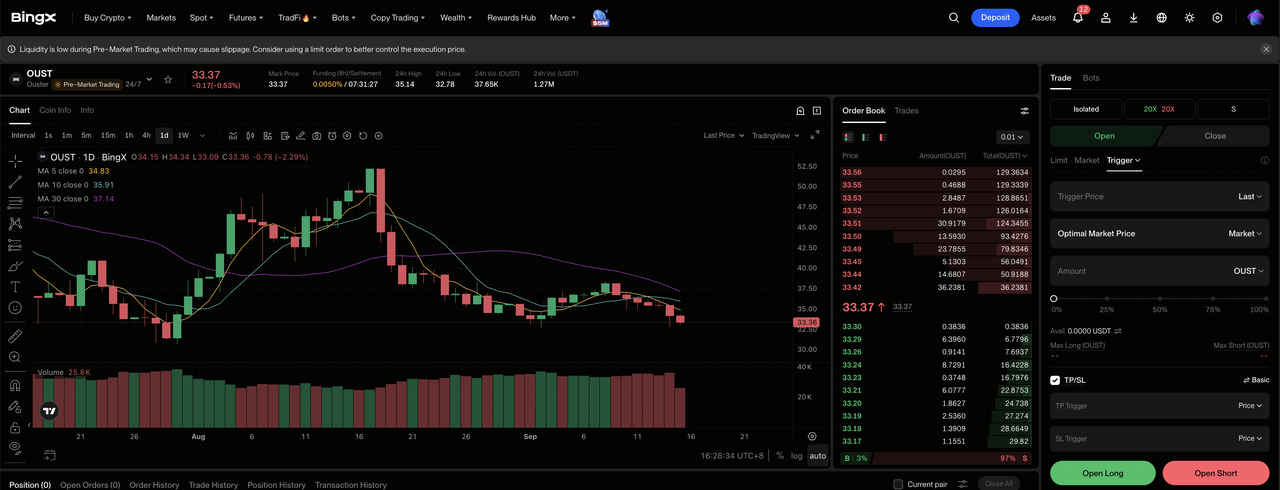
Step 1: Access BingX TradFi. Sign up and navigate to the specialized TradFi section on the BingX exchange dashboard.
Step 2: Select Ouster (OUST). Search for and select the OUST-USDT perpetual futures contract.
Step 3: Choose your direction. Select Open Long if Rev8 adoption, shipments and margins continue improving. Select Open Short if deployments slow, pricing weakens or losses widen.
Step 4: Select leverage and margin mode. Choose Isolated or Cross-Margin based on your risk tolerance. OUST gained 63.26% YTD through September 11, showing why conservative leverage and clear position sizing are important.
Step 5: Execute strict risk protocols. Set Take-Profit and Stop-Loss (TP/SL) levels before or immediately after entering the trade. OUST can react quickly to orders, product launches, quarterly guidance, gross margin, cash use and acquisition integration.
Top 5 Risks to Watch for Ouster Investors in 2026
Ouster's valuation depends on adoption, pricing, integration and profitability. These risks can affect revenue growth, margins and future cash flow.
- Slower customer adoption could reduce shipment growth: More than 17,000 Q2 shipments supported 56% revenue growth. Longer industrial and infrastructure deployments could reduce factory utilization and gross profit.
- Stereolabs integration could take longer than expected: Cameras broaden Ouster's platform, but product roadmaps, sales channels and software still require integration. Delays could raise costs and reduce expected cross-selling benefits.
- An $18.1 million quarterly net loss keeps financing risk relevant: Ouster held $263 million in cash and short-term investments, but continued losses reduce the runway. Additional equity could dilute future per-share earnings.
- Supplier issues could delay deliveries: Ouster relies on manufacturers including Benchmark Electronics and Fabrinet. Component shortages, tariffs or quality problems could delay revenue and raise unit costs.
- Price competition could pressure the 49% gross margin: Lidar and camera competitors continue improving their products. Discounting to win large programs could reduce gross profit and delay adjusted EBITDA break-even.
Final Thoughts: Should You Invest in Ouster in 2026?
Ouster entered the second half with record $54.6 million quarterly revenue, more than 17,000 shipments and a 49% GAAP gross margin. Those numbers show that Physical AI demand and operating efficiency are improving. The remaining question is whether the unified platform can generate enough recurring gross profit to eliminate the $4 million adjusted EBITDA loss.
The Bull Case requires Rev8 adoption, camera cross-selling and positive EBITDA to support $75. The Bear Case reflects slower deployments, pricing pressure and continued losses that could pull OUST toward $25. Conservative traders may wait for revenue above the Q3 midpoint, stable high-40s margins and a clear quarter of positive adjusted EBITDA.
Risk Reminder: Trading and investing in equities like OUST involves a high risk of capital loss. Customer delays, pricing pressure, product defects, supplier disruption, integration costs, dilution and leveraged trading can produce rapid losses. Conduct independent research before allocating capital.
Related Reading
- NVIDIA (NVDA) Price Prediction 2026: Can AI Infrastructure Growth Drive NVDA Toward $420?
- Top AI Compute and GPU Stocks to Buy in 2026: The Shift to Inference and Custom Silicon
- Top AI Data Center Stocks to Buy in 2026: Cloud, Servers, and AI Compute Infrastructure
- Top 10 AI Infrastructure Stocks to Buy in 2026: Chip Manufacturing and Design Leaders
- Top High-Performance Computing (HPC) Stocks to Watch in 2026: Accelerated Computing Market Leaders
