



SpaceX (SPCX) provides launch services, satellite connectivity and artificial intelligence infrastructure for consumers, businesses and government customers. Recurring Starlink subscriptions provide an established earnings engine, while cloud computing contracts and Grok create a route to broader software and infrastructure revenue. Compute utilization, satellite economics and capital spending determine whether that expansion produces sustainable cash returns for shareholders.
The latest quarter showed accelerating cloud revenue while investment continued to absorb substantial capital. SpaceX Q3 2026 revenue rose 161% to $14.575 billion, with SI sales increasing 830%. Operating income reached $2.791 billion, while capital expenditures totaled $19.593 billion. The next-quarter test is whether new compute capacity can generate recurring revenue quickly enough to improve cash conversion despite a larger spending plan.
The SPCX stock forecast for 2026 now centers on two competing views:
- The compute monetization case: New cloud contracts and recurring Starlink earnings could expand operating profit as deployed capacity begins producing revenue for external customers.
- The capital spending pressure case: Rising infrastructure outlays could absorb operating gains if cloud utilization disappoints and satellite margins normalize before new capacity earns attractive returns.
This guide breaks down the SPCX stock forecast, 2026 price scenarios, key risks and analyst outlooks, drawing on SpaceX’s October 20 earnings release, September filing, webcast and October 26 market data, plus how to buy SPCX Stocks on BingX TradFi with USDT or USDC.
Top 5 Things for SpaceX Investors to Know in October 2026
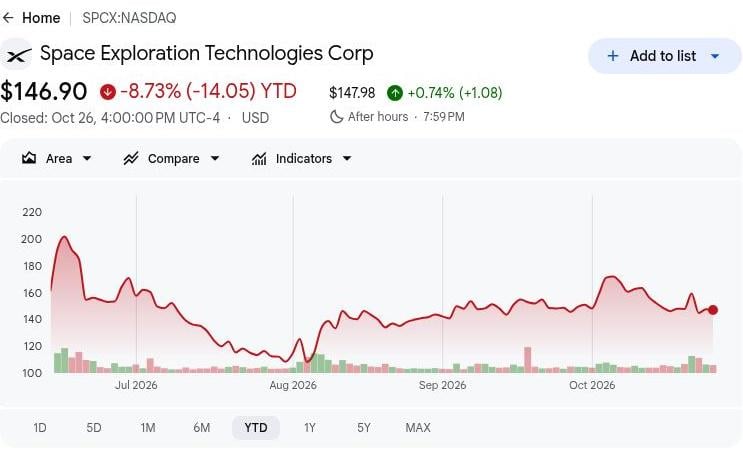
- SPCX closed at $146.90 on October 26: Shares remained below their $159.31 post-earnings close, making the $200 bull scenario dependent on stronger profitability and cash generation. Further upside will require cloud infrastructure investments to generate sustainable returns beyond capacity expansion.
- Q3 revenue surged to $14.575 billion from $5.576 billion. Sales also increased from $7.814 billion in Q2, reflecting rapid expansion in cloud services and acquired Cursor revenue. Sustained growth will depend on organic subscription demand and stronger monetization of computing capacity.
- Starlink consumer subscribers reached 13.6 million: More than 3,800 aircraft were also equipped with Starlink, demonstrating expanding commercial adoption. Subscriber retention, average revenue per user, and satellite operating costs will determine how effectively this scale translates into profitability.
- Starship Flight 14 expanded Starlink's growth opportunities: The mission deployed 26 Starlink V3 satellites, marking Starship's first revenue-generating flight. Successful follow-up launches and additional broadband capacity could strengthen future service revenue and operating efficiency.
- Cash and securities reached $89.855 billion, supporting expansion: Nine-month operating cash flow totaled $13.097 billion against $48.069 billion in capital spending, leaving a $34.972 billion funding gap before other cash flows. Strong liquidity supports infrastructure investment, although improving cash conversion remains essential to long-term shareholder returns.
What Is SpaceX (SPCX)?

Space Exploration Technologies Corp. (SpaceX) is an aerospace, AI cloud computing, and satellite connectivity company trading on Nasdaq under SPCX. Its vertically integrated business combines AI data centers, cloud infrastructure, launch vehicles, satellites, and communications networks. Its SI division provides AI computing capacity, Grok models, and Cursor software for enterprise AI workloads, contributing 52% of Q3 revenue. Meanwhile, Starlink delivers broadband services to households, airlines, and government customers, while Falcon and Dragon support commercial launches and human spaceflight.
SpaceX's growth strategy focuses on expanding AI computing capacity, securing enterprise cloud contracts, and growing Starlink subscriptions. In 2026, Anthropic signed an agreement to use SpaceX's Colossus 1 supercomputer, while NVIDIA adopted Cursor across its engineering operations and collaborated on enterprise AI development. Grok also expanded its reach through integrations with Google Workspace and Microsoft Foundry. In connectivity, Lufthansa advanced its Starlink rollout. With computing capacity reaching 1.7 gigawatts and Starlink subscribers totaling 13.6 million, these partnerships support cloud monetization and recurring revenue growth.
Read More: How the SpaceX IPO on June 12 Is Launching Elon Musk Past the Trillion-Dollar Net Worth Mark
SpaceX (SPCX) Q3 2026 Earnings Overview: AI Cloud Revenue Surges 830% as Infrastructure Spending Triples
SpaceX reported Q3 2026 revenue of $14.575 billion, up 161% year over year and 87% sequentially, driven primarily by expanding SI cloud services and Starlink demand. Operating income reached $2.791 billion, while net income of $4.404 billion also reflected interest income, other gains and a tax benefit, making earnings quality important alongside growth. With $19.593 billion in quarterly capital expenditures and a $35 billion to $40 billion Q4 spending outlook, future returns depend on monetizing capacity and sustaining operating profitability.
|
Financial Metric |
Guidance / Consensus |
Reported / Actual |
Surprise |
|
Revenue |
$5.576B Q3 2025 |
$14.575B |
Surged. Up 161% YoY. |
|
SI revenue |
$813M Q3 2025 |
$7.560B |
Expanded. Up 830% YoY. |
|
Connectivity revenue |
$3.097B Q3 2025 |
$5.248B |
Improved. Up 69% YoY. |
|
Operating income |
−$273M Q3 2025 |
$2.791B |
Reversed. Moved into operating profit. |
|
Net income |
−$1.054B Q3 2025 |
$4.404B |
Reversed. Improved by $5.458B. |
|
Capital expenditures |
$6.880B Q3 2025 |
$19.593B |
Increased. Up 185% YoY. |
|
Starlink consumer subscribers |
7.2M Q3 2025 |
13.6M |
Expanded. Added 6.4M YoY. |
|
Nameplate compute |
1.4GW Q2 2026 |
1.7GW |
Expanded. Added 0.3GW sequentially. |
- Q3 revenue increased 161% to $14.575 billion. Revenue rose 87% sequentially alongside annual growth, reflecting newly activated cloud agreements and Starlink expansion. Sustained compute demand and recurring connectivity subscriptions will be important to maintaining revenue momentum.
- SI revenue rose 830% to $7.560 billion. Cloud service agreements and $608 million of acquired Cursor revenue drove quarterly performance. Continued compute demand and enterprise adoption could support earnings, although infrastructure costs influence profitability and cash returns.
- Operating income reached $2.791 billion as revenue accelerated. Net income also benefited from $873 million in interest income and a $390 million tax benefit. Stronger cloud and connectivity revenue supported profitability, but recurring operating performance will be important as non-operating contributions normalize.
- Capital investment expanded SpaceX’s computing and satellite capacity. Approximately $19.593 billion was spent on infrastructure during Q3, including $16.444 billion in SI. The investments support cloud delivery, with returns depending on utilization and customer payments exceeding ongoing operating costs.
- Year-end compute guidance reached 2.5 to 3 gigawatts. The buildout supports additional cloud services, although Q4 capital expenditure guidance increased to 35billion–40 billion. Activating contracts, collecting payments, and controlling construction costs will be important to future earnings growth.
SpaceX (SPCX) 2026 Investment Outlook: $200 Bull Case vs. $115 Bear Case
SpaceX’s 2026 outlook depends on whether newly deployed compute can produce recurring operating profit while Starlink continues contributing operating earnings. Q3 SI growth shows commercial progress, while the $35 billion to $40 billion Q4 investment plan makes cash conversion central to valuation. The following editorial scenarios reflect how capacity utilization, satellite margins and infrastructure spending could shape performance through December 2026.
The Bull Case: AI Cloud Growth and Starlink Profits Push SPCX Toward $200
Faster monetization of new compute would give SpaceX a direct route to stronger recurring operating earnings. Its Q3 SI revenue reached $7.560 billion, while the segment produced $431 million in operating income after substantial acquisition-related compensation. Converting more available capacity into paid services would lift earnings while Starlink continues contributing profitable connectivity revenue.
The $200 scenario would gain support if paid cloud growth lifts SI operating profit above Q3’s $1.648 billion excluding acquisition-related compensation. Operating cash flow covering more than the nine-month 27% of capital spending would strengthen returns beyond baseline expansion.
The Base Case: Steady Starlink Earnings Keep SPCX Between $145 and $175
Continued Starlink expansion could keep SpaceX’s earnings moving forward even if cloud investment absorbs cash for longer. Q3 Connectivity operating income reached $2.367 billion, helping offset a small Space segment loss and large infrastructure commitments. The base case assumes that support persists, producing operating progress while leaving the gap between capital spending and cash generation unresolved.
A $145 to $175 range would fit resilient connectivity demand, gradual cloud activation and continued heavy infrastructure spending. Faster customer collections would support the upper end, while lower gross margins could absorb enough progress to limit the share-price upside.
The Bear Case: Slower Compute Sales and High Spending Pull SPCX Toward $115
Slower cloud monetization would expose SpaceX more fully to its expanding capital commitments. Connectivity supplied most Q3 operating income, while quarterly capital spending exceeded group revenue and Space operations remained slightly unprofitable. If new compute sits underutilized as satellite margins normalize, SpaceX could lose part of its earnings cushion before infrastructure begins generating adequate cash returns.
The $115 scenario would become more likely if compute activation misses the year-end plan alongside weaker Starlink margins. Existing liquidity would then need to fund more construction and operating costs, leaving less support for per-share earnings growth and valuation.
SPCX Stock Price Forecasts for 2026 By Wall Street Analysts
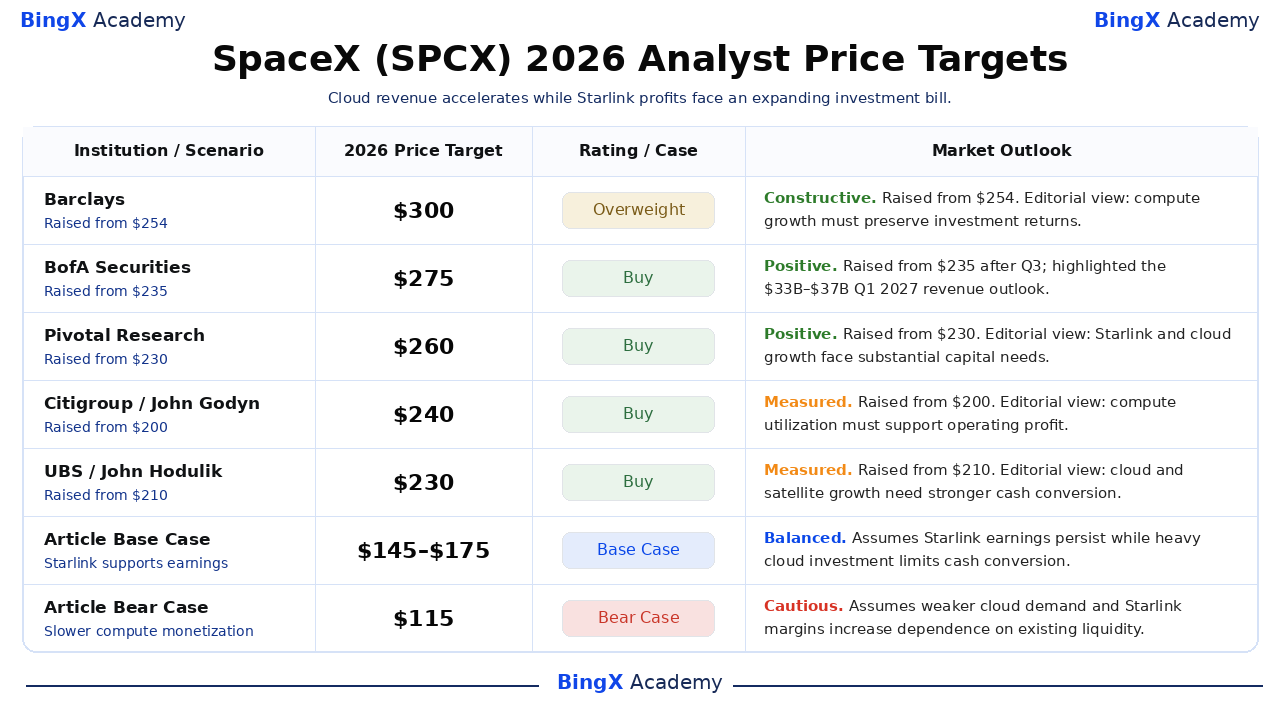
These five named, dated targets refer to Nasdaq-listed SpaceX Class A shares and generally cover roughly 12 months, extending beyond December 2026. The selected $230 to $300 range reflects different views of compute monetization and satellite growth. Rationale is editorial unless attributed; the final two rows are this article’s separate 2026 scenarios.
|
Institution / Scenario |
2026 Price Target |
Rating / Case |
Market Outlook |
|
Barclays |
$300 |
Overweight |
Constructive. October 21, 2026: Raised from $254 and maintained Overweight. Editorial interpretation: faster compute monetization must preserve returns as investment expands. |
|
BofA Securities |
$275 |
Buy |
Positive. October 22, 2026: Raised from $235 and maintained Buy after Q3 results. The published note highlighted the 33B–37B Q1 2027 revenue outlook. |
|
Pivotal Research |
$260 |
Buy |
Positive. October 22, 2026: Raised from $230 and maintained Buy. Editorial interpretation: recurring Starlink demand and cloud revenue expand the earnings opportunity, with capital intensity still material. |
|
Citigroup |
$240 |
Buy |
Measured. October 21, 2026: Raised from $200 and maintained Buy. Editorial interpretation: higher compute utilization needs to translate into operating income as capacity and depreciation expand. |
|
UBS |
$230 |
Buy |
Measured. October 21, 2026: Raised from $210 and maintained Buy. Editorial interpretation: cloud contracts and satellite adoption support sales, while cash generation must catch up with investment. |
|
Article Base Case |
145–175 |
Base Case |
Balanced. Assumes Starlink earnings persist while heavy cloud investment limits cash conversion through December 2026. |
|
Article Bear Case |
$115 |
Bear Case |
Cautious. Assumes weaker cloud demand and Starlink margins increase dependence on existing liquidity for infrastructure spending. |
How to Buy SpaceX (SPCX) Stock on BingX
Buy and hold SpaceX shares through BingX Stocks Trading using USDT or USDC, subject to listing and account eligibility. SpaceX offers exposure to launch services, satellite connectivity and artificial intelligence infrastructure. Eligible users can size holdings according to their investment goals without using leverage or paying perpetual funding fees.
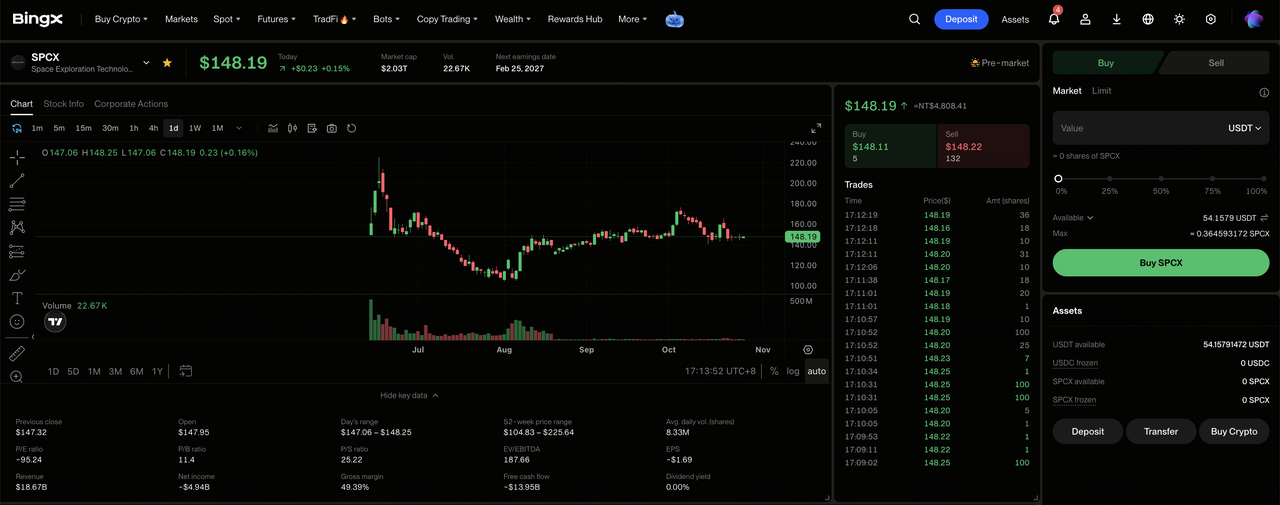
Step 1: Access BingX Stocks Trading. Sign up or log in to BingX, complete the required identity verification, and navigate to “TradFi > Stocks”. Accept the Stock Trading Risk Disclosure if accessing the product for the first time.
Step 2: Prepare USDT or USDC. Ensure your Spot Account has sufficient funds for the purchase. Transfer USDT or USDC from your Fund Account or Wealth Account if needed. Review the selected stock’s minimum order amount and fractional eligibility before choosing the investment size.
Step 3: Select SpaceX (SPCX). Open the Stocks market, search for SpaceX (SPCX), and confirm that the Class A share is available to your account. Review the company identity, current share price, trading session and available order types.
Step 4: Buy SpaceX Shares. Select “Buy”, enter an allowed investment amount or share quantity, and choose a supported market or limit order. Market orders use available prices during supported sessions, while limit orders require the specified price or better and sufficient liquidity to execute.
Step 5: Review and Manage Your Holdings. Open “Stocks > Positions” to monitor your SPCX shares and unrealized profit or loss. Use All Orders to review transactions or sell shares when needed. T+1 settlement generally affects when sale proceeds become withdrawable, rather than when purchased shares can be sold.
Top 5 Risks to Watch for SpaceX Investors in 2026
SpaceX’s launch capabilities, expanding Starlink subscriptions, and substantial financial liquidity support its earnings outlook. However, compute demand, infrastructure spending, satellite margins, and project delivery could pressure profitability and shareholder returns.
- Weaker cloud demand could pressure revenue: Q3 SI revenue reached $7.560 billion, supported by activated computing agreements. Lower customer utilization or contract pricing could reduce operating earnings and returns on newly installed infrastructure.
- Rising infrastructure costs could constrain margins: Q3 SI capital expenditures increased to $16.444 billion as capacity expanded. Higher depreciation and energy costs could weaken profitability if cloud revenue and software subscriptions grow more slowly.
- Satellite deployment delays could limit revenue growth: Q3 Starship Flight 14 delivered 26 Starlink V3 satellites, but additional capacity requires further launches. Delayed satellite deployment, terminal installation, or customer activation could reduce future revenue visibility.
- Capital investment could weaken shareholder returns: $19.593 billion was spent on infrastructure during Q3, supporting compute and satellite capacity. Underutilized equipment or construction overruns could limit cash generation and reduce returns on invested capital.
- Weaker operating returns could pressure valuation: SpaceX’s Q3 operating income reached $2.791 billion, supported by profitable connectivity services. Slower cloud sales, weaker satellite margins, or rising infrastructure costs could reduce earnings and trigger share-price declines.
Final Thoughts: Should You Invest in SpaceX in 2026?
SpaceX’s $14.575 billion in quarterly revenue and $2.791 billion in operating income demonstrate improving earnings from computing and satellite services. Starlink provides substantial operating support, while paid cloud capacity and Cursor integration create opportunities to broaden recurring revenue. Sustaining that progress will depend on preserving satellite profitability and converting infrastructure investment into cash rather than capacity alone.
The $200 bull case assumes stronger SI operating profit, improved cash coverage and resilient Starlink profitability. The $145 to $175 base case reflects steady operations, while the $115 bear case accounts for weaker utilization and persistent spending pressure. With SPCX closing at $146.90 on October 26, investors should watch whether revenue expansion translates into sustainable cash returns.
Risk Reminder: SpaceX’s expanding satellite and computing businesses do not eliminate investment risk. Weaker cloud demand, satellite delays, or infrastructure overruns could reduce earnings and cash generation. Investors should assess valuation, cash conversion, and their risk tolerance before buying SPCX shares.
Related Reading
- Top 10 Things to Know About the SpaceX IPO: Pricing, Valuation, and How to Trade It
- Top Defense Stocks to Buy in 2026: Primes, Missiles, Drones, Space, and AI-Enabled Warfare
- Top Space Stocks to Buy Ahead of SpaceX IPO
- SpaceX (SPXC) Post-IPO: Can the Company Hold a $2.5T Valuation at $230?
- Firefly Aerospace (FLY) Price Prediction 2026: Can Launch and Defense Growth Push FLY Toward $55?
- GE Aerospace (GE) Price Prediction 2026: Can Jet Engine Demand Drive GE Toward $350?
