

SAP (SAP) is a German enterprise-software company whose U.S. depositary shares trade on the NYSE. Its applications connect finance, procurement, human resources, supply chains and customer operations, with cloud subscriptions becoming the primary growth engine as customers migrate from legacy systems to S/4HANA and RISE with SAP. The installed base creates durable recurring demand, though the ADR remains sensitive to cloud-backlog growth, AI execution and currency movements.
The latest quarter confirmed strong cloud demand alongside a less clean earnings result. SAP Q2 2026 total revenue reached EUR 9.88 billion (11.16billion),up9%,cloudrevenuerose22%toEUR6.30billion(7.12 billion), and current cloud backlog increased 27% to EUR 22.93 billion ($25.91 billion). Revenue and non-IFRS EPS missed consensus, and acquisition dilution reduced the operating-profit outlook.
The SAP stock forecast for 2026 now centers on two competing views:
- The cloud-conversion and Business AI case: S/4HANA migrations, 26% constant-currency backlog growth and broader Joule adoption could sustain subscription growth while a larger cloud base improves operating leverage and free cash flow.
- The backlog-slowdown and AI-execution case: slower customer commitments, weak agent delivery or faster decline in legacy support could reduce growth before acquisition costs and investment translate into stronger margins.
This guide breaks down the SAP stock forecast, 2026 price scenarios, key risks and analyst outlooks, drawing on SAP's July 23 Q2 2026 earnings release, half-year filing and market data through September 24, plus how to trade SAP stock futures on BingX TradFi with USDT collateral.
Top 5 Things for SAP Investors to Know in September 2026
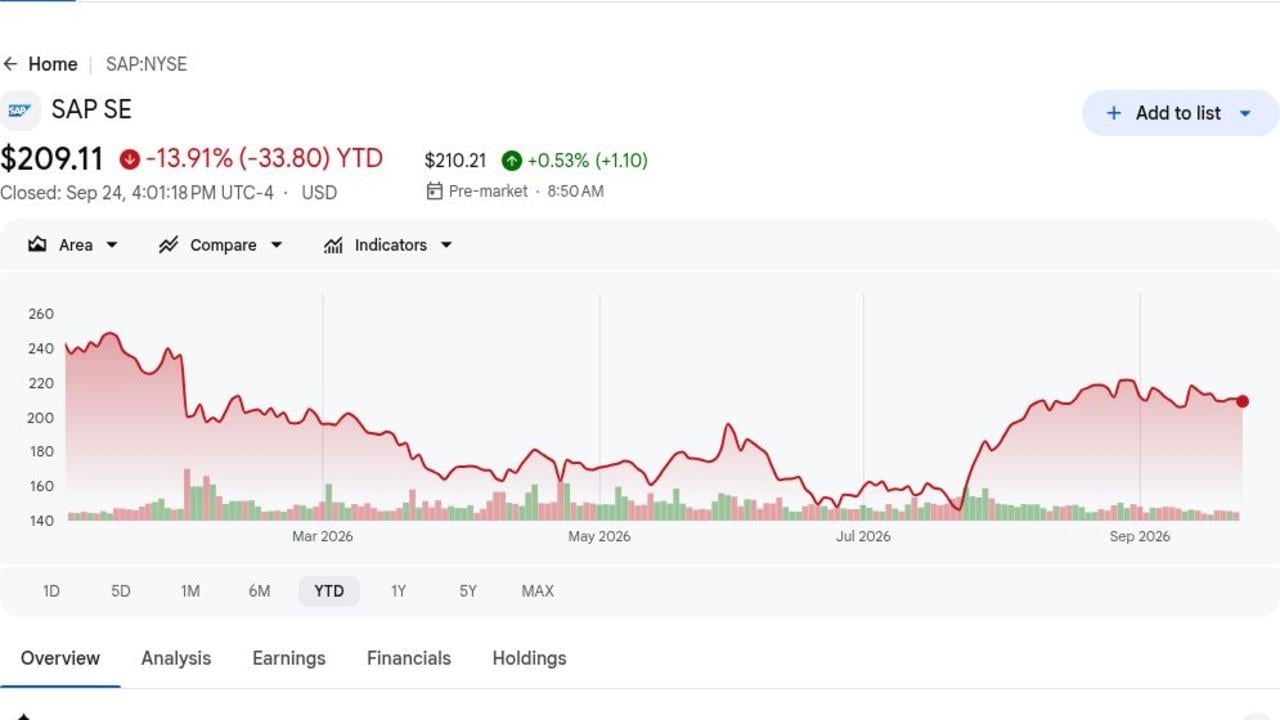
- SAP ADRs closed at $209.11 and were down 13.91% in 2026: Shares remained well below the $281.37 52-week high as investors questioned the pace of SAP's agentic-AI rollout. The pullback creates more valuation room, but also shows that strong cloud growth alone has not resolved execution concerns.
- Q2 revenue reached EUR 9.88 billion ($11.16 billion), up 9%: The result missed the EUR 10.02 billion (11.32billion)consensusbyEUR140million(158 million). Non-IFRS EPS of EUR 1.59 (1.80)alsomissedtheEUR1.78(2.01) estimate, making the quarter operationally solid but financially mixed.
- Current cloud backlog reached EUR 22.93 billion ($25.91 billion), up 27%: Growth was 26% at constant currencies, above the 24% expectation reported around the release. The contracted backlog gives SAP strong subscription visibility as customers continue moving core workloads to S/4HANA Cloud.
- 2026 cloud revenue guidance remained EUR 25.8 billion (29.15billion)toEUR26.2billion(29.61 billion): The range implies 23% to 25% constant-currency growth. Maintaining the outlook after cloud revenue rose 22% to EUR 6.30 billion ($7.12 billion) supports the migration story and second-half visibility.
- Operating-profit guidance was cut by EUR 100 million ($113 million): SAP lowered the non-IFRS range to EUR 11.8 billion (13.33billion)toEUR12.2billion(13.79 billion) after completing Dremio and Prior Labs. The acquisitions strengthen SAP's data and AI capabilities, though their near-term dilution highlights the cost of accelerating that strategy.
What Is SAP (SAP)?

SAP develops enterprise applications that manage finance, procurement, workforce, manufacturing, logistics and customer relationships. Large organizations use its software as a system of record for high-value processes, creating meaningful switching costs and long implementation cycles. Revenue comes primarily from cloud subscriptions, software support, licenses and services. The cloud transition shifts spending from upfront licenses toward recurring contracts, improving visibility while requiring SAP and its partners to move complex customer data and workflows without disrupting operations.
Its long-term direction combines S/4HANA and RISE with SAP migrations with Business Data Cloud, the Joule assistant and an expanding set of AI agents grounded in customer processes. SAP acquired Dremio for data-lakehouse capabilities and Prior Labs for foundation-model technology, while customers such as Bosch and PwC use SAP cloud and AI products for development and complex business workflows. The partner ecosystem includes systems integrators and cloud infrastructure providers that help migrate, customize and operate applications across global enterprises.
SAP (SAP) Q2 2026 Earnings Overview: Cloud Growth and Free Cash Flow Offset Revenue and EPS Misses
SAP reported Q2 revenue of EUR 9.88 billion (11.16billion)versusEUR10.02billion(11.32 billion) expected, non-IFRS EPS of EUR 1.59 (1.80)versusEUR1.78(2.01) expected, and cloud revenue of EUR 6.30 billion (7.12billion).Currentcloudbacklogrose27%toEUR22.93billion(25.91 billion), free cash flow increased 27% to EUR 3.00 billion ($3.39 billion), and the operating-profit outlook was lowered for acquisition dilution.
|
Financial Metric |
Guidance / Consensus |
Reported / Actual |
Surprise |
|
Q2 total revenue |
EUR 10.02B ($11.32B) |
EUR 9.88B ($11.16B) |
Missed. EUR 140M ($158M) below consensus; up 9% YoY. |
|
Q2 non-IFRS EPS |
EUR 1.78 ($2.01) |
EUR 1.59 ($1.80) |
Missed. EUR 0.19 ($0.21) below consensus; up 6% YoY. |
|
Q2 IFRS EPS |
— |
EUR 1.89 ($2.14) |
Improved. Up 30% YoY. |
|
Q2 cloud revenue |
EUR 6.25B ($7.06B) |
EUR 6.30B ($7.12B) |
Beat. Up 22% reported and 24% at constant currencies. |
|
Current cloud backlog |
24% constant-currency growth |
EUR 22.93B ($25.91B) |
Expanded. Up 27% reported and 26% at constant currencies. |
|
Cloud ERP Suite revenue |
— |
EUR 5.50B ($6.22B) |
Accelerated. Up 25% reported and 27% at constant currencies. |
|
Q2 free cash flow |
EUR 2.36B ($2.67B) prior year |
EUR 3.00B ($3.39B) |
Improved. Up 27% YoY. |
|
2026 cloud revenue outlook |
Unchanged |
EUR 25.8B (29.15B)toEUR26.2B(29.61B) |
Maintained. Implies 23%-25% constant-currency growth. |
|
2026 non-IFRS operating profit |
Prior EUR 11.9B (13.45B)toEUR12.3B(13.90B) |
EUR 11.8B (13.33B)toEUR12.2B(13.79B) |
Reduced. Cut by EUR 100M ($113M) for acquisition dilution. |
|
2026 free cash flow outlook |
Unchanged |
EUR 10.0B ($11.30B) |
Maintained. Above EUR 8.24B ($9.31B) in 2025. |
- Revenue of EUR 9.88 billion (11.16billion)missedbyEUR140million(158 million): Revenue still grew 9% year over year and 11% at constant currencies. The miss therefore reflected recognition mix and foreign exchange more than weaker underlying demand.
- Cloud revenue rose 22% to EUR 6.30 billion ($7.12 billion): The result slightly exceeded consensus, while Cloud ERP Suite revenue increased 25% to EUR 5.50 billion ($6.22 billion). Faster cloud growth continues to improve SAP's recurring-revenue mix.
- Cloud backlog increased 27% to EUR 22.93 billion ($25.91 billion): Constant-currency growth of 26% exceeded the 24% expectation. That contracted base provides stronger visibility into future subscription revenue despite the quarterly revenue miss.
- Free cash flow rose 27% to EUR 3.00 billion ($3.39 billion): The improvement supports AI investment, acquisitions, and share repurchases, while the unchanged EUR 10.0 billion ($11.30 billion) annual target points to further second-half cash conversion.
- Operating-profit guidance was cut by EUR 100 million ($113 million): SAP lowered the 2026 non-IFRS range to EUR 11.8 billion (13.33billion)toEUR12.2billion(13.79 billion) after the Dremio and Prior Labs acquisitions. Cloud growth now needs to offset integration costs and restore margin confidence.
SAP (SAP) 2026 Investment Outlook: $280 Bull Case vs. $170 Bear Case
SAP's 2026 outlook depends on whether S/4HANA migrations and Business AI can sustain strong cloud growth while acquisitions translate into better margins. The upside comes from backlog conversion, AI adoption, and rising free cash flow, while slower migrations, weaker AI execution, and further margin pressure remain the main risks.
The Bull Case: Strong Cloud and AI Growth Push SAP Toward $280
The Bull Case assumes current cloud backlog continues growing above 25% at constant currencies as more customers move finance, supply-chain, and HR workloads to S/4HANA. Joule and Business Data Cloud gain measurable adoption, while Dremio and Prior Labs strengthen SAP's data and AI capabilities.
A move toward 280wouldrequirecloudrevenuegrowthnearthe23%to25%annualrange,freecashflowreachingEUR10.0billion(11.30 billion), and operating-profit guidance holding steady. Faster adoption of SAP's AI agents would provide additional confirmation.
The Base Case: Steady Cloud Growth Keeps SAP Between $215 and $250
The Base Case assumes S/4HANA migrations continue supporting recurring growth, while AI monetization develops more gradually. Backlog growth moderates from 26% at constant currencies but remains above 20%, while acquisition costs offset part of the benefit from cloud scale.
SAP could trade mainly between $215 and 250undertheseconditions.CloudrevenuewithinEUR25.8billion(29.15 billion) to EUR 26.2 billion (29.61billion),freecashflownearEUR10.0billion(11.30 billion), and stable guidance would support the range.
The Bear Case: Slower Cloud Growth and AI Delays Pull SAP Toward $170
The Bear Case assumes cloud-backlog growth falls below 20% as migration decisions slow and AI product delivery fails to meet customer expectations. Declining software support and license revenue would become more visible, while acquisition and product-development costs continue weighing on profit growth.
A move toward 170wouldbecomemorelikelyifcloudrevenuegrowthfallsbelow20%,operating-profitguidanceiscutagain,orfreecashflowdropsmateriallybelowEUR10.0billion(11.30 billion). A stronger U.S. dollar could add further pressure to ADR performance.
SAP Stock Price Forecasts for 2026 By Wall Street Analysts
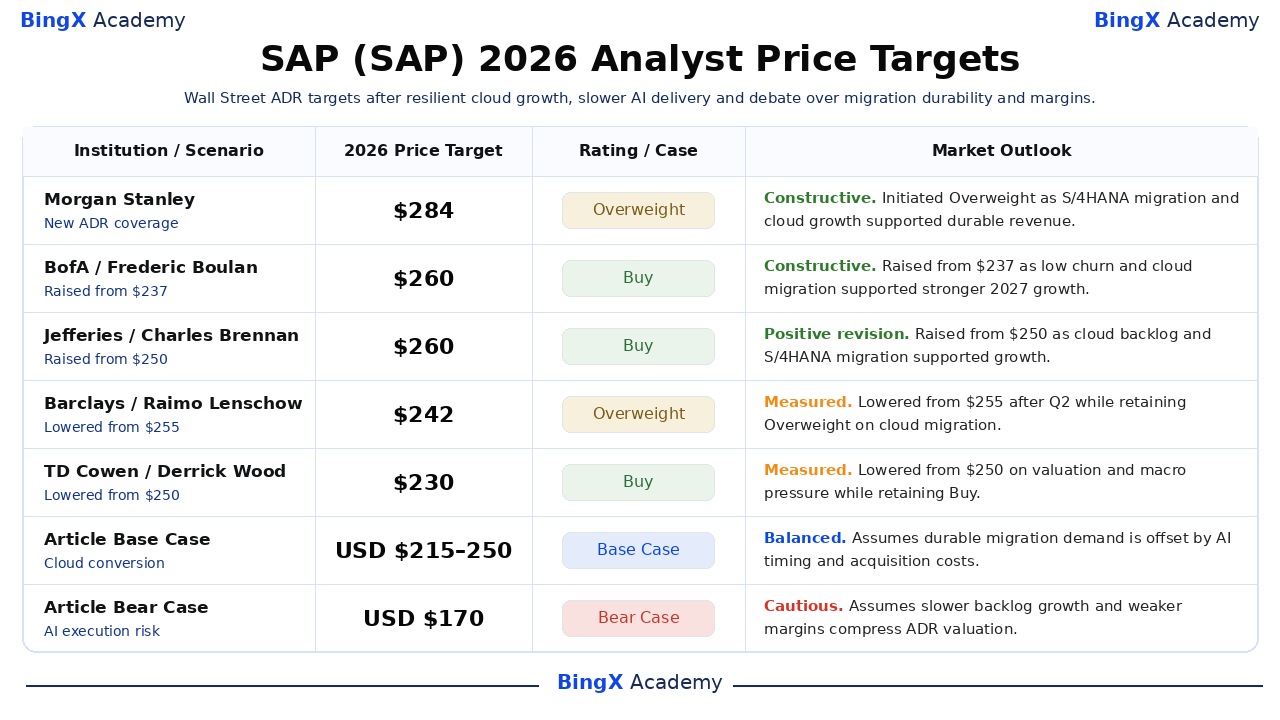
These five dated ADR analyst actions span $230 to $284 and reflect different assumptions about cloud migration, AI delivery, recurring revenue and valuation. All five targets stand above the September 24 close of $209.11, though recent cuts show less confidence in near-term execution. The Base and Bear rows are BingX Academy editorial scenarios and are labeled separately.
|
Institution / Scenario |
2026 Price Target |
Rating / Case |
Market Outlook |
|
Morgan Stanley / Adam Wood |
$284/ADR |
Overweight |
Constructive. February 20: initiated coverage as S/4HANA migration and cloud growth supported durable revenue. |
|
BofA / Frederic Boulan |
$260/ADR |
Buy |
Constructive. August 27: raised from $237 as low churn and cloud migration supported stronger 2027 growth. |
|
Jefferies / Charles Brennan |
$260/ADR |
Buy |
Positive revision. September 22: raised from $250 as cloud backlog and S/4HANA migration supported growth. |
|
Barclays / Raimo Lenschow |
$242/ADR |
Overweight |
Measured. July 27: lowered from $255 after Q2 while retaining Overweight on cloud migration. |
|
TD Cowen / Derrick Wood |
$230/ADR |
Buy |
Measured. May 14: lowered from $250 on valuation and macro pressure while retaining Buy. |
|
Article Base Case |
215-250/ADR |
Base Case |
Balanced. Assumes durable migration demand is offset by AI timing and acquisition costs. |
|
Article Bear Case |
$170/ADR |
Bear Case |
Cautious. Assumes slower backlog growth and weaker margins compress ADR valuation. |
How to Trade SAP (SAP) Stock on BingX
Trade SAP's cloud-migration, Business AI and margin outlook using BingX TradFi and BingX AI tools. Because the ADR can react sharply to backlog growth, guidance and currency moves, traders should define both the catalyst and risk limits before entering a position.
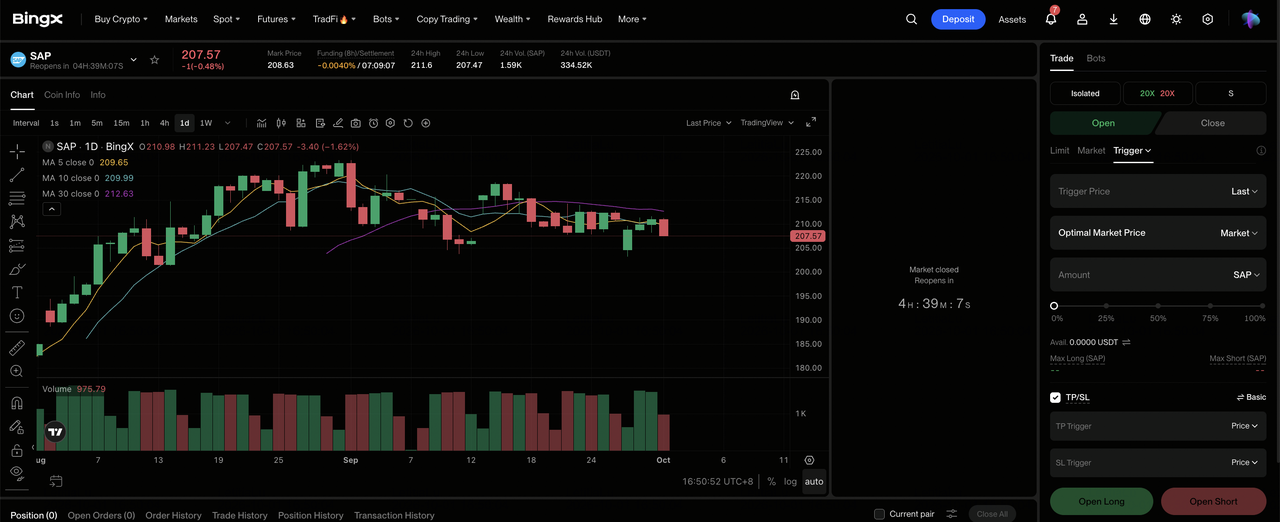
Step 1: Access BingX TradFi. Sign up and navigate to the specialized TradFi section on the BingX exchange dashboard.
Step 2: Select SAP (SAP). Search for and select the SAP-USDT perpetual futures contract.
Step 3: Choose your direction. Select Open Long if cloud backlog, S/4HANA migrations and AI adoption remain strong. Select Open Short if backlog growth or profit guidance weakens.
Step 4: Select leverage and margin mode. Choose Isolated or Cross-Margin based on your risk tolerance. The 13.91% YTD decline and range between $144.97 and $281.37 show why conservative leverage and clear position sizing are important.
Step 5: Execute strict risk protocols. Set Take-Profit and Stop-Loss (TP/SL) levels before or immediately after entering the trade. SAP can react quickly to earnings, backlog, AI releases, acquisition integration, enterprise spending and EUR/moves.
Top 5 Risks to Watch for SAP Investors in 2026
SAP has a large installed base and strong cloud demand, but AI execution, migration timing, acquisition costs, and currency moves can still affect earnings and ADR value.
- AI delivery can fall short of customer expectations: Business AI is central to SAP's growth story. Slower adoption of useful agents would make acquisition and development spending harder to justify and could pressure the valuation multiple.
- Cloud-backlog growth could slow from 26%: Current cloud backlog reached EUR 22.93 billion (25.91billion).Growthbelow20%wouldweakenfuturesubscriptionvisibilityandraisequestionsaroundtheEUR25.8billion(29.15 billion) to EUR 26.2 billion ($29.61 billion) cloud outlook.
- S/4HANA migrations can take longer than expected: Customers must move complex data and business processes without disrupting operations. Longer projects could delay subscription conversion, raise implementation costs, and slow margin improvement.
- Acquisition costs could weigh on profit for longer: Dremio and Prior Labs already reduced operating-profit guidance by EUR 100 million ($113 million). Higher integration, retention, or infrastructure costs could further delay the expected AI and data-platform benefits.
- Currency moves can affect ADR returns: SAP reports in euros while its ADR trades in dollars. A weaker euro can reduce translated revenue, earnings, and the dollar value of the ADR even when constant-currency cloud growth remains strong.
Final Thoughts: Should You Invest in SAP in 2026?
SAP entered the second half with a mixed but strategically important quarter. Revenue rose 9% to EUR 9.88 billion (11.16billion),cloudrevenueincreased22%toEUR6.30billion(7.12 billion), and current cloud backlog reached EUR 22.93 billion ($25.91 billion). Free cash flow growth supports the migration thesis, though the profit-guide cut shows that AI expansion carries near-term cost.
The Bull Case requires strong migration conversion and better AI delivery to support $280/ADR. The Bear Case reflects slower backlog and margin pressure toward 170/ADR.Conservativetradersmaywaitforbackloggrowthabove20%,cloudrevenueinsidetheannualrangeandfreecashflownearEUR10.0billion(11.30 billion) before increasing exposure.
Risk Reminder: Trading and investing in equities like SAP involves a high risk of capital loss. Enterprise spending, cloud migrations, AI competition, acquisitions, currency movements, valuation changes and leveraged trading can produce rapid losses. Conduct independent research before allocating capital.
Related Reading
- Oracle (ORCL) Price Prediction 2026: Can AI Cloud Growth Push ORCL Toward $260?
- Adobe (ADBE) Price Prediction 2026: Can AI Monetization Push ADBE Toward $350?
- IBM (IBM) Price Prediction 2026: Can Software and Quantum Growth Push IBM Toward $350?
- AppLovin (APP) Price Prediction 2026: Can AXON Growth Push APP Toward $600?
- Microsoft (MSFT) Stock Outlook for 2026: Can Azure AI and Copilot Growth Drive MSFT Stock to $550+?
