The Dolphin (POD) ecosystem is a high-performance DePIN (Decentralized Physical Infrastructure Network) project dedicated to democratizing access to Artificial Intelligence. Originally starting as a premier AI research lab known for its uncensored model variants on Hugging Face, Dolphin transitioned in early 2026 to a decentralized network model. By leveraging a Peer-to-Pool architecture and a 100% revenue-driven buyback model, Dolphin offers a scalable alternative to centralized AI providers like OpenAI and Anthropic.
As of May 2026, the project has gained significant traction by powering the Venice.ai ecosystem and processing over 60,000 prompts per hour. Unlike centralized AI models that impose strict alignment via ethical and political filters, Dolphin allows users to steer the model’s intent, making it a "tool as an extension of the user's will."
This article explores the technical architecture of the Dolphin Network, the utility of the $POD token, the xPOD staking vault, and how you can benefit from the decentralized AI revolution by trading POD on BingX futures market.
What Is Dolphin (POD)?
Dolphin is a decentralized network that connects users needing AI compute with GPU owners who have idle hardware. The project addresses three critical pain points in the current AI landscape:
- Censorship: Centralized models often refuse valid prompts, e.g., creative writing or sensitive research, due to corporate alignment.
- Cost: Running large-scale inference on enterprise A100/H100 clusters is expensive.
- Privacy: Centralized providers can see and store all user queries.
Dolphin's AI solution introduces several industry-first features:
- Uncensored Model Lineup: Dolphin produces fine-tuned versions of Llama 3.1, Mistral, and Qwen, stripped of artificial refusals while retaining full intelligence.
- Consumer GPU Efficiency: The network proves that pooling consumer cards like the RTX 4090 is up to 10x more cost-effective for image and audio generation than datacenter hardware.
- Encrypted Live-Weight Proofs: A proprietary verification system that ensures nodes are actually running the specific AI model they claim to be, preventing fraud in a trustless environment.
How Does the Dolphin Network Work?
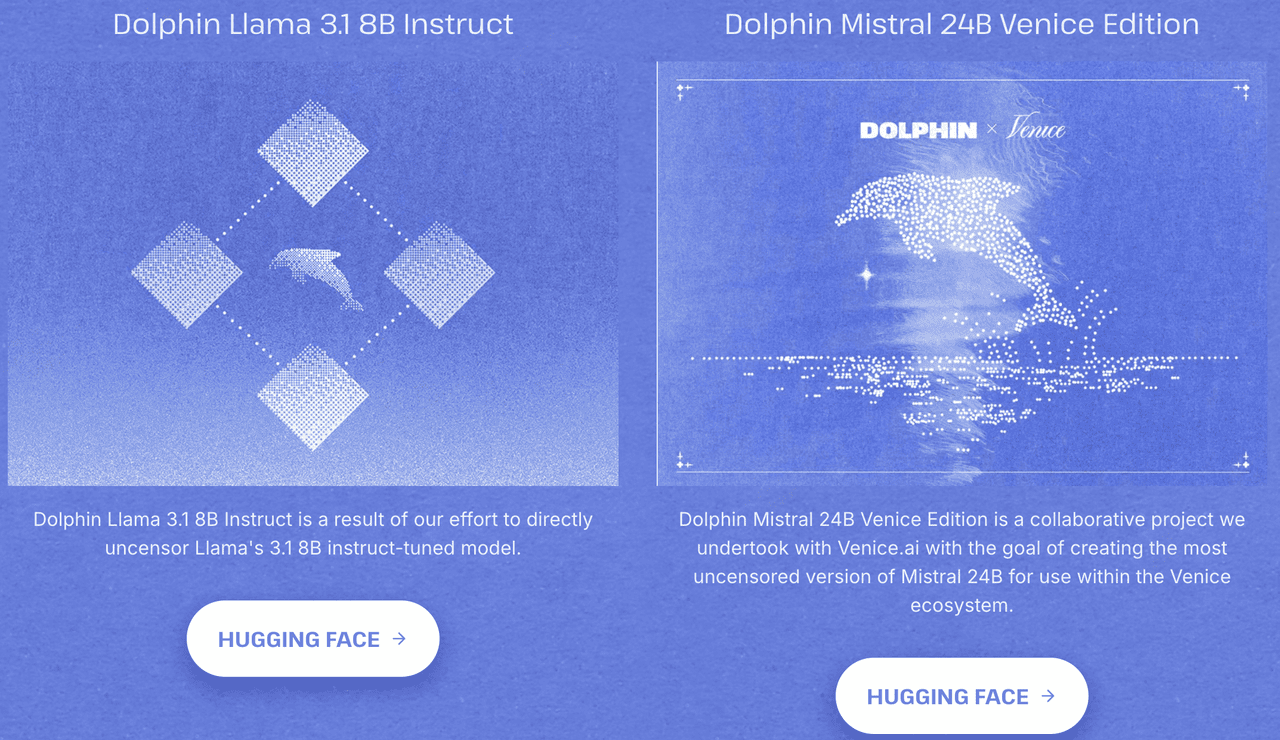
Dolphin's AI models | Source: Dolphin
The protocol operates through a Peer-to-Pool design, decoupling the supply of compute from the demand for inference.
1. Peer-to-Pool Inference
Users send requests to the network via API or the Dolphin Web UI. Instead of being paired 1-on-1 with a specific provider, requests are routed to a pool of nodes running the required model. This ensures high uptime and low latency, as any available node in the pool can pick up the task.
2. Distributed Web Scraping and Deep Research
Beyond GPUs, Dolphin utilizes a CPU-based scraper network. These nodes use residential IPs to bypass anti-bot measures, allowing the Dolphin Deep Research agent to crawl the live web and provide AI-generated answers grounded in real-time data.
3. Node Verification and Anti-Cheat (DAC)
To prevent malicious nodes from sending fake or low-quality AI responses, Dolphin uses Validators. These validators perform random sampling and check Logprobs, probability distributions of tokens. If a node is caught cheating, its Bond Deposit is slashed.
What Is Dolphin (POD) Tokenomics: Value Accrual and xPOD
The $POD token is the lifeblood of the ecosystem, designed with a Flywheel effect that rewards holders as network usage grows.
- 100% Revenue Buybacks: Every cent generated from API fees is used to buy back $POD from the open market. This creates constant buy pressure to offset node emissions.
- xPOD Staking Vault: When you stake POD, you receive xPOD. This is an auto-compounding token that captures dividends from buybacks and grants users Daily Free Credits for AI generation.
- Node Operator Bonds: To secure the network, operators must post a bond in POD. This aligns their incentives with the token’s value; if they cheat, they lose their capital.
Dolphin vs. Centralized AI: Key Differences
|
Feature |
Dolphin ($POD) |
Centralized (OpenAI/Claude) |
|
Alignment |
User-defined (Uncensored) |
Corporate-defined (High Refusal) |
|
Hardware |
Distributed Consumer GPUs |
Centralized Datacenters |
|
Privacy |
Encrypted & Private |
Data may be used for training |
|
Cost Basis |
Around 10x lower for Audio/Image |
High Premium |
|
Governance |
DAO ($POD Holders) |
Centralized Board |
Dolphin dramatically undercuts the centralized AI status quo by leveraging idle consumer GPUs, which operate at a 10x higher performance-per-dollar ratio for multimodal tasks compared to enterprise clusters. While centralized Frontier models like GPT-5.4 or Claude 4.6 maintain $20/month subscription barriers, Dolphin’s Peer-to-Pool model provides API inference at approximately 30% lower than the cheapest market aggregators, e.g., $0.70 per million tokens for Qwen 3.6 vs. $1.00 on OpenRouter. Practically, this shifts the economy from a rent-seeking model to a 100% revenue buyback system, where protocol fees directly purchase $POD on the open market to offset inflation and reward xPOD stakers with auto-compounding dividends and free daily credits.
The defining functional shift lies in Uncensored Intelligence; Dolphin removes the hidden alignment tax of corporate and ethical filters that causes centralized models to refuse up to 25% of creative or sensitive research prompts. Unlike the black-box safety layers of OpenAI or Google, Dolphin utilizes Encrypted Live-Weight Proofs and Validator scoring to ensure decentralized nodes are running the exact model version selected by the user. For developers, this offers a tool as an extension of will, where models are steerable via system prompts without unexpected refusals, while residential IP scraper nodes allow for deep, real-time research that evades the anti-bot restrictions common in traditional datacenter-based AI crawlers.
How to Trade Dolphin (POD) on BingX
As a leading platform for emerging DePIN assets, BingX integrates advanced AI-driven analysis tools to help users navigate the $POD ecosystem with institutional-grade precision.
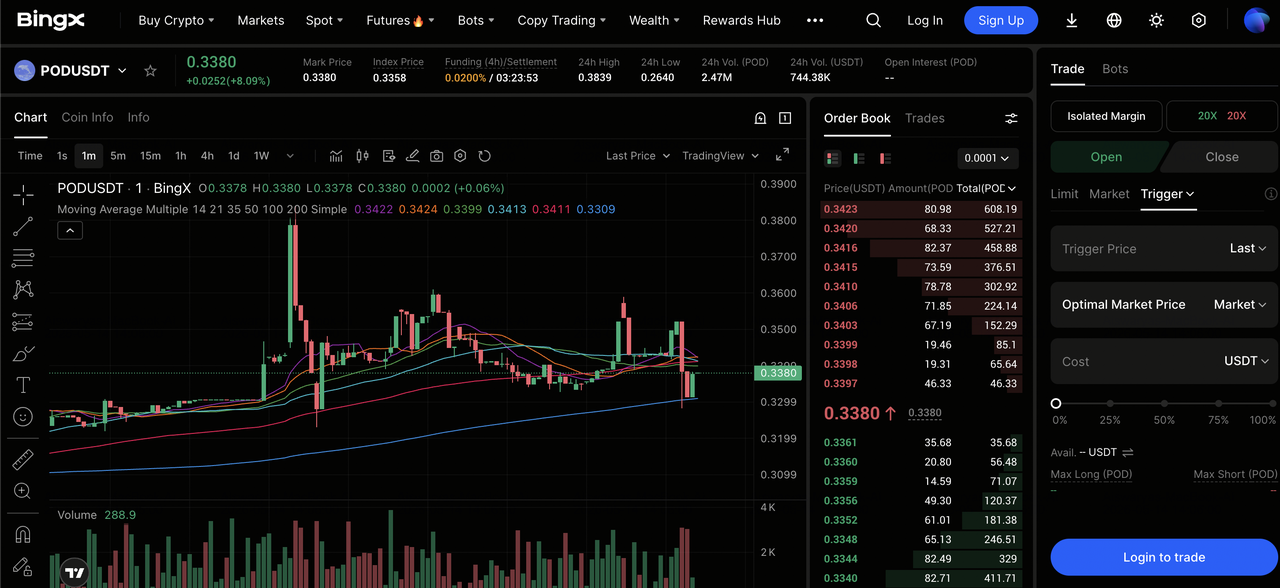
POD/USDT perpetual contract on BingX futures market
Long or Short POD Perpetuals on the Futures Market
- Access Perpetuals: Switch to the Futures section and select the POD/USDT perpetual contract.
- Configure Leverage: Choose your margin mode (Isolated or Cross) and adjust your leverage based on your risk tolerance.
- Execute Position: Analyze market trends using the BingX AI analyst tool, then select Open Long or Open Short to capitalize on $POD price volatility.
5 Key Considerations Before Using Dolphin
Before allocating capital to the Dolphin ecosystem, it is essential to evaluate the technical risks of its distributed inference model, the volatility of its decentralized GPU supply, and the cryptoeconomic security of the $POD bonding mechanism.
- Network Maturity: The V2 mainnet is relatively new, launched May 2026; expect ongoing updates to the verification engine.
- Token Volatility: As a DePIN asset, $POD price can be influenced by GPU hardware cycles and AI market sentiment.
- Hardware Requirements: If you plan to run a node, ensure you have a compatible NVIDIA GPU - RTX 30-series or higher recommended.
- Slashing Risk: For node operators, malicious behavior or severe downtime can result in the loss of your $POD bond.
- Model Limits: While Dolphin models are intelligent, extremely large models like Llama 405B require sharded inference across multiple nodes, which is still in the roadmap phase.
Final Thoughts: Is Dolphin the Future of Sovereign AI?
Dolphin ($POD) represents a shift toward Sovereign AI. By proving that decentralized networks can rival the performance of Big Tech at a fraction of the cost, Dolphin is positioning itself as the foundational layer for unbiased, uncensored intelligence. Its 100% revenue buyback model makes it one of the most economically sound DePIN projects in the 2026 market.
For users, it offers freedom of speech in the digital age. For investors, it offers a direct stake in the global demand for AI compute. As the world moves away from black-box models, Dolphin’s transparent, distributed approach provides a compelling path forward for the AI industry.
Risk Reminder: AI and DePIN investments involve technical and market risks. Always monitor the Dolphin Network status and perform your own due diligence on token emissions. BingX is not responsible for investment losses.
Related Reading
- What Is USDai (CHIP) InfraFi for GPU-Backed Yield and How Does It Work?
- What Is Gensyn (AI)? Discover Decentralised Protocol for AI and How To Trade It On BingX
- What Is Unibase (UB) Decentralized AI Memory Layer and How to Buy UB?
- What Is HeyElsa (ELSA)? A Beginner’s Guide to the AI Crypto Co-Pilot
- What Is Based ($BASED) Crypto Super App and How Does It Work?
