In the fast-paced world of 2026 derivatives trading, the ability to profit regardless of market direction is the hallmark of a professional trader. Going Long and Going Short are the two fundamental strategies that allow you to capitalize on both the meteoric rises and the sharp corrections of the global financial markets.
While traditional investing often limits you to a buy and hold mentality, BingX Futures empowers you to take a directional stance. By longing, you are positioning yourself to profit from upward momentum; by shorting, you are effectively selling an asset you believe is overvalued, aiming to buy it back later at a lower price to pocket the difference.
As of 2026, BingX has unified the long and short experience across its USDT-M, Coin-M, and Standard Futures ecosystems, allowing traders to pivot from a Bitcoin long to a Crude Oil short within a single interface. Whether you are hedging a spot portfolio using Coin-M crypto-collateralized perps or speculating on Standard Futures for TradFi assets like Gold and the S&P 500, BingX provides over 1,100 pairs with up to 500x leverage. This integrated architecture ensures that directional strategies are executed with institutional-grade transparency and minimal slippage across all asset classes.
This guide will demystify the mechanics of longing and shorting in the futures market, providing you with a step-by-step framework to execute your first trades on the BingX Perpetual Futures platform.
What Does It Mean to Go Long or Go Short on Futures?
At its core, futures trading is about speculating on the future price of an asset without actually owning it. This flexibility is what allows for short selling, a concept that can seem counterintuitive to beginners.
Think of futures trading as a price agreement rather than a shopping trip. Instead of buying a coin and putting it in your digital wallet, you are simply betting on the direction of a price ticker. This contract-based system is what gives you the superpower to profit even when the world's markets are crashing.
Going Long: The Buy Low, Sell High Classic
When you go long, you are the optimist. You enter a contract to buy at today's price because you believe the asset will be worth much more tomorrow.
You aren't just buying; you are locking in a price. If you lock in Bitcoin at $100,000 and the market price jumps to $105,000, you’ve effectively gained $5,000 in value because your contract allows you to own the action at that lower entry point. Your position will show as a positive green number (e.g., +2 BTC), signaling you are holding growth.
Going Short: Profiting from the Downfall
Shorting is often the hardest concept for beginners, but it's simple if you think of it as "Sell High, Buy Low." You are the realist who sees a bubble about to burst.
Imagine selling a contract for the NASDAQ 100 at 20,000 points without actually owning it. If the index drops to 19,000, you buy it back to close the contract. Since you sold it for more than you bought it back for, that 1,000-point difference is your profit. Your position will show as a negative red number (e.g., -2 BTC). Don't panic; in the futures world, a negative number just means you are Short. If the market price goes down, your profit goes up.
How Longing and Shorting Works on BingX: 3 Core Pillars
On BingX, this flexibility means you can hedge. If you hold physical Bitcoin in your spot account and the market looks shaky, you can open a Short on Perpetual Futures. If the price drops, the profit from your Short covers the loss of your physical Spot holdings, keeping your total wealth stable.
Before you click Long or Short, you must understand the three pillars of a BingX futures trade: Margin, Leverage, and the Funding Rate.
1. Isolated vs. Cross Margin: Margin Modes
- Isolated Margin: This mode locks a specific amount of money into one trade. If the market crashes, you only lose that specific "isolated" amount. It is the safest choice for beginners because a single bad trade cannot empty your entire wallet.
- Cross Margin: Your entire account balance is used as collateral. If a trade goes into a loss, the system pulls from your remaining balance to keep the position open. While this gives your trade more breathing room, one major collapse could wipe out your entire account.
2. The Power of Leverage: Magnifying Your Trades
Leverage lets you control a large position with a small deposit. For example, using 5x leverage turns a $2,000 deposit (Margin) into a $10,000 market position. This multiplies your profit potential; a 2% price move earns you 10%, but it also moves your liquidation price closer. If the market moves against you even slightly, the exchange may close your position to prevent losses from exceeding your deposit.
3. Funding Rates: Keeping Prices in Sync
Because Perpetual Futures never expire, the Funding Rate acts as the anchor that keeps the futures price tied to the actual market (Spot) price. It is a small fee paid between traders every 8 hours:
- Bullish Market: Longs pay a fee to Shorts.
- Bearish Market: Shorts pay a fee to Longs. For beginners, a high funding rate is a useful signal that the market may be overcrowded in one direction and due for a reversal.
When to Go Long vs. Short: Market Sentiment and Technical Cues
Choosing your trade direction requires balancing fundamental news with technical signals to determine if the market is entering a growth phase or a correction.
1. When to Go Long: Bullish Outlook
- Positive Fundamentals: You anticipate price growth due to strong earnings reports, favorable economic data (like a drop in interest rates), or a supply shortage in commodities like Gold or Crude Oil.
- Technical Breakouts: Prices move above a major Resistance level on high volume, or technical indicators like the Relative Strength Index (RSI) show the asset is recovering from an oversold state.
- Trend Confirmation: The chart consistently shows higher highs and higher lows, suggesting a sustained upward trend.
2. When to Go Short: Bearish Outlook
- Negative Fundamentals: You expect a decline based on poor corporate earnings, disappointing economic forecasts, or news of increased supply, e.g., an OPEC announcement to increase oil production.
- Technical Breakdowns: The price falls below a critical Support level, or chart patterns like a Head and Shoulders or Double Top signal an upcoming reversal.
- Overextension: Technical indicators suggest the market is Overbought, or the price has drifted too far above its Moving Average, making a mean reversion or pull-back likely.
How to Open a Long or Short Position on BingX Web
This tutorial shows you how to go long or short on the BingX Perpetual Futures market, allowing you to master directional trading in just a few clicks. Transitioning to directional trading is straightforward on the BingX web portal.
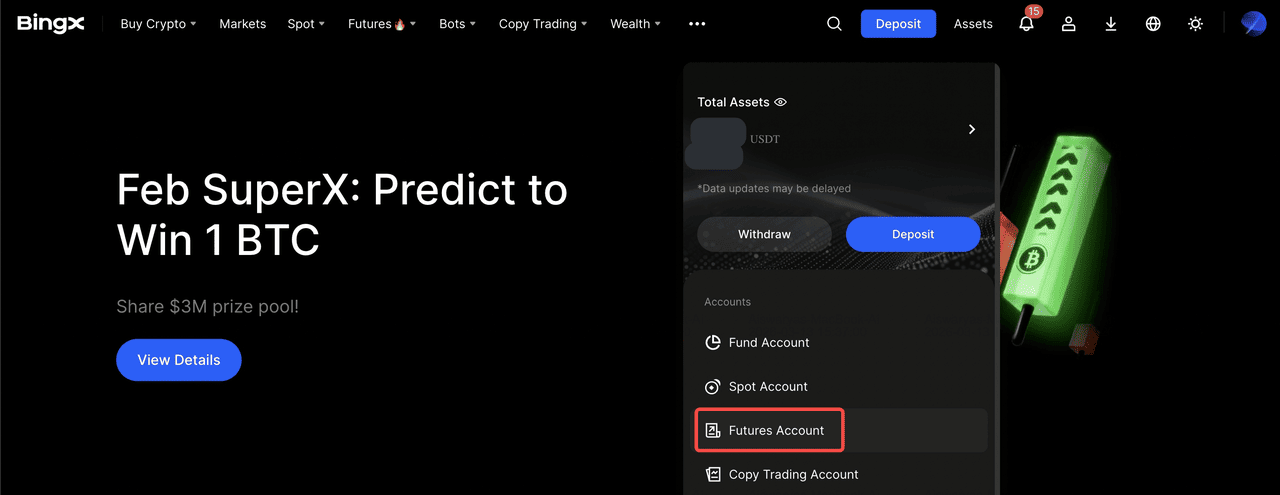
Step 1: Fund Your Futures Account
Navigate to Assets and click Transfer. Move your USDT from your Fund Account into your Futures Account.
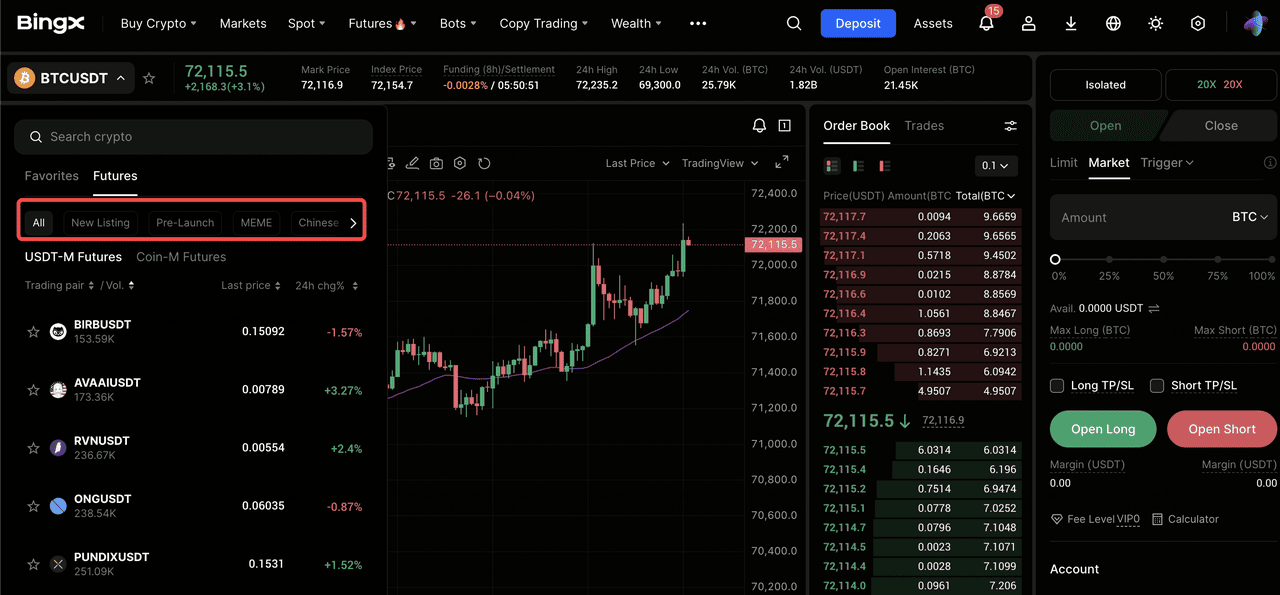
Step 2: Access the Perpetual Futures Trading Portal
Hover over Futures on the top menu and select Perpetual Futures. You can switch between Crypto and TradFi assets like Gold or the S&P 500 on the left side of the trading interface.
Step 3: Configure Your Margin and Leverage
On the right-hand panel, customize your risk settings:
- Select Isolated to limit risk to one trade or Cross margin mode.
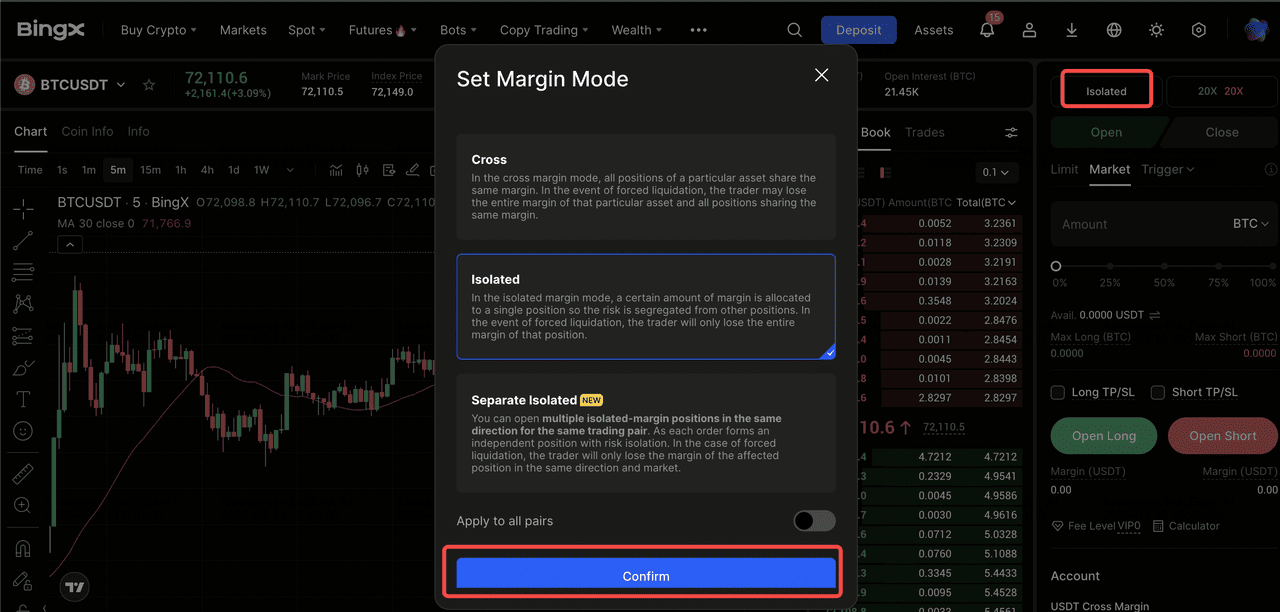
- Adjust your Leverage slider, e.g., 5x or 10x.
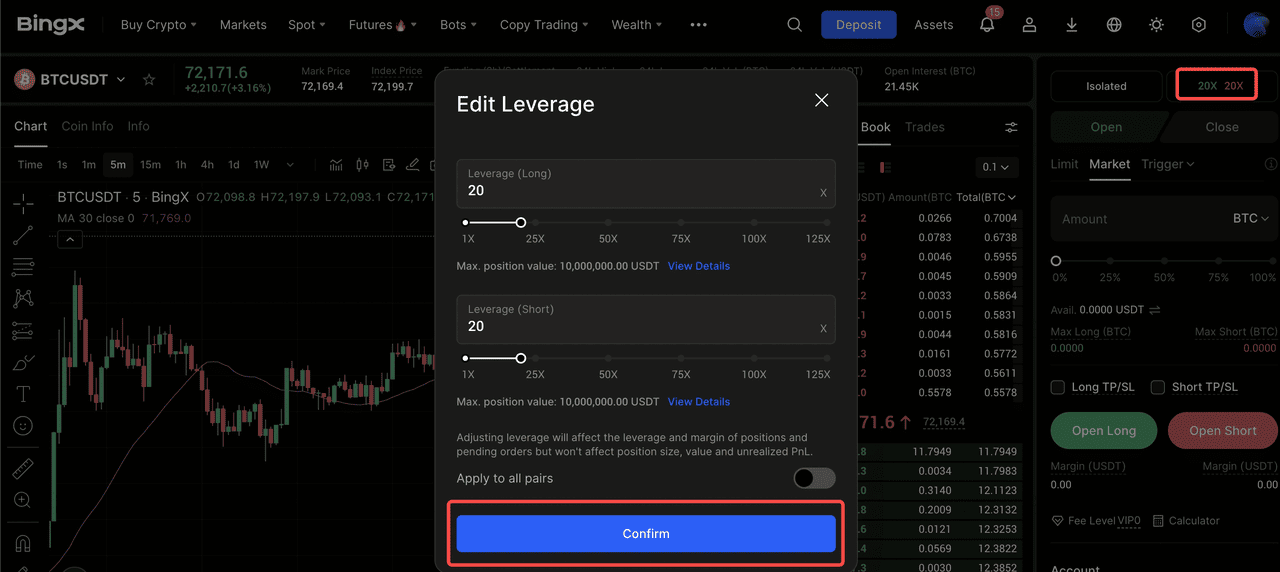
Tip: Use the BingX Calculator icon located near the leverage settings to simulate your estimated liquidation price before confirming.
Step 4: Set Your Order and TP/SL
Choose your order type, such as Limit for a specific price, Market for instant entry. Enter the amount of USDT you wish to commit. Crucially, check the TP/SL (Take-Profit/Stop-Loss) box to set your exit targets immediately.
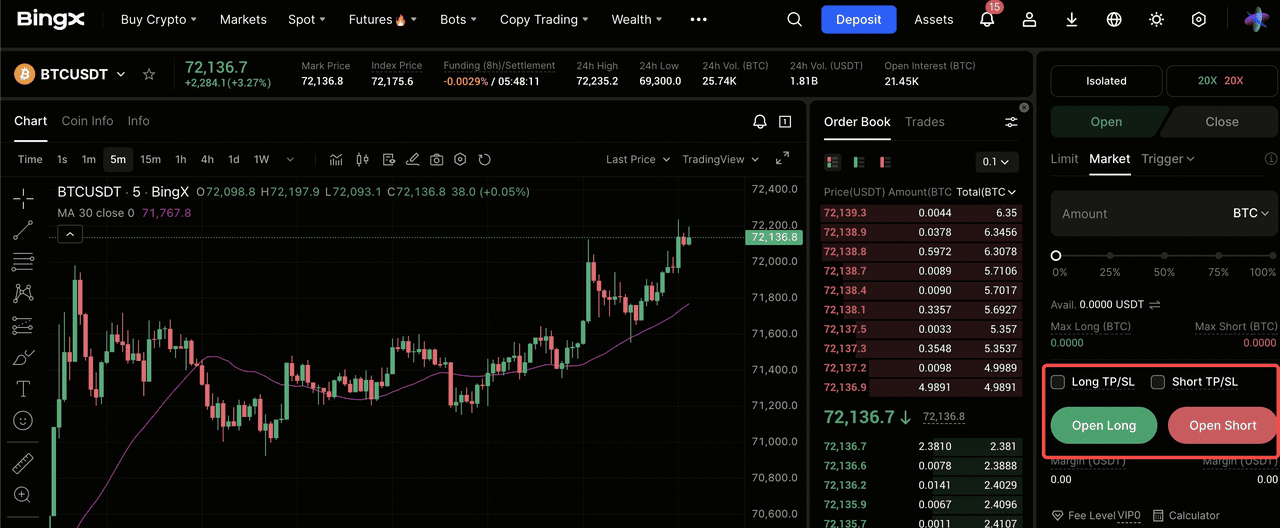
Pro Tip: Enable the Guaranteed Price (GTD) feature for your Stop-Loss to safeguard against slippage during high-volatility market gaps.
Step 5: Open and Monitor Your Position
Click Open Long if you are bullish (expecting a rise) or Open Short if you are bearish (expecting a fall). Your active trade will appear in the Position tab at the bottom, where you can view real-time Unrealized PnL and your ROI%.
How to Open a Long or Short Position on BingX App
The BingX mobile app is optimized for high-speed execution.
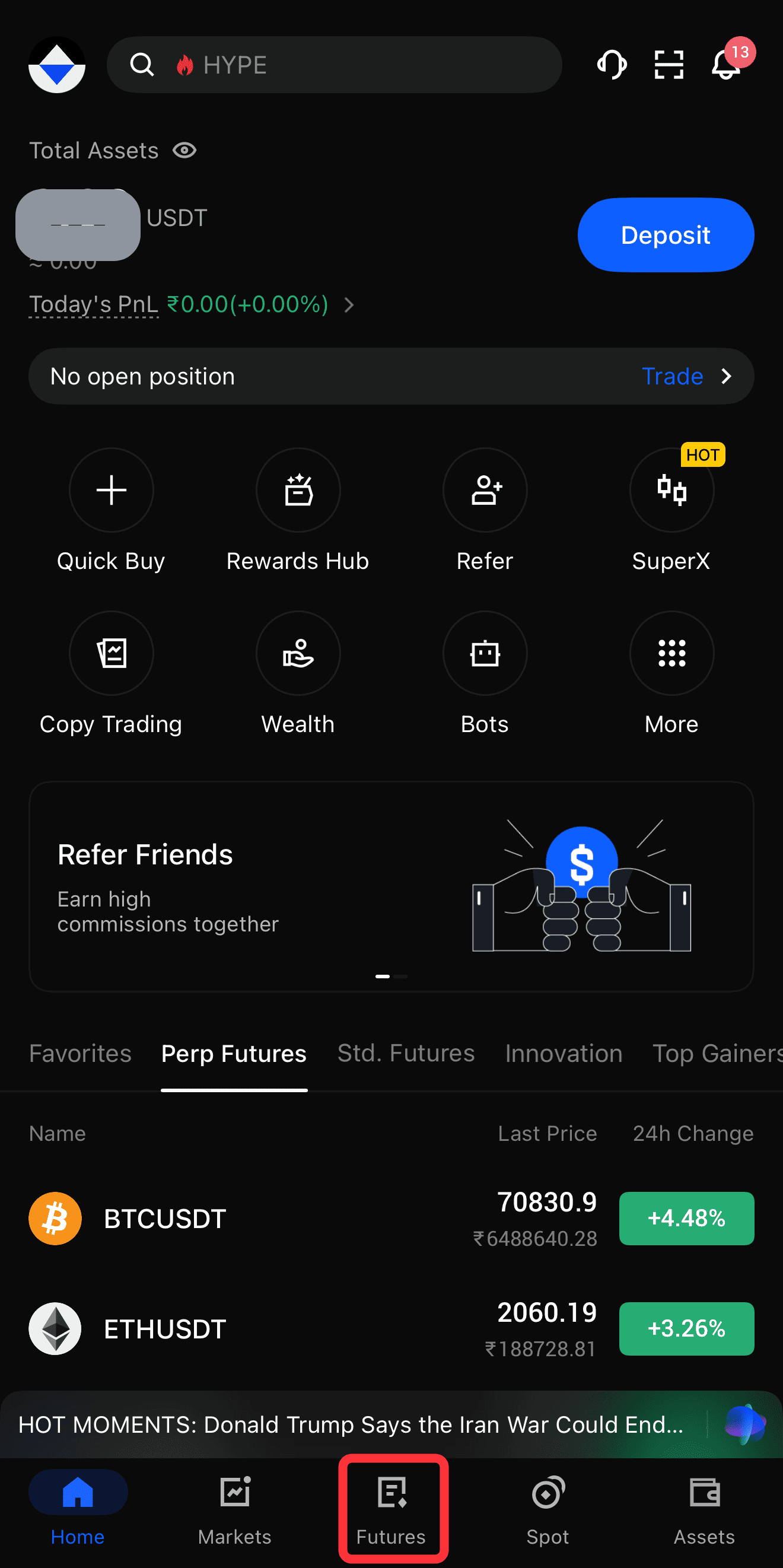
1. Navigate: Tap the Futures icon at the bottom center.
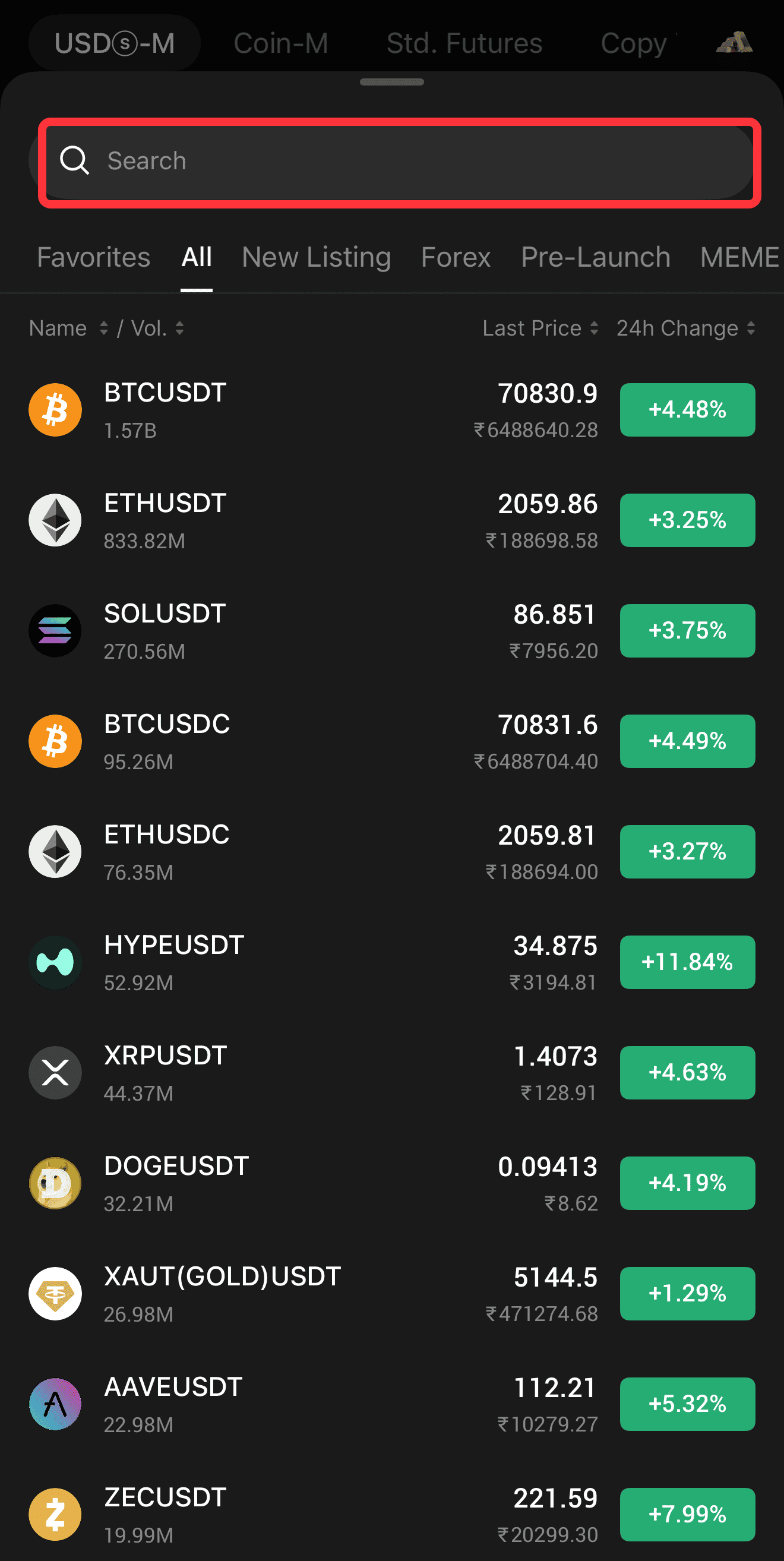
2. Choose Asset: Tap the pair at the top, e.g., ETH/USDT, and select your market between Crypto and TradFi.
3. Set Parameters: Toggle to Isolated, adjust your leverage slider, and enter the amount of USDT for the trade.
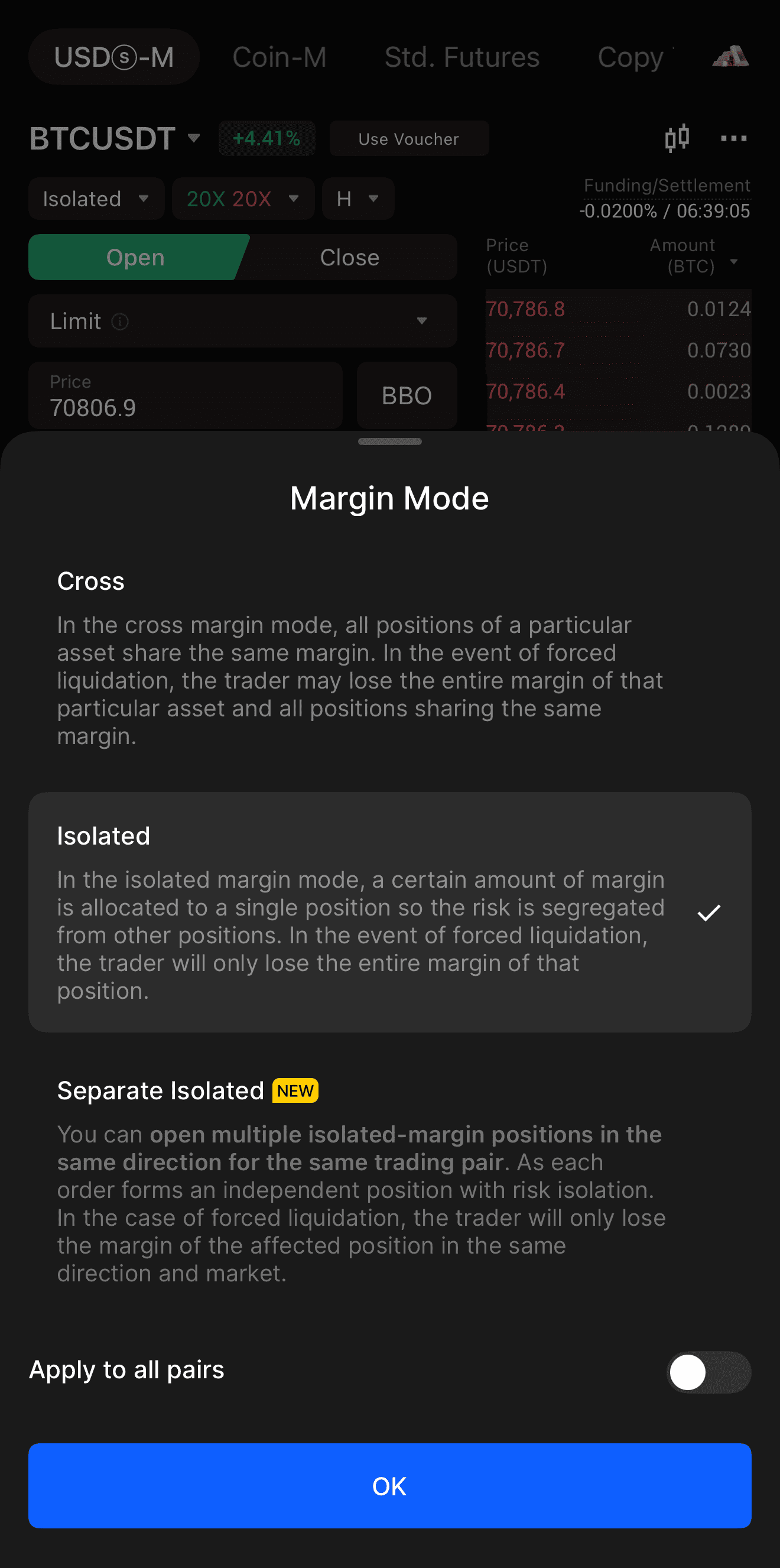
4. Protection: Tap the TP/SL checkbox. This is vital in 2026’s volatile environment.
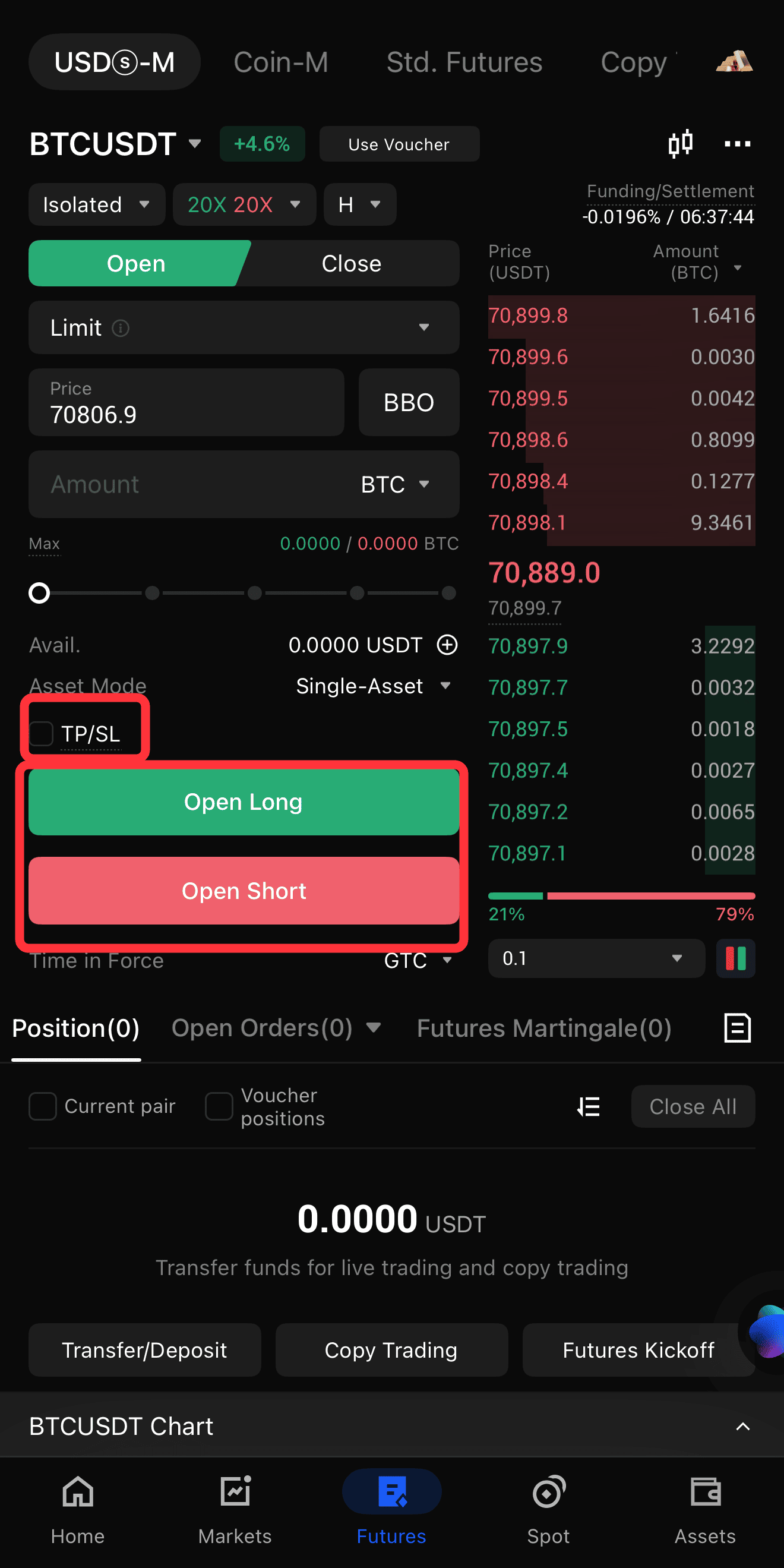
5. Confirm: Tap the green Open Long button or the red Open Short button. Your position will immediately appear in the Positions tab at the bottom.
What Are the Key Benefits of Trading Long and Short on BingX?
Mastering the ability to pivot between long and short positions transforms you from a passive investor into a dynamic trader capable of finding opportunities in any economic climate.
- Profit in Any Market: You are no longer a victim of a bear market. Shorting allows you to build wealth even when prices are crashing.
- Institutional-Grade Protection: BingX’s Dual-Price Mechanism ensures that scam wicks or artificial price spikes don't trigger your liquidation. Your trade is only closed if the global Mark Price confirms the move.
- Guaranteed Price (GTD): BingX is a pioneer in offering Guaranteed Price for Stop-Losses. This ensures that even in extreme volatility, your exit is executed at your exact price, eliminating the risk of slippage.
- Portfolio Hedging: If you hold physical Bitcoin but fear a short-term drop, you can open a Short on BingX. The profit from your short will offset the loss in value of your physical holdings.
Top 4 Risk Management Rules for Long/Short Futures Traders
To survive and thrive in futures trading in 2026, follow these four professional rules:
- Rule 1: Use the BingX Calculator. Before opening a short, use the built-in calculator located above the Long/Short buttons to see your Exact Liquidation Price. If it's too close to the current price, lower your leverage.
- Rule 2: Master the Reverse Feature. In the Positions tab, BingX offers a Reverse button. If you are Long and the market suddenly turns Bearish, one tap will close your Long and instantly open a Short of the same size.
- Rule 3: Monitor the Mark Price. Don't panic if the Last Price on the chart hits your liquidation level. On BingX, liquidations are triggered by the Mark Price or global average, protecting you from local exchange glitches.
- Rule 4: Scale Your Positions. Don't go All-In on a single market trend or position. Open a small position first, and if the market moves in your favor, add more margin to scale into the trend.
Conclusion: Mastering the Two-Way Market
Mastering long and short positions on BingX Futures provides a strategic bridge between the high-growth potential of crypto and the stability of traditional markets. By integrating the 2026 Safety Suite, which includes the Dual-Price Mechanism to prevent unfair liquidations and Guaranteed Price to eliminate stop-loss slippage, you can navigate market swings with the precision of an institutional trader. This flexibility allows you to remain productive in any economic climate, whether you are hedging a long-term portfolio or speculating on short-term price gaps.
A disciplined approach is the foundation of long-term success in the derivatives market. Beginners should prioritize risk mitigation by starting with low leverage like 2x-5x and utilizing the BingX Demo Trading feature to practice order execution without risking real capital. Always ensure every position is protected by a pre-calculated Stop-Loss and use the BingX Calculator to define your worst-case liquidation price before entering any trade.
Risk Reminder: Futures trading involves significant financial risk. Leverage magnifies both potential profits and potential losses, and it is possible to lose your entire initial investment. Never trade with capital you cannot afford to lose, and ensure you fully understand the mechanics of funding rates and liquidation before committing funds.
Related Reading
- BingX Tutorial | How to Get Started With Futures Trading
- 8 Best Crypto Futures Platform for Beginners in 2026
- How to Get Started with Trading Futures on BingX: Beginner’s Guide
- What Is Liquidation in Crypto Futures Trading? How to Calculate Liquidation Price
- Crypto Futures Funding Rate Explained: How It Affects Longs, Shorts, and Trading Costs
- How to Get Started with Perpetual Futures Trading on BingX: A 2026 Beginner's Guide
- How to Start Standard Futures on BingX: Your 2026 Guide to Simple, High-Leverage Trading
FAQs on Longing and Shorting in the Futures Market
1. Can I have a Long and Short position open at the same time?
Yes, if you enable Hedge Mode in your settings. This allows you to hold both directions on the same pair, which is a common strategy for advanced risk management.
2. Why did my Short position lose money when the price went down?
This is likely due to Funding Fees. If the market is extremely bearish and everyone is shorting, the Shorts must pay the Longs every 8 hours. Always check the Funding Rate before holding a short for several days.
3. What is the Protection Point on BingX?
When you use a Market Order, BingX applies a protection point to prevent your order from executing at an unfair price during a flash crash, ensuring you get the best possible entry.
4. Is there a difference between Shorting and Selling?
In Spot trading, you sell what you own. In Futures, Selling (Shorting) is opening a contract to profit from a price drop. To close a Short, you must Buy back the contract (Buy to Close).
5. How do I calculate my profit on a Short?
Profit = (Entry Price - Exit Price) × Position Size. Unlike a Long, you profit when the Exit Price is lower than the Entry Price.
