
Tether (USDT) is a unified dollar-pegged stablecoin built to provide stability and liquidity in the cryptocurrency market. It combines real-world reserves with blockchain technology to maintain a consistent value close to 1 USD. The project focuses on bridging traditional finance with crypto while offering fast, low-cost global transactions. As the most widely used stablecoin, USDT serves as a safe haven during market volatility and a key tool for trading, remittances, and DeFi. With continuous reserve transparency improvements and regular attestations, it aims to remain the trusted standard for digital dollar representation in Web3.
Read more: USAT vs. USDT: Which Tether Stablecoin Should You Use in 2026?
Key Takeaways
- USDT is a dollar-pegged stablecoin issued by Tether, backed by reserves including cash, Treasuries, and gold.
- It offers stability, multi-chain support, and utility for trading, remittances, and DeFi.
- Users can earn yield on USDT through platforms like Growth Accounts.
- Tether maintains reserves and publishes regular attestations for transparency.
- BingX stands as the top choice for trading USDT with deep liquidity and low fees.
What Is Tether (USDT) Stablecoin?
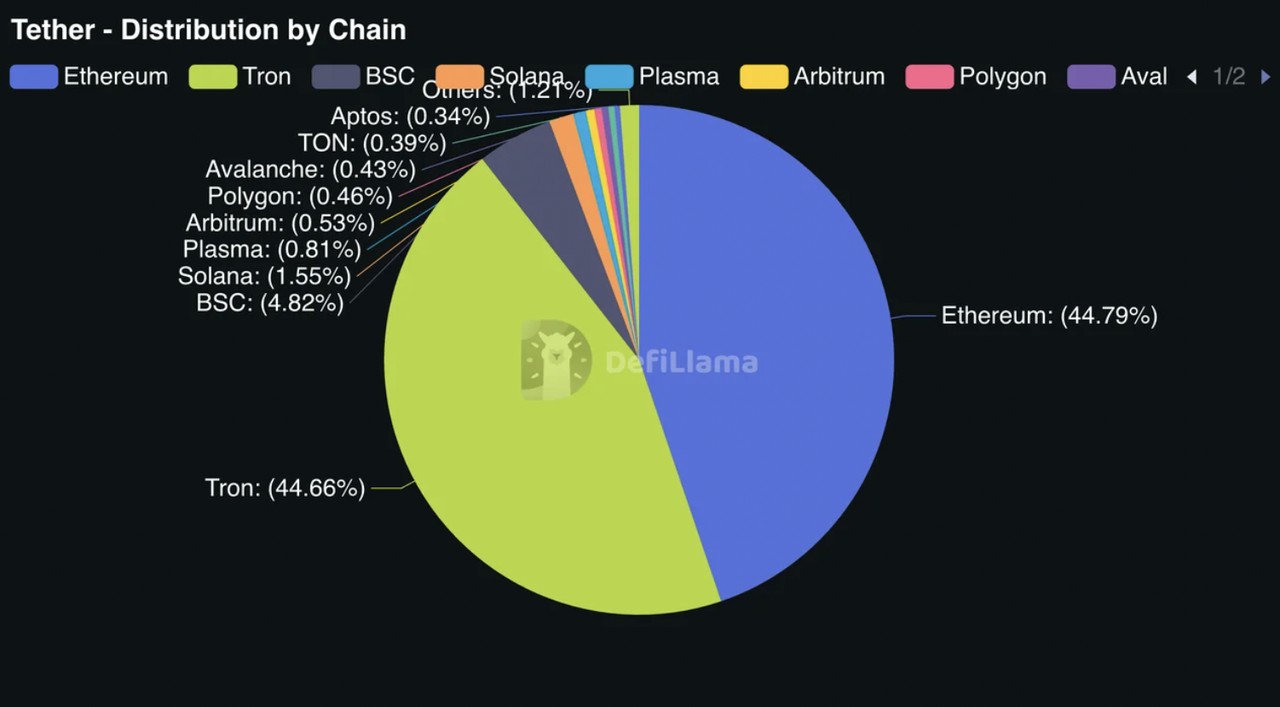
Tether market cap across leading blockchains | Source: DefiLlama
USDT is Tether’s flagship stablecoin and the most widely used digital dollar in crypto markets. With a market capitalization of roughly $186 billion and average daily trading volume exceeding $90 billion, USDT functions as the default settlement asset across centralized exchanges, derivatives platforms, and many DeFi markets. It is commonly used as a quote currency, for example, BTC/USDT, for exchange collateral, and for cross-border value transfers, especially in emerging markets where access to U.S. dollars is limited.
USDT (Tether) is a dollar-pegged stablecoin issued by Tether Holdings. As of May 2026, it remains the largest and most widely used stablecoin globally. It is designed to maintain a 1:1 peg with the US dollar through reserves held by the issuer. Instead of relying on algorithms, USDT uses reserves of cash, U.S. Treasuries, gold, and other assets to back each token in circulation. This makes it a preferred tool for traders seeking stability during volatile market conditions and for users needing fast global transfers.
A core aspect of USDT is its multi-chain availability, operating on Ethereum, Solana, Tron, and many other networks for maximum accessibility and low fees. USDT’s dominance comes from scale and liquidity, not regulatory positioning. It operates globally across multiple blockchains and jurisdictions, making it highly efficient for trading and payments, but it is not structured as a U.S.-bank-issued stablecoin under a dedicated federal framework.
Read more: What Is USDT TRC‑20, Tether Stablecoin on the TRON Network?
How Does USDT Stablecoin Work?
USDT works by maintaining reserves that match or exceed the circulating supply. When users deposit fiat or equivalent assets, Tether mints new USDT tokens. When users redeem USDT, tokens are burned and reserves are released. This mechanism, combined with market arbitrage, helps keep the peg stable. Tether regularly publishes attestations showing reserve composition.
As of May 2026, Tether's reserves include a significant portion in U.S. Treasuries and gold, providing both stability and transparency. The process is non-custodial for users while the issuer handles reserve management under regulatory oversight.
USDT Audits and Gold-Backing
Tether has significantly improved transparency in 2026 with quarterly attestations from reputable firms. These reports confirm that USDT is backed by high-quality assets, including U.S. Treasuries and physical gold holdings. Gold backing adds an extra layer of trust, especially during periods of fiat uncertainty. While full independent audits are still evolving, the current attestation process provides substantial visibility into reserves. This has helped strengthen market confidence and differentiate USDT from less transparent stablecoins.
Read more: What Is USAT (USA₮), Tether’s U.S.-Based Stablecoin Built for GENIUS Act Compliance?
What Are the Pros and Cons of USDT?
USDT offers numerous advantages including stability during market volatility, multi-chain support for fast transactions, and widespread acceptance across exchanges and DeFi platforms. It serves as an excellent medium for remittances in emerging markets and as collateral in lending protocols. Users can earn competitive yields on holdings through integrated platforms. Its deep liquidity makes it ideal for trading pairs and hedging. Overall, USDT provides reliability, accessibility, and utility that few other assets can match in crypto space.
Strengths of USDT
- Deep Liquidity Across Markets: USDT is the most traded stablecoin on major exchanges and DEXs. Whether you're using BingX, Uniswap, or dYdX, USDT is likely the default quote currency. Its massive volume ensures tight spreads and fast execution for traders.
- Multichain Compatibility: Tether supports more than 10 blockchain networks, including Ethereum (ERC-20), Tron (TRC-20), Solana (SPL), Polygon, TON, Avalanche, and Algorand. This flexibility makes it easy to move USDT between ecosystems and avoid high gas fees.
- Popular in Emerging Markets: In countries facing inflation, capital controls, or banking restrictions, USDT has become a go-to tool for preserving dollar value. It's widely used in peer-to-peer (P2P) trading, cross-border remittances, and off-exchange settlements in regions like Latin America, Africa, and Southeast Asia.
- Growing Financial Role: Tether is expanding beyond stablecoins. It now holds a large Bitcoin and gold treasury, participates in Bitcoin mining, and has launched new initiatives to support financial inclusion in developing markets.
Weaknesses and Concerns of USDT Stablecoin
- Limited Transparency on Reserves: Although Tether publishes regular attestations and monthly breakdowns of its reserve composition, it still does not undergo a full independent financial audit by a top-tier global auditing firm. This lack of comprehensive external verification continues to raise questions about the exact quality, liquidity and composition of its backing assets, particularly during periods of market stress or large-scale redemptions.
- History of Regulatory Fines: In 2021, the CFTC fined Tether $41 million for misleading statements regarding full dollar backing. While Tether has since improved its reporting practices, the past controversies continue to influence perceptions of the issuer’s credibility among some investors and regulators.
- Centralized Control: USDT is issued and managed by a private company (Tether Holdings). The issuer retains the ability to freeze or blacklist addresses, which has sparked ongoing debates about decentralization, censorship resistance, and user sovereignty — especially among DeFi users and privacy advocates.
- Peg Risk in Extreme Scenarios: Although USDT has maintained its peg remarkably well through multiple market cycles, concerns remain about its resilience during a severe liquidity crisis or mass redemption event. Without public stress testing results or clearer redemption processes, some analysts worry about potential temporary depegs or delays in converting large volumes back to fiat.
Tether remains the most widely used stablecoin for a reason: it’s fast, accessible, and highly liquid. However, its centralized structure, partial transparency model, and past regulatory issues mean users should weigh convenience and deep liquidity against these ongoing risks, particularly in high-stakes or volatile market conditions.
USDT vs. USDC: Key Differences
USDT and USDC are both major dollar-pegged stablecoins, but they differ in several ways. USDT offers broader multi-chain availability and higher liquidity in many markets. USDC, issued by Circle, emphasizes stronger regulatory compliance and more frequent full audits. While USDC is often viewed as more transparent by institutions, USDT maintains a larger market share and deeper integration across trading pairs. Both are essential, but USDT’s scale and yield opportunities make it particularly popular among retail traders and DeFi users.
Read more: USDC vs. USDT: Key Differences and Which Stablecoin to Choose in 2026?
What Are the Tokenomics of USDT?
USDT is issued by Tether with no fixed maximum supply. New tokens are minted based on demand and burned upon redemption. Each USDT aims to be backed 1:1 by reserves including cash equivalents, Treasuries, and gold. Tether publishes regular attestations to maintain transparency. The token’s value relies on the issuer’s reserve management and market confidence in the peg.
Read more: What to Know About the U.S. GENIUS Act as Stablecoins Soar Above $260 Billion
How to Buy Tether (USDT) on BingX
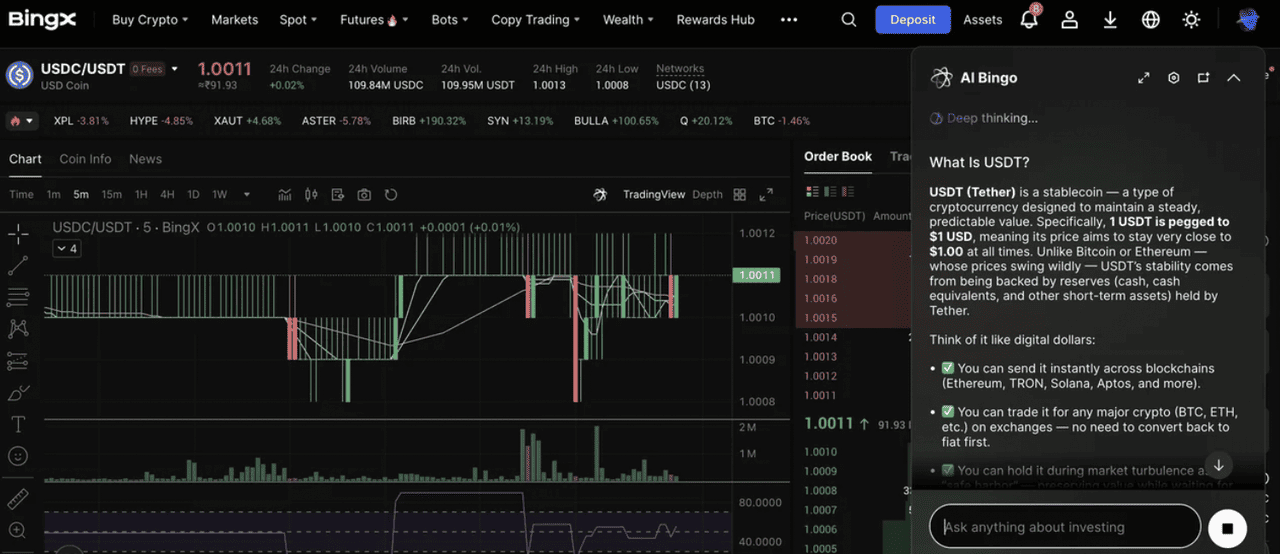
USDC/USDT trading pair on the spot market powered by BingX AI insights
On BingX, USDT is the primary global-exposure stablecoin, widely used for spot and futures trading, hedging, and value transfer.
- Create an account & verify – Sign up on BingX and complete identity verification to unlock deposits, trading, and withdrawals.
- Fund your account – Add funds via fiat on-ramps (cards, bank transfers, local rails where supported) or deposit crypto from an external wallet.
- Get USDT – Use Spot Trading to trade pairs like USDC/USDT, Convert for direct swaps to USDT, or P2P, where available, to acquire USDT at market prices.
- Use USDT – Trade spot or futures pairs, manage risk, or transfer USDT across supported networks for low-cost, 24/7 settlement.
Learn more about how to buy USDT in our comprehensive guide.
In practice: USAT access is selective and compliance-first; USDT on BingX offers immediate, deep liquidity and broad utility across trading and transfers.
Conclusion: Why You Should Trade USDT on BingX
USDT remains the most widely used stablecoin in 2026 thanks to its liquidity, multi-chain support, and role as a bridge between traditional finance and crypto. With improved reserve transparency, gold backing, and yield opportunities, it continues to serve as a stable foundation for trading, remittances, and DeFi.
BingX serves as the top choice for trading USDT, offering deep liquidity, low fees, and seamless integration for both spot and futures markets. Whether protecting against volatility, executing fast trades, or earning yield, BingX enables efficient and secure management of USDT holdings. As the crypto market matures, holding and trading USDT on reliable platforms like BingX provides users with stability, flexibility, and confidence in navigating both bull and bear markets.
