
The stablecoin landscape in 2026 is undergoing a massive infrastructural shift. For years, using digital dollars meant dealing with fragmented liquidity networks, fluctuating gas costs, and the clunky user experience of holding secondary volatile tokens like ETH, POL, or SOL just to move your money.
The launch of StableChain, a specialized Layer 1 blockchain backed heavily by Tether and Bitfinex, introduces a ground-up reconstruction of the payment stack. At the heart of this network is USDT0, Tether’s official omnichain stablecoin standard. Unlike traditional stablecoins that sit passively inside smart contracts on general-purpose networks, USDT0 is integrated directly into StableChain as the native gas and settlement currency.
This guide breaks down exactly what USDT0 is, how it utilizes LayerZero’s Omnichain Fungible Token (OFT) standard, and how it fundamentally differs from the traditional USDT and USDC models you use today.
What Is USDT0 on Stable and How Does It Work?
USDT0 is Tether’s official canonical omnichain stablecoin standard. It operates as a dual-role asset on StableChain, a specialized Layer 1 blockchain optimized for monetary settlement. Utilizing LayerZero’s OFT standard, USDT0 is pegged 1:1 with traditional USDT and maintains a unified global liquidity pool across more than 20 supported blockchains.
Unlike traditional deployments where stablecoins function as passive ERC-20 assets, StableChain integrates USDT0 directly into its base protocol architecture. It simultaneously serves as the network's native gas asset, calculated with 18-decimal precision, and a standard ERC-20 token with 6-decimal precision, entirely eliminating multi-token complexity and the need for users to hold separate volatile assets like ETH or SOL to fund transaction fees.
Mechanically, USDT0 bypasses traditional, risk-heavy bridging infrastructure by deploying a native burn-and-mint architecture via the OFT Mesh, allowing zero-slippage cross-chain transfers. On-chain execution features single-slot deterministic finality with block times of roughly 0.7 seconds, processing high-volume flows through a parallelized, protocol-level USDT Transfer Aggregator pipeline.
The system automatically reconciles the 12-digit precision gap between its native and ERC-20 interfaces, moving micro-fractions to a dedicated reserve address. Because the asset's native balance can decrease externally through standard allowance-based trasnferFrom or permit operations without triggering contract code, developers must bypass internal variables and enforce solvency against real balances via address(this).balance immediately before execution.
Why Traditional Stablecoins Face an Infrastructure Gap
To understand why USDT0 represents an evolution, we must look at the limitations plaguing traditional stablecoin deployments on general-purpose blockchains. Blockchains like Ethereum or Solana were built for broad computational flexibility (DeFi, NFTs, smart contracts) rather than pure monetary settlement. This introduces structural barriers to global payments:
- Gas Token Friction: To send traditional USDT or USDC, a user must maintain a completely separate, volatile asset, e.g., ETH, to pay the network's gas fees. This 'multi-token complexity' destroys mainstream retail and merchant adoption.
- Unpredictable, Fluctuating Fees: Stablecoin transfers on traditional networks share blockspace with speculative token launches and complex smart contract actions. When network traffic spikes, transaction fees escalate unpredictably.
- Fragmented Liquidity Across Chains: Traditional stablecoins are siloed. If you hold native USDT on Tron, you cannot seamlessly spend it on an Ethereum Layer 2 without navigating third-party bridges, incurring extra costs, and absorbing smart contract risks.
How Does USDT0 Work: The Specialized Fuel of StableChain
On StableChain, USDT0’s functionality is taken a step further. StableChain strips away general-purpose friction to make digital dollars operate with the speed of a traditional card payment network. Within this ecosystem, USDT0 fulfills a dual-role identity:
- The Native Gas Asset: Built into the base protocol layer with 18-decimal precision. All transaction fees are calculated and paid directly in USDT0.
- The Standard ERC-20 Token: Built with 6-decimal precision, allowing it to seamlessly plug into all standard EVM smart contracts, DEXs, and decentralized applications without rewrites.
By unifying balances under a single stable unit of account, users can interact exclusively in dollars, effectively erasing the concept of crypto gas from the end-user experience.
USDT0 vs. USDT and USDC: How USDT0 Compares to Traditional Stablecoins
The distinction between USDT0 and traditional digital dollars isn't just a matter of branding; it's an architectural rewrite. Below is an exhaustive look at how USDT0 on Stable compares to traditional iterations of USDT and USDC in 2026.
|
Feature |
USDT0 (on Stable) |
Traditional USDT (Tether) |
USDC (Circle) |
|
Primary Structural Standard |
LayerZero Omnichain Fungible Token (OFT) |
Chain-Specific Native / Bridged Configurations |
ERC-20 / Native App Chains via CCTP |
|
Gas Fee Requirement |
Paid directly in USDT0 (No second token required) |
Paid in the host chain's native token (ETH, TRX, SOL) |
Paid in the host chain's native token (ETH, MATIC, AVAX) |
|
Settlement Speed |
Sub-second finality (Deterministic single-slot blocks) |
Variable (12s on Ethereum, multiple block confirmations) |
Variable (Dependent on underlying host chain structure) |
|
Liquidity Layout |
Unified global supply across 20+ supported chains |
Fragmented across isolated chain contracts |
Fragmented across ecosystems, partially bridged via CCTP |
|
Enterprise Infrastructure |
Built-in guaranteed blockspace & parallel batching |
Requires external middleware / custom configurations |
Requires custom institutional settlement layers |
The structural matrix of digital fiat settlement reveals a stark evolutionary divide between older-generation stablecoins and USDT0 on StableChain. Traditional USDT and USDC operate as passive application-layer assets bound by the constraints of their host blockchains, which results in fragmented liquidity and severe fee friction. To move traditional assets, users face multi-token complexity, requiring volatile gas tokens like ETH, SOL, or AVAX to cover variable fees on networks with fluctuating congestion.
In contrast, USDT0 collapses this friction by utilizing LayerZero's OFT standard to unify liquidity across more than 20 supported chains. By integrating directly into StableChain's base protocol layer as a dual-role asset, USDT0 functions natively as both the transaction medium and the network fee asset. This architectural choice delivers absolute cost predictability, entirely eliminating the need for secondary gas tokens or speculative priority fee bidding.
From a practical performance standpoint, the operational metrics of USDT0 redefine enterprise-grade payment infrastructure. While traditional USDT and USDC settlement speeds are throttled by the underlying host chain, often requiring multiple block confirmations over 12 seconds to several minutes to guarantee finality, USDT0 achieves deterministic, single-slot finality with sub-second block times of roughly 0.7 seconds.
For institutional scale, traditional stablecoins rely on external middleware or custom settlement layers like Circle's CCTP. USDT0, however, leverages built-in protocol-level infrastructure. This includes Guaranteed Blockspace to insulate mission-critical enterprise flows from public network congestion, alongside a parallelized USDT Transfer Aggregator pipeline that batches high-volume payouts with isolated account-failure fault tolerance.
3 Core Differentiators: How USDT0 Changes the Payment Stack
The architectural divergence of USDT0 on StableChain introduces a fundamental overhaul of the traditional payment rail, shifting stablecoins from passive smart contract assets into highly optimized, native economic drivers.
1. The Dual-Role Asset Engine
On a standard EVM chain like Ethereum, address(user).balance reads your native ETH balance, while querying a smart contract contract reads your ERC-20 token balance. On StableChain, both interfaces point to the exact same underlying pool of money.
The network’s internal MonoEVMAnteHandler automatically reconciles the 12-digit precision gap between the 18-decimal native gas asset and the 6-decimal ERC-20 representation. For developers, this allows an external transferFrom or permit invocation to draw from a contract's native balance without needing explicit wrapping/unwrapping steps like swapping ETH for WETH.
2. Elimination of Priority Fee Bidding
Traditional blockchains use a fee market where users bid against each other with priority tips to get their transactions processed first by validators. StableChain implements a flat, single-component EIP-1559 fee model. On Stable, the parameter maxPriorityFeePerGas is ignored and always drops to 0. Transaction ordering is determined by the protocol's base fee, creating complete fee predictability for individuals and institutional treasury managers alike.
3. Native Enterprise Safeguards
Because StableChain was built strictly for monetary settlement, it embeds institutional utilities directly into its base architecture, rather than forcing companies to build complex workarounds:
- Guaranteed Blockspace: Enrolled enterprise partners secure pre-allocated capacity within every block. Mission-critical payments settle with unyielding latency and cost, entirely insulated from general public network congestion.
- USDT Transfer Aggregator: High-volume commercial payouts, such as payroll runs, are organized into parallelized MapReduce pipelines at the protocol level. Individual account payment failures are isolated, meaning one bad transfer won't break or halt the broader batch execution.
- Confidential Transfers: Leveraging zero-knowledge cryptography, Stable is rolling out protocol-layer privacy structures that safely mask transaction values while preserving backend auditability and compliance reporting features.
Critical Realities for Smart Contract Developers
While Stable maintains full EVM compatibility, allowing you to port Solidity or Vyper code using standard tools like Hardhat and Foundry, the dual-role behavior of USDT0 introduces vital changes to standard smart contract assumptions.
The USDT0 Migration Checklist
If you are porting decentralized applications from Ethereum to Stable, you must audit your code against these protocol behaviors:
- Do Not Mirror Native Balances: On Ethereum, tracking user deposits inside an internal state variable, e.g., deposited += msg.value, is safe. On Stable, this is highly dangerous. Because external ERC-20 transferFrom calls can deplete the contract's native balance externally without invoking contract code, internal tracking variables can diverge. Always verify solvency using direct address(this).balance checks before processing payouts.
- Zero-Address Transfers Revert: On StableChain, all native and ERC-20 transfers to address(0) strictly revert. If your protocol utilizes zero-address transfers as a token burn mechanism, your logic must be redesigned around an explicit sink contract.
- Filter Fractional Reconciliation Events: To reconcile the decimal precision gap during transfers, the protocol moves fractional micro-amounts to and from a specialized reserve address. This emits auxiliary Transfer events. Off-chain indexers replaying logs must explicitly filter this reserve address to prevent double-counting balances.
How to Trade Stable (STABLE) on BingX
Leveraging its position as a leading Web3-AI company in 2026, BingX integrates advanced AI-driven liquidity orchestration and predictive analytics to ensure deep order book depth and minimal slippage when trading the STABLE token.
Buy, Sell, or HODL STABLE on Spot Trading
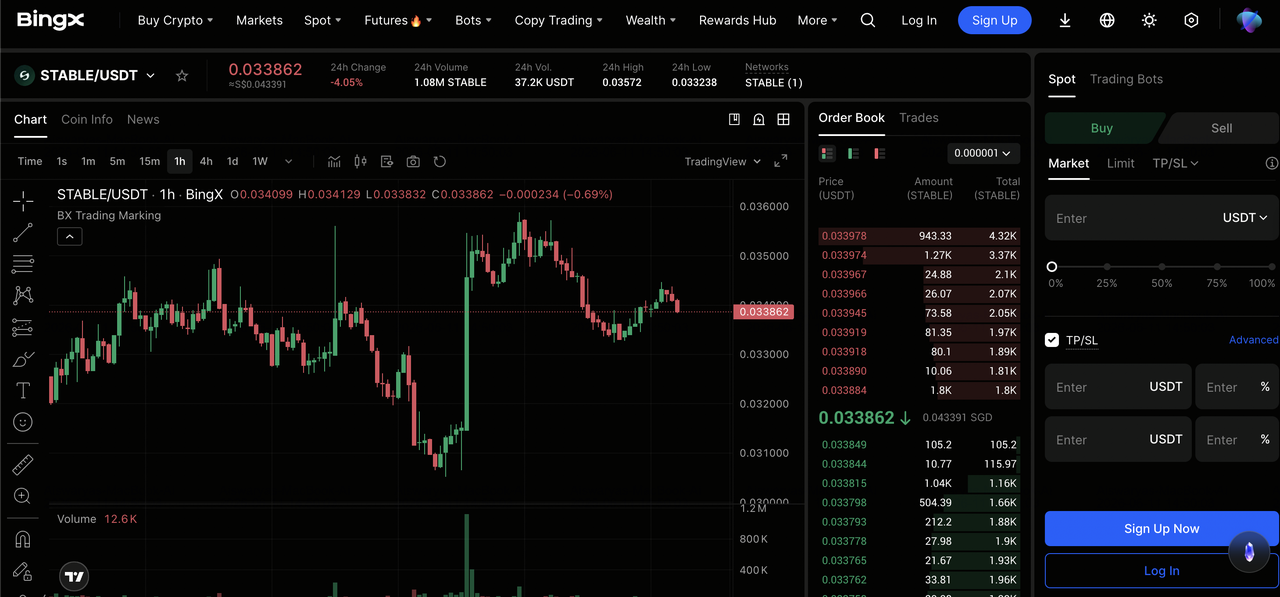
STABLE/USDT trading pair on BingX spot market
- Deposit or Convert Assets: Log into your BingX account and ensure your Fund Account holds USDT; alternatively, use the zero-fee Convert tool to instantly swap other crypto holdings into the required trading pair base asset.
- Navigate to the Spot Terminal: Go to the top navigation bar, select Trade, and click on Spot. Search for the STABLE/USDT pair in the asset selection menu.
- Analyze and Configure Your Order: Review the real-time AI-optimized chart indicators and select your preferred order type, Market Order for instant execution at the best available global price, or Limit Order to specify a precise entry price.
- Execute the Trade: Input the total amount of STABLE tokens you wish to acquire or sell, double-check your parameters, and click Buy STABLE or Sell STABLE to route your transaction directly into BingX's high-speed matching engine
Long or Short STABLE with Leverage on Futures Trading
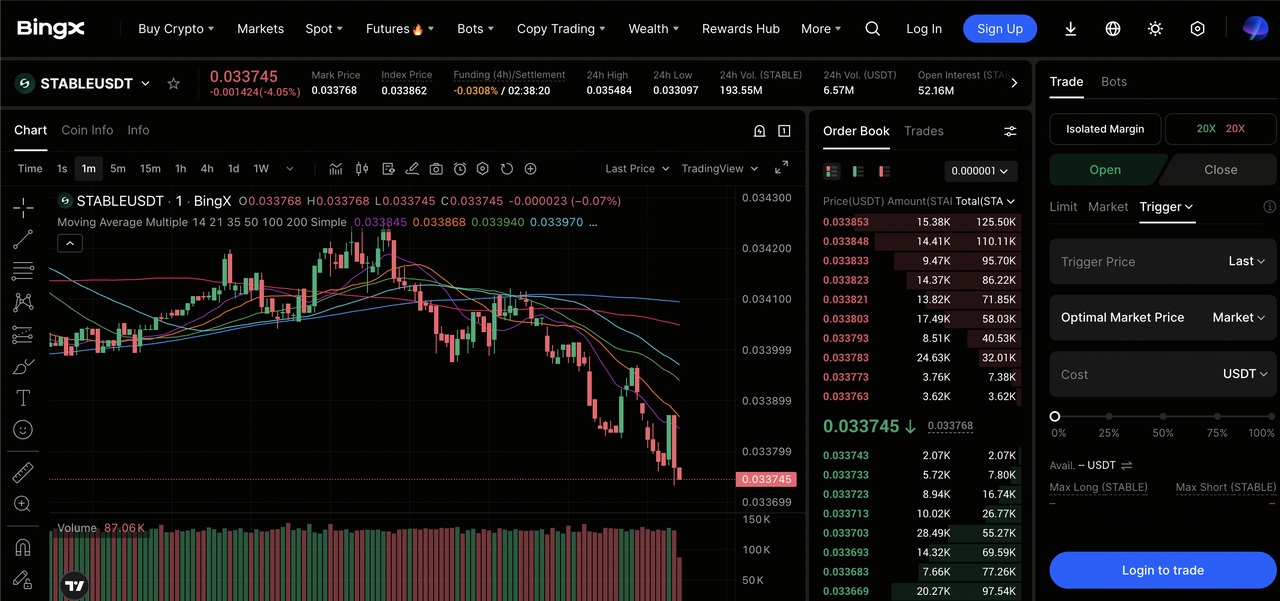
STABLE/USDT perpetual contract on BingX futures market
- Transfer Margin to Your Futures Account: Navigate to your wallet interface and transfer your USDT0 or USDT collateral from your Fund Account over to your Perpetual Futures Account.
- Open the Derivatives Terminal: Hover over Futures in the main menu and select Perpetual Futures, then utilize the asset search bar to open the STABLE-USDT contract terminal.
- Adjust Leverage and Margin Mode: Select your risk structure by switching between Isolated Margin to confine liability to a single position or Cross Margin to share risk across your entire balance, and use the slider to set your desired leverage multiplier.
- Set Risk Parameters and Deploy: Choose your entry style (Limit, Market, or Trigger), and explicitly define your Take-Profit (TP) and Stop-Loss (SL) boundaries to mitigate automated market volatility. Click Open Long if your BingX AI sentiment analysis indicates an upward trajectory, or Open Short to profit from a downward market shift.
Moving Into the Stable Ecosystem
For users wanting to interact with the network, onboarding is streamlined via two distinct routing paths that both deliver clean, unfragmented USDT0 straight to your wallet:
- The OFT Mesh: If you hold USDT0 on any of the 21 LayerZero-supported chains like Arbitrum, Optimism, Base, or Polygon, your cross-chain transfer uses a clean burn-and-mint mechanism. The token is burned on the source network and minted on Stable at an exact 1:1 ratio with zero slippage.
- The Legacy Mesh: If your assets sit as native USDT on legacy networks like Tron or TON, the transfer routes seamlessly through an automated hub-and-spoke pool on Arbitrum. The process is fully managed behind the scenes by a permissionless MultiHopComposer smart contract, charging a flat 0.03% protocol fee on the transferred amount.
Final Thoughts: Is Stable's USDT0 the Future of Digital Fiat Settlement?
USDT0 on Stable represents the transition of stablecoins from speculative trading collateral into true, programmable utility money. By building an isolated, dedicated Layer 1 network and establishing a dollar-pegged asset as the network fuel, Tether and StableChain have eliminated the gas friction and cost unpredictability that historically throttled corporate adoption.
For retail users, sending payments becomes as intuitive as traditional mobile banking apps. For enterprise operators, the introduction of predictable costs, deterministic single-slot finality, and guaranteed blockspace transforms public blockchains into institutional-grade global settlement rails.
Risk Reminder: Digital asset prices and network integrations are subject to market risks. Always verify your wallet configurations and destination contract addresses before initiating cross-chain transfers to ensure secure asset management.
Related Reading
- What Is Stable (STABLE) Stablechain Powering the Future of USDT Payments?
- A Beginner's Guide to Stablecoins and How They Work (2026)
- What Are the Best Stablecoins to Have in Your Portfolio in 2026?
- USDC vs. USDT: Key Differences and Which Stablecoin to Choose in 2026?
- USAT vs. USDT: Which Tether Stablecoin Should You Use in 2026?
FAQs on USDT0 and StableChain (STABLE)
1. Do I need to buy a separate crypto token to pay for gas fees on Stable?
No. StableChain completely removes gas token friction. All network transaction fees are calculated and paid directly out of your existing USDT0 balance.
2. Can I use my standard MetaMask wallet to interact with USDT0?
Yes. Stable is fully EVM-compatible. You can interact with the mainnet using your existing Ethereum tools, developer suites, and Web3 wallets by simply pointing your software to the Stable Mainnet RPC endpoint and Chain ID (988).
3. What is the difference between USDT0 and the STABLE token?
USDT0 is the dollar-denominated token used for all consumer transactions, commercial payments, and gas fees. The STABLE token is a separate, fixed backend utility asset used strictly by validators for network security staking, consensus participation, and protocol governance voting. Staking STABLE enables holders to earn a share of the USDT0 gas fees generated by the network.
