

Velvet (VELVET) is a self-custodial onchain trading ecosystem that combines market discovery, AI-assisted research, and multi-chain execution. Its documentation describes VelvetX as the flagship SocialFAI app, with 13M+ indexed wallets, while CoinMarketCap’s project profile reports 100k+ users and 10k+ vaults as of August 2026. Instead of separating wallet analysis, trade discovery, and execution across distinct tools, Velvet aims to bring those workflow stages into one interface. It sits at the intersection of DeFi, onchain trading, and AI-assisted execution.
Velvet’s documentation, updated in July 2026, distinguishes VelvetX, an invite-only flagship app, from the earlier Trading Terminal, which remains publicly accessible. The ecosystem has four core parts: VELVET is the coordination token, Velvet Unicorn is the multi-agent AI framework, the terminal supports trading and DeFi positions, and onchain vaults support shared portfolios. This guide explains what Velvet is, how the platform works, how VELVET tokenomics function, the main risks to consider, and how to trade VELVET on BingX.
What Is Velvet (VELVET)?
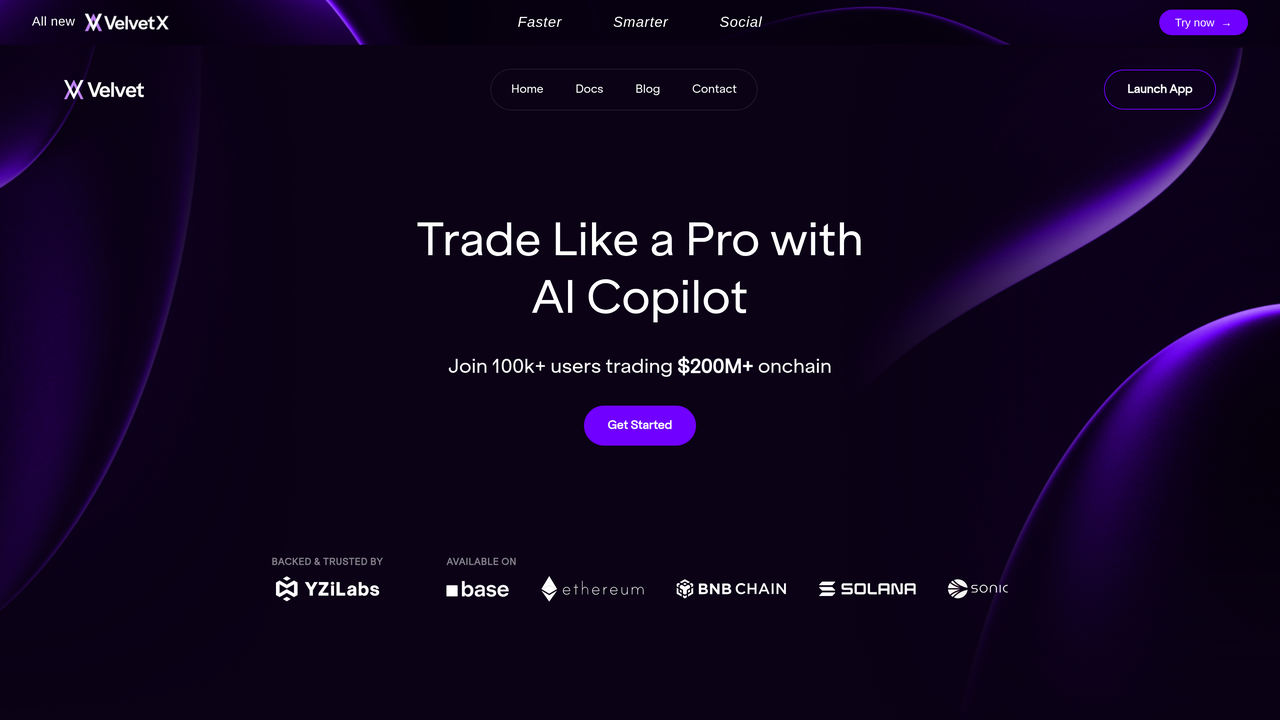
Velvet is a BNB Smart Chain-native token ecosystem connected to a multi-chain, wallet-based trading product. The official documentation describes a consumer trading app, an AI framework, onchain vaults, and white-label infrastructure as one SocialFAI stack. VelvetX combines cross-chain spot and perpetual trading, wallet and KOL tracking, a social feed, and an AI copilot, although it is documented as invite-only early access as of August 2026.
VELVET is the ecosystem’s main coordination token. Staking VELVET creates veVELVET, which is used for emissions rewards, fee-discount tiers, increased Gem reward rates, designated-pair utility for Velvet-created assets, and access to the AI copilot. The project’s reported user and vault figures are project-profile metrics rather than independently audited active-user counts.
The core idea behind Velvet is simple: traders can research onchain activity, prepare a transaction, and keep signing authority in their own wallet.
Key components of the Velvet ecosystem include:
- VelvetX: The flagship SocialFAI application combines social intelligence, wallet tracking, AI analysis, and cross-chain execution in an invite-only interface.
- Trading Terminal: The public terminal supports wallet-based spot, perpetuals, yield positions, and advanced order tools across its documented networks.
- Velvet Unicorn: The multi-agent framework routes research, token analysis, wallet analysis, and user-directed execution requests to specialist workflows.
- Onchain Vaults: Vault contracts let managers and depositors use transparent smart-contract portfolios while assets remain non-custodial.
How Does Velvet Work?
Velvet works as a multi-chain trading and portfolio interface whose execution, research, and incentives are coordinated through connected wallets, the Velvet Unicorn framework, and the VELVET token.
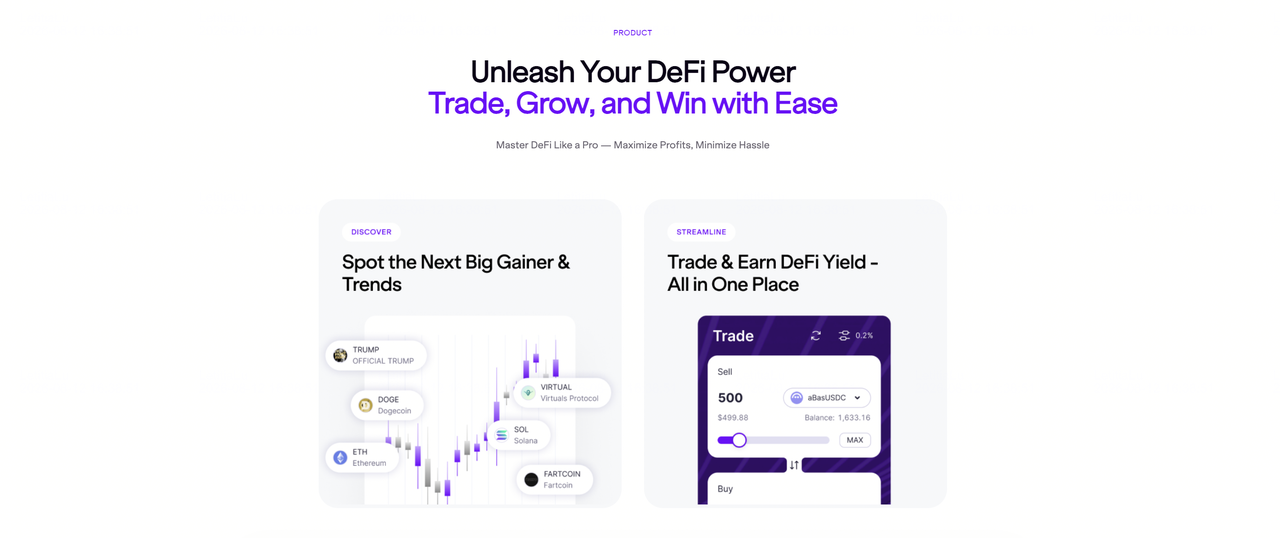
- Wallet-based access: Users connect a wallet rather than depositing assets into Velvet. The terminal documentation states that spot trades, perpetuals, and DeFi-pool access can be used directly from the wallet.
- Market discovery: VelvetX and the terminal organize market views, wallet activity, social inputs, and token-level information to help users identify opportunities before trading.
- AI-assisted analysis: Velvet Unicorn routes requests across token, wallet, swap, trending, sentiment, and fundamentals workflows. Its outputs are tools for research and execution, not investment advice.
- Transaction preparation: For supported swaps, the AI workflow resolves an instruction into a quote and returns a ready-to-sign transaction. The user controls whether to sign and submit that transaction.
- Perpetual and portfolio workflow: Velvet integrates Hyperliquid for perpetual trading within the terminal and shows token, perpetual, and DeFi positions in a unified wallet view.
Velvet vs. Hyperliquid: What Are the Key Differences for Onchain Traders?
Velvet and Hyperliquid belong in the same reader decision because both can be part of an onchain perpetual-trading workflow. This comparison is useful because Velvet focuses on discovery, interface aggregation, and user-directed execution, while Hyperliquid provides blockchain-level trading infrastructure and order books. They differ in product scope, execution role, and how VELVET relates to the user experience.
|
Comparison |
Velvet |
Hyperliquid |
|
Core model |
SocialFAI trading application, AI framework, vault infrastructure, and execution interface. |
Layer 1 blockchain with HyperCore order books and HyperEVM smart-contract infrastructure. |
|
Main users |
Wallet-based traders, researchers, communities, and teams building branded trading apps. |
Traders and builders using onchain spot, perpetual, and application infrastructure. |
|
Token demand |
VELVET staking unlocks veVELVET utility, reward tiers, fee discounts, and designated-pair functions. |
This comparison describes Hyperliquid’s execution stack, not a VELVET utility model. |
|
Main use case |
Discover, analyze, and prepare or execute trades from a connected wallet. |
Run fully onchain order-book trading and build applications using its native infrastructure. |
|
Main advantage |
Combines social, AI, routing, and portfolio tools in one product surface. |
Provides specialized blockchain and order-book infrastructure for onchain markets. |
|
Main tradeoff |
Users must evaluate routing, AI-output quality, supported-network scope, and smart-contract exposure. |
Users still need an application or workflow layer for research, wallet intelligence, and cross-protocol management. |
Velvet focuses on the trader-facing workflow, while Hyperliquid focuses on execution infrastructure. The choice depends on whether users prioritize an integrated research-and-trading interface or direct access to a dedicated onchain trading stack.
Read More : What Is Hyperliquid (HYPE) Decentralized Perpetual Exchange: A Complete Guide
What Are the Velvet (VELVET) Tokenomics?
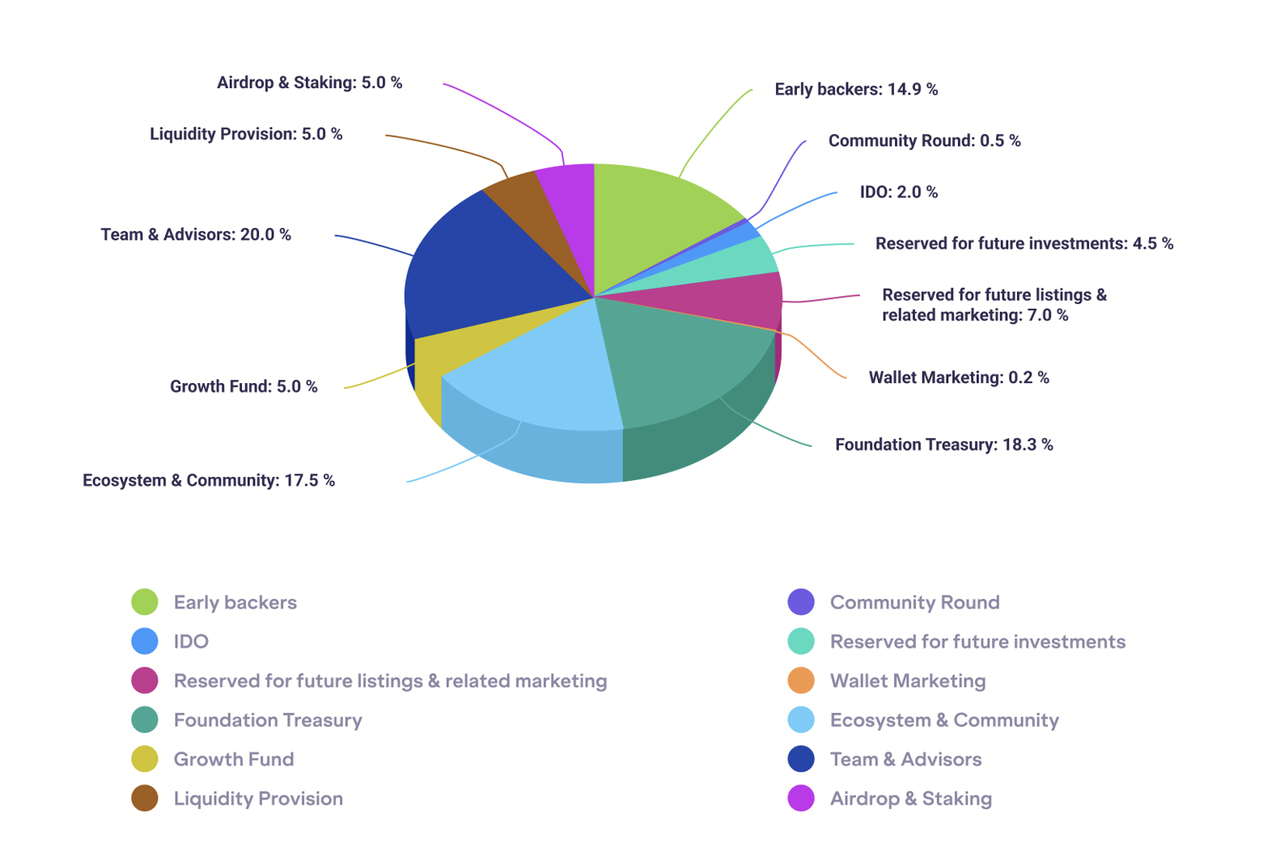
VELVET tokenomics center on veVELVET locking, category-specific launch allocations, and utility tied to activity and staking. The official documentation uses rounded allocation figures that sum to approximately 99.73%, so the chart and grouped figures below preserve that disclosed rounding rather than silently normalizing it.
VELVET Token Utility and Supply Mechanisms
- veVELVET locking: Users can stake VELVET to receive vote-escrowed veVELVET. The documented lock range is one week to 200 weeks, with a longer lock producing more veVELVET and balances decaying toward expiry.
- Staking rewards: veVELVET holders can receive VELVET emissions rewards from the Airdrop and Staking Rewards allocation fixed at token generation.
- Trading fee discounts: veVELVET and 30-day trading volume determine cashback tiers when using the platform.
- Gems and launchpad rewards: veVELVET can increase Gem reward rates, and Gems are used in the documented incentive design for launchpad daily runner drops.
- AI and pair utility: veVELVET provides access to the AI copilot, while VELVET is documented as a designated trading pair for Velvet-created assets and structured products.
VELVET Token Allocation
Source: Velvet Docs
- Treasury and Ecosystem: approximately 35.5%. This groups approximately 18% for the Foundation Treasury and approximately 17.5% for the ecosystem fund, both intended for DAO-managed operating, security, development, and ecosystem initiatives.
- Team and Advisors: 20%. The documentation reserves 20% for the team to align contributors with Velvet DAO’s long-term development.
- Early and Community: approximately 17.53%. This combines approximately 15% for early backers, approximately 0.53% for the Tachyon community round, and 2% for the Binance Wallet IDO.
- Rewards and Listings: 12%. This combines 5% for the initial airdrop and staking rewards with approximately 7% for future listings and related marketing.
- Growth and Liquidity: 10.2%. This combines 5% for the Growth Fund, 0.2% for wallet marketing, and 5% for liquidity provision.
- Future Investments: approximately 4.5%. The documentation reserves approximately 4.5% for future investments.
As of August 2026, VELVET supply dynamics depend on the release schedule for large treasury, ecosystem, team, and early-backer categories relative to staking demand and platform use. Investors should monitor official unlock disclosures, circulating-supply changes, veVELVET participation, and DAO decisions affecting future incentive allocations.
How to Trade Velvet (VELVET) on BingX
BingX offers two ways to gain exposure to Velvet. Spot trading is for users who want to buy and hold VELVET directly, while perpetual futures are for active traders who want long or short exposure to VELVET price movements.
Spot Trading: Buy and Own VELVET Directly
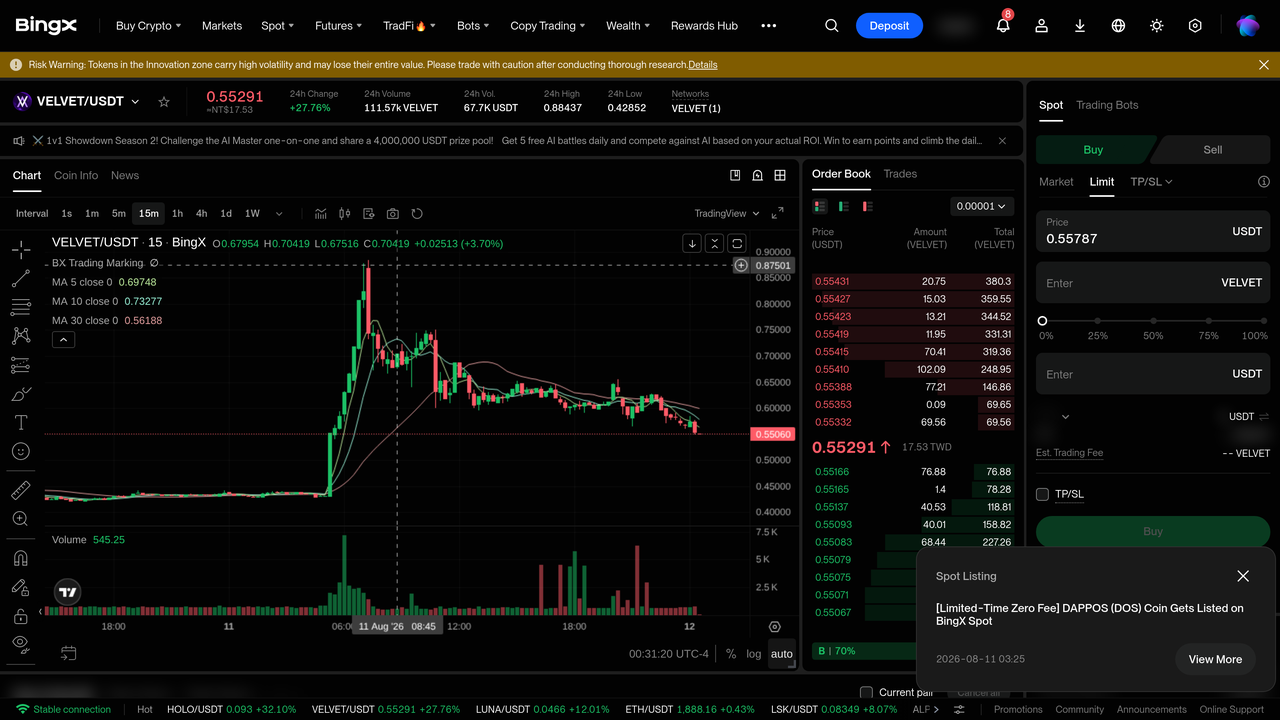
- Step 1: Account setup and security.Sign up and log into BingX, complete the identity verification (KYC) required in your region, and enable two-factor authentication.
- Step 2: Fund your spot account.Deposit USDT or another supported asset into the spot account.
- Step 3: Open the spot market. Search for the VELVET/USDT pair.
- Step 4: Choose an order type. Use a market order to buy VELVET at the available market price, or a limit order to set a target purchase price.
- Step 5: Manage your VELVET. After the order fills, VELVET appears in the spot account. It can remain on BingX or be withdrawn to a BNB Smart Chain-compatible self-custody wallet if withdrawals are supported on the relevant network.
Futures Trading: Trade VELVET Price Movements
BingX lists a USDT-margined VELVET perpetual. Because leverage can amplify both gains and losses, futures are intended for traders who understand liquidation and have a defined risk plan.
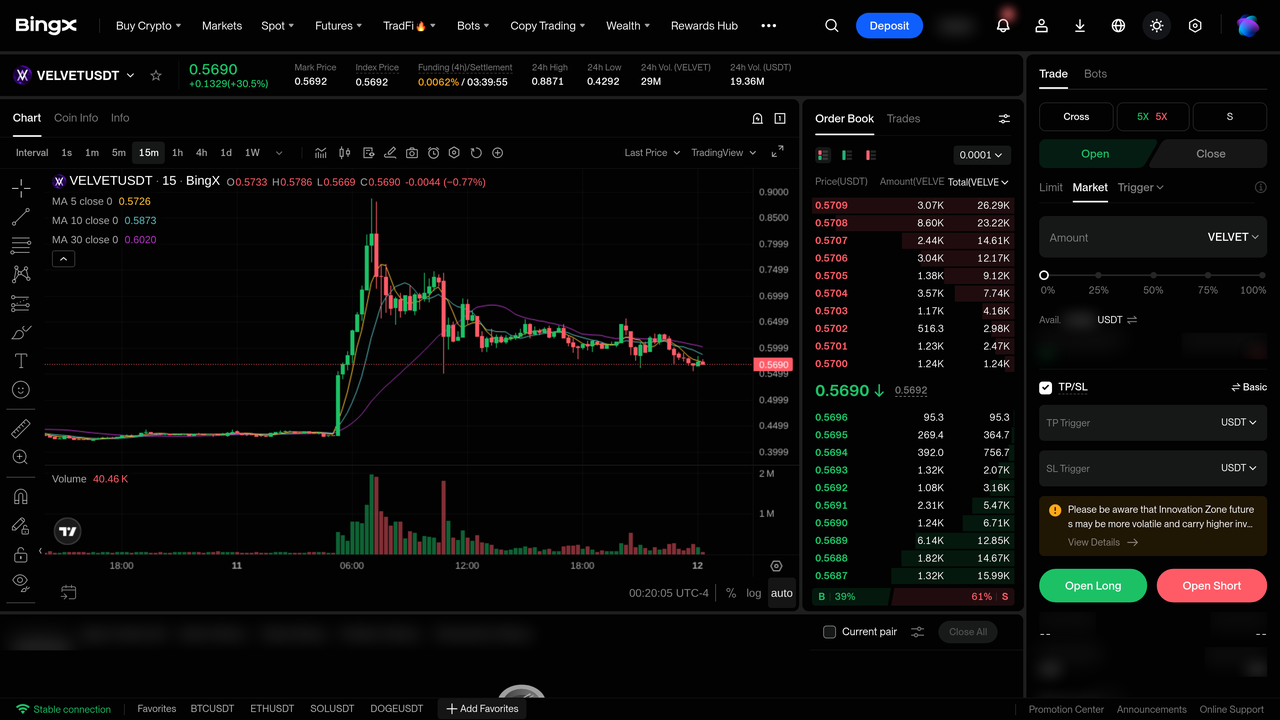
- Step 1: Transfer collateral. Move USDT from the spot account to the futures account, where it is used as margin.
- Step 2: Select the contract. Open the VELVET-USDT perpetual.
- Step 3: Set direction and leverage.Open long or short based on the trading thesis. Select leverage and position size within the defined risk limit.
- Step 4: Execute the trade. Enter the order amount and use a market or limit order according to the trading plan.
- Step 5: Manage risk. Set stop-loss and take-profit controls before or immediately after entry. Profit and loss settle dynamically in USDT.
6 Key Risks to Consider Before Investing in Velvet (VELVET)
Velvet’s investment case depends on whether its AI, discovery, and wallet-execution products can drive sustained demand for VELVET and veVELVET as the platform expands and token supply increases.
- Product access and execution risk: VelvetX remains in invite-only early access, while the older terminal is publicly available. Product availability, supported networks, routing quality, and user experience may change as development continues.
- AI output risk: Velvet’s AI tools can support research and transaction preparation, but users still need to verify token contracts, quotes, slippage, approvals, and transaction details before signing.
- Smart-contract and integration risk: Wallet-based trading, vaults, routing, bridges, and external execution layers introduce multiple technical dependencies. Problems in any connected layer could affect execution or funds.
- Supply and unlock risk: Large allocations to treasury, ecosystem, team, advisor, early, and community categories mean future unlocks and token distribution could create selling pressure.
- Governance and fee-policy risk: Onchain governance is still developing, and future changes to fee allocation or staking rewards have not been finalized. Holders should not assume future protocol-fee distributions.
- Volatility and liquidity risk: VELVET trades in BingX’s Innovation Zone and may experience sharp price swings. Lower liquidity can also increase slippage and execution costs.
Final Thoughts: Should You Invest in Velvet (VELVET) in 2026?
Velvet is a self-custodial trading and intelligence stack that joins multi-chain execution, onchain research, AI workflows, and token-gated incentives. Its 2026 story is anchored by VelvetX’s rollout, the public Trading Terminal, and the development of Velvet Unicorn’s agent and strategy tools.
VELVET may suit readers who want exposure to a platform token whose utility is linked to locking, fee tiers, rewards, AI access, and a trader-facing product, rather than readers seeking a pure execution-infrastructure asset. It does not suit readers who cannot evaluate smart-contract, unlock, AI-output, and high-volatility risks. For investors and traders, the most important metrics to watch are official unlock updates, veVELVET participation, product-access changes, trading and vault activity, supported-network scope, and governance proposals.
Related Reading
- What Is DeFi (Decentralized Finance)? 8 Types of DeFi Protocols to Know
- What Is Aave (AAVE) Crypto Lending: All You Need to Know in 2026
- What Are the Top 10 DeFi Lending Protocols to Watch in 2026?
- 7 Best Crypto Liquidity Mining Platforms to Watch in 2026
- What Is Social Trading? Trader Data, Community Signals, and Transparency in BingX Copy Trading
FAQs About Velvet (VELVET)
1. What makes Velvet different from other onchain trading projects?
Velvet combines a trader-facing application, wallet and social intelligence, an AI framework, onchain vaults, and white-label infrastructure. Its stated design keeps transaction initiation and signing under user control rather than placing assets in a custodial trading account.
2. What blockchain is VELVET on?
VELVET is issued on BNB Smart Chain at 0x8b194370825E37b33373e74A41009161808C1488. Users should verify the official contract address and supported network before transferring tokens.
3. Is VELVET’s supply allocation publicly disclosed?
Velvet publishes allocation categories and an emission-schedule graphic in its tokenomics documentation. Its published figures use approximations and total approximately 99.73%, so readers should follow official release and unlock disclosures rather than treating rounded categories as a precise live schedule.
4. Is Velvet DAO governance live?
As of August 2026, Velvet documents veVELVET as the planned voting mechanism for DAO governance, but says onchain governance voting is not yet live. Fee-allocation changes are likewise subject to a future governance and legal-review process.
5. Which wallets support VELVET?
VELVET can be stored in any BNB Smart Chain-compatible wallet, including MetaMask and other supported wallets. Users should always confirm they are using the correct network before transferring VELVET to avoid loss of funds.
