
DGrid AI (DGAI) is a decentralized AI inference network that gives developers one gateway for accessing models from multiple providers and distributed nodes. Instead of integrating each AI service separately, applications can send requests through DGrid, which routes them across available infrastructure based on factors such as availability, cost and performance. The network also records settlement on-chain and uses Proof of Quality to verify inference results.
DGrid currently provides access to more than 200 AI models through its marketplace and unified API. DGAI is the ecosystem token, while the broader platform combines the AI Gateway, distributed inference nodes, Proof of Quality and an open model marketplace where providers can list models and set pricing. This guide explains how DGrid AI works, how DGAI tokenomics are structured, the main risks to consider and how to trade DGAI on BingX.
What Is DGrid AI (DGAI)?
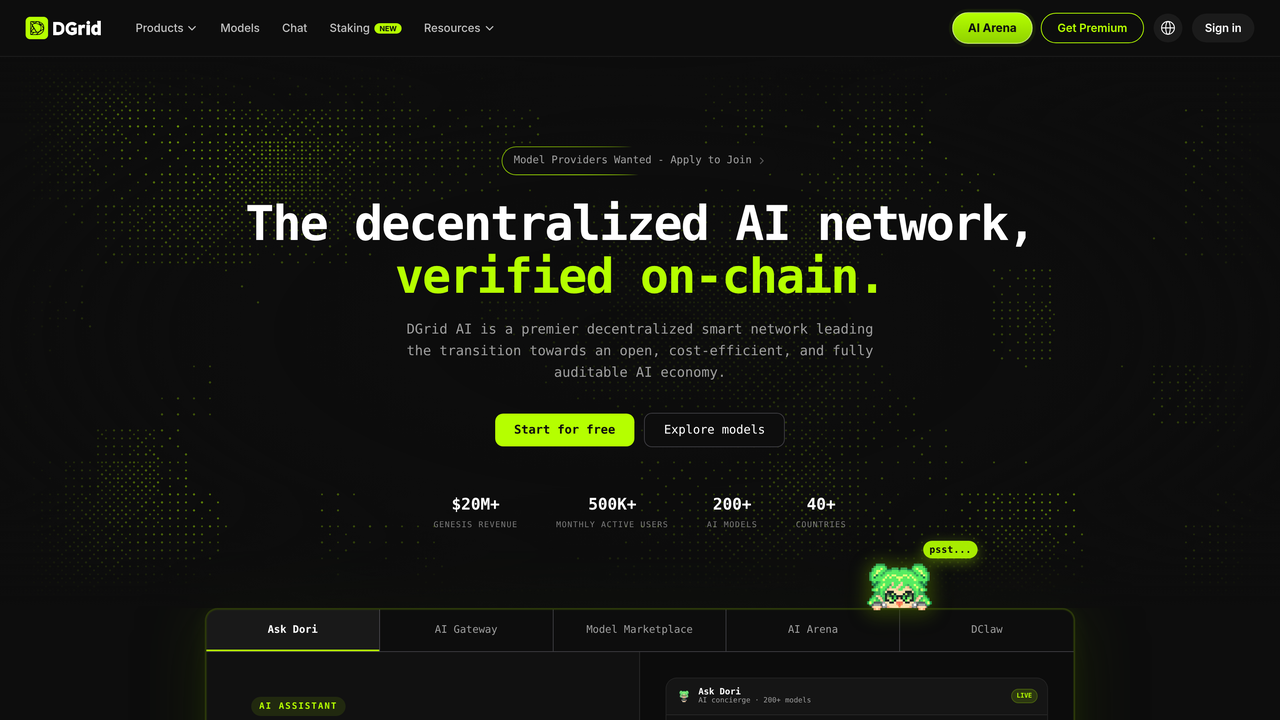
DGrid AI is a decentralized AI infrastructure network that gives developers one gateway for accessing models and AI agents from multiple providers. Its DGridRPC interface routes requests across distributed nodes, while Proof of Quality checks the reliability of returned results and records verification data on-chain. The platform also includes a marketplace where model and agent providers can list services and set pricing.
DGAI is the native utility and governance token of the network. It is used for inference and agent-service payments, node staking, rewards and protocol governance, linking token demand to activity across the platform. DGAI is issued on BNB Chain and designed to work across EVM-compatible networks.
The core idea behind DGrid AI is simple. Developers can access, route, verify and settle AI workloads through one network instead of integrating separate model providers and infrastructure services.
Key components of the DGrid AI ecosystem include:
- AI Gateway: A unified API that lets developers access more than 200 AI models through one integration.
- Distributed Nodes: Independent providers execute inference requests and report performance data used for routing and verification.
- Proof of Quality: DGrid scores outputs based on accuracy, response consistency and format compliance, then records verification proofs on-chain.
- Model and Agent Marketplace: Providers can list models or AI agents, set prices and earn from usage through the network.
How Does DGrid AI Work?
DGrid AI is designed to let developers access many AI models and agents through one interface instead of integrating each provider separately. A user connects to DGrid, chooses the model or agent they need, sends a request, and the network handles routing, execution, verification and payment behind the scenes.
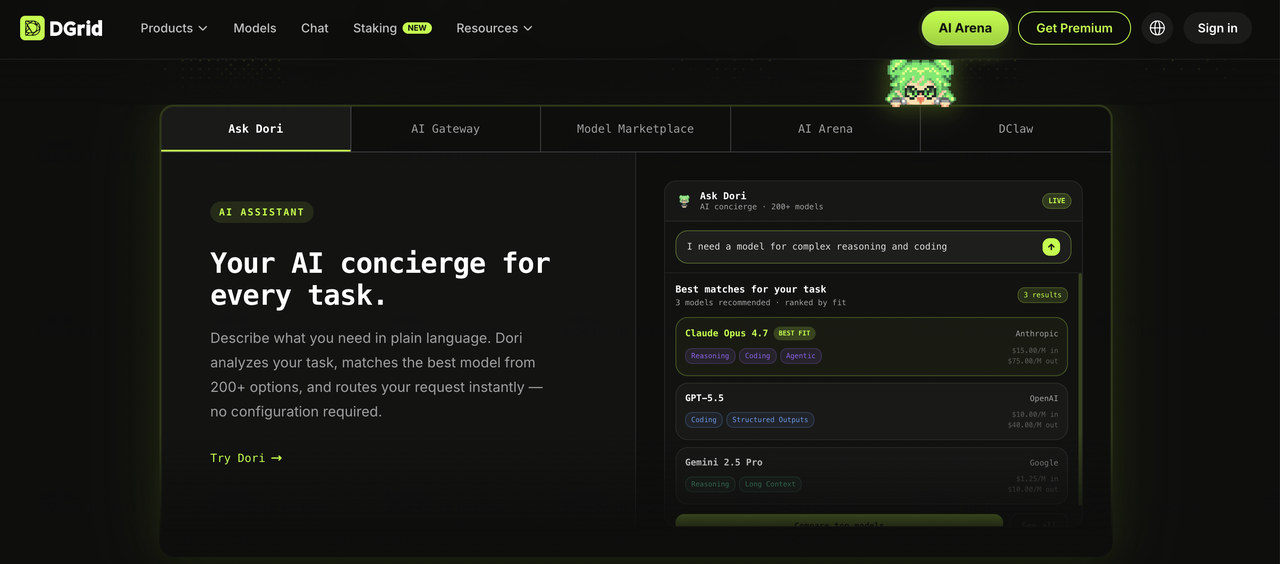
- Choose a model or AI agent: Developers can browse DGrid’s marketplace or connect through its unified API to access models and agents without setting up separate provider integrations.
- Send the request through DGrid: The application submits a prompt or task through DGridRPC. DGrid then selects an available provider based on factors such as task requirements, price and past performance.
- A distributed node runs the task: The selected node processes the inference request using the requested model or agent. Developers do not need to manage the underlying hardware or provider connection themselves.
- DGrid checks the result: Proof of Quality evaluates the returned output for factors such as accuracy, consistency and format compliance, giving users an additional verification layer before relying on the result.
- Payment and rewards are settled automatically: Smart contracts calculate the task fee and distribute rewards to participating nodes. DGAI is used across payments, staking and incentives, while token holders can also participate in governance.
DGrid AI vs. Bittensor: What Are the Differences Between Decentralized AI Networks?
DGrid AI and Bittensor both use decentralized participants and token incentives to support AI services, but their structures are different. DGrid gives developers one gateway for accessing and routing AI inference across multiple providers, with Proof of Quality and on-chain settlement built into the workflow. Bittensor organizes participants into specialized subnets where miners provide services and validators evaluate their performance.
|
Comparison |
DGrid AI |
Bittensor |
|
Core model |
Unified AI inference and routing network |
Network of specialized subnets |
|
Main users |
Developers, model providers and node operators |
Subnet owners, miners, validators and stakers |
|
Token role |
DGAI supports payments, staking, incentives and governance |
TAO supports staking and subnet incentives |
|
Main use case |
Access, route, verify and settle AI requests |
Coordinate specialized AI, compute and other digital services |
|
Quality control |
Proof of Quality evaluates inference results |
Validators evaluate miners within each subnet |
|
Main difference |
One gateway connects users to many models and providers |
Each subnet operates its own service and incentive system |
DGrid is more focused on making decentralized AI inference easy to access through one API and marketplace. Bittensor takes a broader approach, allowing independent subnets to define the service they provide and how miners are evaluated. For developers, the practical difference is a unified inference workflow with DGrid versus a subnet-based AI economy with Bittensor.
Read More: What Is Bittensor (TAO)? A Beginner's Guide to How Bittensor Works (2026)
What Are the DGrid AI (DGAI) Tokenomics?
DGAI has a maximum supply of 1 billion tokens and is designed to support payments, staking, node rewards and governance across the DGrid network. Nodes receive the largest allocation at 50% of total supply, linking a large part of DGAI distribution to decentralized inference and network participation.
DGAI Token Utility and Supply Mechanisms
- Staking: Node operators and AI service providers stake DGAI as collateral to participate in the network. Poor performance or malicious behavior can result in part of that stake being slashed.
- Inference payments: DGAI is used to pay for model inference and AI-agent services, with task pricing based on factors including Compute Units and latency.
- Node incentives: Operators can earn DGAI for providing inference and verification services, with rewards linked to factors such as usage, service quality, latency and uptime.
- Governance: DGAI holders can participate in decisions covering areas such as fees, supported models and protocol upgrades. Governance functions are designed to expand as the network develops.
- Slashing and burning: DGAI confiscated from nodes for specified violations can be permanently burned. This reduces supply when penalties occur, rather than operating as a fixed recurring burn schedule.
DGAI Token Allocation
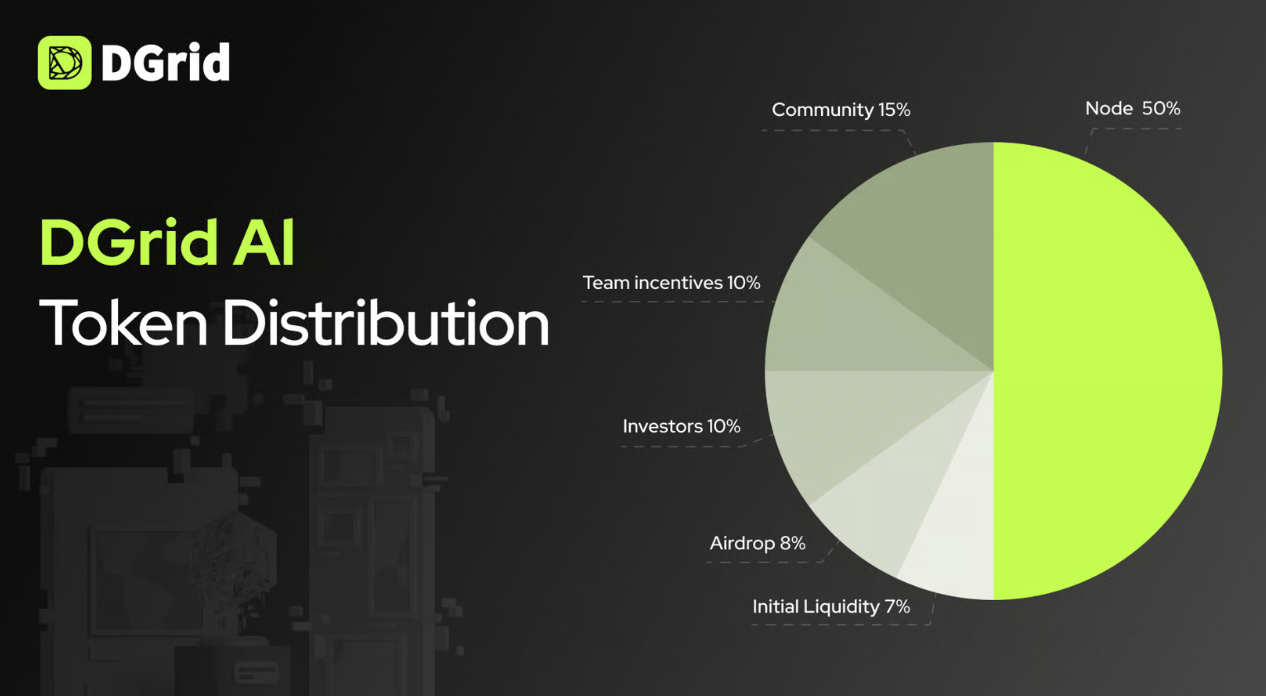
- Nodes: 50%, or 500 million DGAI. The largest share supports decentralized inference and network security. Tokens unlock over 10 years, with emissions halving every two years.
- Community Rewards: 20%, or 200 million DGAI. Funds are reserved for grants, partnerships, cross-chain integrations and community programs. Thirty percent unlocks at TGE, with the remainder released linearly over two years.
- Team Incentives: 10%, or 100 million DGAI. Core-contributor tokens vest linearly over two years.
- Investors: 10%, or 100 million DGAI. Ten percent unlocks at TGE, with the remaining tokens vesting linearly over two years.
- Airdrops: 5%, or 50 million DGAI. These tokens support exchange-listing and ecosystem incentives and are fully unlocked at TGE.
- Initial Liquidity: 5%, or 50 million DGAI. Tokens are reserved for liquidity across centralized and decentralized exchanges and are fully unlocked at TGE.
DGAI supply pressure will depend mainly on node emissions and the release of community, team and investor tokens. Investors can compare the vesting schedule with inference usage, staking demand and node activity to judge whether network demand is keeping pace with new supply.
How to Trade DGrid AI (DGAI) on BingX
BingX offers DGAI through its perpetual futures market, allowing active traders to take long or short exposure to DGAI price movements without holding the underlying token. Users seeking direct ownership should independently verify the official contract and available spot liquidity before using a supported decentralized exchange.
Futures Trading: Trade DGAI Price Movements
BingX lists a USDT-margined DGAI perpetual. Because leverage can amplify both gains and losses, futures are intended for traders who understand liquidation and have a defined risk plan.
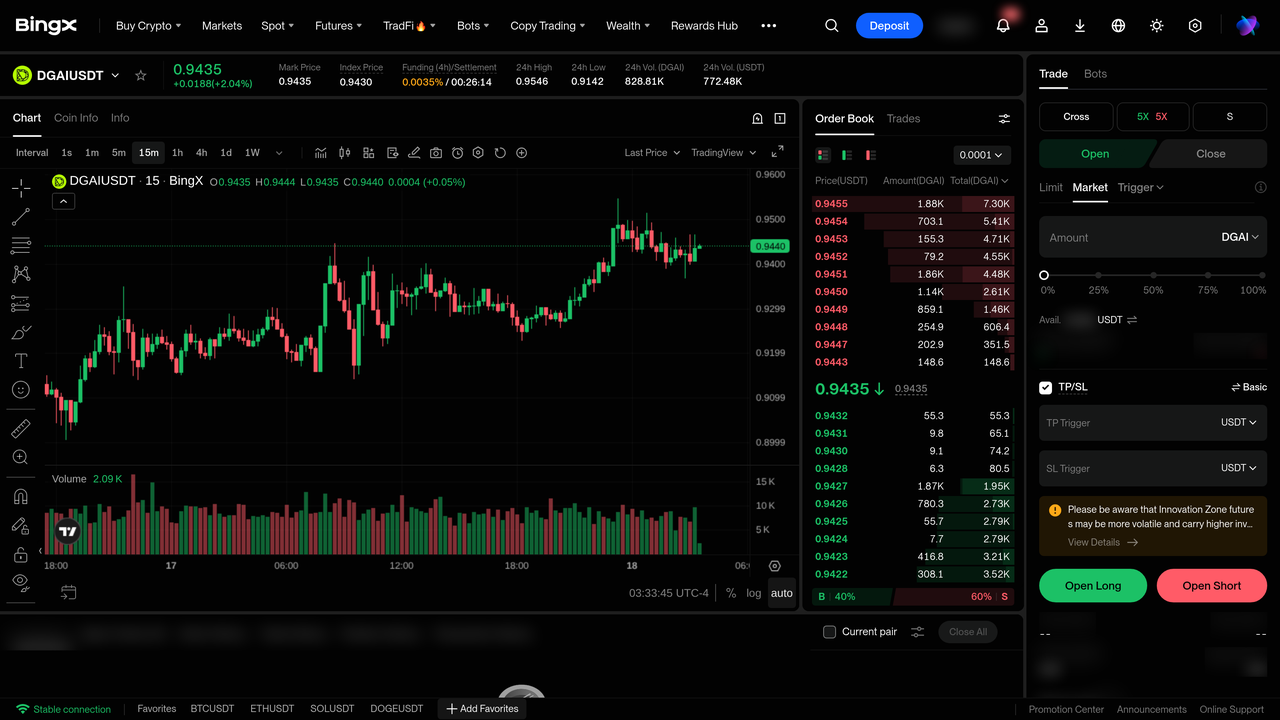
Step 1: Account setup and security. Sign up and log into BingX, complete the identity verification (KYC) required in your region, and enable two-factor authentication.
Step 2: Transfer collateral. Move USDT from the spot account to the futures account, where it is used as margin.
Step 3: Select the contract. Open the DGAI-USDT perpetual.
Step 4: Set direction and leverage. Open long or short based on the trading thesis. Select leverage and position size within the defined risk limit.
Step 5: Execute the trade. Enter the order amount and use a market or limit order according to the trading plan.
Step 6: Manage risk. Set stop-loss and take-profit controls before or immediately after entry. Profit and loss settle dynamically in USDT.
Risks and Considerations Before Investing in DGrid AI (DGAI)
DGrid AI still needs to prove that its gateway, node network and verification system can turn broad model access into sustained usage and fee demand.
- Adoption is still developing: DGrid needs developers, model providers and reliable node operators to grow together. A large model catalog does not automatically translate into recurring usage or fees.
- Proof of Quality still needs real-world validation: PoQ is a key part of DGrid’s design, but its scoring system must remain reliable as usage grows. Weak verification or manipulation could reduce confidence in the network.
- Distributed nodes can face reliability issues: Node performance depends on hardware, uptime and routing quality. Staking and penalties can discourage poor behavior but cannot eliminate technical failures.
- Token unlocks can increase supply: Nodes receive 50% of DGAI over 10 years, while community, team and investor tokens follow separate release schedules. New supply could pressure the token if demand grows more slowly.
- DGAI can remain highly volatile: As an early-stage token, DGAI may react sharply to adoption, liquidity and broader crypto sentiment. Futures trading can increase those risks through leverage.
Final Thoughts: Should You Invest in DGrid AI (DGAI) in 2026?
DGrid AI is a decentralized AI service network that combines gateway access, distributed inference, quality verification, and tokenized settlement. Its 2026 story is anchored by its reported 200+ model catalog, its PoQ-based verification design, and its node-centered token allocation.
The key question for 2026 is whether DGrid AI can turn its service workflow into repeatable paid inference demand without weakening verification quality or node reliability. Its integrated gateway and settlement design set it apart from subnet-led AI networks, but DGAI remains exposed to execution, unlock, and market-volatility constraints. For investors and traders, the most important metrics to watch are official node activity, inference-task demand, reported gateway usage, unlock schedules, PoQ implementation updates, and governance changes.
Related Reading
- What Are the Top 10 AI Crypto Projects to Watch in 2026?
- What Are the Top 10 AI Agent Crypto Projects of 2026?
- What Is Sentient (SENT)? A Beginner’s Guide to Open-Source AGI and Decentralized AI in 2026
- What Is Bittensor (TAO)? A Beginner's Guide to How Bittensor Works (2026)
- What Is Teller (DEBIT)? A Beginner’s Guide to the Debit AI Finance Platform in 2026
- What Is Artificial Superintelligence (FET), the Complete Guide to the ASI Alliance?
FAQs About DGrid AI (DGAI)
1. What makes DGrid AI different from other decentralized AI projects?
DGrid AI combines model access, distributed inference, quality verification and settlement in one network. Its Proof of Quality system checks inference results, while DGAI supports payments, staking, node incentives and governance.
2. What blockchain is DGAI on?
DGAI is issued on BNB Smart Chain and is designed to work with EVM-compatible infrastructure. Users should always confirm the official contract address and network before transferring tokens.
3. What is the DGAI supply?
DGAI has a fixed maximum supply of 1 billion tokens. Half is reserved for node incentives, with the remaining supply distributed across community rewards, team incentives, investors, airdrops and liquidity.
4. Which wallets support DGAI?
DGAI can be stored in BNB Smart Chain-compatible self-custody wallets such as MetaMask or Rabby. Users should add the verified contract and confirm the correct network before sending tokens.
