
Orca (ORCA) is a decentralized exchange and liquidity platform on Solana designed to help users swap tokens and earn trading fees by providing liquidity. Through its Whirlpools concentrated-liquidity pools, providers can choose the price ranges where their capital is active, improving capital efficiency while the market price stays within those ranges. As of October 7, 2026, Orca’s official website reported more than $500 million in cumulative fees earned by liquidity providers, highlighting the platform’s established role in Solana trading.
Operating since 2021, Orca combines token swaps, liquidity-management tools and the ORCA governance token within one ecosystem. Whirlpools underpin its liquidity model, while adaptive fees respond to market volatility and xORCA staking connects token holders with governance and fee-funded ORCA buybacks. This guide explains how Orca works, how ORCA tokenomics are structured, the main risks to consider and how to trade ORCA on BingX.
What Is Orca (ORCA)?
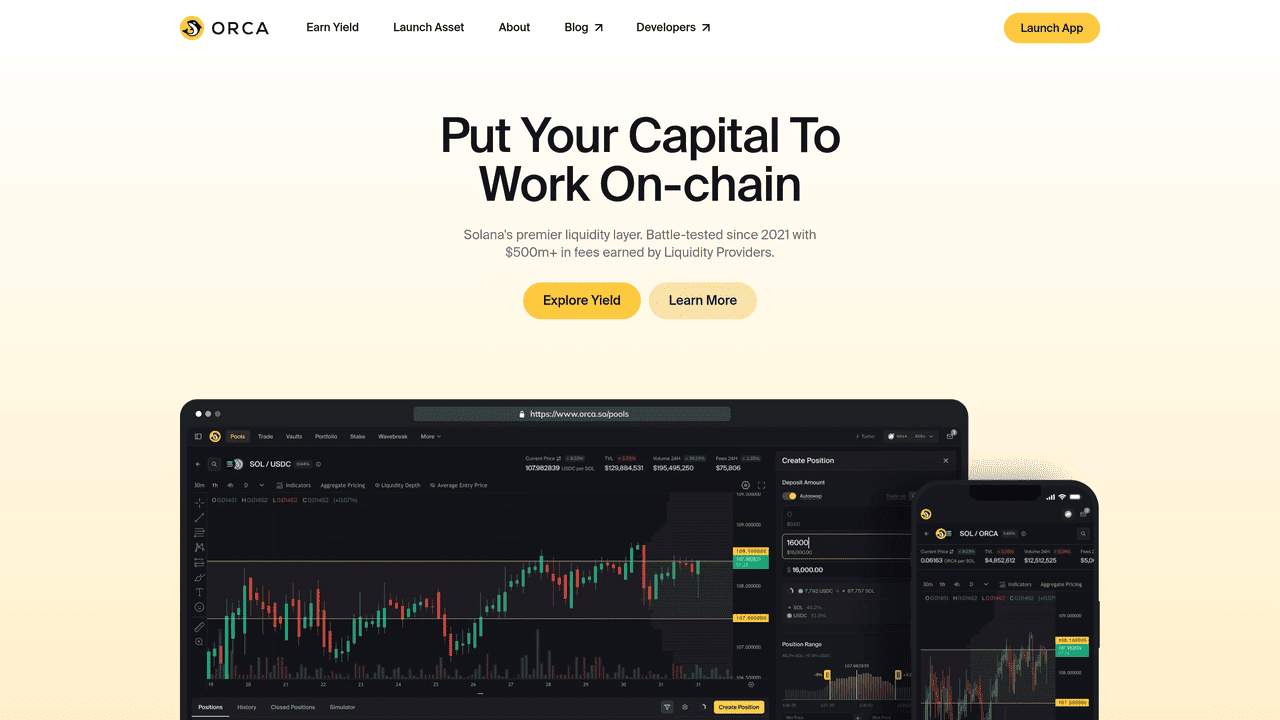
Orca is a decentralized exchange on Solana that lets users swap tokens, provide liquidity and create liquidity pools. It uses an automated market maker (AMM), which allows traders to swap against assets deposited in pools. Its Whirlpools technology supports concentrated liquidity, meaning providers can select the price ranges where their funds are available for trading. This can make capital more efficient, but positions stop earning trading fees when the market price moves outside their selected range.
ORCA is the protocol’s governance token, allowing holders to help shape decisions about protocol development, fees and treasury spending. Holders can also stake ORCA to receive xORCA, which represents their share of the staking vault. A portion of protocol fee revenue funds ORCA buybacks deposited into that vault, connecting staking rewards to trading activity on the platform. The allocation is subject to governance decisions, and rewards vary with protocol revenue.
Key components of the Orca ecosystem include:
- Whirlpools: Concentrated-liquidity pools where providers choose the price ranges in which their capital supports swaps.
- Liquidity Terminal: Orca’s interface for exploring pools, opening positions and managing liquidity, with tools for reviewing fees and simulating potential returns.
- Adaptive Fees: A feature in supported pools that adjusts trading fees in response to market volatility.
- ORCA and xORCA: The governance token and its staking representation, connecting token holders with protocol decisions and fee-funded staking rewards.
How Does Orca Work?
Orca uses an automated market maker (AMM) to connect token traders with liquidity supplied by users. Its Whirlpools concentrated-liquidity model lets providers choose where their capital supports trading, while swap fees reward active liquidity and help fund protocol operations and ORCA staking rewards.
- Liquidity providers select a price range: Providers open a position in a token-pair pool, such as SOL/USDC, and choose the price interval where their funds will support swaps. Narrower ranges concentrate capital around specific prices but require closer monitoring as the market moves.
- Traders swap against active liquidity: Orca’s smart contracts calculate and execute swaps using liquidity available at the current pool price. Trades change the pool’s token balances and price, with larger trades relative to available liquidity generally creating greater price impact.
- Active positions earn trading fees: Providers receive a share of swap fees according to their contribution to active liquidity. When the price moves outside a position’s range, it stops earning trading fees until the price returns or the provider adjusts the position.
- Adaptive fees respond to volatility: Supported pools add a variable fee to their base fee when price volatility rises. This changes trading costs and can increase compensation for providers supplying liquidity during volatile conditions.
- Protocol revenue supports ORCA staking rewards: A portion of protocol fees funds ORCA buybacks that are deposited into the xORCA staking vault. Holders who stake ORCA receive xORCA representing their share of that vault and can participate in governance. Reward funding depends on trading activity and the allocation approved through Orca governance.
Orca vs. Meteora: What Are the Differences Between the Solana DEXs?
Orca and Meteora both let users trade tokens and provide liquidity on Solana, but their main pool designs organize liquidity differently. Orca’s Whirlpools concentrate capital within selected price ranges, while Meteora’s Dynamic Liquidity Market Maker (DLMM) distributes capital across discrete price bins. Both support concentrated liquidity and volatility-responsive fees, so the practical differences lie in pricing mechanics, liquidity distribution and position management.
|
Comparison |
Orca Whirlpools |
Meteora DLMM |
|
Core model |
Concentrated-liquidity AMM using price ranges and ticks |
Concentrated-liquidity market maker using discrete price bins |
|
Liquidity placement |
Providers select a lower and upper price for each position |
Providers choose bins and distribute capital across them |
|
Swap pricing |
Price moves along an AMM curve within the active range |
Each bin has a fixed price; trades move through bins as liquidity is consumed |
|
Fee mechanics |
Fixed-fee pools and adaptive-fee pools |
Base fees plus a volatility-responsive dynamic fee |
|
Position management |
Providers monitor ranges and adjust positions when needed |
Providers manage bin coverage, allocation and rebalancing |
|
Main tradeoff |
Range selection balances capital efficiency against how often positions become inactive |
Bin-level allocation adds flexibility but requires decisions about liquidity distribution |
Meteora also offers other pool products, including DAMM and token-launch infrastructure, so DLMM represents one part of its broader platform. Its fixed price within each bin means a swap filled entirely in that bin has no price impact, although trading fees still apply and larger swaps can cross into other bins.
For liquidity providers, the choice comes down to managing a selected price interval on Orca or shaping liquidity across bins on Meteora DLMM. Both require attention to price movement, trading volume and inventory changes. For traders, the more useful comparison is the quoted execution price, fees and available liquidity for the specific token pair and trade size.
Read More: What Is Meteora DLMM? A Beginner’s Guide to Solana DEXs
What Are the Orca (ORCA) Tokenomics?
ORCA is the governance and utility token of the Orca protocol on Solana. Its tokenomics connect governance participation and xORCA staking with revenue generated by trading activity. As of October 7, 2026, Orca’s official documentation lists a total supply of 75 million ORCA. This follows a 2025 treasury burn that reduced supply from the original 100 million tokens. Orca token documentation, official supply disclosure.
ORCA Token Utility and Supply Mechanisms
- Governance participation: ORCA holders can vote on proposals affecting protocol fees, treasury spending and development. These rights depend on the governance framework and may change through approved proposals.
- Voting delegation: Orca’s documentation allows ORCA and xORCA holders to delegate voting power, helping holders participate through representatives.
- xORCA staking: Users stake ORCA to receive xORCA, which represents their share of the staking vault. Fee-funded ORCA deposits can increase the amount of ORCA backing each xORCA token.
- Protocol-funded buybacks: Orca’s tokenomics page currently describes a 12% protocol share of trading fees, with 40% of that share funding ORCA purchases for the xORCA vault and 60% allocated to the Orca Fee Treasury. These are revenue allocations, separate from token-supply allocation.
- Supply reduction through burns: The April 2025 burn removed 25 million treasury tokens. Buybacks deposited into the staking vault redistribute existing ORCA; they reduce total supply only when the purchased tokens are burned.
ORCA Token Allocation
Orca’s current tokenomics page does not provide an updated allocation chart reconciling the remaining 75 million tokens across team, investor and community categories. The verified supply changes and treasury disclosures provide the following reference points:
- Original supply: 100 million ORCA. This was the supply before the 2025 treasury burn.
- Treasury burn: 25 million ORCA. The approved burn removed 25% of the original supply, leaving 75 million tokens. Official supply disclosure.
- Community treasury: approximately 14.2 million ORCA. A September 29, 2026 governance proposal reported this balance, equivalent to roughly 18.9% of the documented total supply. This is a dated treasury balance, rather than a permanent allocation category. Official governance proposal.
As of October 7, 2026, a proposal is under vote to change protocol-revenue distribution to 10% for xORCA buybacks, 10% for a team-managed buyback account and 80% for operations, alongside treasury transfers and governance changes. Voting is scheduled to end on October 10, so these figures should be presented as proposed changes until approval and implementation are confirmed.
In 2026, ORCA’s supply dynamics depend on treasury deployment, staking participation, buybacks and governance decisions. Investors should monitor circulating supply and any approved changes to minting authority alongside total supply: the current governance discussion explicitly states that future minting would require tokenholder approval.
How to Trade Orca (ORCA) on BingX
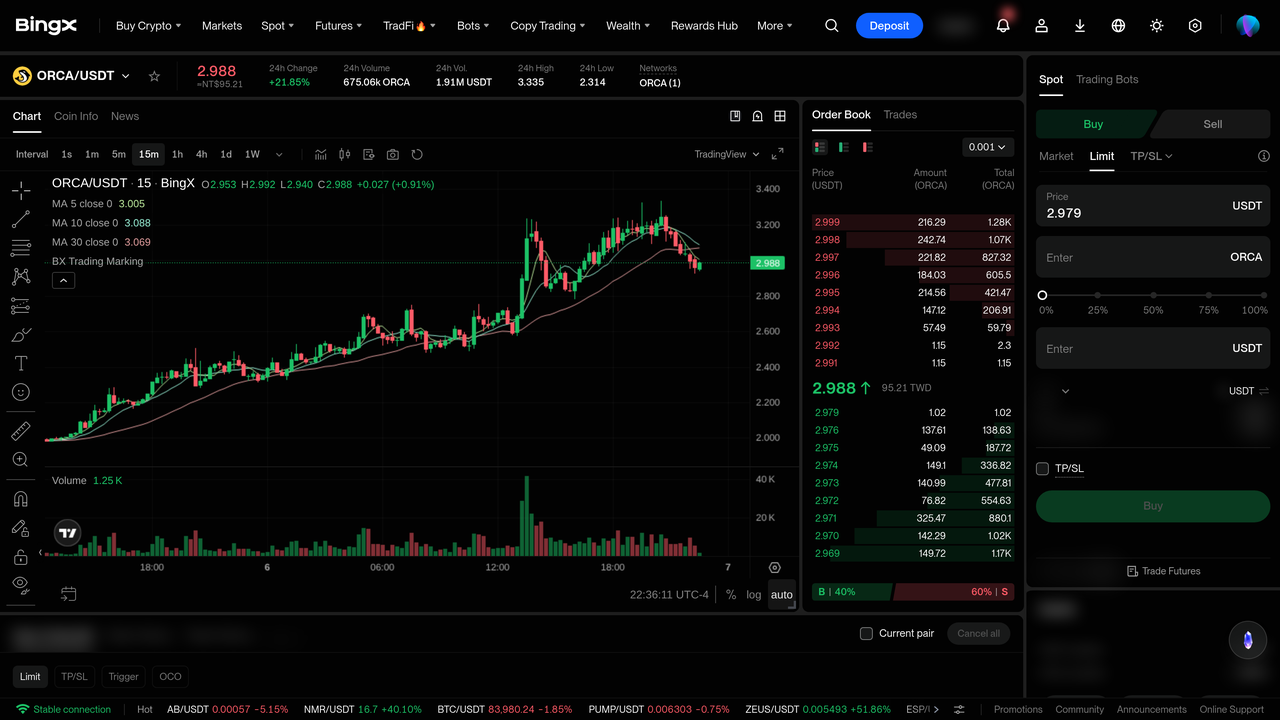
BingX offers two ways to gain exposure to Orca through its ORCA/USDT spot market and ORCA-USDT perpetual futures, subject to regional availability. Spot trading lets users buy and hold ORCA directly, while perpetual futures allow traders to take long or short positions on ORCA price movements.
Spot Trading: Buy and Own ORCA Directly
Step 1: Account setup and security. Sign up and log into your BingX account, complete the identity verification (KYC) required in your region, and enable two-factor authentication.
Step 2: Fund your spot account. Deposit USDT or another supported asset into your BingX spot account. Where available, users can also use supported fiat on-ramp options.
Step 3: Open the spot market. Search for the ORCA/USDT pair and open its trading page.
Step 4: Choose an order type. Use a market order to buy ORCA at the available market price, or a limit order to set your preferred purchase price. Enter the amount and review the order before confirming.
Step 5: Manage your ORCA. Once the order fills, ORCA appears in your spot account. You can keep it on BingX or, when withdrawals are available, transfer it to a compatible wallet after confirming the supported network and destination address.
Futures Trading: Trade ORCA Price Movements
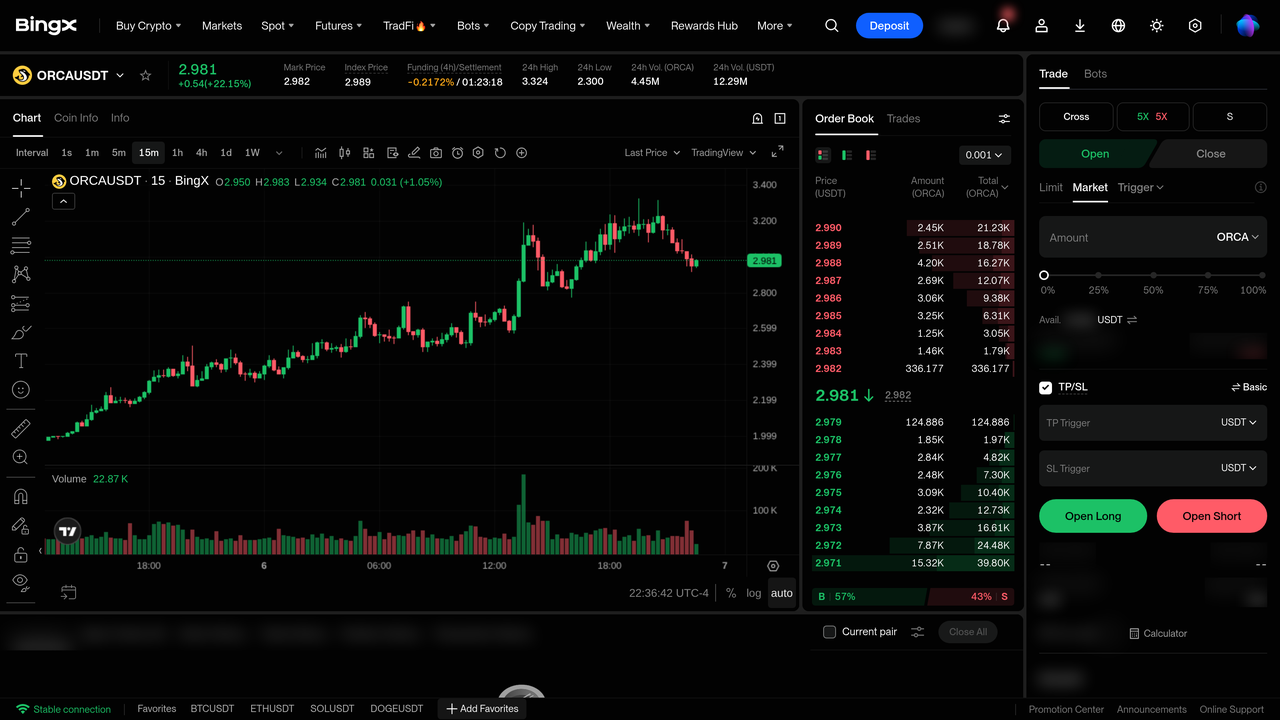
ORCA perpetual futures let traders take positions on price movements without owning ORCA directly. Leverage amplifies gains and losses, so traders should understand liquidation risk and define their position size and exit plan before trading.
Step 1: Account setup and security. Sign up and log into your BingX account, complete the identity verification (KYC) required in your region, and enable two-factor authentication.
Step 2: Transfer collateral. Move USDT from your spot account into your futures account, where it will serve as margin.
Step 3: Select the contract. Search for the ORCA-USDT perpetual contract.
Step 4: Set direction and leverage. Open long if you expect ORCA to rise, or open short if you expect it to decline. Choose leverage and position size based on the amount you are prepared to risk.
Step 5: Execute the trade. Enter the order amount and choose a market or limit order. Review the margin requirement, fees and estimated liquidation price before confirming.
Step 6: Manage risk. Set stop-loss and take-profit orders before or immediately after entry. Monitor your margin balance and funding payments while the position remains open; realized profit and loss are settled in USDT.
Risks and Considerations Before Investing in Orca (ORCA)
Orca’s outlook depends on sustained trading activity on Solana, demand for its liquidity pools and how protocol revenue benefits ORCA holders.
- Trading activity drives staking rewards: Fee-funded ORCA buybacks depend on protocol revenue. Lower trading volume or stronger competition from other Solana exchanges can reduce reward funding, while buybacks do not guarantee ORCA price growth.
- Governance can change token economics: As of October 7, 2026, a proposal under vote would reduce the protocol-revenue allocation for xORCA rewards, transfer treasury assets to team control and narrow tokenholder governance rights. These remain proposed changes until approval and implementation are confirmed. Official governance proposal.
- Liquidity provision carries additional risks: Users supplying liquidity can face impermanent loss and changes in their token balances. Concentrated-liquidity positions also stop earning trading fees when prices move outside their selected ranges.
- Smart contracts and network operations carry risk: Orca’s Whirlpools contracts have undergone multiple security audits, but audits cannot eliminate vulnerabilities. Solana network disruptions or integration failures could also affect swaps and position management.
- ORCA can remain highly volatile: Token prices can react sharply to market sentiment, treasury decisions and liquidity conditions. Staking rewards may not offset a price decline, and leveraged futures introduce additional liquidation risk.
Final Thoughts: Should You Invest in Orca (ORCA) in 2026?
Orca enters the rest of 2026 as an established Solana liquidity platform, combining Whirlpools concentrated liquidity, adaptive fees and xORCA staking. Its investment case rests on whether sustained trading activity generates protocol revenue that benefits ORCA holders. However, stronger platform usage does not automatically translate into a higher token price, and governance decisions can change how revenue and treasury assets are allocated.
The next test is maintaining competitive liquidity while navigating proposed changes to staking rewards and governance. Investors can watch trading volume, active liquidity, protocol fees, executed ORCA buybacks, xORCA participation and treasury movements. The outcome and implementation of the October 2026 governance proposal also deserve attention. Sustained activity and transparent treasury management would provide clearer evidence for ORCA’s investment case, alongside each investor’s tolerance for token volatility and protocol risk.
Related Reading
- What Are the Top 7 Solana DEXs to Trade in 2026?
- Top 8 Solana DeFi Projects to Watch in 2026
- What Is Meteora DLMM? A Beginner's Guide to Solana DEXs
- What Is Raydium (RAY) DEX on Solana?
- What Are the Top Solana Virtual Machine (SVM) Projects of 2026?
FAQs About Orca (ORCA)
1. What makes Orca different from other Solana decentralized exchanges?
Orca centers its liquidity model on Whirlpools, which let liquidity providers choose the price ranges where their capital supports trading. Its ecosystem also includes adaptive-fee pools and xORCA staking, connecting liquidity management with governance and fee-funded ORCA buybacks. Orca’s platform explains these features.
2. What blockchain is ORCA on?
ORCA is a token on Solana. Its official token address is orcaEKTdK7LKz57vaAYr9QeNsVEPfiu6QeMU1kektZE. Confirm the supported withdrawal network and official token details before transferring ORCA.
3. What is the ORCA supply?
As of October 7, 2026, Orca’s documentation lists a total supply of 75 million ORCA, following a 25-million-token treasury burn in April 2025. Total supply differs from circulating supply, and future minting would require tokenholder approval under the governance framework described in the current proposal. Token documentation, governance clarification.
4. Which wallets support ORCA?
ORCA can be stored in a Solana-compatible wallet that supports SPL tokens. Before transferring, confirm that the wallet supports ORCA, select the Solana network and verify the token address against Orca’s official documentation. Keep a small amount of SOL available to pay network transaction fees.
