
As decentralized finance matures toward high-frequency internet capital markets, the structural trade-off between centralized exchange performance and decentralized exchange security, known as The Blockchain Paradox, has reached a critical juncture. Traditional CEXs accommodate over 500 million users with seamless, low-latency execution but subject them to severe custody risk, where user assets are vulnerable to platform insolvencies or unilateral freezes. Conversely, standard decentralized exchanges (DEXs) safeguard user custody but introduce steep UX barriers, including volatile gas fees, high latency, and complex seed phrase management.
Bullbit (BUBI) eliminates this paradox by introducing a hyper-scalable trading architecture that bridges Web2 ease of use with Web3 structural transparency. Operating initially as a production-ready App-rollup on the Base Layer 2 ecosystem, Bullbit abstracts away the underlying cryptographic complexities of decentralized trading into a frictionless, passkey-native interface. By combining off-chain matching speeds with trustless on-chain settlement, Bullbit allows retail traders and institutional allocators to access up to 50x leverage on market-driving narratives without relinquishing control of their private keys.
What Is Bullbit Perp DEX (BUBI)?
Bullbit is a security-first, high-leverage perpetual futures protocol that provides a CEX-grade trading experience entirely on-chain. At its core, the project addresses three fundamental challenges impeding the mass adoption of decentralized derivative markets:
- The Custody Crisis: Traditional CEX users trade via point-in-time Proof of Reserves accounting structures that can be manipulated. Bullbit ensures absolute asset ownership; all collateral resides continuously in open-source smart contracts controlled by the user's biometrics.
- UX Friction and Technical Walls: Standard Web3 onboarding mandates the hazardous management of 12-to-24-character seed phrases. Bullbit implements a 30-second onboarding flow powered by native WebAuthn standards, letting users deploy an invisible wallet using FaceID or TouchID.
- Execution Latency: Shared blockspace on general-purpose public networks causes transaction delays and severe slippage during high market volatility. Bullbit bypasses network congestion via an ultra-low latency execution layer capable of processing tens of thousands of transactions per second (TPS).
How Does Bullbit Perp Decentralized Exchange Work?
The protocol operates via a unique Dual-Track strategy, scaling from an optimized App-rollup architecture on Base L2 to an independent, sovereign Layer 1 infrastructure called BullChain. This setup splits execution from settlement to maximize trading efficiency.
The App-rollup Execution and Settlement Layer
Currently live on Base L2, Bullbit utilizes a specialized hybrid design to match the convenience of traditional order-book trading:
- In-Memory CLOB: The protocol's core Central Limit Order Book matching engine runs entirely ON RAM. By avoiding direct-to-disk bottlenecking during execution, the system achieves transaction latency of less than 50ms, ensuring instantaneous order routing and zero front-running manipulation from public mempools.
- Decentralized Custody and Verifier Contracts: While matching executes at hyper-speed on RAM, the financial truth is settled on-chain. All user margins are secured inside decentralized Pool and Vault contracts on Base. Balance modifications or position liquidations are only validated on-chain when the execution engine submits cryptographic proofs to the Layer 2 Verifier contract.
- Censorship Resistance Via Inclusion Queue and Escape Hatch: To protect users against potential sequencer failures or malicious blockades, Bullbit embeds a rigid Kill Switch architecture. If the platform fails to process a standard withdrawal within 24 hours, users can interact directly with the Base L2 smart contract via the Escape Hatch, forcing a trustless withdrawal of their entire balance via an on-chain Proof of Balance query.
The Sovereign Infrastructure: BullChain Layer 1
To unlock total sovereignty and eliminate the data constraints of general-purpose L2 networks, Bullbit is actively transitioning to BullChain, an independent Layer 1 network built using the Cosmos SDK and the CometBFT consensus engine.
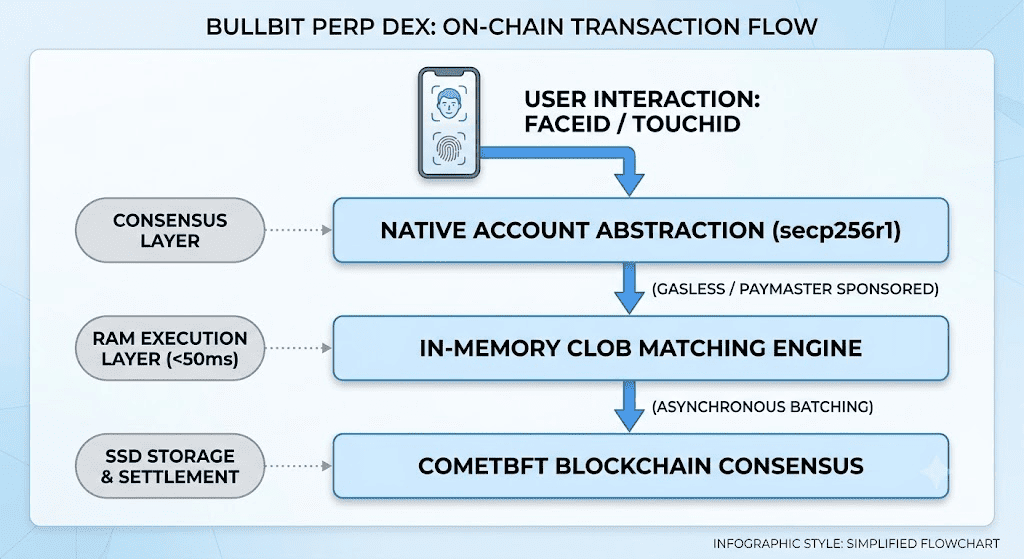
BullChain integrates Native Account Abstraction (x/auth-abstract) directly into the consensus layer, natively supporting the secp256r1 signature standard used by Apple Secure Enclave and Google Password Manager. This allows your mobile device to act as a secure hardware signing mechanism, achieving instant biometric trade signatures with zero intermediate smart-contract gas overhead.
Protocol Trading Mechanics and Cross-Margin Math
Capital efficiency within Bullbit is governed by a robust, real-time Cross-Margin engine that shares account balances across all open derivative positions to optimize purchasing power.
Account health is determined by calculating Account Equity, which continuously aggregates the depositor's wallet balance and unrealized profits or losses (PnL) against the smoothed Mark Price:
Equity = Wallet Balance + Unrealized PnL
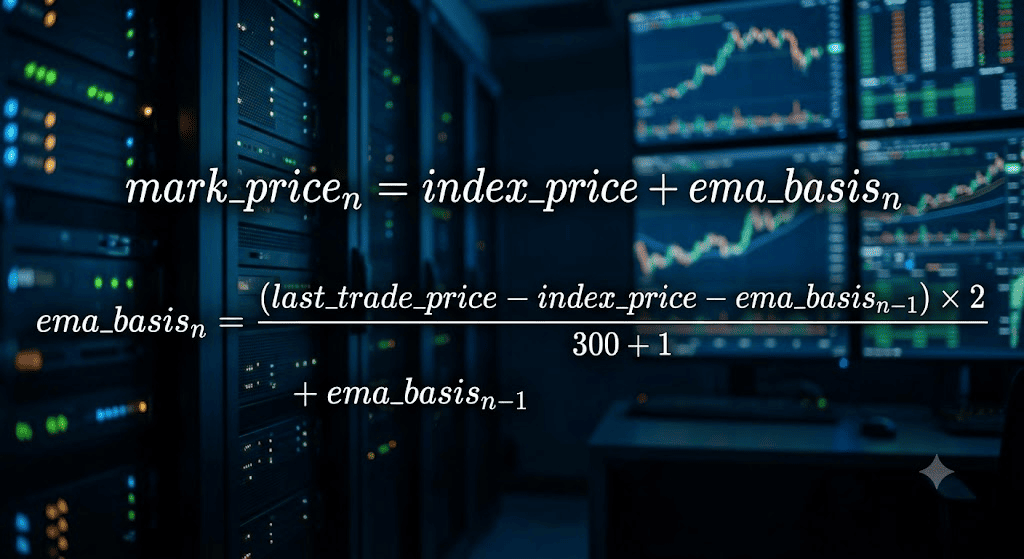
To insulate traders from local order-book manipulation or sudden flash crashes, the platform derives its Mark Price using an Exponential Moving Average (EMA) algorithm mapped across a rolling 300-block cycle:
To protect protocol solvency, Bullbit implements a Tiered Margin System where the Maintenance Margin (MM) rate scales dynamically with the absolute notional value of the position. For example, a standard BTC/USD position under $100,000 requires a baseline MM rate of just 1% (enabling 50x leverage), whereas larger positional tiers demand higher capital buffers. If an account's Margin Ratio reaches 100%, an automated liquidation ladder kicks in:
Margin Ratio (%) = EquityTotal Maintenance Margin × 100%
Bullbit vs. Traditional Perpetual DEXs: Key Differences
|
Feature |
Bullbit Perp DEX ($BUBI) |
Conventional AMM DEXs |
Traditional Centralized Exchanges |
|
Onboarding Process |
30-Sec Passkey (FaceID/TouchID) |
12-24 Word Seed Phrase Setup |
Compulsory KYC & Email Setup |
|
Execution Architecture |
In-Memory CLOB (<50ms Latency) |
Liquidity Pools (High Slippage) |
Centralized Database (Opaque) |
|
Gas Fee Structure |
100% Gasless (Paymaster Layer) |
Native Network Tokens Required |
Variable Internal Withdrawal Fees |
|
Asset Custody |
100% On-Chain Self-Custody |
100% On-Chain Self-Custody |
Third-Party Centralized Custody |
|
Risk Mitigation Layer |
Liquidity Vault Backstop + ADL |
Standard Liquidation Pools |
Internal Insurance Fund / Socialized Loss |
Bullbit eliminates the structural speed and onboarding bottlenecks that hamper conventional Automated Market Maker (AMM) perpetual DEXs by deploying an in-memory Central Limit Order Book (CLOB) architecture running entirely on RAM. While traditional AMM protocols subject traders to high execution latency, volatile gas fees, and severe slippage during periods of peak market volatility, Bullbit achieves sub-50ms execution latency capable of processing tens of thousands of transactions per second (TPS).
Furthermore, traditional DeFi setups mandate the use of complex external Web3 browser extensions and the manual calculation of native gas tokens, such as ETH or SOL. Bullbit bypasses this systemic friction by utilizing native Account Abstraction (ERC-4337) and a dedicated Paymaster system, allowing for a completely gasless trading experience where users can settle transaction fees directly in the assets they are trading, such as USDC or BUBI.
From a custody and risk-mitigation standpoint, Bullbit delivers an institutional-grade security framework that goes far beyond the capabilities of standard decentralized venues. Conventional DEXs rely on simple, highly reflexive liquidation pools that can trigger cascading bad debt during black swan market events. To protect systemic solvency, Bullbit implements a multi-tiered defense architecture consisting of an automated partial-liquidation ladder, a dedicated Liquidity Provider (BLP) Vault that acts as a Backstop Liquidator to absorb distressed positions at zero equity, and an Auto-Deleveraging (ADL) ranking system as a final protocol safety valve. Additionally, while typical DeFi onboarding introduces massive drop-off rates due to hazardous 12-to-24-word seed phrase requirements, Bullbit achieves a frictionless 30-second onboarding flow by integrating the WebAuthn standard. This maps biometric authentication (FaceID or TouchID) directly into the consensus layer, ensuring absolute on-chain self-custody without sacrificing the convenience of a top-tier centralized venue.
Bullbit's AI Ecosystem: Copilot, Vaults, and Launchpad
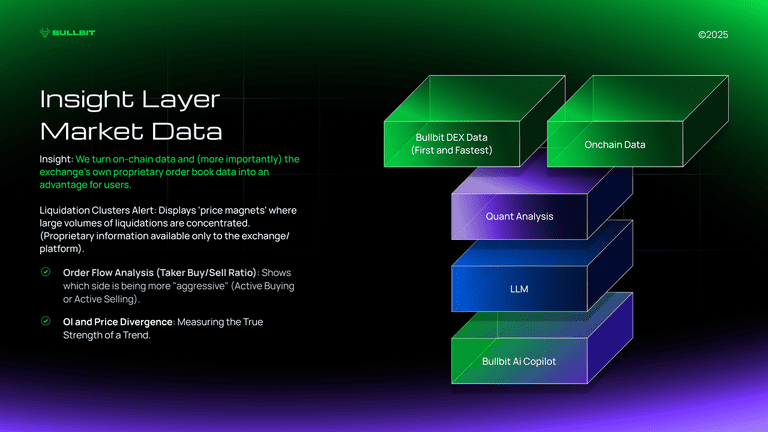
Components of Bullbit's AI ecosystem | Source: Bullbit docs
Bullbit relies heavily on specialized artificial intelligence modules to optimize user performance, automate complex logic, and drive ecosystem utility.
- AI Trading Copilot (v2.5): Powered by an optimized Gemini Flash engine, the Copilot reads real-time on-chain data and protocol liquidation clusters via direct Function Calling. It translates natural language prompts into technical analysis, monitors systemic volatility, and surfaces instructional guides natively within the interface. Strict guardrails prevent the agent from issuing directional financial advice.
- Bullbit Vaults: This asset management layer features three distinct configurations: BLP Vaults, acting as market-making liquidity providers that earn a yield from trading fees and liquidation penalties, Community Vaults for smart-contract copy-trading, and AI Vaults where automated algorithmic neural networks execute rapid delta-neutral strategies.
- AI Meme Launchpad: A highly successful proof-of-execution venue that attracted over 50,000 active users and generated over $15 million in volume during its launch phase. It features a completely no-code environment where autonomous AI agents assist in creating tokenomics, establishing automated rug-proof bonding curves, and burning LP keys upon hitting deployment thresholds on external DEXs.
What Is Bullbit (BUBI) Tokenomics?
The $BUBI token serves as the native utility, governance, and economic coordination asset across both the Base L2 and the sovereign BullChain L1 network architectures.
BUBI Token Utility and Automated Fee Allocation
Value accrues to the $BUBI ecosystem via an automated fee distribution module built directly into the core code (x/distribution), completely removing discretionary manual intervention:
- Real Yield Incentives (40%): 40% of all gross protocol fees (generated from spot trading, leverage parameters, liquidations, and cross-chain withdrawals) are accumulated and streamed directly in USDC to Node operators and long-term BUBI stakers.
- Protocol Repurchase Fund (30%): Managed by the x/buyback native module, this mechanism automatically executes market buybacks of BUBI based on real-time protocol revenue parameters, channeling the bought-back tokens into governance burn schedules or treasury reserves.
- Foundation Treasury (30%): Allocated toward protocol operations, ecosystem grants, and global outreach campaigns under strict multi-signature management.
What Is Bullbit's Dual-Staking Framework and How Does It Work?
To secure the Sovereign Layer 1 network, Bullbit deploys a distinct Dual-Staking Model separating liquidity from governance weight:
- vBUBI (Vote-escrowed BUBI): Acquired by locking $BUBI tokens long-term or purchasing a validated Node License. vBUBI awards maximum voting power within the DAO and qualifies holders for the institutional 40% Node Owner fee pool.
- Liquid BUBI: Tailored for flexible staking, giving users quick liquidity access paired with lower governance weights. To maintain low inflation, emissions scale inversely via a dynamic module based on total network participation:
Emission Rate is proportional to 1 / sqrt(Total Staked)
BUBI Token Distribution and Release Plan
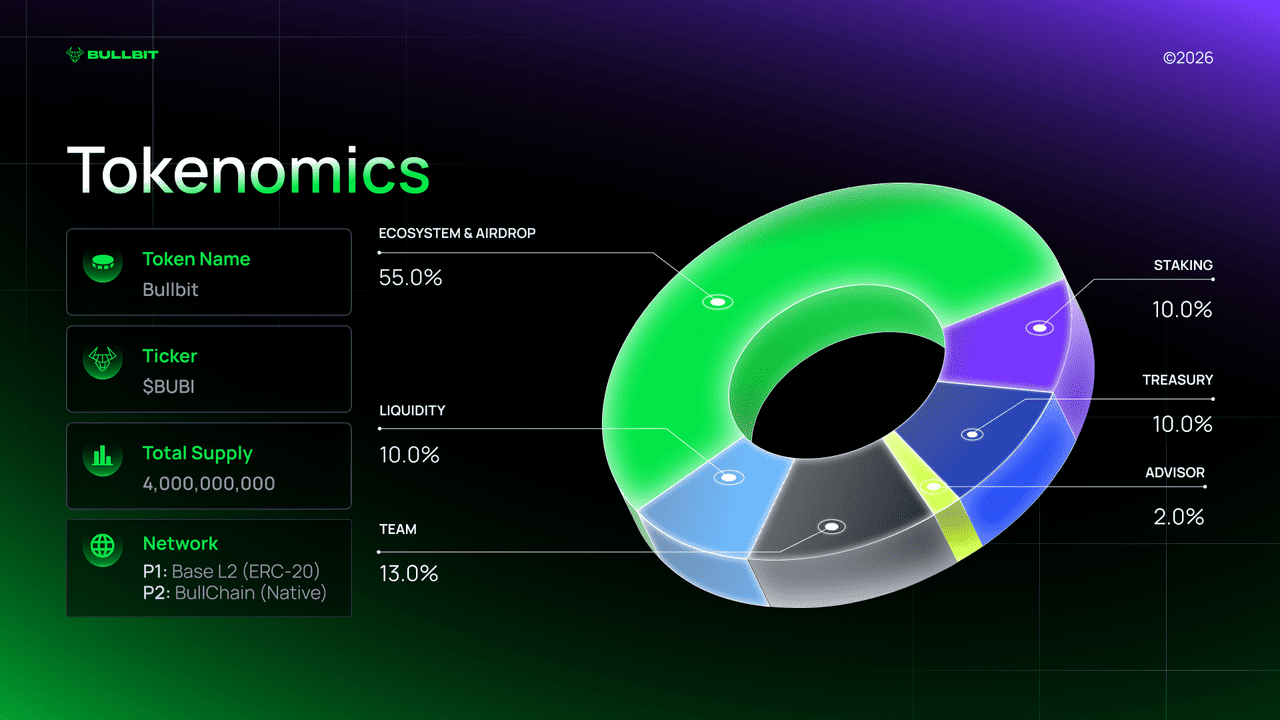
BUBI token allocation | Source: Bullbit docs
The BUBI token features a strictly fixed maximum supply of 4,000,000,000 tokens, protecting the asset from inflation. The initial Token Generation Event (TGE) took place in June 2026 with an initial unlock allocation of 7.50% (300,000,000 BUBI).
- Ecosystem and Community Airdrop (55.0%): 2,200,000,000 tokens allocated toward bootstrapping liquidity, farming campaigns, and the Genesis Point rewards program. 10% unlocked at TGE, followed by a 24-month linear monthly vesting schedule.
- Team and Core Contributors (13.0%): 520,000,000 tokens locked behind a strict 18-month structural cliff, followed by a 36-month linear distribution.
- Staking Incentives (10.0%): 400,000,000 tokens reserved for network security distribution across a 2-month cliff and an 18-month release horizon.
- Ecosystem Treasury (10.0%): 400,000,000 tokens dedicated to operational liquidity and strategic scaling; 10% unlocked at TGE, with the remainder vesting over 12 months.
- Liquidity Allocations (10.0%): 400,000,000 tokens designated for market-making books and exchange depth; 10% liquid at launch, remainder over 12 months.
- Strategic Advisors (2.0%): 80,000,000 tokens subject to a 12-month cliff and a subsequent 24-month linear vest.
How to Buy Bullbit (BUBI) on BingX
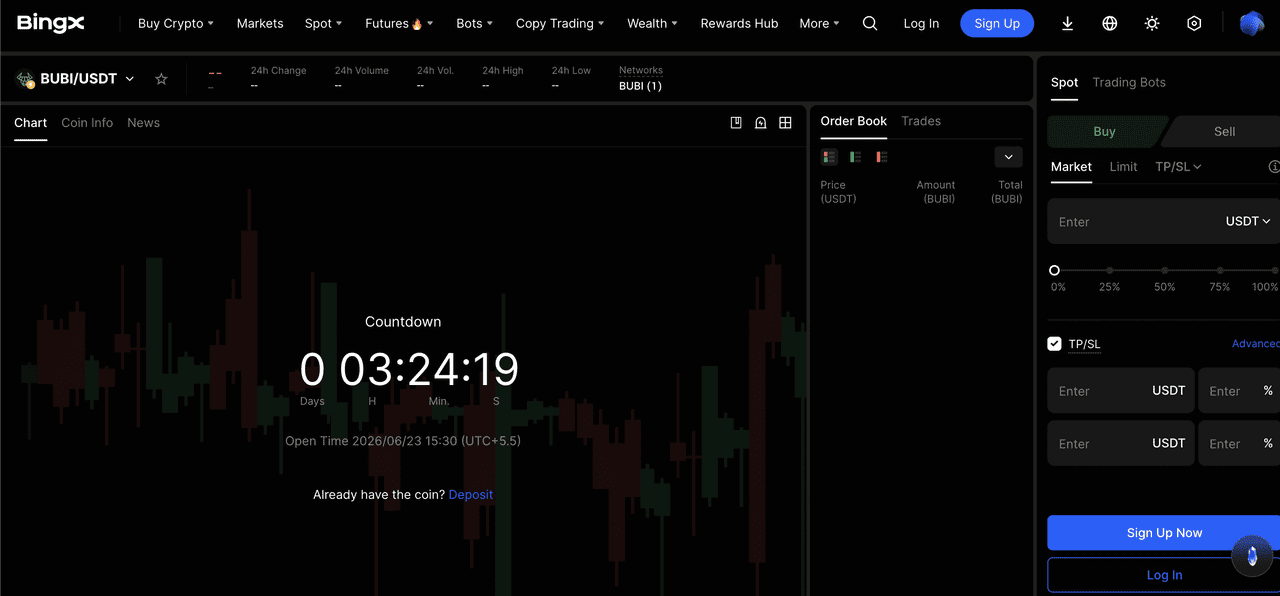
BUBI/USDT trading pair on BingX spot market
BingX offers an advanced trading ecosystem featuring its intuitive BingX AI tool to help users seamlessly monitor and trade the native $BUBI token.
- Step 1: Access the Spot Market – Log into your BingX account, navigate to the Spot drop-down menu, and select Spot to open the primary trading terminal.
- Step 2: Search for BUBI – Use the terminal search bar to input BUBI and select the BUBI/USDT trading pair.
- Step 3: Choose Your Order Type – Select a Market Order for instantaneous execution at the current market price, or a Limit Order to specify your exact desired entry price.
- Step 4: Set the Amount & Execute – Enter the amount of USDT you wish to allocate or the number of tokens you want to purchase, and click Buy BUBI to finalize the transaction.
5 Key Considerations Before Investing in Bullbit ($BUBI)
Before allocating capital or trading on the Bullbit platform, carefully review these essential risk components:
- Network Transition and Upgrade Volatility: Bullbit is moving from an App-rollup on Base L2 to a custom Sovereign Layer 1 (BullChain). Although automated snapshot tools are designed to securely port balances and data, structural infrastructure upgrades introduce potential smart-contract or execution delays.
- High-Leverage Market Volatility: Trading with up to 50x leverage significantly compounds capital exposure. Rapid market swings can push your account's Margin Ratio to 100% almost instantly, triggering automatic liquidations.
- Oracle and Pricing Dependencies: The system relies on decentralized Oracle data networks to update the asset Index Price. Any temporary data delays or price anomalies on external venues could affect the calculated Mark Price and lead to premature liquidations.
- Device-Level Passkey Responsibility: By replacing seed phrases with native Account Abstraction, security shifts directly to your personal hardware. If your physical device is compromised, or if you lose access to your biometric recovery keys (Cloud/Social Recovery), your assets could become permanently inaccessible.
- Liquidation Cascades and ADL Constraints: During extreme market conditions or black swan events, if the order book and the Backstop Liquidity Vaults cannot absorb open liquidations, the system triggers Auto-Deleveraging (ADL). This means highly profitable, highly leveraged positions may be automatically closed early to safeguard overall protocol solvency.
Final Thoughts: Is Bullbit (BUBI) the Right Choice for You?
Bullbit Perp DEX marks a significant step forward for decentralized derivatives by addressing the user experience issues that have long slowed down mass adoption. By building its infrastructure around a high-performance, in-memory CLOB, native passkey security, and a value-backed Real Yield token model, the platform successfully balances the accessibility of a centralized exchange with the security of a decentralized protocol.
As the Base Layer 2 ecosystem gains momentum and the upcoming launch of BullChain L1 approaches, $BUBI is well-positioned to bridge the gap between traditional Web2 users and self-custodial DeFi. However, because perpetual markets and high-leverage trading carry inherent systemic risks, it is vital to research the platform's mechanics thoroughly, keep an eye on upcoming governance updates, and only trade with capital you can afford to lose.
Risk Reminder: Derivative instruments and decentralized asset vaults carry significant structural, smart contract, and market counterparty risks. Perform continuous individual research, closely track platform governance updates, and never risk capital beyond your individual risk tolerance parameters. BingX assumes no legal liability for external trading outcomes or protocol asset allocations.
Related Reading
- What Are the Top Perp DEXs (Perpetual DEXs) to Know in 2026?
- What Is Hyperliquid (HYPE) Decentralized Perpetual Exchange: A Complete Guide
- What Is Aster Perpetual DEX and How Does It Work?
- Aster vs. Hyperliquid: Which One Will Lead the Perpertual DEX Market in 2026?
- What Are the Top Decentralized Exchanges (DEXs) in the Base Ecosystem for 2026?
