


Synopsys (SNPS) provides electronic design automation software, silicon intellectual property, verification hardware and engineering simulation tools used to design chips and complex systems. Design Automation now includes Ansys products and represents most revenue, while Design IP licenses reusable interfaces, memories and security blocks into customer chips. This broader platform increases exposure to AI infrastructure, automotive and physical systems, though it also leaves SNPS sensitive to integration execution, customer project timing and export controls.
The latest quarter showed rapid reported growth after the Ansys combination alongside the work still required to realize its value. Synopsys Q3 FY2026 revenue reached $2.477 billion, up 42.4%, and non-GAAP EPS was $3.91; Design Automation generated $2.003 billion. The $11.10 billion to $11.20 billion FY2027 revenue outlook and new AWS and OpenAI partnerships give Synopsys room to expand its engineering platform even though roughly $10 billion of debt and the need to convert partnerships into revenue remain constraints.
The SNPS stock forecast for 2026 now centers on two competing views:
- The integrated engineering and AI-monetization case: Ansys cross-selling, GPT-Synopsys, royalty-bearing IP and the $1 billion-plus AWS agreement expand revenue faster than the underlying EDA market and move adjusted operating margin toward the long-term 50% target.
- The execution and policy risk case: slower Design IP execution, export restrictions or delayed AI adoption could prevent the fiscal 2027 step-up from reaching earnings quickly enough to support a premium valuation.
This guide breaks down the SNPS stock forecast, 2026 price scenarios, key risks and analyst outlooks, drawing on Synopsys' August 26 fiscal Q3 earnings release, September 30 Investor Day and market data through October 5, plus how to trade SNPS stock futures on BingX TradFi with USDT collateral.
Top 5 Things for Synopsys Investors to Know in October 2026
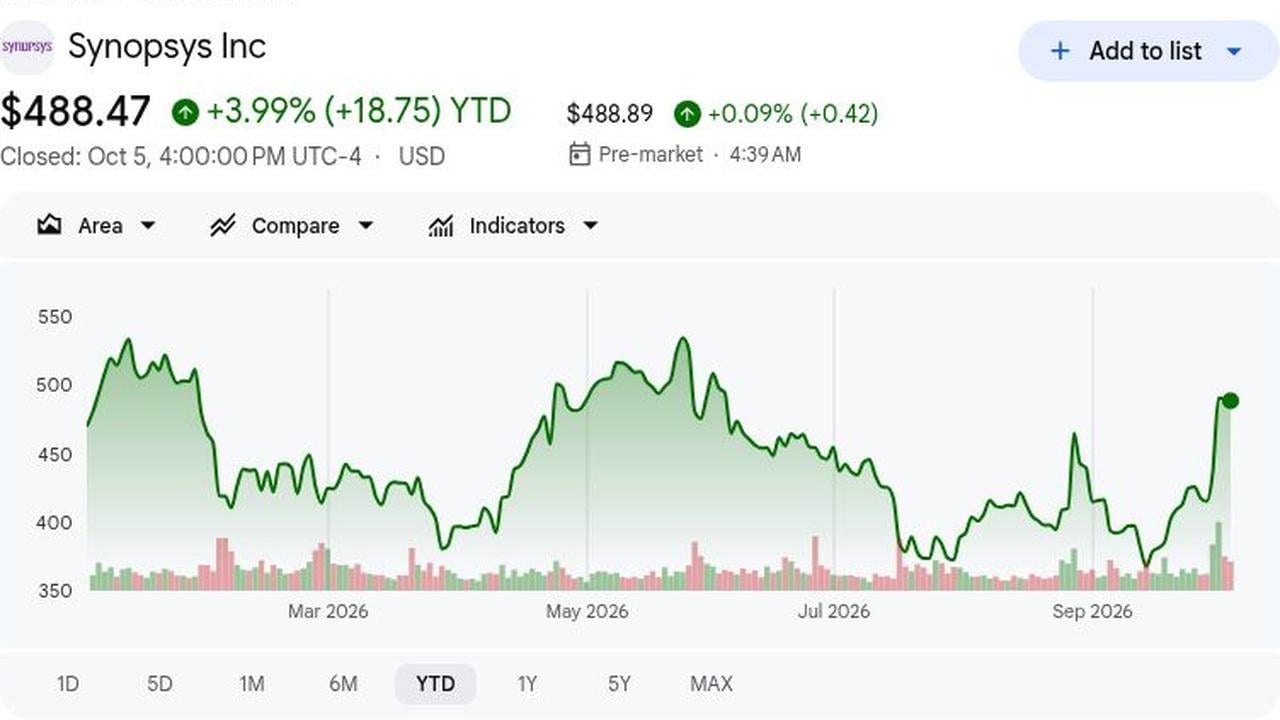
- SNPS closed at $488.47, up 3.99% YTD: After the Investor Day rally, shares remained below the $539.48 52-week high. The October 5 range was $482.16 to $508.38, showing that guidance and AI deals improved sentiment but volatility persists after the sharp repricing.
- Q3 revenue reached $2.477 billion, up 42.4%: It beat the $2.44 billion consensus by $37 million and the guidance ceiling by $17 million. Ansys contributed to growth, so future comparisons must also track organic execution and integration as acquisition effects normalize.
- Design Automation revenue rose 52.7% to $2.003 billion: It supplied 80.9% of sales and $905 million in adjusted operating income. Ansys and EDA demand give Synopsys more opportunity to cross-sell simulation, verification and system-design tools as chip complexity rises.
- Fiscal 2027 revenue guidance reached $11.10 billion to $11.20 billion: The $11.15 billion midpoint stands 3.1% above the $10.81 billion LSEG estimate, while adjusted EPS guidance of $19.04 to $19.12 exceeded the $17.81 consensus. Management also targets about 15% annual revenue growth through fiscal 2030 and an adjusted operating margin near 50%.
- AWS committed more than $1 billion as OpenAI joined an AI program: The multi-year deal covers custom-silicon design and IP; GPT-Synopsys applies an OpenAI model to chip design with revenue sharing. Commercial timing and customer adoption will determine the financial contribution.
What Is Synopsys (SNPS)?
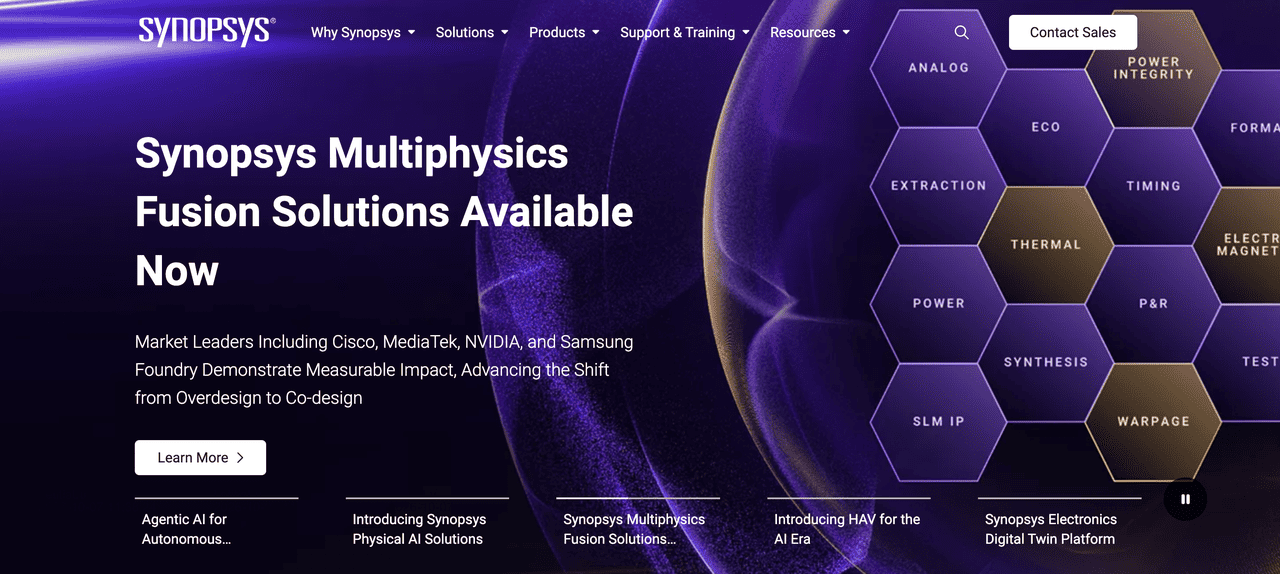
Synopsys develops electronic-design-automation (EDA) software, verification hardware, engineering simulation tools, and reusable semiconductor IP. Chip designers use its products to design and verify complex processors before fabrication, while automotive, aerospace, and industrial engineers use its simulation tools to test larger systems. Its Design Automation business covers chip design, verification, emulation, and manufacturing software, while Design IP licenses reusable interfaces, memories, and security blocks. Much of the business is embedded in long product-development cycles, creating recurring demand for software, IP, and support.
Synopsys is expanding into a broader engineering platform that combines chip design, reusable IP, verification, and system simulation. Ansys adds multiphysics capabilities for electrical, thermal, mechanical, and optical modeling, while partnerships with Amazon, AWS, OpenAI, NVIDIA, and major foundries extend Synopsys into custom silicon, AI-assisted engineering, and advanced manufacturing workflows. These relationships give Synopsys more ways to monetize each stage of product development, though the long-term payoff depends on customer adoption and successful integration of the expanded portfolio.
Read More: Top 10 AI Infrastructure Stocks to Buy in 2026: Chip Manufacturing and Design Leaders
Synopsys (SNPS) Q3 FY2026 Earnings Overview: Revenue and EPS Beat as EDA Growth Lifts Guidance
Synopsys reported Q3 revenue of $2.477 billion versus $2.44 billion consensus and non-GAAP EPS of $3.91 versus $3.67 expected. Design Automation revenue rose 52.7% to $2.003 billion, Design IP grew 10.8% to $473.8 million, and non-GAAP operating margin reached 41.6%. Management raised the FY2026 revenue midpoint to $9.715 billion, lifted EPS guidance to $15.04 to $15.10, and increased free-cash-flow guidance by about $600 million to $2.6 billion, strengthening the earnings outlook despite acquisition costs and higher debt.
Read More: Synopsys (SNPS) Q3 FY2026 Earnings Overview: $2.477B Revenue Lifts a 13.39% Price Rally
|
Financial Metric |
Guidance / Consensus |
Reported / Actual |
Surprise |
|
Q3 FY2026 revenue |
$2.44B consensus; 2.410B-2.460B guidance |
$2.477B |
Beat. $37M above consensus and $17M above the guidance ceiling; up 42.4% YoY. |
|
Q3 non-GAAP diluted EPS |
$3.67 consensus; 3.63-3.69 guidance |
$3.91 |
Beat. $0.24 above consensus and $0.22 above the guidance ceiling. |
|
Q3 GAAP diluted EPS |
$1.50 one year earlier |
$2.84 |
Improved. Increased 89.3% YoY. |
|
Q3 GAAP net income |
$242.5M one year earlier |
$545.8M |
Improved. More than doubled as revenue scaled. |
|
Q3 Design Automation revenue |
$1.312B one year earlier |
$2.003B |
Expanded. Increased 52.7% and represented 80.9% of total revenue. |
|
Q3 Design IP revenue |
$427.6M one year earlier |
$473.8M |
Recovered. Increased 10.8% YoY after earlier execution pressure. |
|
Q3 non-GAAP operating margin |
Prior guidance high end 41.0% |
41.60% |
Beat. Finished 60 basis points above the guidance ceiling. |
|
Nine-month operating cash flow |
$878.9M one year earlier |
$2.299B |
Accelerated. Increased 162% as collections and deferred revenue improved. |
|
FY2026 revenue outlook |
Prior midpoint $9.665B |
9.690B-9.740B |
Raised. New midpoint of $9.715B added $50M. |
|
FY2026 non-GAAP EPS outlook |
Prior midpoint $14.76 |
15.04-15.10 |
Raised. New midpoint of $15.07 increased by $0.31. |
|
FY2026 free cash flow outlook |
Prior outlook about $2.0B |
About $2.6B |
Raised. The target increased by about $600M. |
- Revenue of $2.477 billion beat consensus by $37 million: It also cleared the guidance ceiling by $17 million. The 42.4% increase reflects Ansys and EDA strength, supporting the subsequent FY2027 growth plan and integration work in Q4 ahead.
- Non-GAAP EPS of $3.91 beat consensus by $0.24: It was $0.22 above guidance and up from $3.39 year over year. Profit grew despite acquisition investment, though amortization and stock compensation widen the GAAP-to-adjusted gap and complicate comparisons.
- Design Automation revenue climbed 52.7% to $2.003 billion: Adjusted operating income rose 55% to $905 million and margin expanded to 45.2% from 44.5%. These results suggest Ansys and core EDA can scale together while preserving profitability through continued product integration.
- Design IP revenue returned to 10.8% growth at $473.8 million: Adjusted income rose 45.8% to $125.4 million and margin improved to 26.5% from 20.1%. This recovery supports the royalty-based IP model highlighted at Investor Day and its future earnings contribution.
- Free cash flow guidance rose $600 million to $2.6 billion: Nine-month operating cash flow was $2.299 billion versus $878.9 million a year earlier. Better conversion can fund debt reduction and the planned $1 billion repurchase, supporting per-share earnings over time.
Synopsys (SNPS) 2026 Investment Outlook: $750 Bull Case vs. $390 Bear Case
Synopsys' 2026 outlook depends on whether AI-assisted design, Ansys integration, and Design IP can lift growth while margins expand and debt comes down. The upside comes from deeper hyperscaler partnerships, stronger royalty revenue, and cross-selling, while integration risk, export restrictions, and weaker IP execution remain the main risks.
The Bull Case: Strong AI Design and IP Growth Push SNPS Toward $750
The Bull Case assumes the $1 billion-plus AWS agreement converts into meaningful IP revenue, GPT-Synopsys attracts paying customers, and Ansys cross-selling raises customer spending. Revenue grows faster than the 15% fiscal 2027 plan as royalties scale and adjusted operating margin moves gradually toward the longer-term 50% target.
A move toward $750 would require revenue above $11.20 billion, EPS above $19.12, and enough cash flow to support debt reduction and the $1 billion repurchase. New hyperscaler programs, paid AI-agent adoption, and stronger Design IP growth would strengthen the case.
The Base Case: Steady Growth Keeps SNPS Between $500 and $620
The Base Case assumes Synopsys delivers within its $11.10 billion to $11.20 billion fiscal 2027 revenue range as EDA, Ansys, and IP royalties offset integration costs. AI partnerships build gradually, while roughly $10 billion of debt keeps deleveraging a priority.
SNPS could trade mainly between $500 and $620 if revenue stays within guidance, EPS remains near $19.08, and margin holds around 44%. Weaker Design IP growth, cash conversion, or software pricing would limit the upper end.
The Bear Case: Integration Delays and Export Restrictions Pull SNPS Toward $390
The Bear Case assumes Ansys cross-selling develops more slowly, custom-silicon IP programs are delayed, and tighter export restrictions limit demand. Fixed engineering and acquisition costs would then weigh on margins, while weaker cash flow slows debt repayment.
A move toward $390 would become more likely if revenue falls below $11.10 billion, adjusted margin misses 44%, or Design IP contracts again. Lower earnings estimates and multiple compression would put further pressure on the stock.
SNPS Stock Price Forecasts for 2026 By Wall Street Analysts
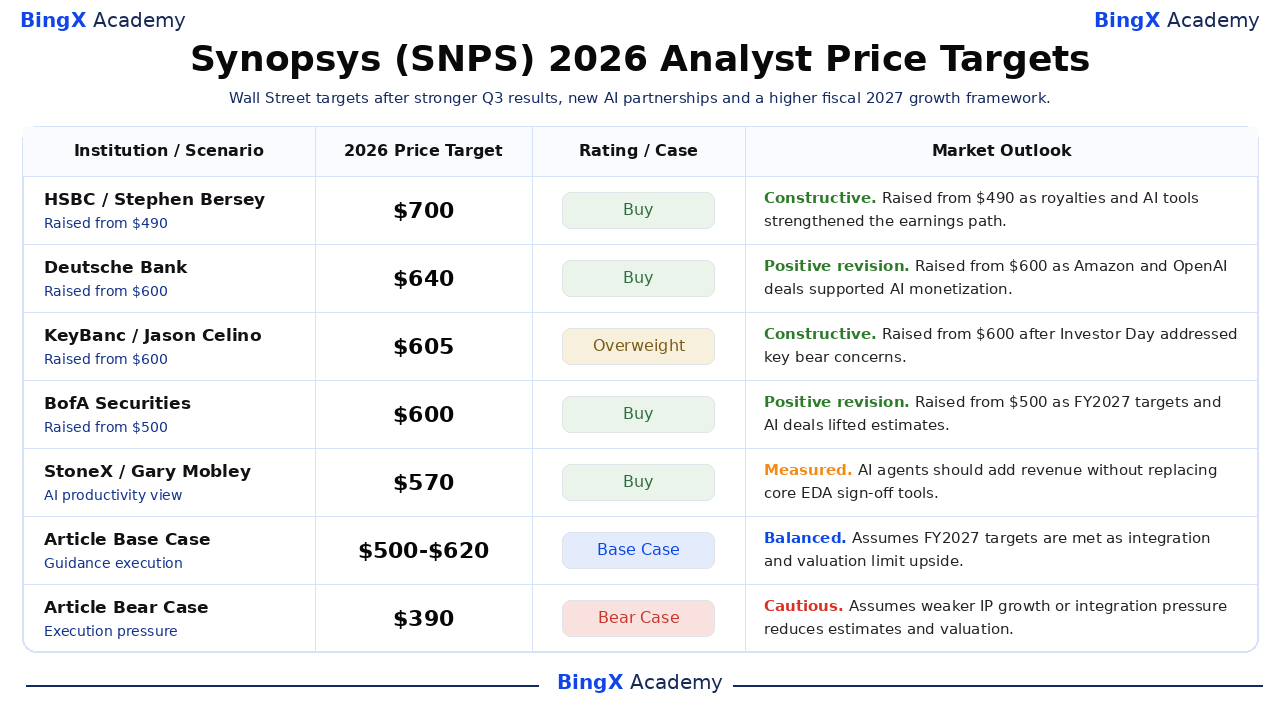
These five dated analyst targets range from $570 to $700 after Q3 and Investor Day. The spread reflects uncertainty around monetization, integration and valuation, rather than a unified consensus. Base and Bear are BingX Academy scenarios, not institutional targets or consensus forecasts.
|
Institution / Scenario |
2026 Price Target |
Rating / Case |
Market Outlook |
|
HSBC / Stephen Bersey |
$700 |
Buy |
Constructive. September 25: upgraded from Hold and raised from $490, citing royalties, AI tools and 28% projected EPS growth through fiscal 2028. |
|
Deutsche Bank / Ross Seymore |
$640 |
Buy |
Positive revision. October 1: raised from $600 as Amazon and OpenAI agreements supported AI monetization. |
|
KeyBanc / Jason Celino |
$605 |
Overweight |
Constructive. October 1: raised from $600 after Investor Day reinforced durable EDA growth. |
|
BofA Securities / Vivek Arya |
$600 |
Buy |
Positive revision. October 1: raised from $500 on FY2027 targets, Ansys synergies and AI partnerships. |
|
StoneX / Gary Mobley |
$570 |
Buy |
Measured. October 1: AI agents could add revenue without replacing core sign-off tools. |
|
Article Base Case |
500-620 |
Base Case |
Balanced. Assumes fiscal 2027 targets are met as integration work, debt reduction and valuation limit upside. |
|
Article Bear Case |
$390 |
Bear Case |
Cautious. Assumes weaker IP growth, export limits or integration pressure reduces estimates and valuation. |
How to Trade Synopsys (SNPS) Stock on BingX
Trade Synopsys' EDA, Ansys and AI-partnership outlook using BingX TradFi and BingX AI. SNPS reacts to guidance, customer deals, export policy and integration, so define the catalyst and risk limits first.
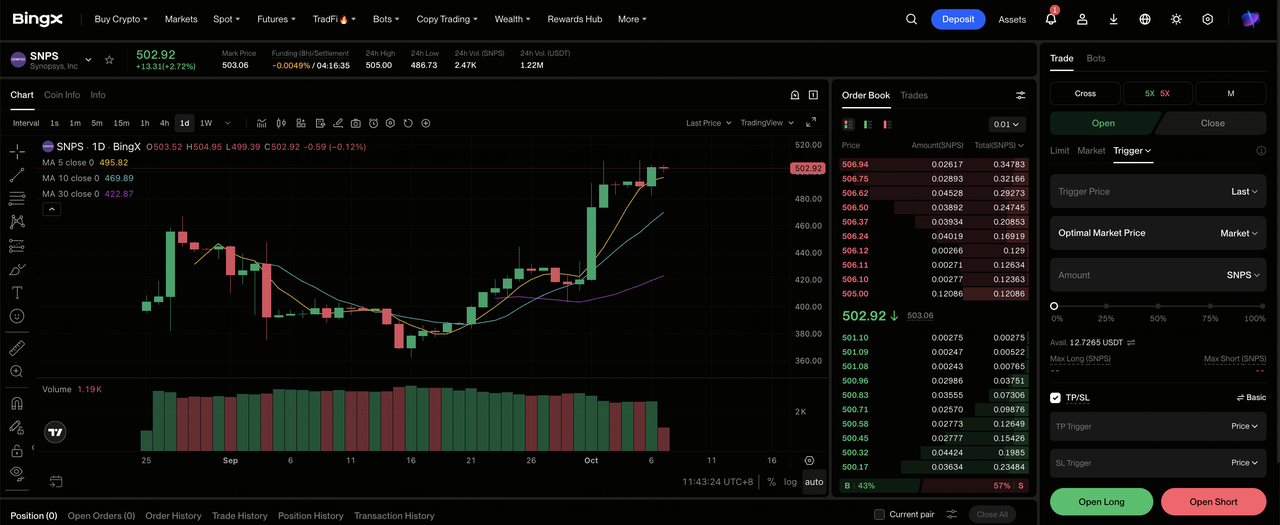
Step 1: Access BingX TradFi. Sign up and navigate to the specialized TradFi section on the BingX exchange dashboard.
Step 2: Select Synopsys (SNPS). Search for and select the SNPS-USDT perpetual futures contract.
Step 3: Choose your direction. Select Open Long if AI partnerships, Ansys cross-selling and royalties support estimates. Select Open Short if integration delays, export restrictions or weaker Design IP threaten earnings.
Step 4: Select leverage and margin mode. Choose Isolated or Cross-Margin based on your risk tolerance. The 13% October 1 rally and October 5 range of $482.16 to $508.38 show why conservative leverage matters.
Step 5: Execute strict risk protocols. Set Take-Profit and Stop-Loss (TP/SL) levels before or immediately after entering the trade. SNPS reacts to EDA demand, IP agreements, guidance, export rules and Ansys integration.
Top 5 Risks to Watch for Synopsys Investors in 2026
The stronger growth framework does not remove the financial, operating and policy variables that can reduce earnings, slow cash conversion and compress per-share value.
- The $35 billion Ansys acquisition adds execution and balance-sheet pressure: Synopsys must integrate products and customer contracts while managing roughly $10 billion of debt. Slower synergies or cash conversion could delay deleveraging and reduce capital for repurchases.
- Export controls can reduce the addressable EDA and IP market: Fiscal guidance assumes no tighter U.S. restrictions or Entity List rules. New limits could delay licenses or block sales to specific customers, reducing high-margin revenue, earnings and the valuation multiple.
- Design IP growth depends on customer program schedules: Q3 IP revenue recovered 10.8% to $473.8 million. A delayed custom-silicon tape-out or hyperscaler production ramp can defer licensing and royalties, weakening revenue visibility and earnings quality.
- AI partnerships must become commercial revenue: GPT-Synopsys and AWS still require product development, customer validation and adoption. Weak uptake would leave Synopsys with added costs but less growth toward its fiscal 2030 targets and delayed revenue contribution.
- A premium valuation amplifies estimate changes: At $488.47, SNPS traded near 86 times trailing GAAP earnings. If fiscal 2027 EPS falls below $19.04 or margin expansion slows, estimate cuts and multiple compression could deepen the share decline.
Final Thoughts: Should You Invest in Synopsys in 2026?
Synopsys entered October with a stronger operating case. Q3 revenue rose 42.4% to $2.477 billion, Design Automation reached $2.003 billion, and non-GAAP EPS climbed to $3.91. The fiscal 2027 revenue target of $11.10 billion to $11.20 billion, combined with new AWS and OpenAI programs, gives investors clearer benchmarks for whether AI-assisted design, IP royalties, and Ansys cross-selling can support the next stage of growth.
The Base Case of $500 to $620 looks reasonable if Synopsys delivers within guidance, keeps Design IP growing, and converts stronger cash flow into debt reduction. The $750 Bull Case requires faster AI monetization, larger royalty contributions, and margin expansion, while the $390 Bear Case becomes more relevant if integration slows, export restrictions tighten, or IP growth weakens again. FY2027 revenue, Design IP growth, operating margin, and cash flow are the key metrics to watch.
Risk Reminder: SNPS trading carries a high risk of capital loss. Integration, debt, export controls, customer timing, AI monetization, and valuation can move shares sharply. Research independently before investing.
Related Reading
- Top AI Semiconductor Stocks to Buy in 2026: AI Chips and Supply Chain Complete Guide
- Top 10 AI Infrastructure Stocks to Buy in 2026: Chip Manufacturing and Design Leaders
- What Is OpenAI Pre-IPO and How to Trade It on BingX?
- NVIDIA (NVDA) Price Prediction 2026: Can AI Infrastructure Growth Drive NVDA Toward $420?
- Amazon (AMZN) Price Prediction 2026: Can AWS and AI Growth Push AMZN Past $400?
- Arm Holdings (ARM) Price Prediction 2026: Can AI Compute Demand Push ARM Toward $350?
