
CFDs and perpetual futures are two of the most common ways to trade an asset's price movements with leverage, without owning the underlying asset. Both let traders go long or short, both use margins, and both can be used for short-term trading or hedging. The differences lie in how each product is structured, what it costs to hold, when it trades, and how positions are liquidated.
This guide explains what CFDs and perpetual futures are, how they compare across the factors that matter most, and how the two products work on BingX, where CFDs and TradFi perpetual contracts both give traders access to markets such as gold, oil, stock indices, and forex.
Key Takeaways
- Both are leveraged derivatives: CFDs and perpetual futures let traders gain exposure to price movements without owning the underlying asset, and both support long and short positions.
- Holding costs work differently: CFDs typically charge an overnight swap fee at daily settlement, while perpetual futures use periodic funding payments exchanged between long and short traders.
- Trading hours differ: CFDs generally follow the underlying market's trading sessions and may pause on weekends, while perpetual futures generally trade around the clock.
- Liquidation methods differ: CFDs are often liquidated based on the margin ratio and Bid/Ask prices, while perpetual futures typically use a mark price.
- On BingX, both are available under TradFi: BingX CFD runs on the MetaTrader 5 (MT5) engine with a dedicated account, while BingX TradFi perpetual contracts use the native BingX interface, so traders can choose the product that fits their strategy.
What Is a CFD?
A CFD, or contract for difference, is a derivative that lets traders speculate on an asset's price without owning the asset itself. Profit or loss is based on the difference between the opening and closing price of the position. Traders go long when they expect prices to rise and short when they expect prices to fall.
Common CFD markets include forex pairs, stock indices, commodities, and precious metals such as gold and silver. Instead of buying and storing physical gold, purchasing every stock in an index, or opening a separate brokerage account, traders can use CFDs to gain price exposure more directly. CFD availability depends on local regulations and is restricted in some jurisdictions.
Read More: What Is BingX CFD and How to Trade CFD on BingX? A Beginner's Guide (2026)
What Are Perpetual Futures?
Perpetual futures are leveraged derivatives with no fixed expiry date. Unlike traditional futures, which settle on a set date and require rolling positions to stay in the market, perpetual contracts can be held open indefinitely. Traders go long or short without owning the underlying asset, and positions remain open until they are closed or liquidated.
Because there is no expiry, perpetual futures use a funding rate mechanism to keep the contract price aligned with the underlying market. When the contract trades above the reference price, funding is typically positive and long positions pay short positions; when it trades below, funding can turn negative and short positions pay long positions. This exchange happens directly between traders at set intervals.
Read More: How to Get Started with Perpetual Futures Trading on BingX: A 2026 Beginner's Guide
CFDs vs. Perpetual Futures: Key Differences Explained
CFDs and perpetual futures share the same core purpose, leveraged exposure without ownership, but differ across the factors that shape day-to-day trading. The table below sets them side by side.
|
Feature |
CFD |
Perpetual Futures |
|
Product type |
Leveraged derivative |
Leveraged derivative |
|
Ownership |
No |
No |
|
Expiry date |
None, held until closed |
None, held until closed |
|
Direction |
Long and short |
Long and short |
|
Main holding cost |
Overnight swap fee |
Funding payments |
|
Trading hours |
Follows the underlying market, may pause on weekends |
Generally available 24/7 |
|
Liquidation basis |
Margin ratio and Bid/Ask prices |
Mark price |
|
Order sizing |
Standard lot sizes |
Contract-based sizing |
1. Holding costs: swap fees vs. funding payments
A CFD position held past the daily settlement time may be charged or credited a swap fee, which reflects the financing cost of the leveraged position and varies by instrument and direction. A perpetual futures position instead pays or receives funding at set intervals, exchanged directly between long and short traders. The cheaper option depends on the instrument, position direction, and holding period.
2. Trading hours: market sessions vs. around the clock.
CFDs typically follow the trading hours of the underlying market. A stock index CFD, for example, may pause outside its market session and on weekends, creating the possibility of price gaps when trading resumes. Perpetual futures generally trade around the clock, offering continuous market access.
3. Liquidation: Bid/Ask vs. mark price.
Both products can be liquidated if account margin falls too low, but the reference price can differ. CFDs are often settled against the actual Bid/Ask price, while perpetual futures typically use a mark price designed to reduce the impact of short-lived abnormal price movements. Traders should maintain a sufficient margin buffer under either product.
CFDs vs. Perpetual Futures on BingX: Which Should You Choose?
On BingX, both CFDs and TradFi perpetual futures provide leveraged exposure to traditional assets such as gold, oil, forex, and stock indices without owning the underlying instrument. The main differences are the trading interface, account structure, holding costs, trading hours, and liquidation method.
|
Feature |
BingX TradFi CFD |
BingX TradFi Perpetual Futures |
|
Interface |
BingX App, web, or optional MT5 |
Native BingX contract interface |
|
Account |
Dedicated CFD account funded in USDx |
Contract account funded with USDT |
|
Holding cost |
Swap fee at daily settlement |
Funding payments at set intervals |
|
Trading hours |
Follows the underlying market |
Generally available 24/7 |
|
Liquidation basis |
Margin ratio and Bid/Ask prices |
Mark price |
|
Order sizing |
Standard lot sizes |
Contract-based sizing |
- CFDs may suit traders who prefer traditional market tools: They use a dedicated CFD account, support MT5, follow underlying market hours, and use standard lot sizing.
- Perpetual futures may suit traders who prefer continuous contract trading: They use the native BingX interface, settle in USDT, support contract-based sizing, and generally trade around the clock.
Neither product is inherently better. The right choice depends on the asset, preferred interface, trading hours, and expected holding cost.
How to Trade a CFD on BingX: A Step-by-Step Guide
CFDs are traded under TradFi using a dedicated CFD account funded in USDx. Orders can be placed in the BingX App or on the web, with the MT5 terminal optional for advanced tools.
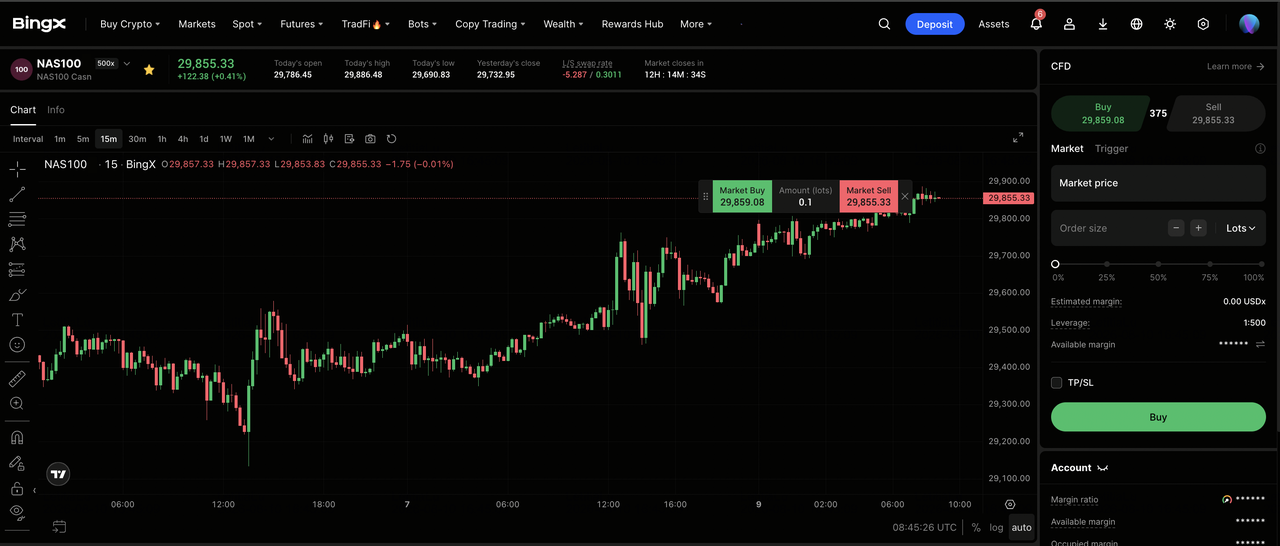
Step 1: Account setup and security. Sign up and log into your BingX account, complete the identity verification (KYC) required in your region, and enable two-factor authentication.
Step 2: Open the CFD trading page. Go to "TradFi > CFD" from the BingX navigation bar. If you have not used CFDs before, activate your dedicated CFD account. BingX will also display your MT5 ID and server address for future MT5 access.
Step 3: Fund your CFD account. Select "Transfer" and move USDT from another BingX account into the CFD account. The funds are converted to USDx at a 1:1 ratio and used as margin.
Step 4: Choose an instrument. Browse Metals, Stock Indices, Forex, or Commodities, or search directly for a symbol.
Step 5: Place your trade. Choose a "Market Order" for immediate execution or a "Trigger Order" to enter at a specified price. Enter your position size in lots, then select "Buy" to go long or "Sell" to go short. You can also set take-profit and stop-loss levels.
Step 6: Manage and close the position. Monitor the trade under "Positions," including floating profit or loss and margin status. You can close the position manually or manage risk using take-profit, stop-loss, or trigger settings.
How to Trade a TradFi Perpetual Contract on BingX: A Step-by-Step Guide
TradFi perpetual contracts are traded through the native BingX contract interface using a contract account funded with USDT.
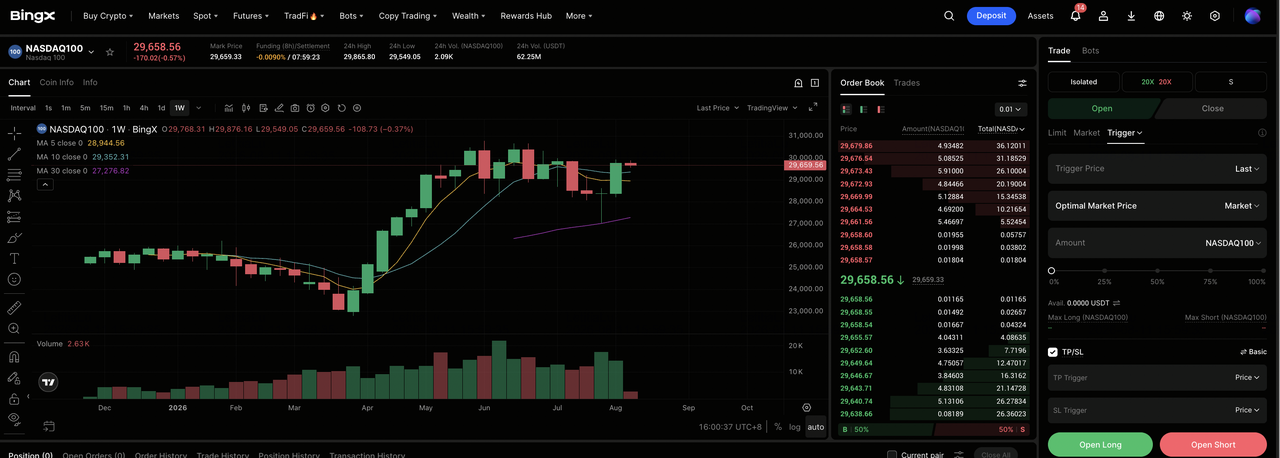
Step 1: Access BingX TradFi. Sign up and navigate to the specialized TradFi section on the main BingX exchange dashboard.
Step 2: Open the perpetual futures market. Go to the TradFi perpetual futures section and search for the contract you want to trade.
Step 3: Fund your contract account. Transfer USDT into your contract account if needed. USDT is used as margin and for settlement.
Step 4: Set leverage and margin mode. Choose the leverage level and margin mode before placing the trade. Higher leverage reduces the upfront margin requirement but increases liquidation risk.
Step 5: Place your trade. Choose a "Market Order" for immediate execution or a "Limit Order" at a specified price. Enter your position size, then select "Open Long" if you expect gold to rise or "Open Short" if you expect it to fall.
Step 6: Manage the position. Monitor your position, funding payments, margin, and liquidation price in the positions panel. You can close the trade manually or set Take-Profit and Stop-Loss (TP/SL) levels to manage risk.
5 Key Risks to Know Before Trading CFDs and Perpetual Futures
CFDs and perpetual futures both use leverage, so even relatively small market moves can lead to significant losses or liquidation.
- Leverage can magnify losses: Adverse price moves can quickly consume deposited margin, making position sizing and stop-loss management important.
- Liquidation can occur: Positions may be force-closed if margin falls below the required level. Maintaining sufficient available margin can help reduce this risk.
- Holding costs can add up: CFD swap fees and perpetual futures funding payments may accumulate over longer holding periods and reduce returns.
- Trading hours create different risks: CFDs can gap when underlying markets reopen, while perpetual futures trade continuously and may still experience sharp moves during volatile periods.
- Availability varies by region: Access depends on local eligibility and supported jurisdictions, and product rules may differ by market.
Final Thoughts: Choosing Between CFDs and Perpetual Futures
CFDs and perpetual futures both provide leveraged exposure without requiring ownership of the underlying asset, but they differ in how they are traded. CFDs use swap fees and generally follow traditional market hours, while perpetual futures use funding payments and typically trade around the clock. On BingX, both are available through TradFi across markets including gold, oil, forex, and stock indices.
The better fit depends on the trader’s preferred interface, market hours, cost structure, and holding period. Because both products use leverage, traders should understand margin requirements, liquidation rules, and ongoing fees before opening a position.
Reminder: This article is for informational purposes only and does not constitute investment advice. CFDs and perpetual futures are leveraged products and can result in substantial losses, including the loss of your entire margin.
Related Reading
- What Is BingX CFD and How to Trade CFD on BingX? A Beginner's Guide (2026)
- How to Trade Oil CFDs on BingX: WTI, Brent, Natural Gas & More (2026)
- How to Trade Index CFDs on BingX: S&P 500, Nasdaq 100, Nikkei 225 & More (2026)
- Gold CFDs vs. Gold Perpetual Futures vs. Tokenized Gold (XAUT): Key Differences and Which Should You Choose?
FAQs About CFDs vs. Perpetual Futures
1. What is the difference between CFDs and perpetual futures?
CFDs typically use swap fees and follow underlying market hours. Perpetual futures have no expiry, use funding payments, and generally trade around the clock.
2. Are CFDs the same as futures?
No. CFDs are over-the-counter derivative contracts, while futures are standardized derivative contracts. Perpetual futures are a type of futures contract with no fixed expiry date.
3. Which is cheaper to trade, CFDs or perpetual futures?
It depends on the instrument and holding period. CFDs may charge overnight swap fees, while perpetual futures use periodic funding payments.
4. Can you trade CFDs and perpetual futures with leverage?
Yes. Both use margin and leverage, which can magnify gains and losses and may lead to liquidation.
5. Can you trade the same assets with CFDs and perpetual futures?
Often, yes. On BingX, markets such as gold, oil, forex, and stock indices may be available through both CFDs and TradFi perpetual futures.
6. What is the difference between CFDs and perpetual futures on BingX?
BingX CFDs use a dedicated CFD account, USDx margin, MT5 support, and swap fees. BingX TradFi perpetual futures use the native contract interface, USDT settlement, funding payments, and mark-price liquidation.
