

Stablecoins are cryptocurrencies designed to maintain a constant value typically pegged 1:1 to the US dollar by holding equivalent reserves in cash, government bonds, or other liquid assets. They act as the settlement layer of crypto: traders use them to move between positions, exchanges use them for trading pairs, and institutions use them for cross-border payments.
The stablecoin market has grown to over $230 billion in total supply, with USDT and USDC dominating, but two newer challengers, Ripple's RLUSD and First Digital's FDUSD, are carving out significant territory in 2026 and reshaping how exchanges and institutions think about dollar-pegged settlement.
In this guide, you will learn why BUSD's collapse created an opening for both assets, how RLUSD and FDUSD differ in structure, reserves, and regulatory standing, which offer better yield opportunities, and how to trade both stablecoins on BingX.
Read more: A Beginner's Guide to Stablecoins and How They Work (2026)
Life After Binance USD (BUSD): How the New Stablecoin Race Began
To understand the RLUSD vs. FDUSD dynamic, you need to understand what BUSD was and why its collapse in 2023 mattered so much.
Binance USD (BUSD) was the exchange-native stablecoin that dominated Binance's trading ecosystem from 2019 to 2023. At its peak, it held a $23 billion market cap and was used across thousands of Binance trading pairs. Then, in February 2023, the SEC issued a Wells Notice to Paxos, the issuer behind BUSD and the New York Department of Financial Services ordered Paxos to stop minting new BUSD tokens. Within months, BUSD began winding down entirely.
The collapse of BUSD carried a lesson that every exchange-native stablecoin has had to grapple with: regulatory goodwill is not permanent, and a stablecoin built entirely on one jurisdiction's tolerance can evaporate overnight.
Two very different responses emerged:
FDUSD (First Digital USD), issued by Hong Kong-based First Digital Trust, stepped into the Binance liquidity vacuum by mid-2023 with a Hong Kong-regulated structure that kept it outside direct US regulatory reach. Binance promoted it aggressively through zero-fee trading pairs, and FDUSD surged past a $2.5 billion market cap by early 2024, fuelled almost entirely by Binance's promotional infrastructure.
RLUSD (Ripple USD) took the opposite approach. Issued under a New York State Department of Financial Services charter, RLUSD positioned itself as the compliance-first stablecoin for institutional players. Rather than chasing retail volume, Ripple aimed at enterprise remittance corridors, leveraging its network of over 300 financial institutions. By late 2025, RLUSD had crossed $773 million in market cap modest by total stablecoin standards but backed by serious institutional infrastructure and audited by Deloitte.
The Significance of BUSD's Collapse
FDUSD and RLUSD each drew a different lesson from BUSD's regulatory exit:
- FDUSD's lesson: stay offshore, maximize utility within the Binance ecosystem, and grow market cap through liquidity incentives rather than regulatory positioning
- RLUSD's lesson: build the deepest institutional credibility possible: NYDFS charter, BNY Mellon custody, Big Four attestations to make stablecoin regulation-proof by design
The result is two stablecoins that are almost perfectly complementary in their market positioning, which makes the "war" framing somewhat misleading. They are fighting for different territories.
What Is RLUSD? Ripple's Institutional Stablecoin
RLUSD (Ripple USD) is a US dollar-pegged stablecoin issued by Standard Custody, a Ripple affiliate, under a New York State Department of Financial Services (NYDFS) charter. It launched in late 2024 and is designed primarily for institutional use cases — enterprise remittances, cross-border payments, and bank-grade on-chain settlement.
RLUSD Key Facts
|
Feature |
Detail |
|
Issuer |
Standard Custody (Ripple affiliate) |
|
Regulator |
NYDFS (New York State) |
|
Primary custodian |
BNY Mellon |
|
Reserve auditor |
Deloitte (attestation, late 2025) |
|
Reserve composition |
USD, short-term US Treasuries, cash equivalents |
|
Reserve coverage |
~103% (overcollateralised per Deloitte attestation) |
|
Market cap (Q1 2026) |
~$773 million |
|
Blockchain(s) |
XRP Ledger, Ethereum |
|
Primary use case |
Institutional DeFi, cross-border settlement, enterprise treasury |
Is RLUSD the Same as XRP?
No and this is one of the most commonly searched questions about Ripple's products. RLUSD is not XRP. XRP is Ripple's native blockchain token, a volatile cryptocurrency used for liquidity and transaction fees on the XRP Ledger. RLUSD is a separate, dollar-pegged stablecoin that also runs on the XRP Ledger but maintains a fixed $1 value through reserve backing. They are different assets entirely.
Is XRP a stablecoin?
No. XRP is a freely floating cryptocurrency whose price is determined by market supply and demand it is not pegged to any fiat currency and has no reserve backing. RLUSD is the stablecoin issued by Ripple; XRP is Ripple's native network token.
Why Institutional Traders Prefer RLUSD
RLUSD's reserve model is what sets it apart for institutional counterparties. Ripple selected BNY Mellon, one of the world's largest custody banks, as the primary custodian for RLUSD reserves. In late 2025, Deloitte issued an attestation confirming reserves of approximately $773 million against circulating supply, representing a 103%+ coverage ratio.
The NYDFS charter requires Standard Custody to back RLUSD 100% with highly liquid, short-term, transparent reserves. For US financial institutions navigating post-GENIUS Act compliance requirements, this regulatory provenance provides a level of certainty that offshore-issued stablecoins structurally cannot match.
What Is FDUSD? Binance's In-House Stablecoin Champion
FDUSD (First Digital USD) is a US dollar-pegged stablecoin issued by First Digital Trust, a Hong Kong-based licensed trust company. It launched in mid-2023 as the primary replacement for BUSD within the Binance ecosystem and has grown into one of the most liquid stablecoins in Asia-Pacific crypto markets.
FDUSD Key Facts
|
Feature |
Detail |
|
Issuer |
First Digital Labs / First Digital Trust |
|
Regulator |
Hong Kong regulators |
|
Reserve composition |
Cash and cash equivalents, fully segregated accounts |
|
Reserve reporting |
Monthly attestation reports |
|
Market cap (Q1 2026) |
~$2.5 billion+ |
|
Blockchain(s) |
BNB Smart Chain, Ethereum, Solana, Sui, Arbitrum, TON |
|
Primary use case |
Binance trading pairs, Launchpool farming, Asian market settlement |
FDUSD's Stress Test
FDUSD's credibility was tested dramatically in early 2025 when a rumour-sparked liquidity run briefly pushed its peg off $1. The issuer's rapid disclosure of audited holdings and immediate secondary-market support restored the peg within twelve hours, a real-world demonstration of how a transparent reserve model performs under genuine market stress.
Market observers called it a resilient performance; the episode is now frequently cited as evidence that FDUSD's reserves are genuinely accessible and not hypothetically segregated.
FDUSD has since expanded beyond BNB Chain to Solana, Sui, Arbitrum, and natively to TON, plugging into Telegram's user base of over one billion monthly active users and opening a pathway into everyday payment flows that no institutional stablecoin has yet matched.
RLUSD vs. FDUSD: Side-by-Side Comparison
|
Feature |
RLUSD |
FDUSD |
|
Issuer |
Standard Custody (Ripple) |
First Digital Trust |
|
Regulatory jurisdiction |
USA (NYDFS — strictest state regulator) |
Hong Kong |
|
Market cap (2026) |
~$773M — growing fast |
~$2.5B — established |
|
Primary blockchain |
XRP Ledger + Ethereum |
BNB Smart Chain (+ 5 others) |
|
Reserve auditor |
Deloitte (Big Four) |
Independent CPA |
|
Reserve coverage |
~103% (overcollateralised) |
100% backed |
|
Peg stress test |
Not yet stress-tested at scale |
Survived Q1 2025 depeg event |
|
Best yield opportunities |
Institutional DeFi, enterprise settlement |
Binance Launchpool, PancakeSwap, BNB Simple Earn |
|
Best for |
US institutions, compliance-first traders |
Binance ecosystem users, Asian market traders |
|
Growth trajectory |
Forecast $2.5B+ by end 2026 (CoinDesk Research) |
Established incumbent in BSC ecosystem |
|
GENIUS Act compliance |
Structurally compliant (NYDFS charter) |
Compliant via reporting standards |
Transparency and Reserves: Which Is the Safer Stablecoin, RLUSD or FDUSD?
Reserve transparency has become the central battleground in the stablecoin market accelerated by the GENIUS Act, signed into law in 2025. The GENIUS Act mandated 1:1 reserve backing with high-quality liquid assets and monthly transparency reports for all US payment stablecoins. Both RLUSD and FDUSD meet this bar, but in meaningfully different ways.
RLUSD Reserve Structure
RLUSD publishes monthly attestation reports conducted by an independent CPA, adhering to AICPA standards. Reserves are held in segregated accounts at depository institutions and securities custodians, backed by US dollars, short-term Treasuries, and cash equivalents.
The Deloitte attestation provided an external benchmark confirming that reserve assets exceeded circulating supply a 103%+ coverage ratio per public disclosures.
The key structural advantage: RLUSD operates under NYDFS oversight with direct ties to US Treasury infrastructure through its BNY Mellon custodianship. For US institutions, this removes counterparty risk in a way that Hong Kong-regulated assets cannot.
FDUSD Reserve Structure
FDUSD also publishes monthly attestation reports confirming 100% backing by cash and cash equivalents held in fully segregated accounts with a licensed custodian. Its 2025 depeg event and subsequent rapid resolution demonstrated that the reserves are genuinely liquid and deployable under pressure not just claims on paper.
The key structural advantage: FDUSD is deeply integrated into the most liquid trading infrastructure in Asia. Its Hong Kong regulatory status positions it optimally for traders and institutions operating in Asia-Pacific markets where US regulatory requirements are less relevant.
The Jurisdictional Reality
|
Consideration |
RLUSD advantage |
FDUSD advantage |
|
US regulatory compliance |
NYDFS — highest US standard |
Hong Kong only |
|
Asian market positioning |
Less relevant |
Optimised for Asia-Pacific |
|
Reserve transparency |
Big Four (Deloitte) |
Independent CPA |
|
Institutional trust (US) |
BNY Mellon custody |
— |
|
Binance ecosystem integration |
Listing only (no deep integration yet) |
Deeply embedded |
Neither stablecoin is objectively safer; each is safer for a specific type of user and use case.
Yield Opportunities: Where to Earn on Your Stablecoins
For holders seeking yield on stablecoin positions, the two assets offer very different opportunity landscapes.
FDUSD Yield Options
FDUSD holds a privileged position in the Binance yield ecosystem:
- Binance Launchpool: One of the most lucrative low-risk features in crypto. Users stake FDUSD to farm newly listed tokens before they hit the open market. Staked assets are returned in full at the end of the farming period (typically 3–7 days), along with the farmed tokens. This is effectively zero-risk yield in the form of new token allocations.
- Binance Simple Earn: Flexible and locked staking products with yields ranging from 2% to over 10% APY depending on lock-up periods and specific programmes.
- PancakeSwap Liquidity Provision: FDUSD/USDT and FDUSD/BNB liquidity pools on PancakeSwap offer additional yield through trading fee share and CAKE rewards. This is within the broader BNB Chain ecosystem where FDUSD has deep, native liquidity.
- Venus Protocol: FDUSD can be lent on Venus (BSC's leading lending protocol) to earn interest from borrowers, with rates determined by real-time utilisation of each lending pool.
RLUSD Yield Options
RLUSD is a newer entrant to yield programmes but growing:
- Binance Earn integration announced but still rolling out as of Q2 2026. Will eventually compete for the same stablecoin yield pools as FDUSD within the Binance ecosystem.
- Institutional DeFi: RLUSD's best yield opportunities currently exist in enterprise treasury and institutional DeFi contexts, where Ripple's 300+ financial institution network creates bespoke settlement and lending arrangements unavailable to retail users.
- XRP Ledger AMMs: Automated market makers on the XRP Ledger now support RLUSD liquidity provision, offering yield from trading fees on Ripple's native network.
RLUSD vs. FDUSD Stablecoin Yield Comparison
|
Yield opportunity |
RLUSD |
FDUSD |
|
Binance Launchpool |
Not yet available |
Available — flagship feature |
|
Binance Simple Earn |
Rolling out |
Available |
|
BSC DeFi (PancakeSwap, Venus) |
Limited |
Deep integration |
|
Institutional DeFi |
Primary use case |
Limited |
|
TON ecosystem |
- |
Native on TON |
Practical verdict for retail traders in 2026: FDUSD offers more on-chain yield pathways, particularly within the Binance and BNB Chain ecosystems. RLUSD's yield case is institutional-grade and still maturing for retail access.
2026 Outlook: Which Stablecoin Will Dominate Between RLUSD and FDUSD?
The most likely outcome by the end of 2026 is a functional duopoly not a winner-takes-all result.
FDUSD's dominance will continue in:
- Retail trading pairs on Binance and BSC
- Launchpool and DeFi yield mechanics
- Asian payment flows via TON integration
- The BNB NFT ecosystem and gaming economies on BSC
RLUSD's growth will come from:
- US-regulated institutional adoption (post-GENIUS Act)
- Enterprise cross-border payments via Ripple's 300+ institution network
- Analysts forecast RLUSD surpassing $2.5 billion market cap by end of 2026 (CoinDesk Research)
- Ripple's application for a US national bank charter if successful, would make RLUSD a bank-grade asset
What both stablecoins share: a clear lesson from BUSD's collapse. Both are built around a defined regulatory identity rather than pure exchange loyalty. FDUSD is the compliant Asian incumbent. RLUSD is the compliant US institutional challenger. The stablecoin wars of 2026 are not about who destroys whom they are about who carves the most defensible territory before the next regulatory cycle arrives.
How to Trade RLUSD and FDUSD on BingX
BingX lists FDUSD directly, giving traders immediate access to one of the most liquid stablecoins in the BNB Chain ecosystem. Here is how to use both stablecoins effectively on BingX.
How to Buy FDUSD on BingX: Step-by-Step
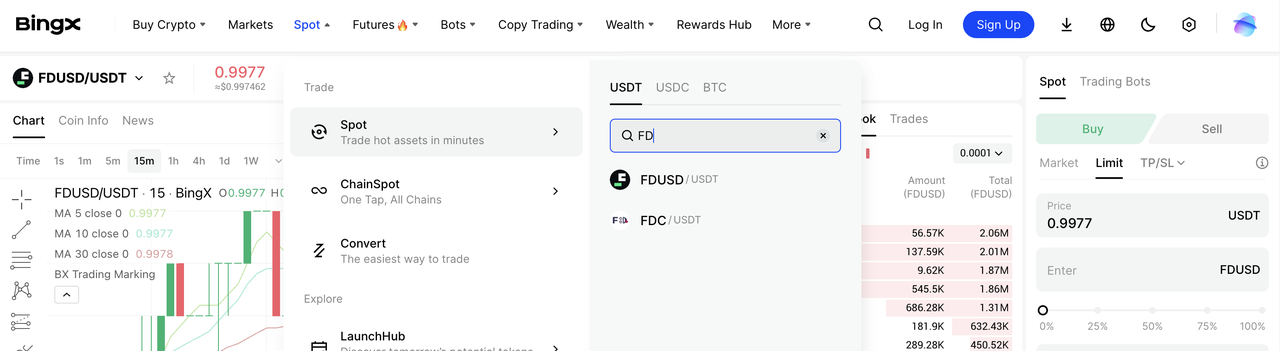
- Log in to BingX and navigate to Spot Trading
- In the search bar, type FDUSD or go directly to the FDUSD/USDT pair
- Choose your order type:
- Limit order: Set your price at $1.000 (FDUSD should trade at or extremely close to $1) and wait for it to fill. This is recommended — you pay the maker fee and avoid any micro-slippage
- Market order: Fills immediately at the current best price. Slightly higher cost due to taker fee
- Enter the amount of USDT you want to convert to FDUSD
- Click Buy FDUSD to confirm
- Your FDUSD balance will appear in your spot wallet immediately upon fill
Use RLUSD and FDUSD Stablecoins in Spot Trading
Once you buy FDUSD on BingX, you can use it as a base currency across FDUSD trading pairs on supported trading platforms. Use limit orders rather than market orders to minimize slippage when converting between stablecoin positions, a key principle covered in our spot trading guide.
- Using stablecoins in perpetuals: Stablecoins serve as margin collateral in futures and perpetual trading. Understanding which stablecoin you are using as collateral matters, different stablecoins may have different withdrawal speeds and fee structures. Review our risk management guide for best practices on position sizing when using stablecoin collateral in leveraged trades.
- Evaluating stablecoin positions with the Sharpe ratio: Stablecoin yield strategies, particularly Launchpool farming and liquidity provision, can be evaluated using risk-adjusted return metrics. Our Sharpe ratio guide explains how to measure whether the yield you are earning justifies the smart contract and liquidity risk involved.
- Copy trading stablecoin strategies: Some BingX copy traders specialize in stablecoin yield maximization, deploying capital into high-APY pools and farming opportunities while managing risk. You can evaluate these strategies on BingX's copy trading platform by reviewing their drawdown history and performance during volatile periods, such as the FDUSD depeg event in early 2025.
Conclusion
The stablecoin landscape in 2026 is not about one asset replacing another, it is about regulatory clarity and defined use cases replacing speculative market positioning. BUSD's collapse proved that exchange-native stablecoins without regulatory grounding are fragile. RLUSD and FDUSD each absorbed that lesson and built defensible moats: RLUSD through NYDFS compliance and Big Four auditing, FDUSD through BSC integration and real-world stress testing.
For most retail traders, FDUSD remains the most immediately useful stablecoin. If you operate within the Binance and BNB Chain ecosystem, the yield opportunities, DeFi integrations, and Launchpool mechanics are unmatched. For institutional and US-based participants, RLUSD's regulatory provenance offers structural advantages that will become increasingly valuable as GENIUS Act compliance requirements take effect across the industry.
Understanding stablecoins and which ones are genuinely safe versus merely convenient, is a foundational skill for anyone trading crypto seriously in 2026. The tools covered in our trading journal guide are applicable to tracking stablecoin yield performance as well as directional trades.
Related Articles
- Binance Smart Chain vs. BNB Smart Chain: Clearing the Confusion
- BNB NFTs in 2026: Top Collections, Marketplaces & How to Get Started
- Altcoin Season: What It Is, How to Spot It, and How to Trade It
- Risk Management in Crypto Trading: 7 Rules Every Trader Must Know
- Implied Volatility in Crypto: What It Means and How to Trade It
FAQs on RLUSD vs. FDUSD Stablecoins
1. What is RLUSD?
RLUSD is a US dollar-pegged stablecoin issued by Standard Custody, a Ripple affiliate, under a New York State Department of Financial Services charter. It maintains a 1:1 peg with the US dollar through reserves held at BNY Mellon, backed by USD, short-term Treasuries, and cash equivalents. As of late 2025, its reserves were independently audited by Deloitte at approximately 103% of circulating supply.
2. What is FDUSD?
FDUSD (First Digital USD) is a US dollar-pegged stablecoin issued by First Digital Trust, a Hong Kong-licensed trust company. Launched in mid-2023 as a replacement for BUSD in the Binance ecosystem, it maintains 100% reserve backing confirmed by monthly attestation reports. It is deeply integrated into Binance's trading infrastructure, Launchpool farming, and BNB Chain DeFi.
3. Is XRP a stablecoin?
No. XRP is Ripple's native blockchain token — a freely floating cryptocurrency whose price fluctuates based on market supply and demand. It is not pegged to any fiat currency and carries no reserve backing. RLUSD is the separate, dollar-pegged stablecoin issued by Ripple; XRP is the native network token. They are entirely different assets.
4. What happened to BUSD?
BUSD (Binance USD) was shut down in early 2023 after the SEC issued a Wells Notice to its issuer Paxos, and the New York Department of Financial Services ordered Paxos to halt new minting. BUSD's market cap shrank from $23 billion to near-zero as users migrated to alternatives. FDUSD and USDT absorbed the bulk of displaced BUSD liquidity on Binance.
5. What is the U.S. GENIUS Act and how does it affect stablecoins?
The GENIUS Act is US federal legislation signed into law in 2025 that established regulatory requirements for payment stablecoins. It mandates 1:1 reserve backing with high-quality liquid assets, monthly transparency reports, and compliance with US financial oversight frameworks. RLUSD, issued under an NYDFS charter, is structurally compliant. FDUSD, regulated in Hong Kong, meets GENIUS Act standards through its reporting infrastructure but lacks direct US regulatory oversight.
6. Which stablecoin is safer, RLUSD or FDUSD?
Both maintain transparent, fully backed reserves — neither is inherently unsafe. The distinction is jurisdictional: RLUSD offers stronger compliance assurances for US institutions through its NYDFS charter and BNY Mellon custody. FDUSD is better positioned for traders in Asia-Pacific markets or anyone operating primarily within the Binance ecosystem. Your "safer" stablecoin depends on your regulatory environment and use case.
7. Where can I earn yield on stablecoins like RLUSD and FDUSD in 2026?
FDUSD offers the richest retail yield ecosystem through Binance Launchpool (farm new tokens for 3–7 days), Binance Simple Earn (2–10%+ APY), PancakeSwap liquidity provision, and Venus lending on BNB Chain. RLUSD's best yield opportunities are currently institutional — enterprise DeFi, Ripple network settlement, and XRP Ledger AMMs. Binance Earn integration for RLUSD is rolling out through 2026.
8. Can I trade RLUSD and FDUSD on BingX?
FDUSD is listed directly on BingX and can be traded immediately via the FDUSD/USDT spot pair. To buy FDUSD, navigate to Spot → search FDUSD/USDT → place an order. RLUSD is not currently listed on BingX as a direct trading pair — for the most up-to-date pair availability across all stablecoins, check BingX's spot market directly.
9. What is the difference between RLUSD and USDC?
Both RLUSD and USDC are USD-pegged stablecoins with strong compliance credentials. USDC is issued by Circle, co-founded with Coinbase, and holds approximately $40+ billion in market cap — making it the dominant institutional stablecoin. RLUSD is smaller (~$773M), issued by Ripple, and specifically designed for cross-border payment use cases within Ripple's financial institution network. USDC has broader DeFi and institutional integration; RLUSD has a more focused enterprise remittance angle.
