
As decentralized digital ecosystems evolve toward autonomous machine interactions, the structural challenge of securely scaling transaction clearing without human oversight has reached a critical bottleneck. Conventional Internet of Things (IoT) ecosystems rely heavily on centralized cloud intermediaries to coordinate data exchange, clear payments, and enforce system security. When these centralized nodes face connectivity gaps, latency bottlenecks, or cyber attacks, the entire network's operational flow breaks down, trapping device capability within passive boundaries.
SEALCOIN (QAIT) solves this systemic vulnerability by introducing an autonomous machine-to-machine transaction framework that abstracts complex, secure physical identities into programmatic, on-chain value exchanges. Developed by SEALCOIN AG, a Swiss-based subsidiary of NASDAQ-listed cybersecurity pioneer WISeKey International Holding Ltd., in partnership with The Hashgraph Group AG, SEALCOIN bridges physical hardware security with the high-throughput, enterprise-grade infrastructure of the Hedera network.
By anchoring millions of physical devices into a post-quantum cryptographic envelope, SEALCOIN allows machines to act as self-governing economic actors, executing micro-payments, buying resource capacity, and trading data independently across decentralized networks. This guide explores the foundational technology, architecture, and tokenomics of SEALCOIN (QAIT), giving you everything you need to navigate and trade the emerging machine-to-machine economy on BingX.
What Is SEALCOIN (QAIT)?
SEALCOIN is a security-first, hardware-to-ledger machine transaction network that delivers real-time, tamper-proof settlements for the automated machine economy. At its core, the project addresses three fundamental challenges in the modern IoT and AI agent sectors:
- Transactional Isolation: Traditional IoT networks generate passive telemetry but cannot transfer economic value autonomously; SEALCOIN transforms devices into transactional units capable of independent negotiation and payment.
- Security Vulnerabilities: Conventional devices are exposed to edge computing cyber exploits; SEALCOIN integrates hardware-level secure elements and post-quantum cryptography (PQC) to guarantee tamper-proof identities.
- Centralized Latency: Relying on human intermediaries slows down micro-transaction processing; SEALCOIN brings operations onto an automated smart contract ledger layer, delivering deterministic, low-latency transaction processing.
How Does SEALCOIN Work?
The protocol operates as a robust multi-layered architecture where hardware-level device authentication natively maps to decentralized network validation, ensuring security is hardcoded into every machine interaction.
1. Hardware Identity and Security Layer: The Root of Trust
Every device or AI agent entering the SEALCOIN ecosystem receives a unique digital identity via a Public Key Infrastructure (PKI) system. These identities are managed as cryptographic digital certificates throughout the device's lifecycle.
Rather than storing these keys in vulnerable software environments, SEALCOIN mandates the use of Secure Elements (SE), specialized, tamper-resistant hardware chips embedded directly within the physical machinery. Utilizing Elliptic Curve Cryptography (ECC) for resource-constrained edge computing alongside Post-Quantum Cryptography (PQC) primitives, the network ensures that data integrity and machine authentication remain ironclad against future quantum-scale attacks.
2. The Hedera DLT Settlement Layer
SEALCOIN utilizes the high-performance Hedera Hashgraph distributed ledger technology (DLT) as its foundational clearinghouse. Hedera provides the high transaction throughput (TPS), sub-second finality, and ultra-low predictable fees required for microscopic machine transactions. Through the Hedera Token Service (HTS) and automated smart contracts, machines can settle service-for-payment exchanges in real time.
3. Space-Enabled and Offline Connectivity Layer
To bridge the connectivity gaps inherent in global logistics, agriculture, and maritime environments, SEALCOIN is natively integrated with WISeSat satellite constellations. This unique configuration permits remote or off-grid edge devices to securely authenticate, sign transactions, and queue value exchanges even when completely disconnected from terrestrial internet networks, pushing the transactional economy into low Earth orbit.
SEALCOIN vs. Traditional IoT Platforms: Key Differences
|
Feature |
SEALCOIN Platform (QAIT) |
Conventional IoT Platforms |
Standard Web3 DePIN Networks |
|
Primary Settlement Type |
Autonomous M2M (Device-to-Device) |
Centralized cloud clearing / Manual invoicing |
Wallet-to-wallet human transfers |
|
Identity Verification |
Hardware Secure Elements + PKI |
Software passwords / API tokens |
Public-private key pairs (software) |
|
Quantum Resistance |
Integrated Post-Quantum Cryptography |
None |
Limited / Upstream implementation |
|
Connectivity Boundaries |
Hybrid Satellite (WISeSat) & Terrestrial |
Terrestrial Internet / Cellular dependency |
Localized hotspot/Wi-Fi reliance |
|
Transaction Processing |
Distributed via Hedera DLT |
Centralized database cluster |
Varied blockchain throughput |
Traditional IoT frameworks fail to achieve real automation because their underlying economic model depends on centralized payment channels, introducing human lag and friction. This structural separation isolates data generation from monetization.
In contrast, SEALCOIN fuses hardware trust metrics directly into ledger operations. Because the platform uses autonomous smart contract scripts, devices can adjust their resource usage on demand. For example, a drone running low on power can autonomously identify an open charging pad, negotiate a spot electricity rate via its local software agent, verify the charging pad's certificate authenticity, execute an instant peer-to-peer payment via its fleet wallet, and receive its charge, all without human oversight.
What Is SEALCOIN Tokenomics: Driving the Machine Economy
The QAIT token is the native utility, payment, and governance asset of the SEALCOIN ecosystem, operating under a strict economic structure managed by the independent QAIT Association based in Zurich, Switzerland.=
QAIT Token Utility
Economic velocity flows through the QAIT token via an integrated utility map:
- M2M Settlement: QAIT serves as the primary currency for machine-to-machine marketplaces, including decentralized data exchanges, compute sharing, and smart grid energy trading.
- Proof of Security (PoSy) Staking: To onboard physical devices onto a fleet or pool, network participants must lock QAIT tokens within structural smart contracts. This locking mechanism anchors network trust metrics and creates structural deflationary pressure proportional to network growth.
- Ecosystem Access Fees: Onboarding fees, device certificate processing, and transaction clearing limits inside the platform are priced and cleared in QAIT.
- Protocol Governance: QAIT holders can participate in protocol governance votes, setting operational parameters, allocation bands, and baseline device onboarding frameworks.
QAIT Token Distribution
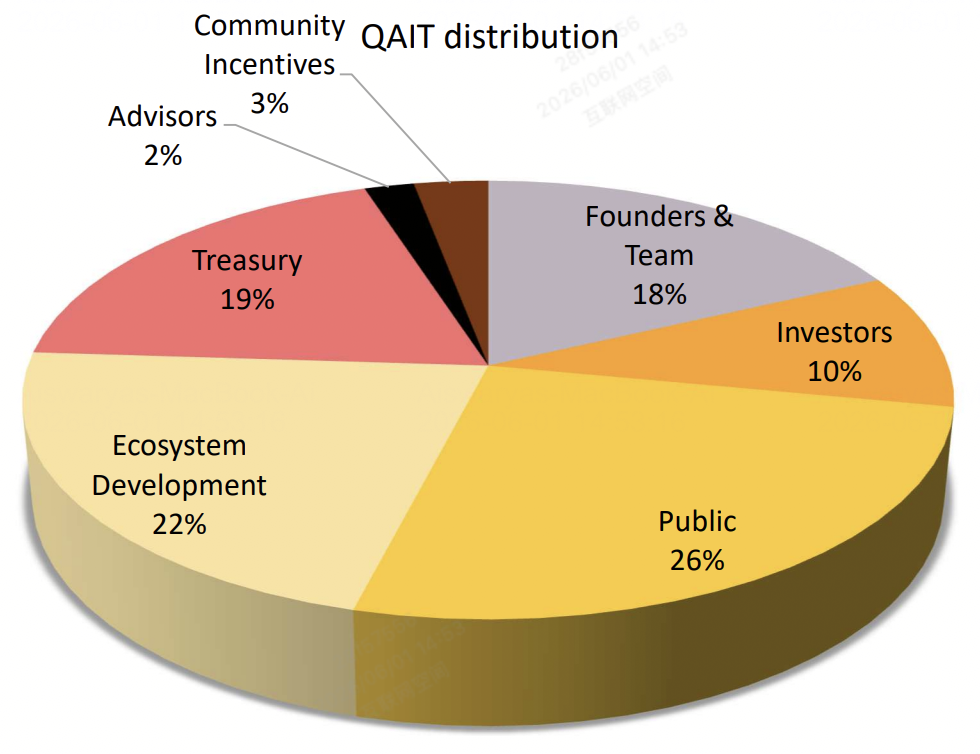
QAIT token allocation | Source: SEALCOIN whitepaper
The QAIT token features a fixed maximum supply of 10,000,000,000 (10 billion) tokens with zero additional minting allowed. Following its official launch and trading deployment on May 28, 2026, the supply distribution framework was structured as follows:
- Ecosystem Incentives (40%): 4,000,000,000 tokens allocated toward device operator rewards, pool incentives, and staking frameworks to bootstrap real-world utility.
- Public Allocation (26%): 2,600,000,000 tokens distributed to ensure robust, highly distributed market liquidity at launch across major centralized venues like BingX.
- Foundation Reserve (20%): 2,000,000,000 tokens held by the independent QAIT Association for long-term strategic ecosystem cultivation and research.
- Team and Advisors (10%): 1,000,000,000 tokens reserved for core architects and technical contributors, subject to a strict 12-month cliff and 24-month linear vesting curve.
- Strategic Partners (4%): 400,000,000 tokens earmarked for infrastructure partners, including software integration agencies and hardware manufacturers.
How to Get Started with the SEALCOIN Platform: Operational Walkthrough
The SEALCOIN platform allows users to manage device fleets, verify hardware certificates, and participate in Proof of Security (PoSy) pools. To connect and configure your ecosystem profile, execute the following operational milestones:
Step 1: Establish Secure Authentication
Navigate to the official SEALCOIN portal. Select Sign in with WISeID. If you do not possess an account, complete the KYC integration via the identity portal to receive your role-based access identity token.
Step 2: Configure a Non-Custodial Wallet
Click on the Connect Wallet interface badge located at the top-right corner. Using an approved Hedera mainnet application, such as Kabila Wallet, scan the displayed connection QR code and approve the transaction pairing inside your wallet interface.
Important Prerequisite: Ensure your Hedera mainnet account contains native HBAR tokens for underlying gas fees and has explicitly associated the QAIT Token ID to permit asset handling.
Step 3: Instantiate Fleet Management
Navigate to the Fleets directory on the left sidebar and click Add new fleet. Input your specific machine parameters, such as device type and service denomination. Allocate your preferred starting deployment budgets of HBAR and QAIT, then sign the automated contract requests inside your wallet extension to securely instantiate the fleet's multi-sig wallet boundary.
Step 4: Execute Device Onboarding
Install and activate the core SEALCOIN Agent software on your edge computing hardware. Navigate to the Devices page, choose Add new device, link it to your newly established fleet structure, and click Buy certificate. Approve the signature request inside your wallet app to add the hardware-level cryptographic key into your control center.
Step 5: Participate in PoSy Pools
To capture distributed network fees, visit the Pools page. Select your designated tracking pool, define your target QAIT allocation amount, and select Participate. Grant the underlying contract permission to interact with your assets, then authorize the final lockup signature.
How to Trade SEALCOIN (QAIT) Futures on BingX
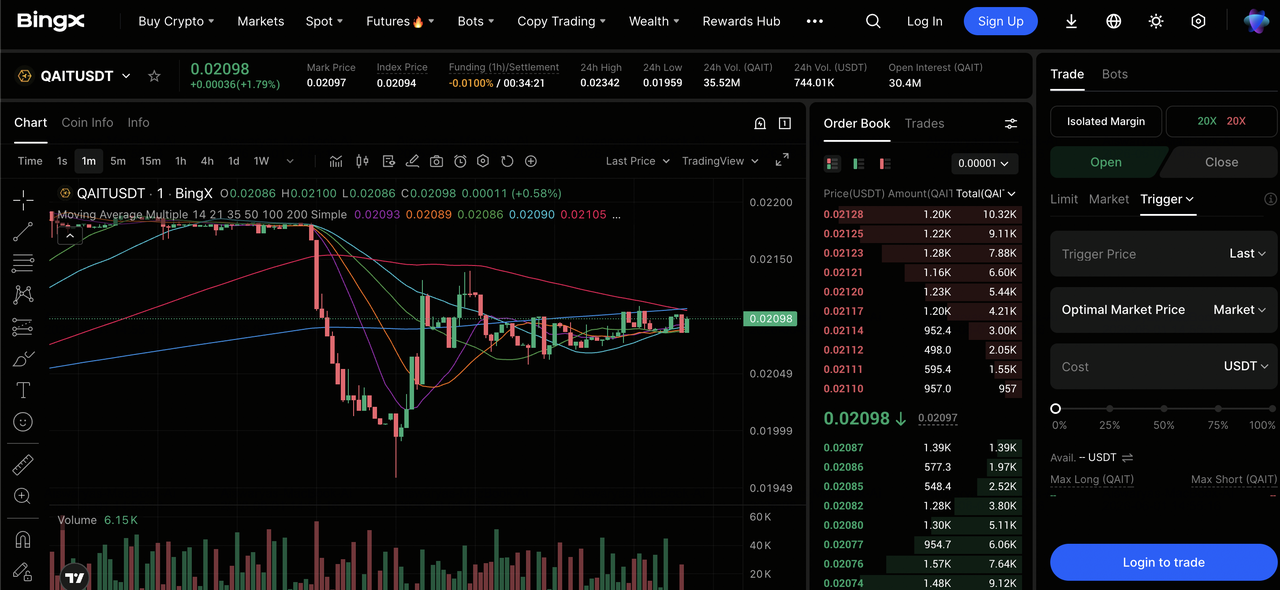
QAIT/USDT perpetual contract on BingX futures market
As a leading Web3-AI company, BingX integrates its sophisticated multi-agent AI operating system directly into the derivatives interface, empowering you to analyze funding rates, assess liquidation thresholds, and deploy automated strategies for the QAIT contract using natural language commands.
- Access the Perpetual Futures Interface: Log in to your verified account, navigate to the Futures dropdown menu on the main navigation bar, and select Perpetual Futures. Input QAIT into the asset search dashboard to pull up the live QAIT/USDT perpetual contract layout.
- Engage BingX AI Tools: Activate the BingX AI Smart Assistant side panel to parse current market dynamics. You can type intuitive prompts like "Analyze QAIT open interest trends" or "Evaluate immediate liquidation risks" to receive immediate, real-time market structure breakdowns before setting your parameters.
- Isolate Your Margin Mode: Locate the margin module configuration in the top right section of the trading ticket. Select Isolated Margin to confine your financial risk parameters to this single transaction, or select Cross Margin to utilize your total available USDT wallet pool as collateral.
- Calibrate Order Leverage: Adjust the interactive leverage slider to align with your personal risk tolerance. Keep in mind that while higher leverage multiples significantly amplify capital efficiency and potential returns, they equally contract your liquidation distance during sudden market wicks.
- Define Order Logic and Execute: Choose your entry vehicle by selecting a Limit Order for specific price targeting or a Market Order for instantaneous execution at current order book depth. Enter your desired token quantity, hardcode your precise Take-Profit (TP) and Stop-Loss (SL) boundary parameters, and select Open Long if your indicators trend bullish or Open Short to profit from machine economy downside.
5 Key Considerations Before Investing in SEALCOIN
Before committing capital to the SEALCOIN (QAIT) ecosystem, carefully evaluate these foundational risk metrics:
- Vesting and Supply Expansion: Following the TGE on May 28, 2026, the early circulating supply represents a fraction of the 10 billion maximum cap. Monitor upcoming linear vesting releases from foundation and partner tranches to track supply expansion dynamics.
- Hardware Dependency Constraints: Unlike pure-software crypto protocols, SEALCOIN's adoption speed is directly linked to real-world industrial hardware integrations, semiconductor supply metrics, and commercial device onboarding.
- Cross-Network Bridge Vulnerabilities: While trading on multiple standard EVM/CEX venues via wrapped tokens or centralized market paths, the core transactional infrastructure resides on Hedera DLT, requiring users to carefully track multi-chain network paths.
- Operational Edge Health: Device-to-device transaction streams are bound to the stability and execution state of local SEALCOIN software agents. Connectivity glitches or unpatched edge software can stall real-time micro-payments.
- Regulatory Compliance Hurdles: Because M2M infrastructure touches real-world energy networks, micro-payments, and identity parameters, local variations in DePIN and FINMA regulatory frameworks could impact compliance costs.
Final Thoughts: Should You Buy SEALCOIN (QAIT)?
SEALCOIN establishes an essential architectural bridge by combining physical semiconductor root-of-trust security with the hyper-scalable ledger throughput of Hedera. By anchoring its framework inside a decentralized physical network (DePIN) and providing a plug-and-play SDK for independent AI agents, the network shifts the automation landscape away from isolated cloud solutions and toward genuine, self-sustaining machine economies.
Backed by WISeKey’s deep industrial expertise and structured around a hard-capped, utility-centric token model, SEALCOIN delivers a verifiable framework for real-world automated interactions. As the internet of things transitions into a transactional network of smart agents, QAIT offers an enterprise-grade coordination protocol built to capture value across tomorrow's industrial, city, and space-based networks.
Risk Reminder: DePIN assets and autonomous token networks involve specialized smart contract, hardware connectivity, and protocol implementation dynamics. Conduct thorough independent research, track the platform's device registration metrics, and never invest capital beyond your risk tolerance boundaries. BingX assumes no liability for external transaction structures or portfolio losses.
Related Reading
- What Are the Top 10 DePIN Crypto Projects to Know in 2026?
- What Are the Top 10 AI Agent Crypto Projects of 2026?
- What Are the Top 10 Base AI Agent Projects to Know in 2026?
- Top 7 AI Agent Tokens on Solana to Watch in 2026 Amid the Rise of the Machine Economy
- What Is Quack AI (Q) AI-Powered DAO Governance and How to Trade It On BingX?
