
As decentralized applications and artificial intelligence mature toward global internet-scale adoption, the structural conflict between public ledger transparency and data privacy has reached a critical juncture. Traditional public blockchains operate under a public-by-default state model. Every smart contract input, state modification, and transaction history is completely exposed to the public. This lack of confidentiality inherently restricts Web3 applications from integrating sensitive real-world use cases, such as proprietary AI models, institutional order flow, healthcare tracking, and confidential corporate data analytics.
Arcium solves this systemic vulnerability by introducing an institutional-grade, decentralized confidential computing infrastructure layer. Instead of requiring users to expose their plaintext data to network operators or central clouds, Arcium orchestrates high-performance execution over fully encrypted data.
Backed by top-tier Web3 institutions and strategic capital, having raised around 14 million from investors including Greenfield Capital, Coinbase Ventures, Heartcore Capital, LongHash VC, and Solana co-founder Anatoly Yakovenko, Arcium bridges advanced applied cryptography with high-throughput distributed systems. By offering developer-friendly integration primitives natively composable with high-speed blockchains like Solana, Arcium enables retail builders and institutional enterprises to access sophisticated, encrypted compute power without sacrificing permissionless liquidity or on-chain settlement assurances.
What Is Arcium (ARX)?
Arcium is a security-first, parallelized confidential computing network built primarily on Solana that delivers trustless, verifiable, and scalable execution over fully encrypted data. At its core, the project addresses three fundamental challenges in the decentralized internet and modern computing space:
- Public Data Exposure: Traditional cloud servers and standard blockchains must open and decrypt data in plaintext to process it. Arcium introduces a zero-trust model where data remains encrypted throughout its entire computational lifecycle.
- Shared Confidential State Restrictions: While conventional privacy primitives like single-party Zero-Knowledge Proofs (ZKPs) are excellent for proving individual data points, e.g., identity verification, without revealing the underlying data, they struggle with multi-user calculations where multiple parties need to manipulate a shared, evolving state secretly. Arcium establishes a scalable framework for continuous, shared encrypted state processing.
- Performance Bottlenecks: Pure Fully Homomorphic Encryption (FHE) models are computationally heavy, frequently introducing severe throughput constraints that render them impractical for real-time applications. Arcium overcomes this barrier by parallelizing computation across decentralized node networks.
How Does Arcium Work?
The protocol operates as a highly scalable, decentralized cryptographic engine orchestrated by its distributed operating system (arxOS) and executed through custom developer frameworks. Rather than processing computations on a single machine, Arcium breaks data down, spreads it out, and processes it across a decentralized matrix of dedicated infrastructure pieces.
Secret Sharing and Multi-Party Computation (MPC)
The core cryptographic backbone of Arcium is Secure Multi-Party Computation (MPC), specifically utilized through its proprietary Cerberus protocol. When a user or application submits a confidential computation request, the sensitive inputs are immediately encrypted and divided into fragmented mathematical components called secret shares.
These fragments are distributed across a dynamic cluster of independent Arx Nodes, the decentralized fortresses of the network. No individual node ever possesses the complete dataset; it only sees an unintelligible fragment. The nodes then jointly run calculations on their respective secret shares. Because the mathematical properties are preserved across the fragments, the nodes generate a single, verifiable output that can be decrypted only by the authorized recipient.
MPC eXecution Environments (MXEs)
MXEs serve as the modular virtual machines of the Arcium network. They are highly configurable confidential execution environments where developers can customize trust assumptions, security parameters, and hardware requirements.
Unlike rigid virtual machines, MXEs are highly flexible. They can dynamically combine MPC protocols with hybrid elements like FHE for data security, and ZKPs for mathematical validation and cheater detection. This hybrid architecture ensures that if any malicious node attempts to tamper with a calculation or alter a state transition, the network flags the anomaly instantly via built-in integrity checks, protecting the system from insider threats.
Clusters and Stake-Weighted Scheduling
To achieve high parallel throughput, Arx Nodes arrange themselves into collaborative groups called Clusters. Each cluster operates at a specific tier that dictates how much parallel workload it can process.
To join a cluster and offer compute supply, an Arx Node operator must stake a corresponding amount of the native network asset (ARX). Computation allocation across the network follows a stake-weighted scheduling framework: the higher an operator’s total collateral stake, the higher their probability of being assigned computational tasks and earning corresponding execution fees.
The Arcis Developer Framework
To ensure developers can easily tap into this encrypted engine, Arcium features Arcis, a specialized Rust-based Domain-Specific Language (DSL). Arcis enables developers to write custom, confidential smart contracts and computational workflows that interact seamlessly with the Solana blockchain.
Because Arcium acts as an external execution layer rather than an independent blockchain, it uses the underlying layer like Solana for data availability and consensus settlement. This architecture avoids liquidity fragmentation, allowing dApps to natively deploy encrypted functions right beside public DeFi pools.
Arcium vs. Traditional Confidentiality Protocols: Key Differences
|
Feature |
Arcium (Cerberus MPC / MXE) |
Pure ZK-Based Protocols |
Pure FHE-Based Networks |
|
Primary Mechanism |
Decentralized Multi-Party Computation (MPC) |
Zero-Knowledge Proving Systems |
Fully Homomorphic Encryption |
|
Shared Encrypted State |
Supported natively across multi-user nodes |
Limited (Requires plaintext knowledge for proof generation) |
Supported but constrained by processing overhead |
|
Throughput & Performance |
High (Parallelized scale via node clusters) |
Moderate (Computationally heavy proof generation) |
Low (Severe processing bottlenecks at scale) |
|
Verification Engine |
Built-in cryptographic cheater detection |
Cryptographic mathematical verifiers |
Complex, high-overhead validation loops |
|
Infrastructure Reliance |
Decentralized Arx Nodes & Clusters |
Single prover or decentralized prover networks |
Heavy hardware single-node processing |
Real-World Use Cases: How Arcium Can Power the Privacy Layer
Arcium’s structural architecture addresses critical privacy limitations across three high-impact verticals:
- Confidential DeFi and Payments: Traditional decentralized finance suffers heavily from Miner Extractable Value (MEV) exploits, front-running, and fully visible transaction histories. Arcium powers private order flow routing, dark pools, sealed-bid auctions, and confidential asset transfers via C-SPL, the Confidential SPL-Token Standard built native to Solana.
- Confidential Artificial Intelligence: AI development frequently requires processing proprietary models or highly sensitive personal user data. Through its upcoming Arcium Blackthorn™ AI framework, the network enables privacy-preserving AI inference and training. Data sets can be fed into machine learning models in an entirely encrypted state, unlocking secure analytics for healthcare, financial institutions, and enterprise applications.
- Enterprise Data Collaboration: Regulated organizations can securely collaborate on shared analytics, such as supply chain coordination, credit scoring, or inter-organizational risk assessments, without ever disclosing their underlying proprietary databases to their partners or competitors.
What Is Arcium (ARC) Tokenomics?
The $ARX token is the native utility, access, and governance token of the Arcium network, serving as the foundational coordination mechanism for all decentralized participants. Following its official Token Generation Event (TGE) on June 22, 2026, the token launched as an SPL standard token on Solana with an initial circulating supply of approximately 20.88%.
ARX Token Utility
Value flows to the $ARX asset through a strict utility design centered around network security and protocol resource scheduling:
- Node Staking Collateral: ARX serves as the mandatory collateral that node operators must commit to participate in the network's supply side. Operating a node and joining a compute cluster requires locking up an amount of ARX determined by the cluster's performance tier.
- Delegated Staking: Token holders who do not wish to run bare-metal node hardware can delegate their $ARX to active node operators. This increases the operator's total capacity, allowing them to capture more network tasks, with rewards shared back to delegators based on individual operator commission parameters.
- Dual-Track Governance: Staked $ARX functions as the primary voting instrument across two distinct governance vectors launching later this year. A Technical Track voted on by node operators handles core protocol updates, fee parameters, and staking thresholds, while a Community Track handles broader treasury allocations and ecosystem incentives. Long-term lockups grant significant voting power multipliers.
Network Fees and Distribution Architecture
A core design philosophy of Arcium is its product-first fee structure. Users pay computation fees in the underlying blockchain’s native gas token, e.g., SOL on Solana, rather than ARX. This decouples fee transaction mechanics from ARX market volatility, allowing ARX to focus purely on network security and alignment.
For every confidential computation executed across the network, the native gas fees are distributed automatically via arxOS:
- 70% is routed directly to the Node Operators performing the execution.
- 20% is routed to Recovery Nodes responsible for maintaining backup secret shares and enabling seamless environment migrations.
- 10% is routed directly to the Network Treasury to fund ongoing research, protocol resilience, and developer ecosystem grants.
Supply and ARC Token Allocation Breakdown
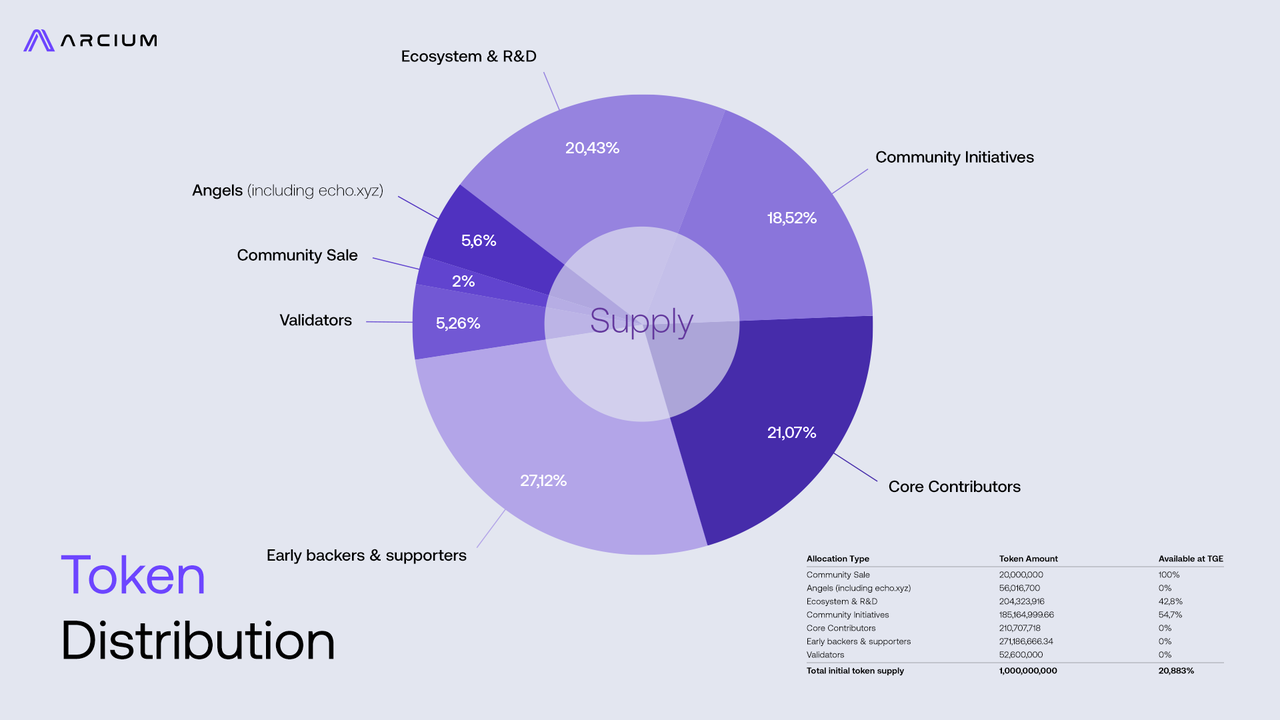
ARX token distribution | Source: Arcium
The network features a strictly fixed maximum supply of 1,000,000,000 ARX tokens, with zero built-in inflation mechanisms or dynamic minting capabilities. Over 50% of the entire token architecture is fundamentally directed toward network participants, validators, and community stakeholders.
- Early Backers and Supporters (27.1%): Allocated to early venture investors, subject to a 12-month cliff followed by a 24-month linear vesting schedule.
- Core Contributors (21.1%): Allocated to the founding team, employees, and advisors, subject to a 12-month cliff and a 27-month linear monthly vest.
- Ecosystem and R&D (20.4%): Dedicated to protocol expansion, partnerships, and developer tooling. 42.8% was unlocked at TGE to provide liquidity and initial bootstrapping, with the remainder subject to a 12-month cliff and a 42-month linear vest.
- Community Initiatives (18.5%): Allocated to growth programs, educational initiatives, and ambassador grants. 54.7% was unlocked upfront at TGE to kickstart early interaction campaigns.
- Angels (5.6%): Allocated to early strategic founders and ecosystem builders, subject to a 12-month cliff and 18-month linear vesting.
- Validators / Node Operators (5.3%): Dedicated directly to the infrastructure providers securing the permissionless MPC network, vesting over 24 months following a 12-month cliff.
- Community Sale (2.0%): Distributed via the CoinList community sale platform, 100% fully liquid and unlocked at TGE to maximize decentralized distribution.
The locked portion (79.12% of total supply) vests systematically over a 4.5-year horizon, ensuring deep, long-term ecosystem alignment among core builders and financial backers.
How to Trade Arcium (ARX) on BingX
BingX provides a highly secure, AI-enhanced trading environment equipped with the advanced BingX AI Claw analyst tool to help you seamlessly execute and monitor your ARX positions.
Buy, Sell, or HODL ARX in the Spot Market
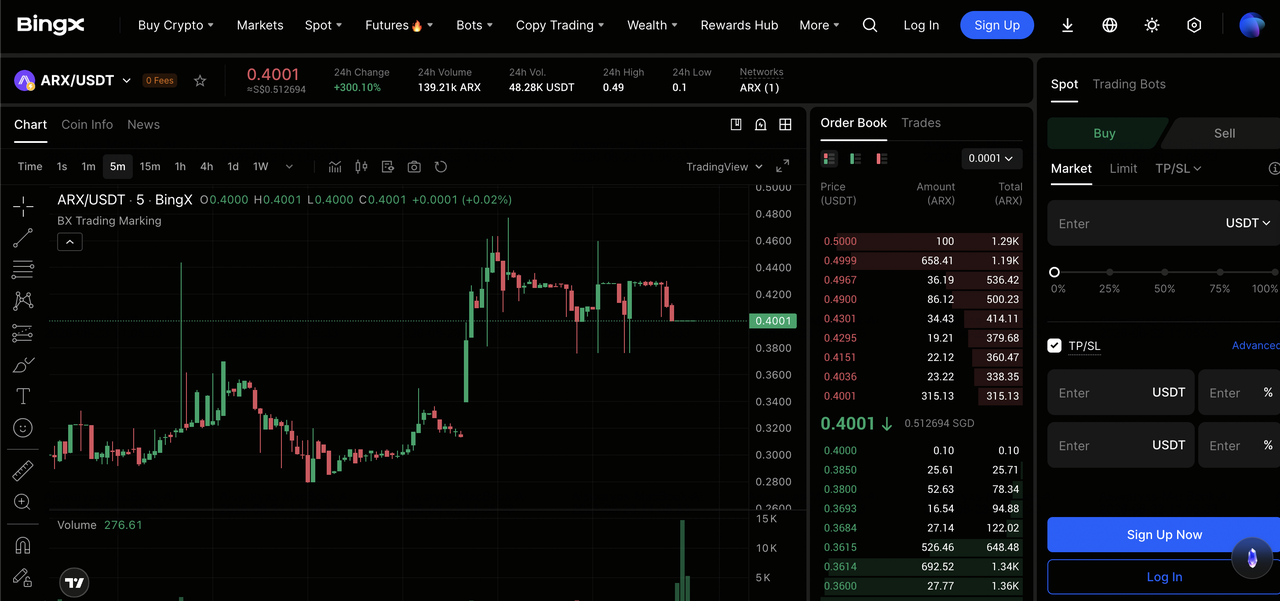
ARX/USDT trading pair on BingX spot market
- Access the Spot Market: Log into your account, hover over the Trade menu, and select Spot. Search for the ARX/USDT trading pair.
- Select Order Type: Choose a Market Order for instant execution at the prevailing rate, or a Limit Order to specify your precise entry price.
- Execute the Trade: Enter the amount of USDT you wish to spend or the amount of ARX you want to purchase, then click Buy ARX to instantly route the tokens to your spot wallet.
Long or Short ARX Perpetuals in the Futures Market
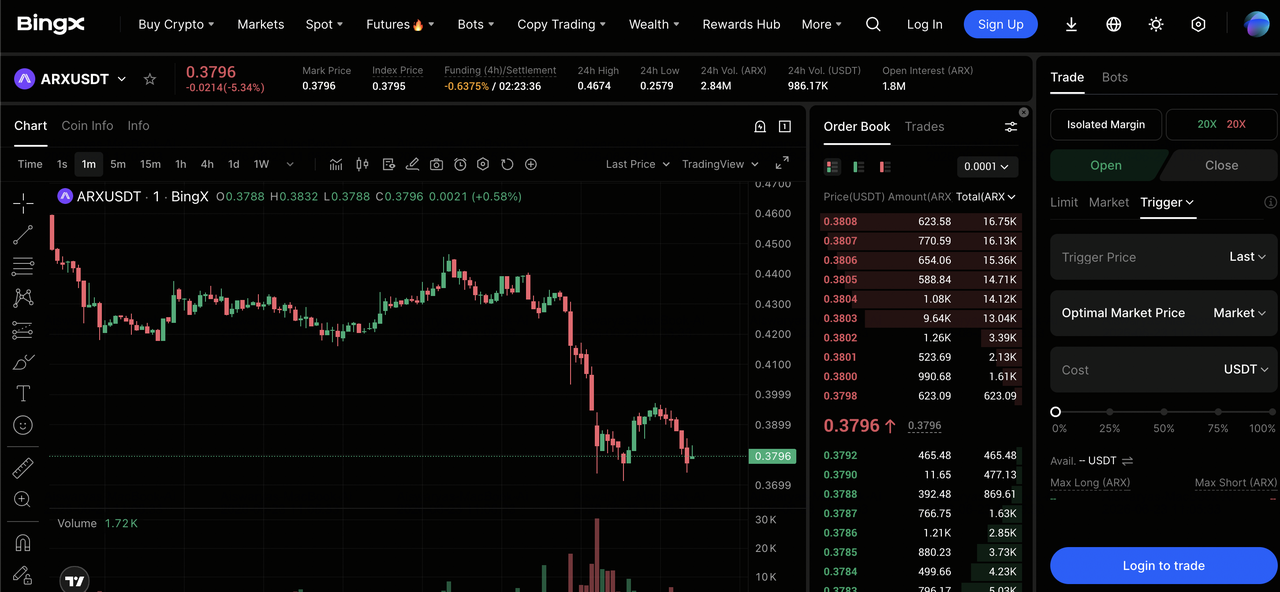
ARX/USDT perpetuals on BingX futures market
- Open the Futures Interface: Navigate to the Futures drop-down menu and select Perpetual Futures, locating the ARX/USDT perpetual contract.
- Configure Margin and Leverage: Select Isolated Margin to restrict risk to that specific position, or Cross Margin to utilize your entire futures balance, then carefully adjust the leverage slider to fit your risk management plan.
- Submit Your Position: Enter your contract size, establish protective take-profit and stop-loss boundaries, and click Open Long if you anticipate price appreciation, or Open Short to profit from downside market movements.
5 Key Considerations Before Investing in Arcium (ARX)
Before allocating capital or participating in the Arcium token ecosystem, carefully analyze these critical project characteristics:
- Vesting and Circulating Supply Dynamics: Following the June 2026 token launch, nearly 80% of the fixed supply remains locked. While the 12-month cliff protects the market from early team and VC distributions, investors must carefully monitor downstream token unlock timelines and circulating supply expansion.
- Cryptographic Competition: The privacy-enhancing technology (PET) landscape is rapidly evolving. Arcium faces ongoing competition from pure FHE rollups, alternative ZK-proving layers, and Hardware-enforced Trusted Execution Environments (TEEs). Its long-term value depends heavily on its Cerberus MPC protocol maintaining superior developer UX and processing throughput advantages.
- Slashing Risks in Staking: Both node operators and individual delegators face structural financial risk. Staked or delegated $ARX is subject to protocol-enforced slashing penalties. If an associated node suffers prolonged downtime, encounters severe hardware failures, or exhibits malicious behavior, a portion or all of the locked collateral can be permanently lost.
- Adoption and Network Fee Dependency: Because $ARX is not consumed as gas, its organic demand model relies entirely on node operators buying and locking the asset to capture computation capacity. If developer adoption stalls or network usage drops, the velocity of capital entering staking nodes will contract, directly impacting token demand.
- Ecosystem Volatility: Arcium operates hand-in-hand with its underlying settlement networks. As a heavily Solana-reliant protocol in its initial live phase, macroeconomic shifts, liquidity transitions, or network events within the wider Solana DeFi layer can introduce highly volatile trading dynamics for new exchange pairs like ARX/USDT.
Final Thoughts: The Road Ahead for Arcium
Arcium establishes an essential infrastructure primitive by translating complex, multi-party cryptographic theories into a highly accessible, developer-friendly computation network. By decoupling public ledger transparency from data exposure, its "Confidential Supercomputer" blueprint opens the door to next-generation Web3 use cases, from dark-pool asset exchanges to fully private AI workflows.
Backed by robust applied cryptography, real historical network usage throughout its pre-TGE alpha phases, and a clear product roadmap extending across the decentralized internet, Arcium offers a sustainable framework for encrypted computation. As global industries lean further into privacy-enhancing architectures, Arcium provides a foundational layer engineered to remain resilient, secure, and fully verifiable across all market cycles.
Risk Reminder: Decentralized computing protocols and crypto-assets carry significant smart contract, operational execution, and market volatility risks. Always perform your own continuous, independent research, closely track project governance disclosures, and never risk more capital than you can afford to lose. BingX assumes no responsibility for external trading allocations or financial investment choices.
Related Reading
- What Are the Top Zero-Knowledge (ZK) Crypto Projects of 2026?
- Top 8 Solana DeFi Projects to Watch in 2026
- What Is Solstice Finance (SLX), Solana’s Institutional Yield Layer, and How Does It Work?
- What Is Solscan and How to Use the Solana Blockchain Explorer?
- What Are the Top 7 Privacy Coins to Watch in 2026?
