
Naoris Protocol (NAORIS) is one of the most technologically unique and structurally resilient infrastructure platforms in the digital asset market celebrated for its revolutionary approach to protocol governance and ecosystem expansion. Conceived as an open-source decentralized internet trust fabric for hyper-connected environments, Naoris Protocol (NAORIS) was engineered to mitigate the critical vulnerabilities of centralized cybersecurity systems. It bridges decentralized finance (DeFi) with the broader digital economy by allowing every connected device to act as a self-defending security validator, transforming single points of failure into a unified network defense.
As of 2026 Naoris Protocol (NAORIS) stands out as a highly efficient layer 1-grade execution ecosystem widely respected for its institutional-grade security framework, full-stack tooling, and massive structural adoption. Moving past legacy security models that operate as isolated cost centers, Naoris Protocol (NAORIS) has evolved into an essential infrastructure pillar for high-value asset validation, decentralized device orchestration, and real-world Web3 security mesh networks. Powered by its community-centric architecture, Naoris Protocol (NAORIS) ensures a secure, user-governed environment making it a premier choice for the global expansion of the Web3 economy.
Key Takeaways
- Full-Stack Cybersecurity Infrastructure Provider: Naoris Protocol (NAORIS) builds foundational decentralized applications (dApps) for the security ecosystem, incubating major real-world validation protocols and specialized threat-monitoring frameworks.
- On-Chain Cyber Health Scalability: Operating at the "Sub-Zero Layer" beneath traditional blockchain networks, the environment functions as an EVM-compatible foundation tailored for high-volume device matching and ongoing compliance.
- Post-Quantum Cryptographic Realism: The protocol integrates NIST-aligned post-quantum cryptographic primitives, yielding decentralized trust insulated from future quantum computing threats.
- SWARM AI Threat Mitigation: Users access an automated, coordinated security hive mind where decentralized AI node layers analyze and isolate system threats in real time.
- Top Trading Venue: BingX stands as the premier choice for trading Naoris Protocol (NAORIS) with deep market liquidity, low trading fees, and robust security features on its spot exchange.
Read More: Top 7 Ethereum DeFi Projects to Watch in 2026
What Is Naoris Protocol (NAORIS)?
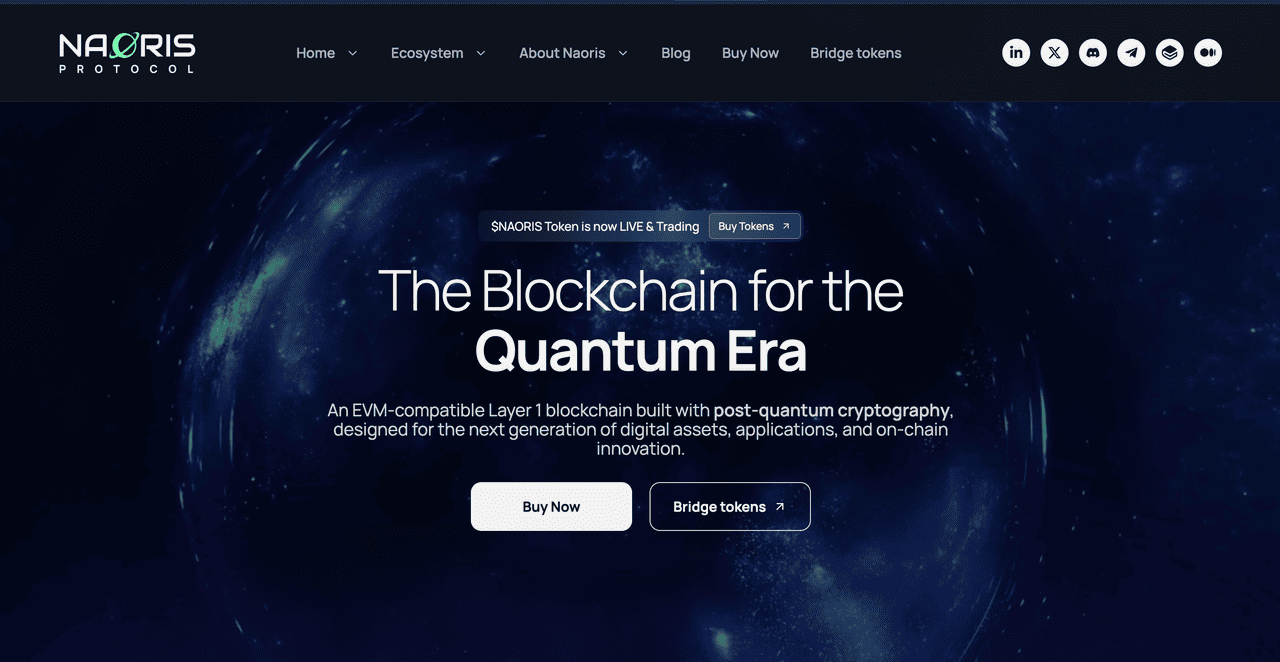
Source: Naoris Protocol
Naoris Protocol (NAORIS) is an open-source decentralized blockchain network designed to act as a flexible smart contract platform, enabling friction-free peer-to-peer value transfer and secure decentralized application deployment. Engineered to help Web3 protocols overcome code vulnerability and governance deadlocks, Naoris Protocol (NAORIS) removes structural innovation barriers by implementing a comprehensive suite of developer tools and execution primitives built right into the ledger's base rules.
In 2026 Naoris Protocol (NAORIS) continues to serve as an indispensable, highly adaptive infrastructure environment within the global crypto space. The platform has distinguished itself by continually onboarding advanced technical capabilities, such as automated multi-device trust transfers and real-time state audits across Web2 and Web3 ecosystems, without ever breaking application backward-compatibility or dividing its ecosystem. Operating as a decentralized Trust Mesh, Naoris Protocol (NAORIS) bridges the gap between secure enterprise software design and user-centric network control.
How Naoris Protocol Works
Naoris Protocol (NAORIS) achieves its rapid transaction speeds and structural finality by utilizing a specialized Proof of Stake variant and an interconnected product layer. Instead of exposing users to unstable network fee models or sudden consensus splits, Naoris Protocol (NAORIS) organizes its core execution framework through several vital ecosystem components:
Decentralized Proof of Security (dPoSec)
The primary consumer-facing application powered by the network channels device capacity into a self-validating framework. Connected systems and hardware devices act directly as nodes within the mesh. Instead of using a centralized server system where users rely on an isolated authority to monitor threat vectors, the dPoSec matching engine coordinates continuous device-to-device verification, ensuring that there is no single point of failure across the entire infrastructure.
SWARM AI Mesh Intelligence
The protocol features customizable, smart contract-based automated infrastructure suitable for enterprise monitoring and consumer node systems. It acts as a decentralized intelligence engine that allows distributed AI nodes to work collaboratively. This gives users an increased level of security; devices independently learn from, report on, and respond to cyber-integrity threats in real time while syncing status updates back to the global network.
Sub-Zero Layer Cryptographic Complexity
The core matching framework addresses many of the scaling challenges of protecting multi-layered networks. The architecture operates at a foundational "Sub-Zero" stratum beneath legacy blockchain structures, incorporating NIST, NATO, and ETSI-standardized post-quantum algorithms like Dilithium-5. The underlying validator layer handles high throughput efficiently, allowing nodes to lock up the native asset to enforce systemic security and claim validation yields.
Key Trends and Utility of NAORIS in 2026
Naoris Protocol (NAORIS) exhibits impressive technological evolution and structural adoption in 2026. The network has successfully expanded its real-world validation footprint across billions of active connections, bridging Web3 node environments with traditional infrastructure spanning government servers, enterprise operations, cloud environments, and IoT systems. This system enables participants to secure digital transactions globally across diverse hardware networks without inflating gas expenses or exposing assets to systemic breach vectors.
Naoris Protocol (NAORIS) has also carved out a dominant niche in cross-organizational threat intelligence and open cybersecurity coordination where mathematical certainty is paramount. The native token, NAORIS, remains heavily utilized across the entire ecosystem. It serves as the primary coordination layer for network validation, the required asset needed to lock up node staking allocations, and the financial foundation backing the contribute-and-earn device economy that underpins real-time network trust verification.
Benefits and Advantages of Naoris Protocol
Naoris Protocol (NAORIS) presents several core operational advantages that keep it at the forefront of the smart contract and decentralized application sector:
- Incubated Application Ecosystem: Native access to the Sub-Zero infrastructure layer provides the ultimate foundational stack for quantum-safe decentralized applications (dApps).
- Real-Time Threat Protection: Continuous, machine-to-machine state audits shield users from zero-day exploits and malicious network takeovers.
- Institutional-Grade Platform Safety: NIST and NATO-compliant encryption matrices provide cryptographic data protection that safeguards high-value enterprise setups.
- Minimally Extractive Costs: Running validations via near-zero fee schedules isolates users from volatile transaction spikes during network-wide cyber-audits.
- Extreme Network Scalability: The architecture utilizes a participatory model where every added device expands validation capacity, delivering a thoroughly optimized environment.
- Ecosystem Positive-Sum Alignment: The network balances protocol growth using community-centric rewards, ensuring that data validation contributors are dynamically incentivized for maintaining collective network hygiene.
Naoris Protocol vs. Dezen and Other Cybersecurity/Compliance Protocols
When evaluating dedicated, blockchain-based trust layers designed for enterprise cybersecurity and data compliance, Naoris Protocol (NAORIS) is directly comparable to protocols like Dezen or specialized decentralized infrastructure lines focusing on decentralized machine identity. While traditional security setups and basic chain monitors rely on sandboxed reporting environments, Naoris Protocol (NAORIS) differentiates itself by running an active, EVM-compatible "Sub-Zero" validation matrix that captures threats across billions of distinct Web2 and Web3 end devices simultaneously.
Naoris Protocol (NAORIS) handles complex ecosystem decisions directly through a token-weighted DAO, utilizing an active governance model where the quantity of tokens held translates directly to voting weight over validation parameters, node structures, and security policy changes. Furthermore, while generic data verification protocols often rely on latency-heavy post-computation checks, Naoris Protocol (NAORIS) implements specialized SWARM AI meshes coupled with NIST-standardized post-quantum cryptography, providing the immediate hardware validation speed and resilience required to protect modern institutional infrastructure.
Read more: What Are the Top Layer-1 (L1) Blockchains to Know in 2026?
What Are the Tokenomics of NAORIS Token?
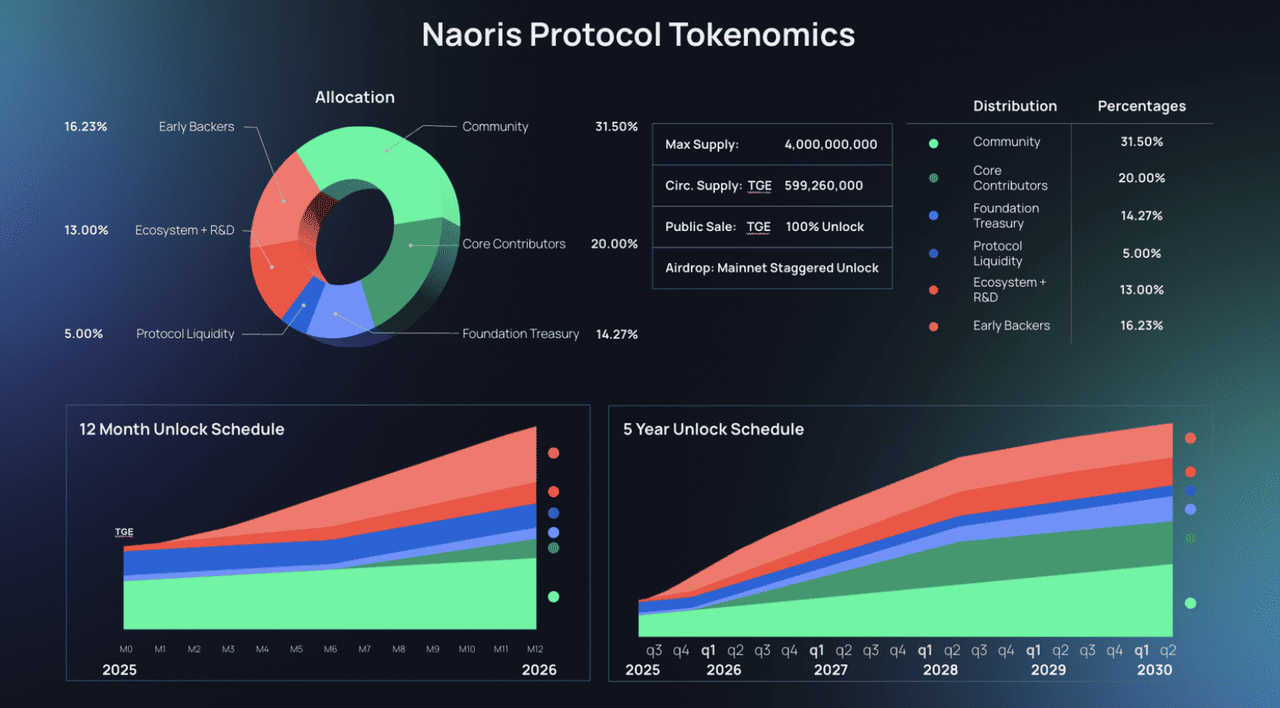
Naoris Protocol (NAORIS) uses an industry-tailored, utility-focused Proof of stake (PoS) model. Following major community-approved tokenomic overhauls, the network utilizes a highly controlled supply model to align validators, device networks, and long-term stakers.
Key Supply and Launch Data
- Maximum Supply: 4,000,000,000 NAORIS
- Circulating Supply at TGE: 599,260,000 NAORIS
- Public Sale Terms: 100% unlocked at the Token Generation Event (TGE).
- Airdrop Distribution: Executed via a structured Mainnet Staggered Unlock schedule to encourage organic user retention.
NAORIS Token Allocation Breakdown
The total token allocation is strategically divided to balance protocol decentralization with ongoing operational research and network liquidity preservation:
|
Allocation Category |
Percentage of Total Supply |
Strategic Purpose & Utility |
|
Community |
31.50% |
Long-term economic engine supporting node validation rewards and system contribution. |
|
Core Contributors |
20.00% |
Multi-year incentive alignment for project engineering teams and core architects. |
|
Early Backers |
16.23% |
Distributed to foundational investors supporting the protocol's incubation phases. |
|
Foundation Treasury |
14.27% |
Strategically preserved capital to back open ecosystem grants, ecosystem scaling, and expansion. |
|
Ecosystem + R&D |
13.00% |
Ongoing funding for post-quantum threat exploration and sub-zero architectural optimization. |
|
Protocol Liquidity |
5.00% |
Maintaining deep, highly efficient execution paths across primary digital exchange markets. |
Key Supply and Tokenomics Data
- Circulating Supply: Released gradually via structured community reward mechanisms to reflect expansion across the device trust mesh.
- Maximum Supply Cap: Fixed at exactly 4B Naoris Protocol (NAORIS) tokens, programmatically bounded to protect ecosystem long-term sustainability.
- Vesting & Lock-up: Allocations for core contributors (20%) and early supporters (16.23%) are locked and unlocked incrementally over multi-year schedules, preventing short-term market imbalances.
How the Economics Work
- Network Security & Staking: In order to run a full validator node and authorize transaction verification blocks, nodes must lock up an established allocation of the native asset. Stakers earn validation yields for preserving structural trust.
- Governance Weight: Holding Naoris Protocol (NAORIS) acts as the baseline layer for orchestrating protocol parameters. Token holders command proportional voting influence over node elections, core developments, and base layer technical changes.
- Ecosystem Integration: Naoris Protocol (NAORIS) plays a functional role in broader projects under the platform's security umbrella, serving as the required clearing unit to record verifiable proof of trusted actions across distributed networks.
- Inflation Distribution: The tokens minted through the annual inflation are distributed to key network stakeholders to ensure security and continued development:
- 31.5%: Formally reserved as Community Allocation, acting as a long-term economic engine for node validation rewards and ecosystem utility.
- Remaining Portions: Distributed linearly across foundations, operational research, and liquidity preservation pools over defined 12-month and 5-year periods.
Understanding the Treasury Backing
Over time, the platform treasury has retained a dedicated allocation of tokens, managed safely to fund long-term development, research grants, and ecosystem expansion. Together, the validator requirements and community-powered contribute-and-earn structures encourage investors to lock up their Naoris Protocol (NAORIS) tokens as opposed to liquidating them on the secondary market, helping reduce market volatility and driving sustainable utility for existing tokens in circulation.
How to Buy Naoris Protocol (NAORIS) on BingX
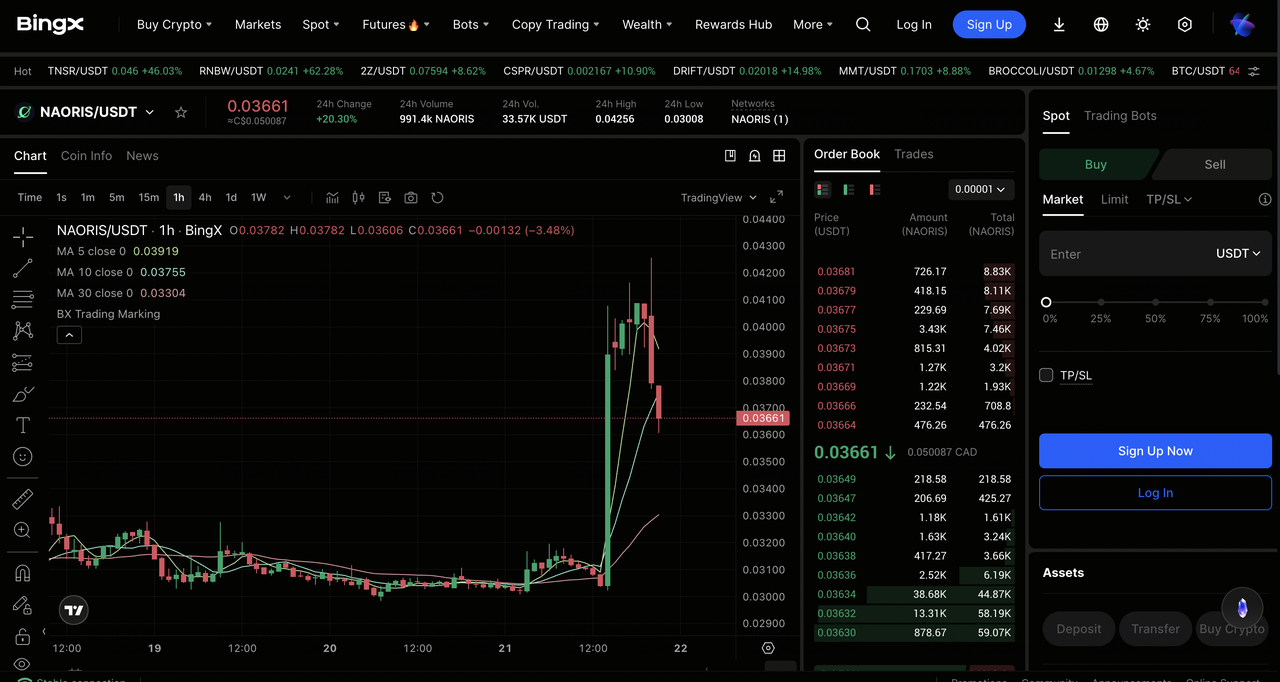
Before you can unlock advanced post-quantum validation tools, you can utilize BingX AI, the platform’s intelligent trading assistant, to analyze real-time market trends and identify the most optimal entry points for your purchase. Follow these steps to secure your tokens on the NAORIS/USDT trading pair on the spot market:
- Fund Your Account: Navigate to the Buy Crypto section to purchase USDT using a credit/debit card, Apple Pay, or bank transfer.
- Access the Spot Market: Go to the Spot tab and search for the NAORIS/USDT trading pair.
- Execute Your Trade: Select Market Order for an instant purchase at the current price, enter the amount of NAORIS you wish to buy, and click Buy NAORIS.
- Confirm Holdings: Once the trade is complete, your tokens will appear in your Spot Account, ready to be utilized for node validation staking or long-term ecosystem storage.
Trade Naoris Protocol Futures with Leverage
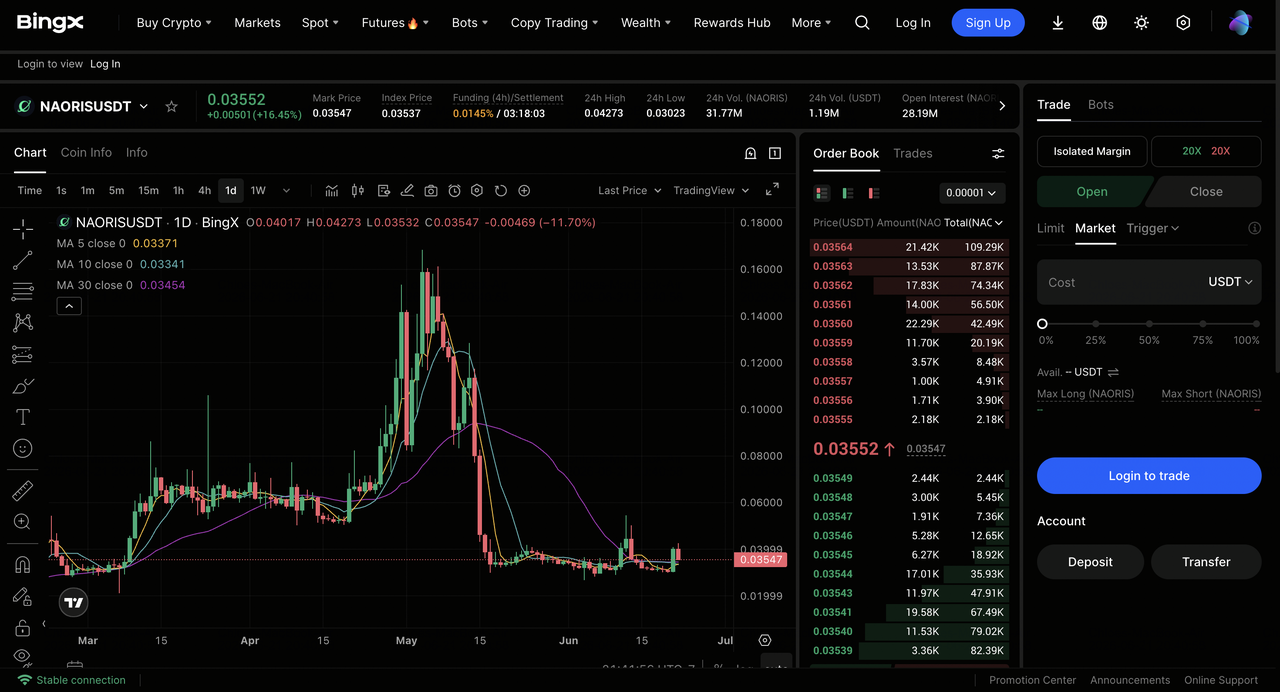
Advanced traders looking to hedge risk or capitalize on short-term macro trend shifts in the decentralized cybersecurity sector can trade the NAORIS/USDT perpetual contract on the futures market.
- Transfer Capital: Move USDT from your Funding or Funding wallet directly over to your Perpetual Futures account.
- Select the Market: Access the Futures terminal, search for the NAORIS/USDT trading engine, and define your margin settings (Isolated or Cross).
- Configure Risk Parameters: Choose your desired leverage and leverage built-in risk containment settings by configuring automated Stop-Loss (SL) and Take-Profit (TP) triggers.
- Execute: Open a long position if you anticipate the expansion of post-quantum mesh demand, or go short to manage broader market downturns.
Conclusion: Why You Should Trade Naoris Protocol on BingX
Naoris Protocol (NAORIS) continues to prove its immense structural value in 2026 through its strict cryptographic privacy, ecosystem predictability, capped token issuance, and community-driven development. As global developers and financial institutions demand Web3 environments that combine rigorous transaction security with real-world integrations and optimized decentralized exchange (DEX) routing, Naoris Protocol (NAORIS) remains an exceptionally reliable choice for modern digital infrastructure.
BingX stands out as the ultimate exchange hub for trading Naoris Protocol (NAORIS), providing excellent liquidity depth, minimal trading fee tiers, and rapid execution speeds for spot holders. Whether you are trading Naoris Protocol (NAORIS) to exploit short-term market movements, accumulating assets for long-term network validation utility, or interacting with institutional-grade decentralized finance (DeFi) applications, BingX lets you process and manage your Naoris Protocol holdings safely and effectively.
As public and developer demand for cyber-health transparency and post-quantum network infrastructure continues to accelerate, trading Naoris Protocol (NAORIS) on a platform like BingX ensures users have the tools and structural reliability needed to confidently navigate the Web3 landscape.
