
Saga is a unified Layer-1 blockchain protocol built to simplify how developers launch and scale decentralized applications. It combines automated Chainlet deployment with horizontal scalability and shared security to deliver high-performance infrastructure for gaming, DeFi, AI agents, and entertainment apps.
The project focuses on removing technical complexity and congestion issues while giving each application its own dedicated blockchain environment. As a developer-centric platform, Saga empowers creators to build without competing for block space, offering seamless interoperability and elastic scaling. With the native SAGA token powering the ecosystem, it aims to provide a complete solution for the next generation of high-performance Web3 applications.
Key Takeaways
- Saga enables developers to automatically launch dedicated, parallelized application-specific blockchains called Chainlets.
- It solves scalability through infinite horizontal scaling without network congestion.
- Chainlets inherit shared security from the Saga mainnet while maintaining sovereignty.
- The SAGA token is used for staking, governance, and paying for Chainlet resources.
- BingX stands as the top choice for trading Saga (SAGA) perpetual futures.
What Is Saga (SAGA)?
Saga (SAGA) is a Layer-1 blockchain protocol that enables developers to automatically launch their own dedicated, parallelized, and interoperable application-specific blockchains, known as "Chainlets". It allows for infinite horizontal scaling, meaning apps can scale to peak performance without network congestion, with the native SAGA token used for staking, governance, and paying for Chainlet upkeep.
Instead of building on a congested general-purpose chain, Saga (SAGA) gives each application its own sovereign environment while benefiting from the security and liquidity of the main Saga network. This architecture is particularly powerful for high-demand sectors like gaming, entertainment, and DeFi. A core aspect of Saga (SAGA) is its developer-first design. It automates infrastructure deployment so builders can focus on product innovation rather than complex blockchain operations.
Read more: What Are the Top Layer-1 (L1) Blockchains to Know in 2026?
What Are the Key Features of Saga?
Saga (SAGA) stands out through several advanced capabilities tailored for high-performance Web3 applications. Chainlets provide dedicated, sovereign blockchains for individual apps, delivering isolated compute and storage with customizable parameters. Horizontal scaling allows applications to expand infinitely without competing for resources on a single chain.
Additional features include shared security through the Saga Security Chain, seamless interoperability between Chainlets and the broader Cosmos ecosystem, and a Liquidity Integration Layer (LIL) that automatically connects liquidity across chains. The platform also offers native DeFi tools and stablecoin infrastructure for optimized capital efficiency.
Read more: How to Stake Cosmos (ATOM) and Earn Passive Rewards in 2026
What Are the Use Cases of Saga?
Saga (SAGA) offers several powerful use cases for developers and users. Gaming studios can launch high-performance Chainlets for play-to-earn titles, NFTs, and metaverse experiences with dedicated resources and low fees. DeFi projects benefit from isolated environments for lending, DEXs, and yield protocols with superior throughput.
SAGA Token Key Tokenomics
The SAGA token is the native utility and governance token of the Saga ecosystem. It is used for staking to secure the network, paying for Chainlet deployment and maintenance, and participating in governance decisions. The tokenomics are designed to align incentives between developers, validators, and users, supporting long-term network growth and sustainability.
- Total Initial Supply: 1,000,000,000 SAGA.
- Inflation: Targeted at ~7% annually.
SAGA Token Allocation Breakdown
- Ecosystem Development: 30.0%
- Core Contributors: 20.0%
- Investors: 20.0%
- Airdrops: 15.5% (6% at TGE, 4% in phase 2–6, 10% post-Phase 6).
- Foundation Reserve: 10.0%
- Binance Launchpool: 4.5%
SAGA Token Utility and Mechanism
- Chainlet Payment: Developers pay in SAGA tokens to instantiate and run dedicated chains, which are in turn used to reward validators.
- Staking: Staked to secure the network and validator infrastructure.
- Governance: Holders vote on network maintenance and policies
AI agents networks and entertainment apps use Chainlets for scalable, low-latency operations. Developers can also create custom sovereign chains for enterprise solutions, social platforms, or payment systems while inheriting Saga’s security and interoperability.
Read more: What Are the Top Bitcoin Layer-2 Networks of 2025?
How to Trade SAGA Futures on BingX
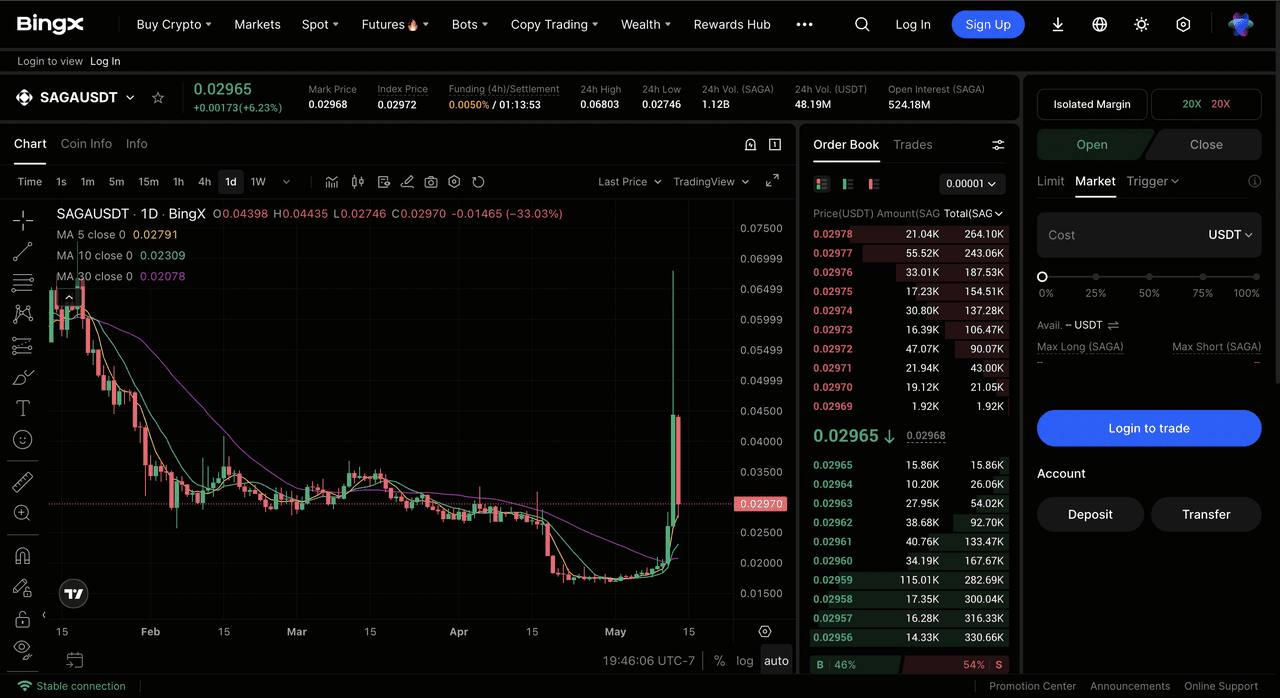
SAGA/USDT on BingX Futures
BingX, a user-friendly centralized exchange, supports SAGA trading with pairs like SAGA/USDT and offers tools for efficient purchases. Amid the hype, the token is already listed on major centralized exchanges, including BingX, where users can trade SAGA/USDT perpetuals in the futures market. Follow these steps to trade SAGA securely:
Step 1: Create and Fund Your BingX Futures Account
Sign up on BingX and complete identity verification. Deposit USDT into your account and transfer your funds into your Futures Wallet.
Step 2: Open the Futures Trading Interface
Navigate to the Futures trading section and search for "SAGA" or the SAGA/USDT perpetual contract trading pair. Review the current price, chart, and market data for informed decision-making.
Step 3: Choose Long or Short
- Go long if you expect SAGA's price to rise
- Go short if you expect SAGA's price to decrease
Step 4: Set Leverage and Order Type
Adjust leverage based on your risk tolerance. Choose market order for instant execution or limit order for a specific price entry.
Step 5: Manage Risk
Always use stop-loss (SL) and take-profit (TP) to manage downside risk. Monitor margin levels to avoid liquidation. This approach mirrors traditional gold futures trading, but with crypto-native speed, leverage, and flexibility. Monitor your position using BingX's advanced charting tools, set price alerts, and manage risk with stop-loss orders given the high volatility of memecoins. Always consider exchange fees, market conditions, and your risk tolerance before trading.
Read more: Risk Management in Crypto Trading: 7 Rules Every Trader Must Know
Conclusion: Why You Should Trade SAGA on BingX
Saga (SAGA) represents a major advancement in blockchain scalability by giving developers the ability to launch dedicated, high-performance Chainlets with shared security and seamless interoperability. Its focus on horizontal scaling and developer experience positions it as critical infrastructure for the next wave of Web3 gaming, DeFi, and AI agents applications. BingX serves as the top choice for trading Saga (SAGA) perpetual futures, combining ease of use, robust liquidity, leverage options, and trusted infrastructure.
Whether speculating on price movements or participating in the ecosystem, BingX enables efficient trading. As demand for scalable blockchain infrastructure continues to grow, integrating innovative Layer-1 solutions like Saga (SAGA) with reliable centralized platforms such as BingX offers developers and traders greater flexibility, security, and confidence in navigating the evolving Web3 landscape.
