


The commercial space landscape in 2026 has officially broken past the boundaries of government-dominated aerospace programs. The industry is no longer a speculative arena for defense primes; it has transitioned into a highly commercialized, multi-trillion-dollar infrastructure layer. This evolution is driven by reusable launch logistics, satellite mega-constellations, and a major structural integration with space-based AI computing.
With McKinsey and PwC projecting the global space economy to hit $1.8 trillion to $2 trillion by 2035–2040, the upcoming mid-June SpaceX initial public offering (IPO) is serving as a powerful lens for the global investment community. The offering is forcing Wall Street to fundamentally rethink how it values off-planet infrastructure.
As vast capital flows converge on this emerging asset class, traditional brokerage barriers are dissolving. Through the rise of the BingX TradFi platform, crypto-native capital can access premier space and satellite infrastructure equities using USDT collateral. This framework offers 24/7 fractional exposure to global space market leaders without requiring traditional, cross-border banking accounts, routing institutional liquidity directly into the core infrastructure of the orbital economy.
What Are the Top Trends Driving the Global Space Economy in 2026?
The space sector has evolved into a hyper-growth ecosystem. Reusable rocket architectures have radically lowered the cost per kilogram to low Earth orbit (LEO), unlocking commercial pathways that were entirely cost-prohibitive a decade ago. The mid-2026 macro environment is shaped by four foundational trends:
1. The SpaceX Halo Effect and Space Sector Re-Rating
The impending SpaceX debut on Nasdaq, targeting a fixed price of $135 per share to raise a record-setting $75 billion at a $1.75 trillion to $2 trillion valuation, is completely resetting public valuation benchmarks. Legacy tech multiples are being replaced by growth-oriented metrics. Generalist institutional funds, which historically avoided space assets due to low liquidity, are aggressively routing capital into public pure-plays to establish exposure ahead of the June 12 listing bell.
Read more: SpaceX Will File for Historic $75 Billion IPO at $1.75 Trillion Valuation on June 12, 2026
2. "Tollbooths on the AI Superhighway" and Orbital Data Centers
Satellite infrastructure is increasingly recognized as critical hardware for the next stage of the communications revolution. Rather than relying solely on terrestrial fiber networks, enterprise networks are utilizing satellite mega-constellations to build solar-powered orbital data centers. By running high-compute AI models directly on in-space hardware, operators can bypass international data sovereign laws and achieve instant, secure edge computing across the globe.
3. Direct-to-Device Cellular Satcom Infrastructure
The race to establish global satellite cellular broadband has reached an inflection point. Major telecommunications operators are bypassing land-based cell towers by embedding space-based cellular arrays directly into standard consumer smartphones. This allows continuous call, text, and video streaming data access in the most remote regions of the Earth, transforming space companies into global telecommunications utilities.
4. Systemic Volatility and Infrastructure Monopolies
Despite massive multi-year runs, the space sector remains deeply capital-intensive and exposed to single-point-of-failure infrastructure risks. This reality was punctuated over the weekend when Blue Origin's New Glenn rocket suffered a static fire launchpad explosion at LC-36 in Florida. The event caused minor shockwaves through public stock prices, reinforcing the massive competitive moat held by companies with reliable, operational launch manifests.
What Are the Best Space Stocks to Watch Ahead of the SpaceX IPO?
The following list identifies the leading rocket launch providers, lunar infrastructure builders, and direct-to-device satellite networks driving the commercial space sector in the second half of 2026.
1. SpaceX (SPCX)
- 2026 Valuation Benchmark: $1.75T–$2.0 Trillion Target Market Cap
- Core Role: Sovereign Industry Titan, All-Primary Float Moat, and Capital Allocator
SpaceX stands as the absolute heavyweight of the orbital economy. The company's S-1 prospectus reveals an engine fueled by its highly profitable Starlink connectivity segment, which generated $11.4 billion of SpaceX's $18.67 billion total revenue in 2025. While heavy R&D expenditure on Starship and its new xAI/Grok data center integrations resulted in a net loss of $4.94 billion for 2025, the company's dominance in commercial and defense launch manifests is entirely unmatched.
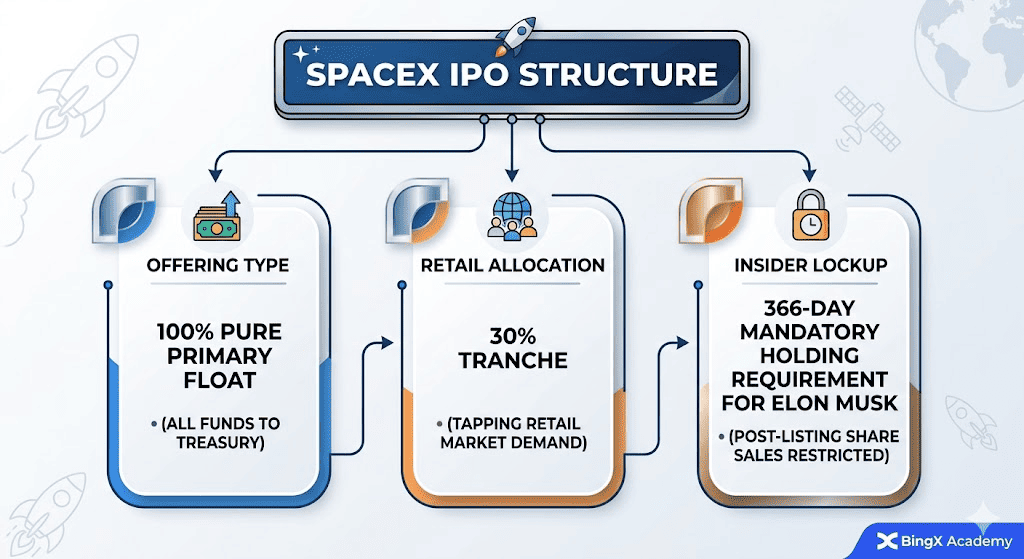
Elon Musk has rewritten the traditional IPO playbook by executing an all-primary offering, ensuring 100% of the $75 billion proceeds go straight into corporate cash reserves to expand AI computing power, while enforcing a strict 366-day lockup on his own shares.
Read more: How to Trade SpaceX Pre-IPO on BingX Pre-IPO: SPACEX (VNTL), SPACEX (PreStocks), and SPCX
2. Rocket Lab USA, Inc. (RKLB)
- Core Role: Direct Reusable Launch Proxy and Defense Infrastructure Compounder
Rocket Lab is the most immediate public proxy for investors seeking exposure to the SpaceX narrative. Operating a vertically integrated business model across launch services, component manufacturing, and spacecraft buses, RKLB posted stellar Q1 2026 revenue growth of 64% YoY to $200 million, while cutting its operating losses nearly in half. Its structural backlog has hit a record $2.2 billion, heavily reinforced by a recent $90 million Space Force satellite contract and a massive $190 million hypersonic test flight award with the Department of Defense.
The stock trades at a premium trailing Price-to-Sales (P/S) multiple of 137.9x following a massive 365% run over the past 52 weeks. While its flagship medium-lift Neutron rocket has faced technical timeline delays pushing its maiden flight to late Q4 2026, Rocket Lab remains the dominant public contender for dedicated small-to-medium payload delivery.
Read more: Rocket Lab (RKLB) Sinks 14.7%: High-Flying Space Stock Hits a Sector-Wide Reality Check
3. AST SpaceMobile, Inc. (ASTS)
- Core Role: Pure-Play Direct-to-Device Cellular Broadband Network
AST SpaceMobile is navigating a high-stakes deployment phase to build the world's first space-based cellular broadband network capable of communicating directly with everyday, unmodified smartphones. Equipped with massive Block 2 BlueBird satellites, the largest commercial phased-array antennas ever deployed in low Earth orbit, the company is targeting a network footprint of up to 60 satellites by the end of 2026.
Backed by a highly resilient $3.9 billion cash cushion built through strategic capital raises, ASTS has secured extensive commercial partnerships with industry giants including AT&T, Verizon, and Vodafone. Multi-stage Discounted Cash Flow (DCF) projections place the stock's intrinsic value at $138.34, indicating that despite its volatile 337% one-year surge to a recent close of $118.12, the asset remains structurally discounted if its global commercial telecom monetization schedule tracks to completion by 2029.
4. Firefly Aerospace, Inc. (FLY)
- Core Role: Medium-Lift Commercial Launch Operator and Lunar Payload Specialist
Firefly Aerospace has captured substantial market traction since its transition to the public markets, carving out an essential niche in medium-lift launches, lunar lander defense services, and high-frequency civil space missions. The company recently seized on intense sector momentum by executing a comprehensive $576 million follow-on public offering of 12 million common shares priced at $48.00 per share, significantly solidifying its capital runway to fund infrastructure expansion across its Texas facilities.
While current fundamental cash-flow indicators display a near-term premium, with DCF valuation metrics tracking close to $36.39 against a market price of $44.24, Firefly's robust backlog of government aerospace missions and proprietary defense technology applications position it as a primary acquisition target or growth vehicle as capital consolidates across the broader aerospace theater.
Read more: Firefly Aerospace Stock Outlook 2026: Can Launch Vehicles, Spacecraft Services Drive FLY to $45+?
5. Intuitive Machines, Inc. (LUNR)
- Core Role: Lunar Economy Anchor and Deep Space Domain Awareness Engine
Intuitive Machines represents the premier public vehicle for capturing the development of the cislunar economy. The firm made history with the first commercial U.S. moon landing under NASA's Commercial Lunar Payload Services (CLPS) initiative. It entered the second half of 2026 on exceptionally strong footing, tripling its Q1 revenue YoY to $186.7 million and expanding its operational backlog by a staggering $842 million.
LUNR is aggressively expanding its tech moat through the $49 million acquisition of the Goonhilly Earth Station network, creating a fully integrated space-to-ground satellite communications network. Furthermore, the company was selected as one of the elite vendors for the U.S. Space Force's sprawling Andromeda program, a major project designed to implement advanced space domain awareness to detect and track threats in geosynchronous orbit. Trading near $39.66, LUNR is a high-conviction asset positioned at the center of deep space exploration contracts.
Comparison of Leading Space Infrastructure Companies in 2026
Based on mid-2026 market dynamics, regulatory filings, and structural tech advantages, here is an analytical overview of the top space equities positioning ahead of the Nasdaq listing:
|
Ticker |
Primary Industry Segment |
Core Product / Structural Advantage |
2026 Strategic Focus & Financial Outlook |
|
SPCX |
Reusable Launch & Satcom |
Starlink connectivity; Starship heavy lift; 100% primary capital float |
Entering public markets at $135/share; expanding solar orbital data centers. |
|
RKLB |
Launch & Space Systems |
Electron launch dominance; $2.2B backlog; deep defense integration |
Mitigating tank testing issues to execute Neutron rocket debut by late 2026. |
|
ASTS |
Satellite Telecom |
Direct-to-cell BlueBird arrays; $3.9B cash reserves; Tier-1 carrier backing |
Launching next satellite batches; ramping global direct mobile subscriptions. |
|
FLY |
Medium Launch Services |
Alpha launch vehicles; $576M follow-on funding runway; NASA payloads |
Scaling medium-lift capacity; expanding logistics infrastructure footprints. |
|
LUNR |
Lunar & Defense Systems |
Robotic lunar landers; Space Force Andromeda program; Goonhilly network |
Tripling baseline revenues via integrated space-to-ground network platforms. |
How to Trade Space Stocks on BingX
BingX provides global market participants with optimized, crypto-native tools to capture price exposure across the rapidly expanding space infrastructure ecosystem. Traders can execute their market theses through two secure pathways:
How to Trade SpaceX (SPCX) Pre-IPO on BingX
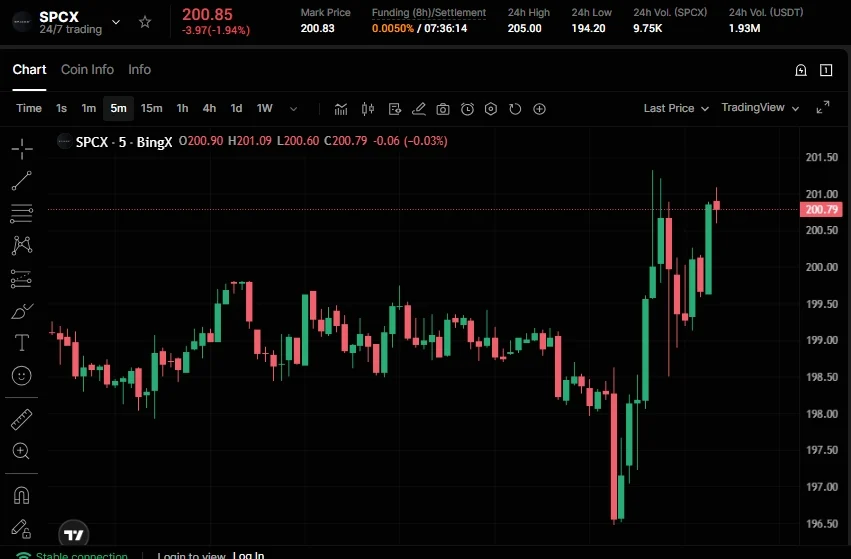
For traders seeking to capture pre-listing momentum or hedge upcoming volatility before the June 12 debut, BingX provides high-performance pathways via its Futures and Pre-IPO markets. Follow this streamlined framework:
Step 1: Select Your Ticker
Log in to your BingX account and navigate to either the Futures Market or the Pre-IPO Zone. Search for your preferred tracking instrument:
- SPACEX(VNTL) or SPACEX(PreStocks): Stock futures mirroring SpaceX's private valuation with fractional sizing as low as 10 USDT.
- SPCX-USDT: Direct pre-market tracking of the upcoming Nasdaq vehicle.
Step 2: Fund Your Wallet
Transfer your USDT stablecoin capital from your main Spot Wallet into your Futures or Pre-IPO trading account via the internal Transfer menu.
Step 3: Choose Your Margin and Leverage
Configure your risk parameters based on your strategy:
- Isolated Margin: Caps your absolute downside risk strictly to the margin assigned to that individual trade.
- Cross Margin: Pools your broader wallet balance to absorb short-term price swings and prevent unwanted liquidation.
- Leverage Multiplier: Select a defensive multiplier, e.g., 2x to 20x.
Risk Warning: Pre-IPO assets do not convey corporate voting rights or physical share delivery. They are highly volatile and respond sharply to private equity rumors, indexing changes, and aerospace testing milestones.
Step 4: Execute Your Position
- Buy / Long: If you expect an explosive post-listing rally fueled by immense retail demand, institutional index fund tracking, and high-margin Starlink growth.
- Sell / Short: If you anticipate a market correction due to the steep 94x price-to-sales multiple, widening R&D net losses, or corporate governance structures.
Step 5: Secure Your Risk Controls
Define your entry parameters via a Market or Limit order, specify your position sizing, and immediately deploy strict Take-Profit (TP) and Stop-Loss (SL) orders to insulate your collateral against sudden volatility spikes.
Trade Space Stock Futures with USDT on BingX TradFi
For active market participants seeking to capture near-term earnings momentum, hedge structural launch risks, or utilize directional flexibility, BingX TradFi offers USDT-settled perpetual contracts mirroring leading U.S. space equities.
- Head to the BingX TradFi portal or the Advanced Futures interface.
- Allocate working capital by transferring your desired quantity of USDT from your main Spot account into your Futures account.
- Select your targeted asset contract from a highly liquid directory of equity perpetual pairs, such as RKLB-USDT, ASTS-USDT, FLYUS-USDT, or SPCX-USDT.
- Determine your macro direction. Select Open Long if you anticipate upside from corporate contract wins and technological deployment milestones, or Open Short to capitalize on technical sector corrections or launchpad testing pullbacks.
- Defensive risk parameters should be configured based on your personal risk threshold. Settle your input position sizing, establish precise TP/SL orders to insulate your capital against unexpected volatility spikes, and execute the trade. Real-time PnL will settle dynamically inside your wallet in USDT.
Top Risks and Key Considerations When Trading Space Stocks
Despite the strong multi-year structural tailwinds backing the evolution of commercial space travel and orbital communications, market participants must manage capital allocation against significant systemic risks:
- Technical and Execution Failure: Space technology operates on razor-thin engineering tolerances. Launch explosions, fuel tank ruptures, payload deployment misalignments, or launchpad facilities failures, such as the Blue Origin setback in late May 2026, can instantaneously erase hundreds of millions in market value and cause severe, multi-quarter program delays.
- Extreme Valuation Multiples: Many pure-play space stocks are trading at hyper-elevated trailing Price-to-Sales multiples, exceeding 100x in some instances. These premium valuations leave zero margin for corporate execution errors, rendering high-beta space names vulnerable to rapid multiple compression if interest rates adjust or general market liquidity cools.
- Crowded ETF Holdings: Asset management inflows have driven over $1.3 billion into pure-play space ETFs in a single month. However, because the underlying universe of listed space stocks remains highly specialized and compact, the top seven space ETFs feature an overlap of over 50% in their top holdings. This concentration creates highly correlated trading movements, accelerating downside drops across the entire sector during broader market pullbacks.
- Dual-Class Corporate Governance: Mega-cap pioneers like SpaceX enforce rigid dual-class equity voting structures that concentrate over 85% of total voting control in the hands of the founder and select corporate insiders. Retail and generalist institutional capital can access the underlying economics of the business but hold zero structural influence over executive capital allocation choices.
Final Thoughts: Should You Add Space Stocks to Your Portfolio?
The space infrastructure landscape features a highly lucrative divergence: while sovereign-scale giants like SpaceX print massive top-line connectivity revenues and deploy historic capital into deep space rocket systems, specialized public enablers like Rocket Lab, AST SpaceMobile, and Intuitive Machines are actively capturing high-margin government defense, cislunar logistics, and commercial telecommunications niches.
Spreading capital across both layers, shielding your portfolio with the robust cash balances and carrier partnerships of AST SpaceMobile and the defense contracts of Rocket Lab, while using the flexible trading tools on BingX to navigate sector-wide launch volatility, provides a comprehensive framework to capture this global technological cycle.
Utilizing high-liquidity stock futures via BingX TradFi enables global capital to execute these macro-driven equity theses efficiently using unified, crypto-native rails. However, managing these exposures successfully requires strict capital discipline and a thorough understanding of underlying launch schedules.
Related Reading
- How to Trade SpaceX Pre-IPO on BingX Pre-IPO: SPACEX (VNTL), SPACEX (PreStocks), and SPCX
- Firefly Aerospace Stock Outlook 2026: Can Launch Vehicles, Spacecraft Services Drive FLY to $45+?
- Top AI Data Center Stocks to Buy in 2026: Cloud, Servers, and AI Compute Infrastructure
- Top Financial Services and Fintech Stocks to Buy in 2026 Amid Agentic AI, Stablecoin Rails Shift
- Top Energy Stocks and ETFs to Buy in 2026: The AI Power Crunch Meets Geopolitical Volatility
- Should You Participate in SpaceX IPO: Pros and Cons
- Top 10 Things to Know About the SpaceX IPO: Pricing, Valuation, and How to Trade It
- How the June 12 SpaceX IPO Could Propel Elon Musk Beyond the $1 Trillion Net Worth Milestone
- What Is SpaceX Tokenized Stock (SPCXB) and How to Buy It?
