
Pharos (PROS) is a next-generation financial Layer-1 blockchain designed to bridge the gap between traditional capital and crypto-native liquidity. Built by former leadership from Ant Group (Alibaba’s fintech arm), Pharos addresses the fragmentation of tokenized assets by embedding compliance and institutional-grade performance directly into its core protocol.
On April 28, 2026, the project reached a major milestone with the launch of its Pacific Ocean Mainnet and the Token Generation Event (TGE) for the $PROS token. Backed by $52 million in funding from investors like Hack VC and SNZ Holding, Pharos enters the market not just as a high-speed L1 blockchain network, but also as a programmable financial layer capable of settling cross-border payments and institutional RWAs (real-world assets) in under one second.
This article examines the RealFi vision of Pharos, its unique modular technical stack, how it aims to scale the agentic web, the utility of the $PROS token, and how to trade Pharos (PROS) on BingX futures market.
What Is Pharos (PROS)?
Pharos (PROS) is a high-performance, EVM-compatible Layer 1 blockchain engineered to serve as the foundational infrastructure for RealFi, the convergence of institutional finance and decentralized rails. Unlike general-purpose networks where financial logic is an application-level add-on, Pharos is architected from the metal up as an asset-native network. It aims to solve the liquidity fragmentation of traditional markets, transforming illiquid assets like energy grids, commodities, and real estate into programmable, on-chain instruments that move with the ease of a stablecoin.
At its core, Pharos is designed to operate as a Borderless Digital Financial City, optimized to handle the rigorous throughput and regulatory demands of global trade through four key pillars:
- Institutional-Grade Velocity: By delivering sub-second block times and near-instant finality, Pharos enables the real-time settlement of tokenized stocks, bonds, and treasuries. This eliminates the multi-day T+2 settlement lag inherent in legacy financial systems.
- Built-in Compliance and Privacy: Pharos embeds regulatory guardrails directly into the protocol layer. Utilizing zk-KYC (Zero-Knowledge Know Your Customer) and programmable AML (Anti-Money Laundering) modules, the network allows institutions to meet global compliance standards while ensuring that sensitive user data remains private and off-chain.
- The Gigagas Performance Engine: Pharos shatters the Bottleneck Effect found in traditional EVM chains. It delivers a staggering 2 Gigagas per second and a sustained throughput of 30,000+ TPS, ensuring that complex smart contracts execute without the prohibitive gas wars common on older networks.
- True Internet-Scale Infrastructure: Leveraging deep-parallel execution and a modular Special Processing Network (SPN) architecture, Pharos is engineered for mass adoption, capable of supporting 1 billion simultaneous users. This allows it to serve as a high-fidelity settlement layer for the Agentic Web, where millions of AI agents and IoT devices transact autonomously in real-time.
How Does the Pharos Ecosystem Work?
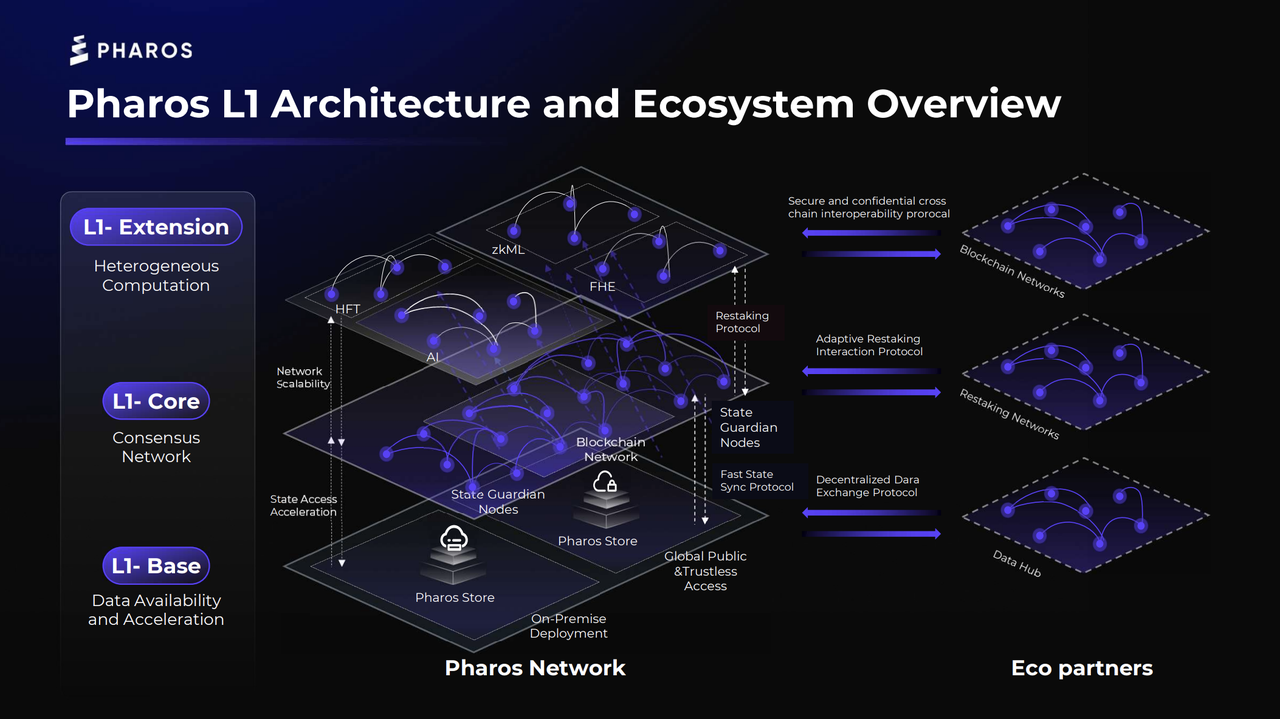
An overview of how Pharos Network works | Source: Pharos docs
Pharos utilizes a multi-layered modular architecture to solve the bottleneck effect that plagues traditional sequential blockchains.
Pharos Network's Three-Layer Stack
- L1-Base: Focuses on hardware acceleration and industry-leading data availability.
- L1-Core: The execution engine, powered by AsyncBFT consensus, achieving over 30,000 TPS and sub-second finality.
- L1-Extension: This layer introduces Special Processing Networks (SPNs), modular, application-specific sidechains that allow builders to customize their environment for specific financial use cases, such as high-frequency trading or AI models.
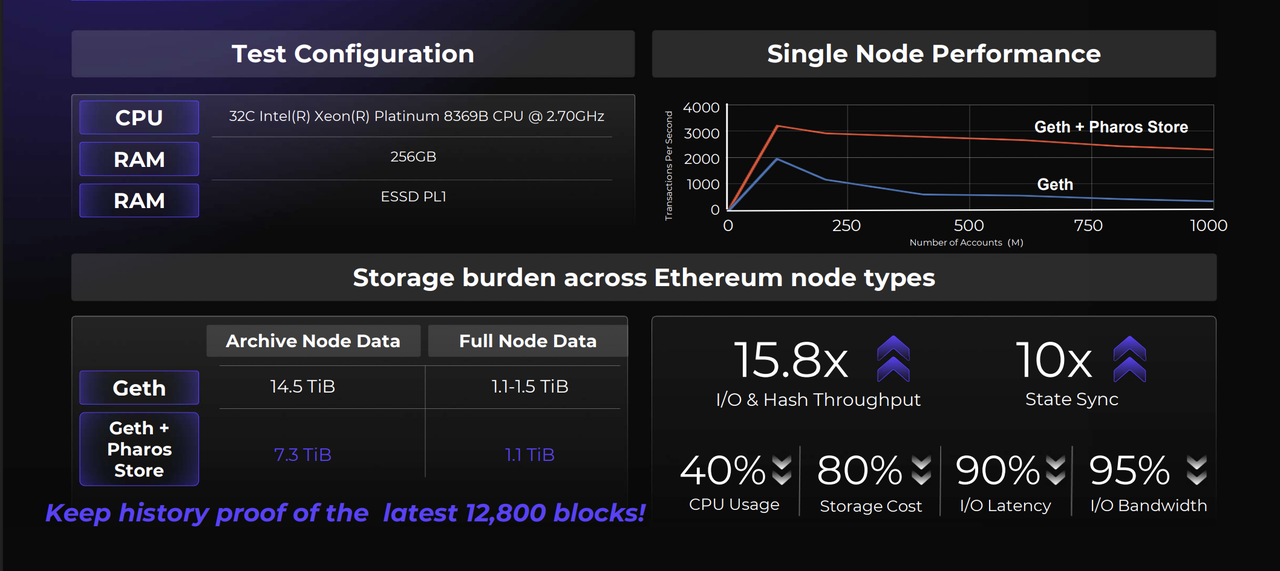
Efficiency of Pharos' modular stack | Source: Pharos docs
Agentic Commerce: The x402 Protocol
Pharos is a primary supporter of the x402 protocol, a lightweight, trustless payment standard for the Agentic Web. By reactivating the HTTP 402 Payment Required status code, Pharos allows AI agents to perform micro-payments for data and compute instantly. This enables pay-as-you-go autonomous economies where agents trade services without human intervention.
What Is the $PROS Token Used For?
The $PROS token is the utility engine and governance backbone of the Pharos network. Its primary functions include:
- Gas Fees: Paying for transaction execution on the Pacific Mainnet.
- Network Security: Staking via Proof-of-Stake (PoS) to secure the network and earn rewards.
- Governance: $PROS holders vote on protocol upgrades, SPN expansion, and Foundation treasury allocations.
- RWA Utility: Potential use as collateral for on-chain stablecoins and priority access to institutional RWA vaults.
What Is $PROS Tokenomics?
The $PROS token has a fixed genesis supply of 1,000,000,000 (1 billion) tokens. The economic model is designed to prioritize early-stage scarcity followed by long-term sustainability.
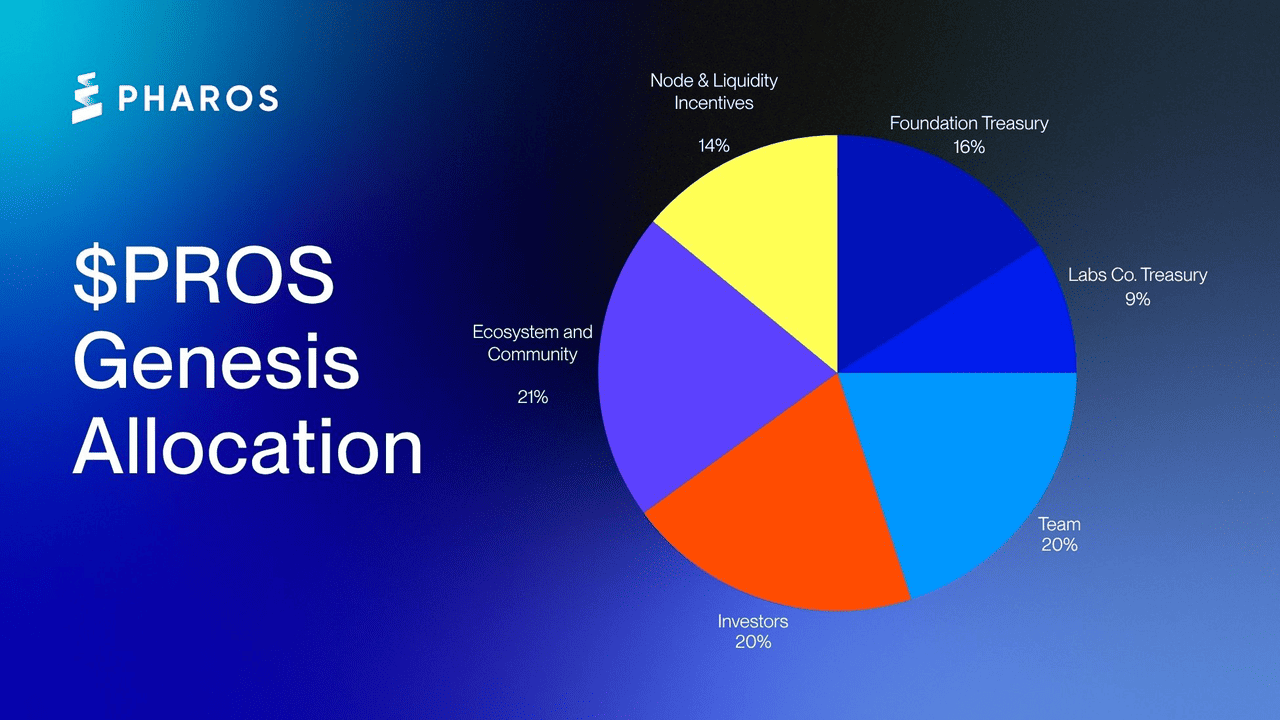
PROS token allocation at genesis | Source: Pharos blog
$PROS Token Distribution
- Ecosystem and Community (21%): Includes a 6% airdrop allocation for early testers and community participants.
- Team and Investors (40%): Combined 40% allocation, subject to a 12-month cliff and 36-month linear vesting to ensure long-term commitment.
- Foundation and Treasuries (25%): Reserved for long-term growth and RWA onboarding initiatives.
- Node and Liquidity Incentives (14%): Distributed to validators and liquidity providers over 48–60 months.
Inflation Note: Staking inflation is set to 0% for the first 6 months of the Pacific Mainnet to support price stability, moving to 5% annually starting in month seven.
Pharos Network vs. Other Layer-1 Blockchains: Key Differences
|
Feature |
Pharos (PROS) |
Standard EVM Chains |
|
Primary Focus |
RealFi & Institutional RWAs |
General Purpose DeFi/NFTs |
|
Throughput |
30,000+ TPS |
15 – 5,000 TPS |
|
Finality |
Sub-second (<1s) |
2 seconds – 15 minutes |
|
Compliance |
Native zk-KYC / AML |
Requires 3rd party dApps |
|
Architecture |
Modular SPN Architecture |
Monolithic or L2-heavy |
Unlike general-purpose Layer-1s such as Solana or Ethereum, which prioritize retail DeFi and dapp ecosystems, Pharos is a RealFi-native chain designed specifically for institutional finance. While Solana and Sui achieve high performance through monolithic parallel execution, targeting 65k–120k TPS, Pharos differentiates itself with a SPN modular architecture. This allows it to hit 30,000+ TPS with sub-second finality while isolating compliance and institutional workflows into dedicated layers. By embedding zk-KYC/AML at the protocol level, Pharos removes the regulatory friction that prevents trillion-dollar pools of capital from migrating to chains like Avalanche or Monad, which often require third-party middleware to achieve similar compliance.
The practical advantage of Pharos lies in its Digital Financial City model, which unifies fragmented RWA liquidity. In traditional L1s, tokenized treasuries and credit often live in siloed protocols; in Pharos, its AsyncBFT consensus and dual VM for EVM and WASM support allow these assets to settle as natively as stablecoins. Technically, Pharos outpaces standard EVM-compatible chains by delivering 2 Gigagas per second, roughly 100x the capacity of Ethereum, and maintaining ultra-low costs even during high-stress market events. This specialized infrastructure makes it uniquely viable for Agentic Commerce, where AI agents require instant, compliant micro-payments that would be economically or technically unfeasible on incumbents focused primarily on consumer-facing retail applications.
Read more: Top 10 Blockchains for Real‑World Asset (RWA) Tokenization Projects in 2026
How to Trade Pharos (PROS) on BingX
Leverage the power of BingX AI to analyze real-time market sentiment, institutional capital flows, and technical indicators for $PROS during its high-volatility mainnet launch phase.
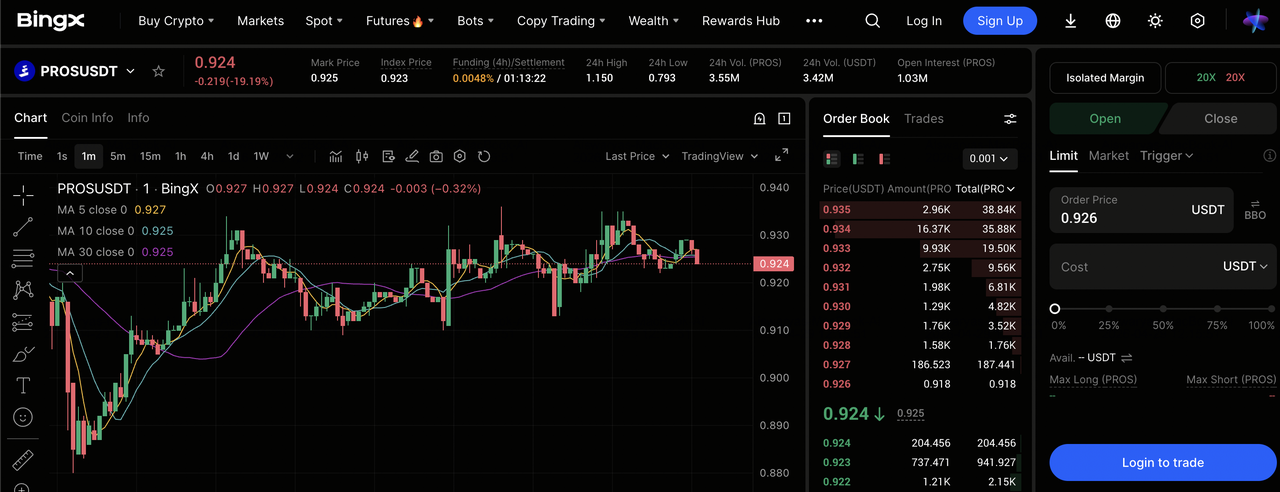
PHAROSUSDT perpetuals on the BingX futures market
Long or Short PROS Perpetuals on the Futures Market
- Access the Futures Terminal: Log in to your BingX account, navigate to the Futures tab, and search for the PROS/USDT Perpetual contract.
- Select Your Margin Mode: Choose between Isolated Margin to limit risk to a specific position or Cross Margin to utilize your entire account balance as collateral.
- Adjust Leverage: Set your preferred leverage. BingX typically offers up to 50x for high-liquidity L1 tokens, but ensure your risk management parameters are strictly defined.
- Analyze with BingX AI: Use the integrated BingX AI Trend Analysis tool to monitor RWA-specific momentum and identify institutional smart money entry points.
- Place Your Order: Select Limit Order for a specific entry price or Market Order for instant execution, then set your Take Profit (TP) and Stop Loss (SL) to protect your capital against the rapid market reactions common in the RealFi sector.
5 Key Considerations Before Investing in Pharos Network ($PROS)
Before buying or selling Pharos (PROS) token, you must evaluate the structural risks of its early-stage mainnet and the technical complexities of its compliance-first institutional model.
- Early Mainnet Stage: The Pacific Mainnet launched in late April 2026; expect initial volatility as airdrop recipients and early investors find price equilibrium.
- Institutional Adoption: The long-term value of $PROS token depends on whether large financial institutions utilize Pharos for asset tokenization.
- Regulatory Hurdles: As a compliance-first chain, Pharos may face unique regulatory scrutiny compared to more permissionless L1s.
- Competitive RWA Space: Competition from Avalanche Subnets and BlackRock-backed protocols is intensifying.
- Low Initial Float: With heavy vesting for team and investors, the early circulating supply is limited, which can lead to high price sensitivity.
Final Thoughts: Is Pharos the Future of RealFi and RWA?
As of late April 2026, Pharos has transitioned from a high-performance testnet into a functional Layer 1 infrastructure specifically optimized for the tokenization of everything. By integrating sub-second finality with built-in compliance modules like zk-KYC, the network addresses the primary technical and regulatory barriers that have historically prevented institutional capital from migrating on-chain. The success of its Digital Financial City vision now depends on the sustained growth of its SPNs and the practical adoption of its x402-powered AI payment gateway for autonomous commerce.
For the strategic investor, Pharos represents a focused bet on the App-Chain thesis, where the protocol layer prioritizes institutional utility over retail speculation. Its long-term viability will be measured by the depth of its RWA liquidity pools and its ability to maintain a competitive Gigagas throughput as more complex financial SuperApps deploy on the Pacific Mainnet. Traders should closely monitor the network’s ability to secure high-value partnerships in the energy and commodity sectors, as these will serve as the true proof-of-concept for its RealFi infrastructure.
Risk Reminder: Digital asset investments, particularly in newly launched Layer 1 tokens like Pharos (PROS), carry high market risk and extreme price volatility. The value of $PROS token may fluctuate significantly following its April 28 TGE and subsequent airdrop claims. Always perform your own research, utilize BingX AI for real-time risk assessment, and only trade capital you can afford to lose. BingX is not responsible for any trading losses incurred.
Related Reading
- Top Real-World Asset (RWA) Tokenization Projects of 2026
- Top 10 Blockchains for Real‑World Asset (RWA) Tokenization Projects in 2026
- What Is USDai (CHIP) InfraFi for GPU-Backed Yield and How Does It Work?
- What Is MANTRA (MANTRA) RWA Layer 1 Blockchain and How to Buy the MANTRA Token?
- What Is Canton Network (CC) RWA Layer-1 Blockchain and How Does It Work?
