
Canton Network (CC) is a public, permissioned blockchain designed to bring the efficiency of DeFi to the regulated world of Wall Street. Developed by Digital Asset, Canton enables banks, asset managers, and exchanges to synchronize data and assets across previously siloed systems without sacrificing privacy or control. Unlike transparent public blockchains, Canton allows institutions to define their own privacy rules, ensuring that sensitive trade data remains visible only to authorized counterparties.
As of April 21, 2026, the Canton ecosystem has reached a major milestone with the launch of the Japan Securities Clearing Corp. (JSCC) pilot, tokenizing Japanese government bonds as collateral. This follows successful live integrations with the DTCC, JPMorgan, and Goldman Sachs. The native utility token, Canton Coin (CC), serves as the economic engine of the network, utilizing a unique burn-and-mint model to align network growth with token value.
This article examines the modular architecture of the Canton Network, the mechanics of its privacy-preserving protocol, the utility of the $CC token, and how to trade Canton Network (CC) on BingX.
What Is the Canton Network?
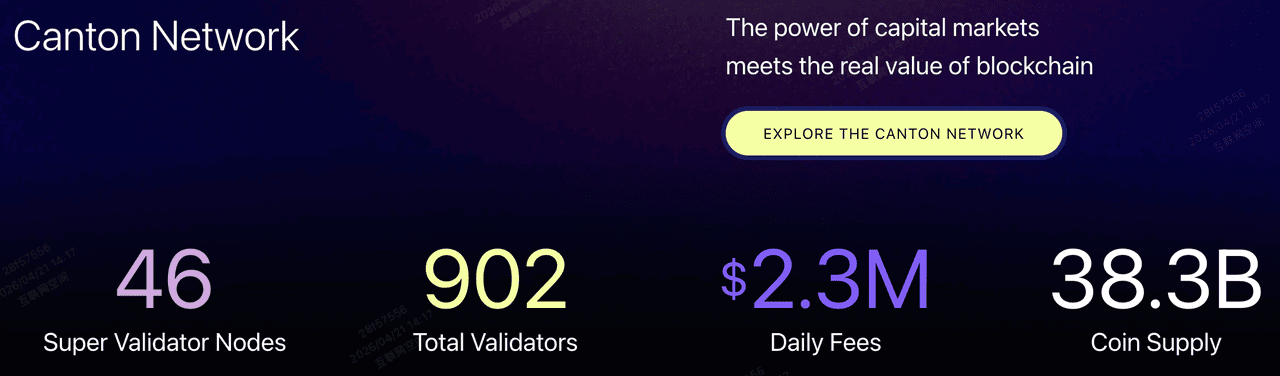
Canton Network in numbers as of April 2026 | Source: Canton
Canton is a network of networks that solves the blockchain trilemma for institutional finance: providing privacy, scalability, and interoperability simultaneously. While traditional DeFi requires total transparency for transaction integrity, Canton leverages the Daml smart contract language to decouple integrity from visibility. This means a transaction can be verified as valid by the network without the underlying data being exposed to competitors.
The platform is anchored by industry giants, including Visa, Nasdaq, and BNP Paribas, who act as Super Validators. Canton targets the trillions of dollars locked in traditional financial silos, offering:
- Atomic Settlement: Instant, all-or-nothing exchange of assets, e.g., cash for bonds, across different applications.
- Selective Privacy: Fine-grained control over data disclosure, compliant with GDPR and banking secrecy laws.
- Institutional Interoperability: A common protocol that allows a Goldman Sachs app to talk to a BlackRock app seamlessly via the Global Synchronizer.
How Does the Canton Network Work?
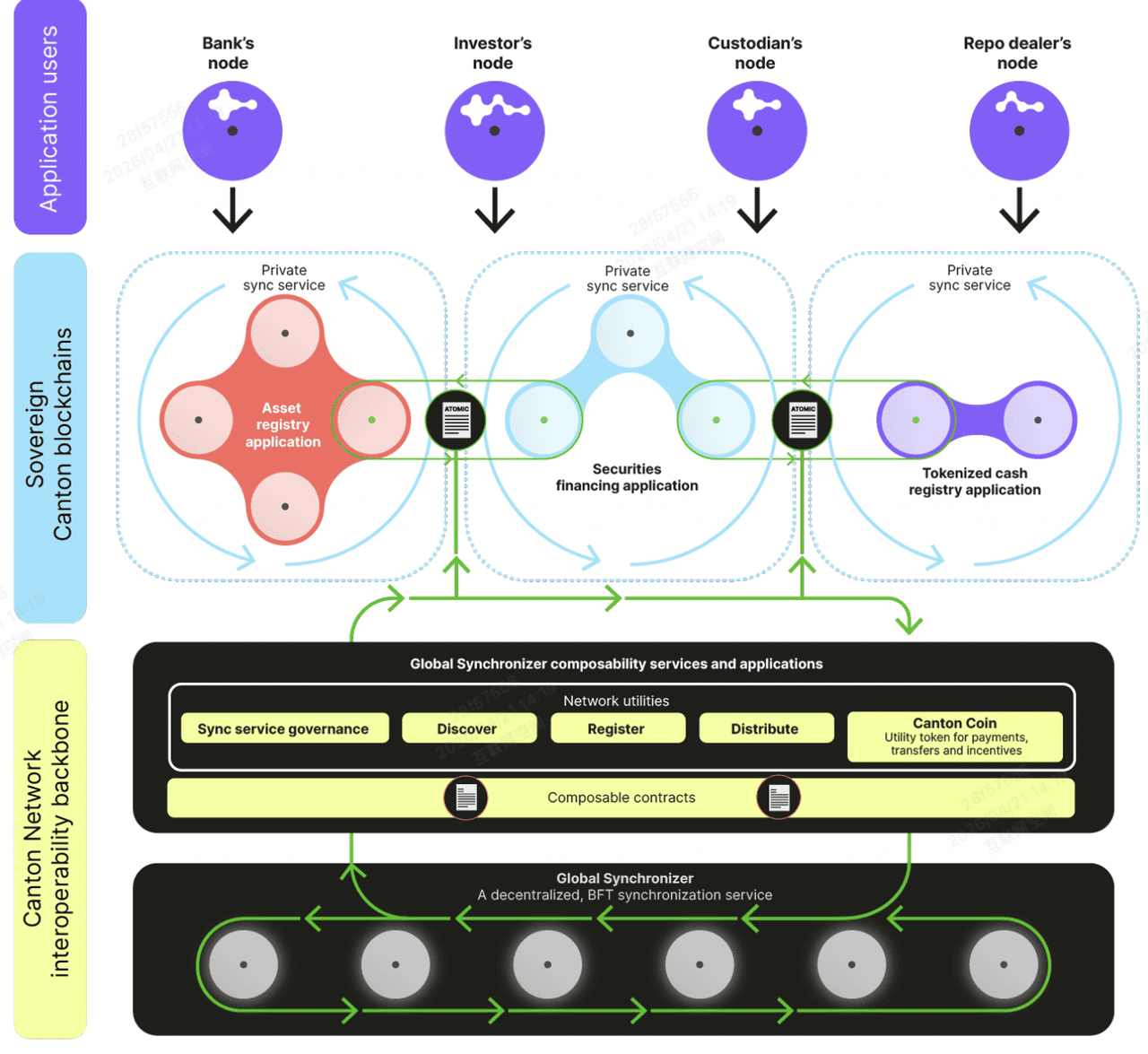
How Canton Network's Global Synchronizer works | Source: Canton whitepaper
At its core, Canton is built on a modular protocol that separates execution from synchronization:
- Participant Nodes: Institutions run their own sovereign nodes. These nodes execute Daml smart contracts and store only the data relevant to that specific institution.
- The Global Synchronizer: This is the decentralized backbone of the network. It sequences encrypted messages between different sub-networks to ensure global consistency. It never sees the content of the transactions; it only ensures they happen in the correct order.
- Daml Smart Contracts: All logic is written in Daml, an open-source language that focuses on rights and obligations. It explicitly defines stakeholders who can see the contract and signatories who must approve changes.
- Privacy-Preserving Consensus: Canton uses a unique mechanism where consensus is reached only among the parties involved in a transaction. The broader network of Super Validators provides the sequencing and timestamping without needing to validate the private data itself.
What Is the $CC Token Utility?
Canton Coin (CC) is the native utility and coordination layer of the Global Synchronizer. Its economic model is designed to discourage speculation and reward real utility.
- Network Fees (The Burn): All transaction fees are denominated in USD but paid by burning CC tokens. As institutional volume like RWA tokenization increases, more CC is removed from circulation.
- Validator Rewards (The Mint): New CC is minted and distributed to Super Validators or infrastructure providers, Validators, and Application Providers who bring active users to the network.
- Governance: $CC holders and Super Validators participate in the decentralized governance of the Canton Foundation, voting on protocol upgrades and fee structures.
- Incentivizing Interoperability: Application builders earn $CC rewards based on the cross-app activity they generate, encouraging a more connected ecosystem.
What Is Canton (CC) Tokenomics?
The CC token follows a fair launch philosophy. There was no initial coin offering (ICO) or venture capital pre-allocation. Every token in circulation is earned through participation in the network.
- Total Supply: Approximately 38.3 Billion CC as of April 2026.
- Burn-and-Mint Equilibrium: If demand for the network is high, more tokens are burned than minted, creating deflationary pressure. If demand is low, the minting of rewards exceeds the burn to lower the cost of entry and encourage adoption.
- Mint Distribution: Over the first 10 years, minting is split equally between the infrastructure providers (Validators) and the builders (Application Providers).
Canton Network vs. Ethereum: What Is the Difference?
|
Feature |
Canton Network (CC) |
Ethereum (ETH) |
|
Privacy |
Native "Need-to-Know" Privacy |
Public by Default (Transparent) |
|
Target User |
Regulated Financial Institutions |
Retail & DeFi Developers |
|
Governance |
Decentralized Public Permissioned |
Fully Permissionless |
|
Fee Model |
USD-denominated (Burn-and-Mint) |
Variable Gas (Gwei) |
|
Asset Focus |
Tokenized JGBs, Treasuries, Repos |
Crypto-native Assets & NFTs |
Canton Network and Ethereum differ fundamentally in their data visibility and consensus models. Ethereum operates as a global broadcast network, where every transaction and smart contract state is transparent and replicated across thousands of nodes to ensure permissionless security. In contrast, Canton utilizes a need-to-know privacy model powered by the Daml language, where transaction data is only stored and validated by the actual participants involved. While Ethereum’s transparency is ideal for open-market DeFi liquidity, Canton’s modular network of networks architecture allows institutions like Goldman Sachs or BNY to maintain strict banking secrecy and GDPR compliance. This enables atomic settlement across sovereign sub-networks, ensuring a trade only settles if all private legs are confirmed, without ever exposing sensitive trade volumes or counterparties to the public.
From a practical performance and economic standpoint, the two networks serve divergent utility. Ethereum's PoS model relies on a universal gas fee (Gwei) that fluctuates with network congestion, often leading to unpredictable costs for complex institutional workflows. Canton decouples execution from synchronization, utilizing a Burn-and-Mint equilibrium where fees are denominated in stable USD but settled by burning $CC tokens. This provides the price predictability required for enterprise budgeting. While Ethereum focuses on horizontal scaling through Layer 2s to increase throughput, Canton achieves unlimited vertical scaling because each participant node only processes its own relevant ledger updates. This allows the network to handle high-value, high-frequency institutional rails, such as the $1.5 trillion monthly repo volumes currently processed on Daml-based systems, without competing for block space with retail NFT or meme coin traffic.
While Ethereum is the World Computer for permissionless innovation, Canton is the Global Synchronizer for the regulated financial system. Ethereum prioritizes transparency for security, whereas Canton uses Daml to ensure that privacy is the default state for every transaction.
Read more: Vitalik Unveils Ethereum’s 5-Year Roadmap: From TPS Race to World Computer Resilience
How to Trade Canton (CC) on BingX
Maximize your trading efficiency by using BingX AI to monitor institutional news cycles and RWA narrative shifts for $CC. With the surge in institutional adoption and its unique burn-and-mint mechanics, BingX provides high-liquidity pairs to capture CC’s market movements.
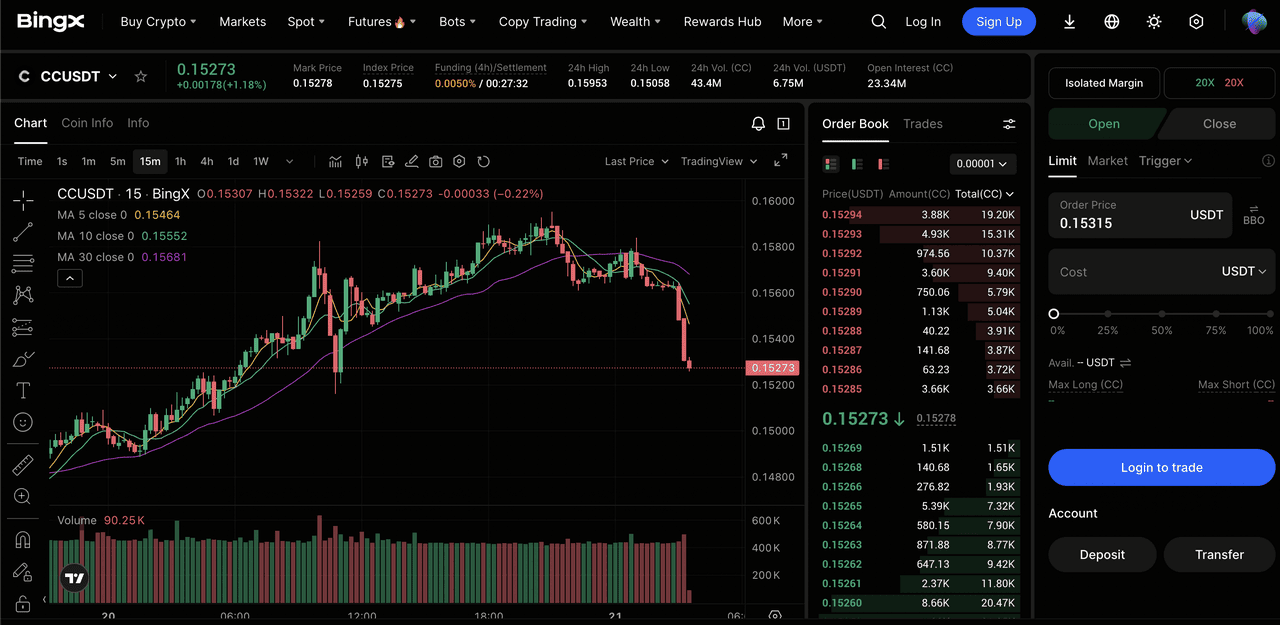
CC/USDT perpetuals on the BingX futures market
How to Long or Short CC Perpetual Futures
Trading $CC on the BingX Futures market allows you to utilize leverage and profit from both rising and falling price trends.
- Access the Futures Terminal: Log in to your BingX account, navigate to the Futures tab, and select Perpetual Futures. Use the search bar to find the CC/USDT perpetual contract.
- Transfer Funds: Ensure your Futures Account has USDT collateral. If your funds are in the Fund Account, use the Transfer function to move them instantly.
- Configure Your Trade:
- Margin Mode: Choose Isolated Margin to limit risk to a specific position or Cross Margin to use your entire futures balance to prevent liquidation.
- Leverage: Adjust your leverage, e.g., 5x, 10x, or up to 50x, based on your risk tolerance.
- Margin Mode: Choose Isolated Margin to limit risk to a specific position or Cross Margin to use your entire futures balance to prevent liquidation.
- Set Order Type: Select Market for an instant entry at the current price or Limit to execute at a specific price point, such as a retest of key support levels.
- Execute and Manage: Click Open Long if you anticipate a price increase driven by RWA adoption news, or Open Short if you expect a pullback. Always set Take Profit (TP) and Stop Loss (SL) levels to protect your capital.
5 Key Considerations Before Investing in Canton ($CC)
Before allocating capital to the institutional ecosystem, investors should evaluate the unique economic stabilizers and regulatory dependencies that distinguish $CC from traditional retail-driven altcoins.
- Utility-Driven Value: $CC's price is structurally tied to network usage. If institutions stop building on Canton, the token loses its primary value driver.
- Regulatory Sensitivity: Canton operates in a highly regulated space. Changes in RWA or stablecoin laws in Japan, the EU, or the US can impact adoption.
- Low Speculative Premium: The burn-and-mint model is designed to dampen speculative bubbles, making it a slower mover compared to memecoins.
- Institutional Lock-in: Once a major bank like Mizuho integrates its core collateral system with Canton, the switching cost is high, creating long-term network effects.
- Upcoming Unlocks: Monitor the scheduled $120 million token unlock in late April 2026, which may provide a short-term entry point.
Read more: What Is JPYSC, Japan’s First Trust Bank-Backed Yen Stablecoin, and How Does It Work?
Final Thoughts: Should You Invest in Canton (CC)?
As of April 2026, Canton has proven itself as the primary plumbing for the On-chain Wall Street. By successfully navigating the complex requirements of the JSCC and the DTCC, the network has moved beyond the Proof of Concept phase into full production. CC offers a unique investment thesis: exposure to the trillion-dollar RWA market through a token model that rewards genuine infrastructure utility over hype.
For the strategic investor, Canton Network represents a bet on the long-term migration of traditional finance to blockchain rails. While it lacks the explosive moonshot potential of permissionless L1s, its integration into the bedrock of global finance makes it a foundational asset for any RWA-focused portfolio.
Risk Reminder: Digital asset investments carry high market risk. While CC is backed by institutional utility, price volatility remains possible. Always perform your own research and utilize BingX AI for real-time risk assessment.
Related Reading
- Top Real-World Asset (RWA) Tokenization Projects of 2026
- Top 10 Blockchains for Real‑World Asset (RWA) Tokenization Projects in 2026
- What Is MANTRA (MANTRA) RWA Layer 1 Blockchain and How to Buy the MANTRA Token?
- What Is Ondo Finance (ONDO), Bringing Tokenized RWAs and Real-Yields On-Chain?
- Ondo Global Markets Unlocks 100+ Tokenized U.S. Stocks on Ethereum - All You Need to Know
