
In mid-May 2026, Lead (XPB) finds itself in a unique position within the base metals complex. While sister metals like Copper and Aluminum have surged to all-time highs following the Strait of Hormuz closure, Lead remains remarkably anchored. Trading near the $1,980 mark, the metal is caught between a projected global surplus and surging operational costs for smelters. Analysts from the International Lead and Zinc Study Group (ILZSG) and Fastmarkets suggest that while the physical market is well-supplied, the geopolitical multiplier on energy prices is creating a high floor for refined metal.
As the global economy grapples with the largest crude oil supply disruption in history, Lead’s role as the backbone of the old energy economy (SLI batteries) and the new digital economy (5G backup power) is being re-evaluated. This guide breaks down the Lead price prediction for 2026 using data from the ILZSG, Wood Mackenzie, SMM, and the World Bank.
You will also discover how to trade Lead futures and other base metals through BingX TradFi.
Top 5 Things for Lead Traders to Know in 2026
As Lead navigates a surplus-heavy environment clashing with macro-economic volatility, traders must monitor these five market-moving factors.
- The 109,000-Tonne Surplus: The ILZSG projects a refined lead surplus in 2026, with a 1.3% production growth slightly outpacing the 1.1% demand growth. This acts as a natural ceiling on aggressive price spikes.
- The Energy Surcharge Effect: While LME spot prices are rangebound, European and UK smelters are implementing energy surcharges to combat record electricity costs, effectively raising the cost for physical delivery.
- The Silver By-product Link: With Silver hitting record highs near $60/oz, mine operators are accelerating polymetallic projects. This is expected to bring unexpected accidental lead supply to the market by Q4 2026.
- Data Center Demand: Lead-acid batteries are seeing a 0.4% CAGR boost from the expansion of 5G networks and massive AI data centers, which require reliable, low-cost stationary storage.
- China’s Secondary Dominance: China now accounts for 50% of global refining capacity. Any shift in Chinese trade-in policies for e-bikes or automotive batteries can trigger immediate LME inventory fluctuations.
What Is Lead (XPB)?
Lead is a dense, corrosion-resistant base metal primarily consumed by the battery sector, accounting for 80% of global use. In 2026, its value proposition is bifurcated: it remains the standard for Starting, Lighting, and Ignition (SLI) batteries in traditional vehicles and serves as a critical auxiliary power source for Electric Vehicles (EVs).
As of May 2026, the lead market is defined by a recycling-dominant supply structure. Unlike lithium, over 55% of global lead supply comes from secondary production (recycled batteries). On the BingX TradFi platform, traders can speculate on these price movements through Lead (PB) perpetual contract with Tether (USDT), leveraging the metal’s tendency to trade in predictable technical corridors compared to the more volatile green metals.
Lead's Performance in 2025: A Review
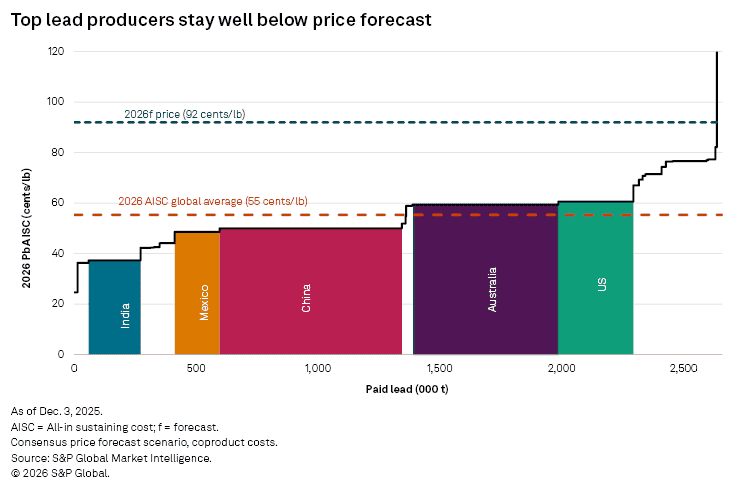
Lead production as of December 2025 | Source: S&P Global
2025 was a year of polarization for Lead. The metal started the year at $1,921 and faced a Flash Crash in April 2025 down to $1,829 following the U.S. Liberation Day tariff announcements. However, it spent the latter half of the year recovering, fueled by a 6.6% rise in US domestic battery production and a massive 45,150 MT delivery to LME warehouses in November. By December 2025, the metal had stabilized in the $1,930–$2,050 range, setting the stage for the rangebound sideways trend seen in early 2026.
Lead’s 2026 Strategy: How to Navigate Commodity Volatility
- The $2,000 Pivot: Technical analysts view $2,000 as the gravity point for 2026. Prices oscillating around this level indicate a market in equilibrium.
- The Zinc-Lead Spread: With Zinc in a 19,000-tonne deficit, traders are watching the spread between the two. Historically, a wide gap leads to smelter shifts that eventually rebalance both.
- LME Inventory Levels: Watch the 240,000 MT level. Declines below this threshold in 2026 typically signal a bullish squeeze regardless of the macro surplus.
Lead 2026 Investment Outlook: $2,250 Breakout vs. $1,800 Mean Reversion
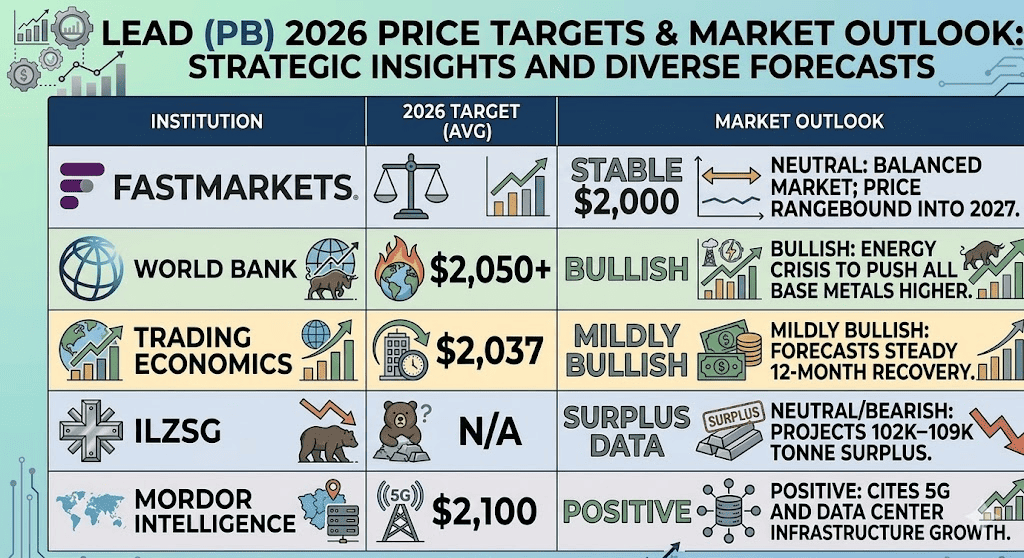
Lead price forecasts for 2026 by various analysts
Navigating the 2026 lead market requires balancing a technical supply surplus against a backdrop of historic energy-driven inflation and shifting industrial demand.
The Bull Case: The $2,250 Energy-Push Breakout
The bullish narrative centers on supply-side destruction driven by the ongoing Strait of Hormuz crisis. If energy costs remain elevated through H2 2026, the Brent crude average of $86/bbl will continue to push European electricity prices to levels where smelting becomes economically unviable. This forced scarcity occurs when the marginal cost of production exceeds the LME spot price, potentially knocking out 5–7% of global primary smelting capacity. In such a scenario, Lead would likely decouple from its physical surplus as paper traders hedge against a total supply chain freeze, driving prices toward a $2,250 target.
For traders, this represents a classic laggard play. As Copper and Tin reach all-time highs and become prohibitively expensive for retail and mid-tier institutional participants, capital typically rotates into undervalued base metals like Lead. Practically, a breach of the $2,100 resistance level on high volume, coinciding with a 15% drawdown in LME on-warrant inventories, would confirm this breakout. Investors should monitor the Zinc-Lead spread; if Zinc’s deficit widens further, integrated miners may prioritize Zinc, inadvertently tightening the Lead concentrate market.
The Base Case: $1,900 – $2,050 Rangebound Stability
The most likely scenario, supported by the ILZSG’s 109,000-tonne surplus forecast, is a market in structural equilibrium. While the surplus exists, it is relatively thin at 0.8% of global demand, meaning it can be easily absorbed by the steady 0.4% CAGR in backup power systems for 5G and AI data centers. Furthermore, the 6.6% rise in US domestic battery production acts as a sturdy demand floor. In this environment, Lead functions as a low-beta safe haven within the commodity complex, offering a hedge against the extreme volatility seen in green battery metals like Lithium or Cobalt.
This scenario favors range-trading strategies. Analysts suggest that the $1,930 support and $2,070 resistance levels will define the majority of 2026 trading sessions. Investors should focus on China’s SMM lead ingot inventory data; as long as social inventories remain under 30,000 mt, the downside risk remains limited. Practically, this is a carry trade environment where profits are found in capturing small price oscillations and maintaining neutral-to-long bias during peak seasonal battery replacement months in Q3 and Q4.
The Bear Case: The $1,800 Chinese Slowdown Trap
The bearish scenario is triggered by a 1.7% contraction in Chinese domestic demand and a failure of the global circular economy to absorb excess scrap. If China’s trade-in policies for e-bikes and automotive batteries lose momentum, or if reciprocal tariffs further throttle battery exports, the projected 109,000-tonne surplus could swell toward 200,000 tonnes. This would force secondary (recycled) smelters, which account for 55% of global supply, into a price war to clear inventories, potentially driving the market toward the $1,800 psychological floor.
Technically, the bear case is confirmed if LME lead fails to hold the $1,900 line in the sand during a period of US Dollar (DXY) strength. A move below this level would likely trigger systematic liquidations from speculative funds currently holding long positions in anticipation of an energy-led rally. Traders should keep a close eye on Lead TCs (Treatment Charges); if TCs rise significantly, it indicates that smelters have an overabundance of concentrate, signaling that a supply glut is imminent and a retest of 2025 lows is likely.
Lead Price Forecasts for 2026 by Leading Analysts
|
Institution |
2026 Target (Avg) |
Market Outlook |
|
Fastmarkets |
$2,000 |
Neutral: Balanced market; price rangebound into 2027. |
|
World Bank |
$2,050+ |
Bullish: Energy crisis to push all base metals higher. |
|
Trading Economics |
$2,037 |
Mildly Bullish: Forecasts steady 12-month recovery. |
|
ILZSG |
N/A |
Neutral/Bearish: Projects 102k–109k tonne surplus. |
|
Mordor Intelligence |
$2,100 |
Positive: Cites 5G and Data Center infrastructure growth. |
How to Trade Lead Futures on BingX TradFi
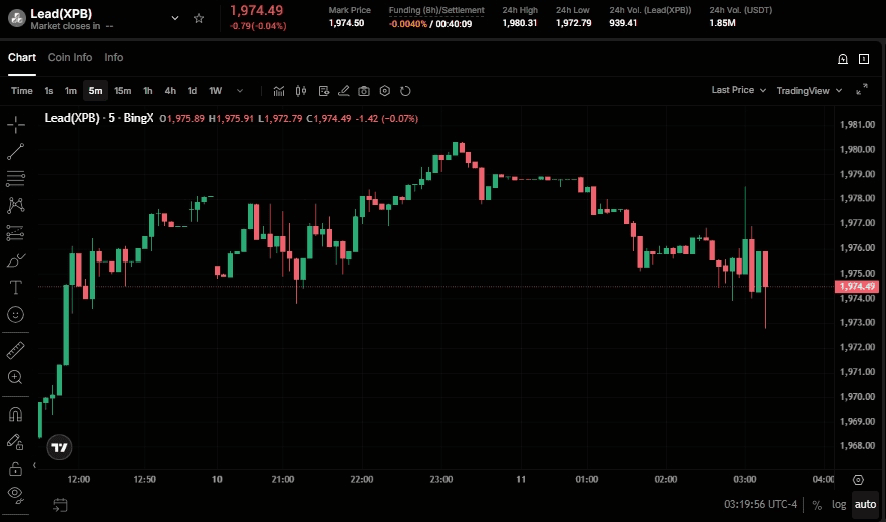
Lead (XPB) perpetual contract on BingX futures market
Capitalize on Lead’s predictability using BingX TradFi. Whether you are hedging against battery cost inflation or trading the LME inventory cycles, BingX provides the tools for precision trading.
- Access BingX TradFi: Navigate to the Commodities/TradFi section.
- Select Lead: Choose the Led(XPB)-USDT perpetual contract.
- Choose Your Direction: Open Long if you expect energy costs to force smelter closures, or Open Short to trade the 109,000-tonne surplus.
- Risk Management: Use TP/SL (take-profit/stop-loss) orders to navigate the spike volatility caused by speculative LME positioning.
Top 5 Risks to Watch for Lead Traders in 2026
While lead is often viewed as a stable base metal, the intersection of geopolitical energy shocks and changing battery technologies creates several high-impact risks for futures traders.
- Energy-Driven Smelter Curtailments: With the Strait of Hormuz closure driving energy costs to record highs, European smelters are facing unprofitable zones. If electricity prices stay above the marginal cost of production, a sudden wave of force majeures could trigger a supply-side price spike that overrides traditional demand fundamentals.
- The Paper vs. Physical Decoupling: Lead's speculative positioning on the LME is currently extremely polarized. Large-scale delivery of lead ingots into warehouses, similar to the 45,000 MT delivery in late 2025, can trigger flash crashes in futures contracts even if the long-term industrial outlook remains positive.
- By-product Supply Shocks: Lead is rarely mined as a primary metal; its supply is 80% linked to zinc and silver mining. The current 2026 silver boom is incentivizing polymetallic miners to increase output, which may flood the lead market with unintended by-product supply, deepening the projected 109,000-tonne surplus.
- Technological Substitution: While lead-acid batteries remain the standard for 12V auxiliary power in EVs and 5G backup, rapid advancements in Sodium-ion or LFP (Lithium Iron Phosphate) technologies pose a long-term threat. Any accelerated pivot by major data center operators or e-bike manufacturers away from lead could lead to structural demand destruction.
- Inventory Concentration in China: With China controlling 50% of global refining capacity, lead prices are highly sensitive to Chinese domestic policy. Changes in export duties, environmental winter cuts for secondary smelters, or car trade-in subsidies can create sudden volatility that disrupts global LME pricing.
Final Thoughts: Is Lead a Buy at $1,980 in 2026?
As of May 2026, Lead is the quiet metal in a loud market. At $1,980, it is trading near the marginal cost of production for many secondary smelters, suggesting a limited downside. For tactical traders, Lead offers a lower-risk alternative to the hyper-volatile silver and copper markets. The key for 2026 will be monitoring the $1,900 support; as long as this holds, the metal remains a solid foundational asset for a diversified commodity portfolio.
Risk Reminder: Lead is highly sensitive to LME warehouse rent-seeking and speculative positioning. Rapid shifts in inventory can cause price swings that decouple from physical fundamentals. Always implement strict stop-loss orders and never trade with capital you cannot afford to lose.
Related Reading
- Zinc (XZN) Price Prediction 2026: $3,500 Supply Breakout or $2,950 Demand Trap?
- Nickel (XNI) Price Prediction 2026: $25,000 Supply Shock or Surplus Ceiling?
- Platinum (PL) Price Prediction 2026: $2,500 Industrial Breakout or Speculative Retrace?4
- Silver Price Prediction for 2026: Can XAG Surge Above $200 or Face a Correction?
- Platinum (PL) Price Prediction 2026: $2,500 Industrial Breakout or Speculative Retrace?
