


The financial services landscape in 2026 has officially broken past the boundaries of traditional banking interfaces. The industry is no longer merely digitizing manual workflows; it is entering an era of automated, programmable value movement driven by Agentic AI, artificial intelligence capable of executing complex, multi-step financial actions independently, and institutional stablecoins.
Global banking recorded a blistering $1.3 trillion in net income over the past year, yet structural shifts are accelerating. Mature fintech platforms and agile neobanks are aggressively capturing consumer ownership, claiming roughly 17% of joint industry revenues. Concurrently, the implementation of federal frameworks like the Genius Act and the Clarity Act has provided definitive regulatory guardrails, allowing major financial institutions and payment networks to integrate blockchain-based settlement rails seamlessly.
As these capital systems converge, traditional brokerage barriers are dissolving. Through the rise of tokenized stocks, digital assets that mirror real-world equities 1:1 on public ledger layers, and the BingX TradFi platform, crypto-native capital can access premier financial and fintech equities using USDT collateral. This system offers 24/7 fractional exposure to global market leaders without requiring traditional, cross-border accounts, routing institutional liquidity directly into the core infrastructure of the modern digital economy.
Key Trends in the Global Financial Services and Fintech Sectors in 2026
The financial services sector has diverged into a multi-speed ecosystem. Legacy incumbents are rapidly deploying defensive AI technologies, while scale-driven fintechs capitalize on a massive embedded finance wave. The 2026 macro environment is shaped by four foundational trends:
1. The Rise of Agentic Commerce
The integration of artificial intelligence has shifted from standard generative assistance like text synthesis and customer query handling to autonomous Agentic AI. In retail and corporate banking, specialized AI agents now actively monitor balances in real time, benchmark yields across platforms, optimize credit card loyalty allocations, and execute capital routing automatically. This transition forces institutions to optimize for close to zero additional cost of customer acquisition and service to protect profit margins.
2. Stablecoin Settlement and Tokenization Rails
Stablecoins have transitioned from speculative trading collateral into a systemically vital utility for global money movement, pushing total circulation toward a multi-billion-dollar baseline. Backed by U.S. regulatory tailwinds, network operators are leveraging stablecoins to enable near-instant, programmable cross-border and trade finance settlements. This architecture bypasses the multi-day delays and legacy fees associated with the aging SWIFT network, fundamentally altering cash buffer requirements for enterprise supply chains.
3. Embedded Finance and B2B Software Proliferation
Monetization has shifted decisively toward vertical software platforms that embed financial products directly into non-financial interfaces. Over 90% of SaaS companies now identify embedded payments as a critical growth engine. The business-to-business (B2B) fintech services segment is experiencing outsized expansion as enterprises seek turnkey modules for payroll, lending, and corporate card issuing, expanding the total addressable fintech market.
4. Incumbent Restructuring and the M&A Pipeline
To keep pace with the velocity of technological disruption, mega-cap banks are radically altering their internal workforce composition, substantially scaling up AI engineering teams while modifying traditional analyst headcount. Simultaneously, following a severe recalibration of private market valuations, a robust pipeline of consolidation is emerging. Capitalized leaders are actively deploying cash reserves to execute precise, capability-led mergers and acquisitions (M&A) to plug gaps in data analytics and digital asset custody.
What Are the Best Financial Services and Fintech Stocks to Watch in 2026?
The following list identifies the leading diversified banks, global payment networks, and hyper-growth digital asset infrastructure providers driving the global financial tech cycle in the second half of 2026.
1. JPMorgan Chase & Co. (JPM)
- 2026 Valuation Benchmark: ~$800 Billion Market Cap
- Core Role: Dominant Mega-Cap Banking Powerhouse and Enterprise AI Adopter
JPMorgan Chase stands as the absolute heavyweight of global banking, showcasing an exceptional 19% return on tangible equity (ROTE). The firm’s massive, diversified structure acts as a highly resilient defensive compounder across fluctuating interest rate cycles. JPM is moving aggressively to implement global AI infrastructure across its investment banking, asset management, and trading divisions, optimizing data synthesis and client coverage workflows via Anthropic's high-tier cybersecurity frameworks under Project Glasswing.
Led by CEO Jamie Dimon, the bank maintains an extensive capital fortress, signaling a readiness to deploy up to $20 billion on strategic, capability-led acquisitions to enhance its technological moat. Supported by robust investment banking fee generation and steady firmwide net interest income (NII) tracking near $103 billion, JPM remains the premier asset for quality-focused capital.
Read more: JPMorgan Chase (JPM) Price Prediction 2026: Fortress Defense or AI-Driven Alpha at $330?
2. Mastercard Incorporated (MA)
- Core Role: Global Transaction Switching Network and Trust Layer
Mastercard operates one of the most structurally advantaged fee-collection models in global finance. Rather than extending credit or holding volatile deposits, Mastercard operates a global switching network connecting billions of cardholders across more than 220 countries, capturing a small fee on every transaction crossing its rails. This capital-light framework yields a phenomenal 59% operating margin and a return on equity exceeding 230%.
While the stock has experienced near-term multiple compression due to broader consumer spending anxieties, its underlying fundamentals remain highly resilient, with forward EPS projected to compound at 16% annually. Mastercard is positioning itself directly beneath the next wave of transaction rails, aggressively rolling out its Intelligent Commerce Connect for agentic commerce payments and expanding its stablecoin settlement footprints through strategic neobank partnerships and targeted infrastructure acquisitions.
Read more: Mastercard (MA) Stock Price Forecast for 2026: Fintech Giant or Regulatory Target?
3. Goldman Sachs Group, Inc. (GS)
- Core Role: Global Investment Banking Titan and M&A Dealmaking Super-Cycle Beneficiary
Goldman Sachs represents the premier pure-play asset for capturing the massive resurgence in global capital markets and corporate dealmaking. Following a prolonged period of suppressed activity, the investment banking landscape has entered a powerful consolidation super-cycle. GS has delivered near-record performance, driven by a 48% surge in overall investment banking revenues and a staggering 89% spike in financial advisory fee generation from completed high-profile mergers, acquisitions, and cross-border restructurings.
Following a highly deliberate strategic pivot away from capital-intensive consumer banking operations, including transitioning its legacy Apple Card credit card portfolio to JPMorgan Chase, Goldman Sachs has successfully re-centered its business model onto its highest-return, core competencies: institutional underwriting, global trading market-making, and alternative asset management. Furthermore, the firm is aggressively optimizing its elite advisory and research workflows by deploying specialized, multi-step AI frameworks, augmenting human human-relationship capital with deep data synthesis to maximize productivity and defend its leading positions across global league tables.
Read more: Goldman Sachs (GS) Price Prediction 2026: Strategic Renaissance or Value Trap at $860?
4. Morgan Stanley (MS)
- 2026 Valuation Benchmark: $328 Billion Market Cap
- Core Role: Premier Wealth Management Compounder and Mega-Cap Growth Leader
Morgan Stanley has constructed one of the most resilient, stable, and highly valued business models in mega-cap finance. Unlike legacy peers that remain highly exposed to the cyclical volatility of transactional trading and investment banking fees, Morgan Stanley generates the vast majority of its core earnings from stable, high-margin, recurring fee-based asset streams within its premier Wealth Management and Asset Management divisions.
The firm's technical momentum has hit historic milestones, supported by record-breaking wealth management flows pulling in an exceptional $118 billion in net new assets in a single quarter. Concurrently, Morgan Stanley's global macro strategy team continues to lead institutional cross-asset research, accurately charting capital flows driven by global data center capital expenditure cycles. By successfully scaling its platform infrastructure, Morgan Stanley consistently achieves massive positive operating leverage and superior wealth monetization, making it an essential, low-beta anchor for diversified portfolios.
Read more: Morgan Stanley (MS) Price Prediction 2026: Investment Bank Resurgence or $170 Correction?
5. Robinhood Markets, Inc. (HOOD)
- Core Role: High-Velocity Alternative Markets Engine and Retail Wealth Gateway
Robinhood is navigating a high-stakes evolution into a full-stack digital wealth ecosystem, capturing the lifetime value of Gen Z and Millennial capital. Following a massive multi-year price rally, the platform has diversified away from pure equity trading by scaling up market share in event-driven prediction markets via its Kalshi integration and offering tokenized private equity exposure internationally.
In a massive technological leap, Robinhood has launched support for AI agentic trading, enabling users to establish dedicated wallets that allow automated external AI agents to execute stock trades within strict balance parameters. While the HOOD stock remains subject to retail trading sentiment and competitive yield cross-currents from crypto-native challengers, its premium margins and rapid product iteration make it a primary growth vehicle for digital asset adoption.
Read more: Robinhood Stock Forecast 2026: $130 Hyper-Growth or Valuation Correction?
6. Circle Internet Group (CRCL)
- 2026 Valuation Benchmark: ~$29 Billion Market Cap
- Core Role: Regulated Stablecoin Infrastructure and Yield-Capture Asset
Circle represents the ultimate structural integration of traditional fixed income and public blockchain architecture. As the premier regulated issuer of the USDC stablecoin, Circle’s business engine operates with exceptional margins. When capital enters the USDC ecosystem, Circle takes those fiat reserves and backing assets and purchases short-term U.S. Treasury bills.
This model effectively transforms Circle into a massive yield-capture machine, generating $1.25 billion in revenue in the first half of the current fiscal year alone, with over 95% derived directly from reserve interest income. Bolstered by the passage of the federal Genius Act, Circle has secured critical strategic alliances with legacy processing giants like FIS to embed USDC directly into traditional B2B payment networks, placing it at the forefront of the trillion-dollar global stablecoin migration.
Read more: Circle (CRCL) Stock Outlook for 2026: Can USDC Growth and Dominance Drive CRCL Stock to $250+?
7. Coinbase Global, Inc. (COIN)
- Core Role: Institutional Digital Asset Gateway and Infrastructure Layer
Coinbase has successfully evolved from a simple retail spot cryptocurrency exchange into a diversified systemic utility for the digital asset economy. Despite experiencing localized volume fluctuations, the company has built an insulated competitive moat by anchoring institutional services, global derivatives markets, and custodial architectures for premier asset managers.
Coinbase is aggressively executing an international expansion strategy, launching direct local currency rails, such as India's IMPS network, and securing formal regulatory compliance registries globally to tap into high-growth emerging retail populations. Furthermore, Coinbase is capturing steady recurring revenue through its co-share arrangement of USDC reserve interest income and the rapid scaling of its Base Layer 2 network, decoupling its long-term financial health from pure spot transaction fee dependency.
Read more: Coinbase (COIN) Stock Forecast for 2026: Can the Everything Exchange Take COIN Back to $300?
Comparison of Leading Financial and Fintech Companies in 2026
Based on 2026 market dynamics, financial reporting, and structural competitive advantages, here is an updated comparison table of the top financial services and fintech stocks:
|
Ticker |
Primary Industry Segment |
Core Product / Structural Advantage |
2026 Strategic Focus & Financial Outlook |
|
JPM |
Traditional Banking |
Global CIB Franchise; Fortified Balance Sheet; ~19% ROE |
Implementing enterprise-wide Agentic AI; deploying $10B–$20B capital for technology M&A. |
|
MA |
Payment Networks |
Global switching duopoly; 59.5% LTM EBIT margin; zero credit risk |
Rolling out Agentic Ready payment flows; expanding B2B stablecoin settlement networks. |
|
HOOD |
Growth Fintech |
Alternative prediction markets; AI Agentic trading integration |
Expanding premium gold subscriptions; developing comprehensive full-stack digital banking. |
|
CRCL |
Stablecoin / Digital Assets |
Issuer of USDC; programmatic on-chain money rails |
Captured $1.25B in H1 revenue via Treasury yields; embedded into FIS core infrastructure. |
|
COIN |
Digital Asset Exchange |
Institutional crypto custody; Base L2 ecosystem; global derivatives |
Launching direct sovereign fiat rails (INR); driving institutional DeFi integration. |
How to Trade Financial and Fintech Stocks on BingX
BingX provides global market participants with optimized, crypto-native tools to capture price exposure across the modern financial services and fintech ecosystem. Traders can execute their market theses through two secure pathways, powered by automated analysis from BingX AI:
Buy, Sell, or HODL Tokenized Fintech Stocks on the Spot Market
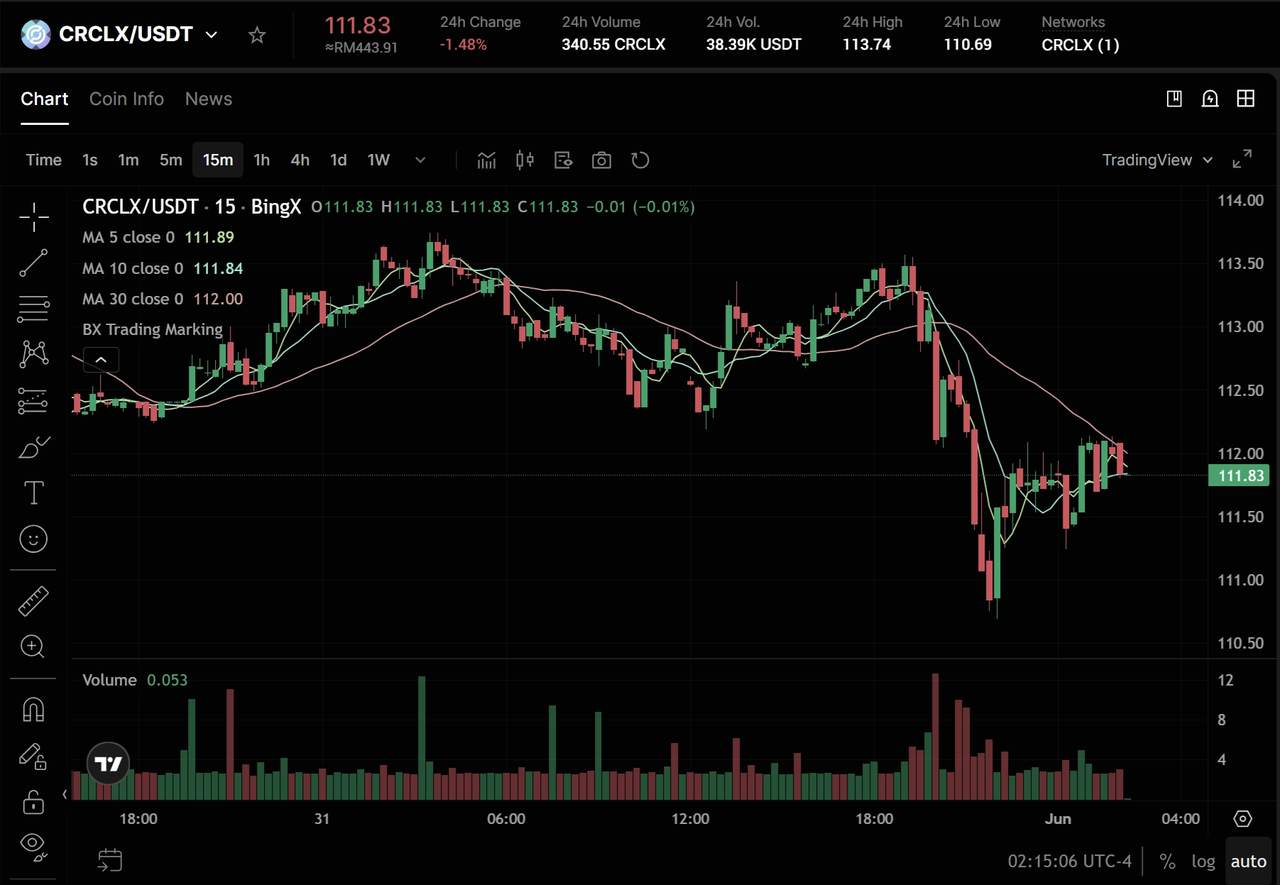
CRCLX/USDT trading pair on BingX spot market
For investors targeting direct, non-leveraged asset exposure tracking real-world equities on a 1:1 economic basis, the BingX Spot market provides secure access to tokenized financial shares issued via regulated asset frameworks.
- Log into your verified BingX account and ensure comprehensive security protocols (such as Google 2FA) are fully active.
- Fund your Spot Wallet by depositing stablecoins like USDT through your preferred network layer, e.g., TRC-20, ERC-20, or Arbitrum.
- Navigate to the Spot Trading terminal and search for fully backed tokenized stock symbols, such as CRCLX/USDT, HOODON/USDT, or COINON/USDT.
- Deploy the built-in technical analysis panels within the chart window to visualize automated support/resistance zones and volume indicators.
- Define your execution parameters via a Market or Limit order, specify your desired USDT transaction volume, and confirm. Your tokenized equity balance will instantly reflect inside your spot account.
Trade Financial Stock Futures with USDT on BingX TradFi
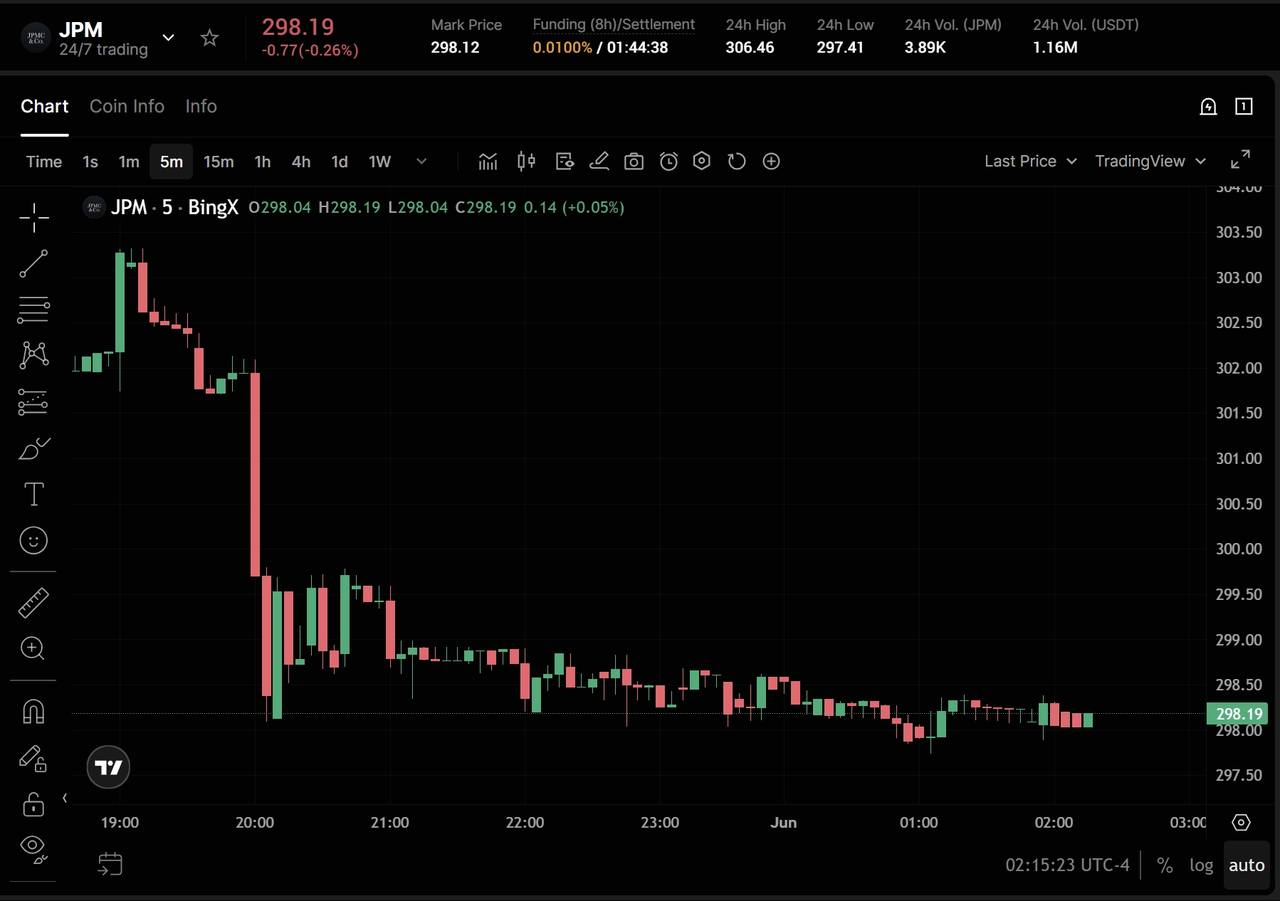
JPM-USDT perpetual contract on BingX futures market
For active market participants seeking to capture near-term earnings momentum, hedge structural banking portfolios, or utilize directional flexibility, BingX TradFi offers USDT-settled perpetual contracts mirroring leading U.S. equities.
- Head to the BingX TradFi portal or the Advanced Futures interface.
- Allocate working capital by transferring your desired quantity of USDT from your main Spot account into your Futures account.
- Select your targeted asset contract from a liquid directory of equity perpetual pairs, such as JPM-USDT, MS-USDT, or GS-USDT.
- Determine your macro direction. Select Open Long if you anticipate upside from corporate earnings beats and technological adoption, or Open Short to capitalize on financial sector pullbacks. Configure your leverage parameters defensively based on your risk threshold.
- Settle your input position sizing, establish precise Take-Profit (TP) and Stop-Loss (SL) orders to insulate your capital against sudden volatility spikes, and execute the trade. Real-time PnL will settle dynamically inside your wallet in USDT.
Top Risks and Key Considerations When Trading Financial Stocks
Despite the strong multi-year structural tailwinds backing the evolution of digital finance, market participants must manage capital allocation against significant systemic risks:
- Interest Rate and Macro Sensitivities: Traditional banks and asset-backed fintechs like Circle are heavily sensitive to net interest margin fluctuations. If the Federal Reserve executes aggressive rate cuts, interest income generated from short-term Treasury reserves will compress swiftly, directly dampening top-line revenue metrics.
- Evolving Regulatory and Compliance Scrutiny: The intersection of banking, AI, and digital assets remains subject to intense regulatory oversight. Sudden adjustments in debit routing fees, anti-trust reviews of mega-cap banking consolidation, or shifting compliance mandates on stablecoin velocity can trigger abrupt asset repricings.
- Valuation Overhangs and Competition: High-growth fintech and crypto-native names frequently trade at premium multiples that leave no margin for execution errors. If retail trading volume cools or a yield war erupts between platforms, high-beta fintech valuations will compress rapidly toward historical sector means.
- Tokenized Asset Architecture: Tokenized equity pairs function exclusively as structured price-tracking vehicles. They capture 1:1 real-world economic movements using crypto rails but do not convey corporate voting rights, physical stock delivery, or traditional shareholder legal architecture.
Final Thoughts: Should You Add Financial and Fintech Stocks to Your 2026 Portfolio?
The financial landscape in mid-2026 features a highly lucrative divergence: while traditional banking powerhouses and transaction networks are printing record profits and returning immense capital via dividends, high-growth fintech enablers are actively capturing the next generation of money movement. Spreading capital across both layers, shielding your portfolio with the high-margin defensive moats of JPMorgan and Mastercard while scaling into the structural growth of Circle, Coinbase, or Robinhood, provides a comprehensive framework to capture this global financial technology cycle.
Utilizing tokenized spot vehicles or flexible stock futures via BingX TradFi enables global capital to execute these macro-driven equity theses efficiently using unified, crypto-native rails. However, managing these exposures requires rigorous capital discipline and a thorough understanding of underlying macro catalysts.
Related Reading
- Top AI Data Center Stocks to Buy in 2026: Cloud, Servers, and AI Compute Infrastructure
- Top High-Bandwidth Memory (HBM) Stocks to Buy in the 2026 Memory Supercycle
- Oil Stocks vs. Natural Gas Stocks vs. Energy ETFs in 2026: Which Is the Better Investment?
- Top Energy Stocks and ETFs to Buy in 2026: The AI Power Crunch Meets Geopolitical Volatility
- Top AI Cloud Infrastructure Stocks to Buy in 2026 Amid Hyperscaler Capex and the Neocloud Boom
