

As public networks transition from speculative playgrounds to institutional infrastructure, conventional blockchains face severe bottlenecks in speed, fee predictability, and absolute finality. When network congestion spikes on traditional networks, gas fees skyrocket, and transaction settlement times become unpredictable. For Fortune 500 enterprises, central bank digital currency (CBDC) architects, and automated AI agents, these operational variables represent unacceptable system vulnerabilities.
Hedera eliminates these systemic hurdles by abandoning linear blockchains entirely. Invented by Co-founder and Chief Scientist Dr. Leemon Baird, Hedera’s underlying technology replaces traditional blocks with a Directed Acyclic Graph (DAG) data structure. Governed exclusively by a rotating council of the world's leading enterprises, Hedera combines fixed USD-denominated fees with sub-3-second transaction finality, bridging the gap between rigorous enterprise regulatory demands and open-source decentralized utility.
What Is Hedera Hashgraph (HBAR)?
Hedera is an open-source, public Proof-of-Stake (PoS) distributed ledger that completely abandons traditional block-by-block architectures in favor of Hashgraph consensus. Invented by computer scientist Dr. Leemon Baird, Hashgraph utilizes a Directed Acyclic Graph (DAG) data structure that allows transactions to be processed in parallel rather than ordered in a single linear chain.
This technical distinction earns Hedera an asynchronous Byzantine Fault Tolerant (aBFT) security rating, the highest mathematical grade achievable in distributed system design, rendering it immune to traditional blockchain split risks or front-running attacks.
From a practical and data-focused perspective, Hedera operates as an institutional-grade utility network designed for massive web3 throughput and strict regulatory environments.
- Throughput & Speed: The network reliably handles 10,000+ transactions per second (TPS) within a single shard, achieving absolute, irreversible finality in just 2.90 seconds.
- Fixed, Low Fees: To prevent the volatile fee spikes that plague networks like Ethereum, Hedera hardcodes its transaction fees to a fixed USD rate, such as $0.0001 for a standard native token transfer. While paid natively in HBAR, the fee remains invariant to token price fluctuations, providing predictable overhead for enterprise budgets.
- Sustainability: Hedera is audited as a carbon-negative network, consuming an average of just 0.000003 kWh per transaction, significantly less energy than a single legacy Visa credit card transaction.
- The HBAR Economy: HBAR is the network's native fuel and securing mechanism, capped at a hard supply of 50 billion tokens. It functions simultaneously as network gas for execution layers, such as the EVM-compatible Smart Contract Service or the Hedera Token Service, and as staking collateral to weight consensus nodes without relying on artificial token inflation.
How Does Hedera Work: How aBFT Consensus Powers 2026 Enterprises
Hedera is not a blockchain. Instead, it is a public Proof-of-Stake (PoS) distributed ledger built on the Hashgraph consensus algorithm. In a traditional blockchain, miners or validators construct a single, linear chain of blocks; if two blocks are generated simultaneously, the network must eventually discard one branch, artificially throttling throughput via intensive Proof-of-Work mining or leader-based sequencing loops.
Hashgraph processes transactions in parallel, ensuring that no data container is thrown away. The system weaves every transaction into a single, immutable historical tapestry using two foundational computer science principles:
- Gossip about Gossip: Nodes within the peer-to-peer network constantly and randomly share transaction data along with the historical timeline of who they received it from. This creates a highly efficient, mathematically verifiable record of network activity with near-zero bandwidth overhead.
- Virtual Voting: Instead of sending explicit voting messages across the network to agree on transaction order, a process that creates severe latency in traditional Byzantine agreements, each Hedera node runs an internal mathematical calculation based on the local copy of the gossip history. Nodes instantly calculate how other nodes would vote, achieving consensus autonomously.
By removing heavy block production overhead, Hedera achieves asynchronous Byzantine Fault Tolerance (aBFT). Rigorously verified via computer-checked proofs using the Coq system, aBFT is mathematically the highest possible security standard for distributed systems. It guarantees that the network will reach 100% certainty regarding transaction validity and precise sequencing (consensus timestamps) even if up to one-third of the network nodes are malicious or offline.
Hedera vs. Ethereum vs. Solana: Key Differences in Speed and Security
To understand why enterprise applications are prioritizing Hedera for high-throughput scaling in 2026, consider how its base infrastructure stacks up against the market's leading smart contract networks:
|
Feature |
Hedera (HBAR) |
Ethereum (ETH) |
Solana (SOL) |
|
Architecture Type |
Directed Acyclic Graph (DAG) |
Linear Blockchain |
Proof-of-History Blockchain |
|
Max Throughput (TPS) |
10,000+ |
15–30 (L1 Layer) |
50,000+ |
|
Time to Finality |
2.90 Seconds (Absolute) |
12–15 Minutes |
12–15 Seconds (Deterministic) |
|
Fee Structure |
Fixed USD ($0.0001 per transfer) |
Volatile Gas (Market-dependent) |
Dynamic/Localized Priority Fees |
|
Security Proof |
aBFT (Highest standard) |
Simple Byzantine Fault Tolerance |
Optimistic Concurrency Control |
|
Energy Per Tx |
0.000003 kWh (Carbon negative) |
0.03 kWh |
0.0008 kWh |
While Solana offers raw potential speed, its leader-based block propagation can lead to intermittent congestion under extreme volume. Ethereum provides deep liquidity but remains shackled by high, erratic gas costs. Hedera carves out a dominant institutional niche by keeping transaction fees completely decoupled from speculative token price swings, always pricing network operations in fixed USD fractions while settling them in fractions of a second.
What Is the Hedera Governing Council That Runs the Network?
Central to Hedera’s enterprise appeal is its completely decentralized, institutional governance framework. While traditional networks often suffer from ideological forks or concentrated mining pools, Hedera is managed by the Hedera Governing Council, a rotating body of up to 39 multi-billion-dollar corporations, non-profits, and prestigious universities spanning 11 distinct industries and global geographies.
As of 2026, this council includes global titans such as Google, IBM, Boeing, Dell, NVIDIA, and recently joined legacy brands like McLaren Racing, who leverage the network to pioneer fan engagement and digital motorsport innovation.
Core Governance Structure
Every Council member has an equal vote regarding network software upgrades, economic policies, fee schedules, and treasury management. To enforce true decentralization, members are term-limited and do not receive corporate profits or dividends from Hedera LLC.
All council minutes are published transparently to the public within 30 days of approval, eliminating back-room protocol deviations.
This public-permissioned model serves as Stage 1 of Hedera's long-term Path to Decentralization. Currently, Council members operate the initial consensus nodes securing the network. However, as infrastructure upgrades like Dynamic Address Books (HIP-869) and Block Nodes (HIP-1081) roll out through the 2026 roadmap, the network is gradually relaxing permissions. This transition enables independent node operators and everyday users to eventually run anonymous, permissionless consensus nodes, fostering a resilient, globally distributed network footprint.
What Is the HBAR Token Utility in the Hedera Ecosystem?
The HBAR token is the native utility asset powering the Hedera ecosystem. It features a strict, un-inflationary maximum supply of 50,000,000,000 (50 billion) tokens, preventing arbitrary supply dilution.
HBAR operates through three principal network mechanisms:
- Network Fuel (Transaction Fees): Every call made to Hedera's core layers, whether deploying a Solidity contract via the Smart Contract Service, logging a supply chain event through the Consensus Service (HCS), or issuing an RWA stablecoin via the Hedera Token Service (HTS), requires HBAR. Fees are fixed in USD but settled dynamically in HBAR, shielding developers from asset volatility.
- Network Security via Staking: Hedera operates a Proof-of-Stake framework where users can natively stake HBAR to consensus nodes. Nodes receive a weight proportional to their staked HBAR, which directly determines their consensus influence. In turn, stakers earn rewards derived purely from real network transaction fees rather than inflationary token printing, establishing a sustainable economic flywheel.
- Ecosystem Coordination and Ecosystem Growth: HBAR fuels the rapid development of modular Layer-2 rollups, AI agent automation labs, and global institutional marketplaces like RedSwan, which tokenizes over $5 billion in institutional commercial real estate using Hedera’s Asset Tokenization Studio.
How to Trade Hedera (HBAR) on BingX: A Step-by-Step Guide
For global allocators looking to gain exposure to Hedera’s expanding utility ecosystem, BingX offers a highly secure, institutional-grade trading platform equipped with advanced charting tools and multi-tier security.
Buy, Sell, or HODL HBAR on BingX Spot Market
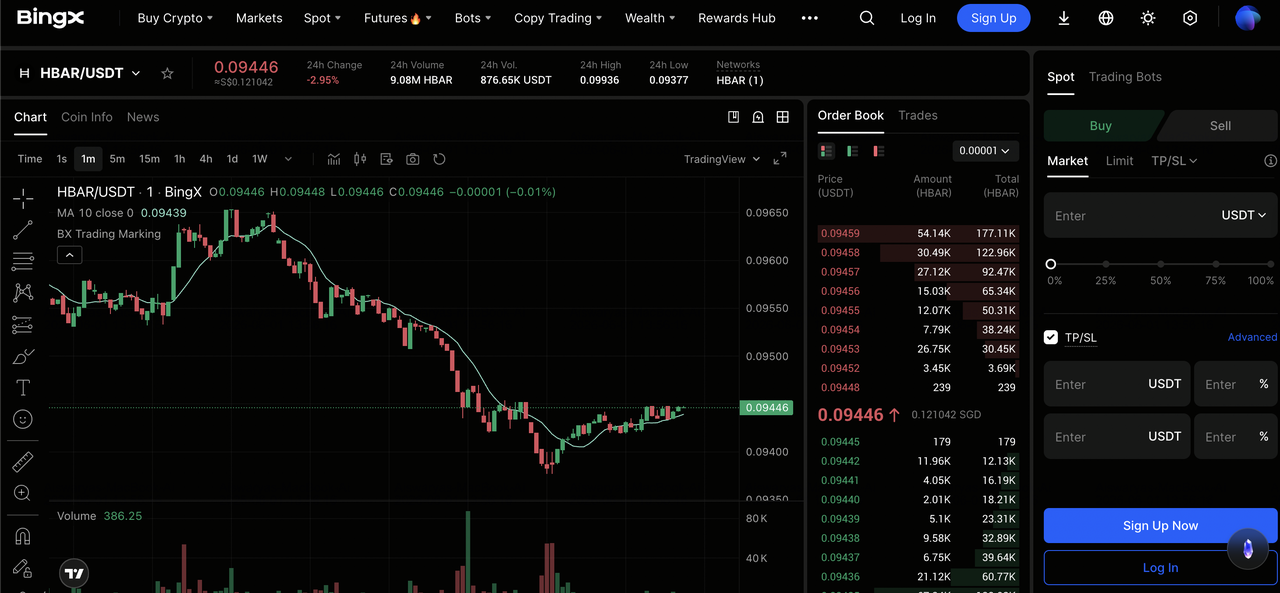
HBAR/USDT trading pair on the BingX spot market
- Log In and Fund Your Account: Navigate to your BingX dashboard. Deposit USDT or your preferred digital asset into your spot wallet.
- Locate the HBAR Trading Hub: Hover over the Spot menu and select Spot. Type HBAR into the asset search bar to open the HBAR/USDT trading pair interface.
- Configure Your Order Parameters: Analyze live order-book depth. Choose a Limit Order if you wish to capture HBAR at a specific calculated support price, or a Market Order to instantly execute the trade at current fair market value.
- Execute Trade: Input the desired allocation volume and click Buy HBAR. The assets will settle instantly into your spot ledger.
Long or Short HBAR Perpetuals on BingX Futures Market
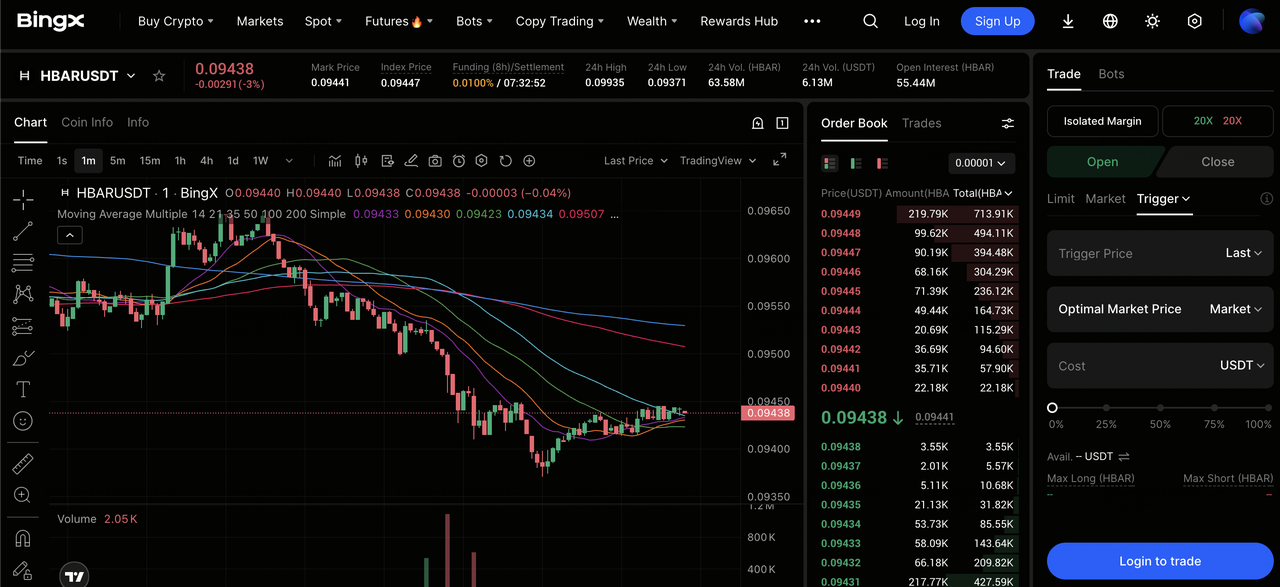
HBAR/USDT perpetual contract on the BingX futures market
For advanced traders aiming to capitalize on HBAR’s macro price swings or hedge institutional real-world asset (RWA) allocations, BingX provides a high-throughput derivatives engine featuring leverage up to 50x or more on top-tier altcoins. Follow this structured protocol to open a leveraged position:
- Transfer Capital to Your Futures Account: Navigate to the Assets tab and click Transfer. Shift your available USDT or USDC balance from your Fund/Spot Account to your Perpetual Futures Account. BingX futures positions are primarily settled in USDT.
- Access the HBAR/USDT Contracting Hub: Hover over the Derivatives or Futures top-level navigation menu and select Perpetual Futures. In the asset selection search dashboard on the left side of the chart, input HBAR and select the HBAR/USDT perpetuals or HBAR/USDC perpetual contract.
- Configure Your Margin Mode: Locate the position settings panel. Select either Isolated Margin, which restricts your liquidation risk strictly to the capital allocated to this single trade, or Cross Margin, which aggregates your entire available futures balance to maintain the position during extreme volatility.
- Calibrate Leverage and Select Order Type: Next, choose your entry mechanism: a Market Order to fill your position instantly at the current global ask price, or a Limit Order to specify a custom entry price at historical support lines.
- Establish Risk Gating and Execute: Before finalizing the trade, activate the TP/SL (Take Profit / Stop Loss) checklist inputs. Input a realistic profit target and clear invalidation stop-loss coordinates to insulate your capital against unexpected macro shifts. Click Buy/Long if your technical analysis points toward structural upside, or Sell/Short to capture yield from downside price movement.
Key Considerations When Investing in Hedera (HBAR)
While Hedera provides a robust, institutional-grade alternative to traditional linear blockchains, allocating capital to HBAR requires a balanced assessment of its unique market position and operational architecture.
- The Low-Fee Value Capture Paradox: Hedera’s fixed, ultra-low fee model of $0.0001 per native transfer is excellent for corporate onboarding, but it creates a steep hurdle for token value accrual. To generate substantial on-chain revenue and organic demand for HBAR as fuel, the network requires an astronomically high, sustained volume of transactions compared to high-gas networks like Ethereum.
- Enterprise Adoption Timelines: Corporate integration cycles are notoriously slow; while the Governing Council includes massive entities like Google, FedEX, and McLaren Racing, many enterprise initiatives remain in the pilot or testing phases. Translating high-profile partnerships into consistent, production-scale transaction volume on the mainnet can take years to materialize.
- Stiff Competition in the RWA and L1 Sectors: Hedera targets institutional real-world asset (RWA) tokenization and financial services, putting it in direct competition with dominant networks like Ethereum and its highly scalable Layer-2 ecosystems, fast chains like Solana, and permissioned frameworks like Canton Network. If Hedera cannot translate its technical superiorities into deep developer gravity and liquidity, its market share may face erosion.
- Crypto-Native DeFi Deficit: Historically, Hedera’s ecosystem depth and Total Value Locked (TVL) lag significantly behind top competitors, with its daily trading volume routinely eclipsed by Solana and Ethereum. The relative lack of a highly reflexive, speculative retail DeFi culture means HBAR lacks the explosive, community-driven volume spikes common to other major altcoins.
- Governance Philosophy and Centralization Risk: The very enterprise council model that provides regulatory comfort to institutions can alienate decentralized-maximalists or retail communities. For investors seeking pure censorship-resistance and absolute financial sovereignty, a permissioned, corporate-led governing structure may cap grassroots web3 enthusiasm.
- Treasury Distribution Pressure: Although HBAR features a fixed maximum supply of 50 billion tokens, regular scheduled releases from the Hedera Treasury for ecosystem development, grants, and operator incentives introduce ongoing circulating supply dilution. If real network demand does not scale quickly enough to absorb these structural inflows, the price can face persistent overhead pressure.
Final Thoughts: Is Hedera (HBAR) a Good Investment in 2026?
Hedera establishes a highly distinctive footprint within the digital asset economy by prioritizing institutional infrastructure over speculative retail hype. By replacing linear block production with its high-throughput, aBFT-secure Hashgraph consensus, the network successfully solves the core conflict between transaction speed, fee predictability, and regulatory alignment. Backed by a diverse, multi-billion-dollar Governing Council and processing billions of real-world transactions, Hedera provides a robust framework for enterprise deployments, real-world asset tokenization, and automated AI agent environments.
Ultimately, Hedera's long-term market valuation depends on its ability to convert corporate pilots into massive, sustained on-chain transaction volumes while simultaneously building deeper liquidity across its retail decentralized finance ecosystem. As global regulatory frameworks mature and enterprises demand predictable, sustainable public networks, Hedera's structured path toward progressive decentralization offers an optimized model for institutional adoption.
Risk Reminder: Investing in utility tokens and distributed ledger infrastructures involves substantial market, operational, and regulatory risks. Future token distributions from the treasury and slow enterprise integration cycles may exert ongoing structural pressure on market dynamics. Always conduct thorough, independent technical analysis, closely monitor governance shifts via Hiero Improvement Proposals (HIPs), and never allocate more capital than you can afford to lose. BingX assumes no liability for external investment configurations or asset allocations.
