

Palantir (PLTR) reported second-quarter results on August 3 that beat on every headline metric and lifted full-year guidance, sending shares higher after hours. Revenue reached $1.94 billion, up 92.8% year over year and well ahead of the roughly $1.81 billion consensus, while adjusted EPS of $0.41 topped the $0.33 estimate by 24%. US commercial revenue surged 149% to $764 million as enterprises accelerated AI deployment. Shares climbed roughly 9% to 12% in after-hours trading, a reversal from a pattern in which the stock had fallen after each of its prior four reports despite consistent beats.
The results underscored a rare combination of hypergrowth and profitability. GAAP operating income reached $912 million at a 47% margin, adjusted operating income hit $1.19 billion at a 62% margin, and the company's Rule of 40 score reached 155%, a level few software companies approach. Total contract value of $3.37 billion rose 49%, and net income reached $1.07 billion against about $329 million a year earlier. Management raised full-year 2026 revenue guidance to $8.15 billion to $8.16 billion, representing 82% growth, and lifted its US commercial revenue outlook to more than $3.42 billion.
The PLTR stock forecast for 2026 now centers on two competing views:
- The AI sovereignty case: Bulls expect surging US commercial demand, government expansion, sovereign AI partnerships and a Rule of 40 score of 155% to justify the premium, with analyst targets running as high as $255.
- The valuation case: Bears see a stock trading near 138 times forward earnings and 41 times projected 2026 revenue, down about 30% year to date, where a blowout quarter confirms the baseline rather than justifying a higher multiple.
This guide breaks down the PLTR stock forecast, 2026 price scenarios, key risks, and research from Oppenheimer, Baird, DA Davidson, Deutsche Bank and the broader Street, drawing on the August 3 earnings release and the Q2 investor call, and how to trade PLTR stock futures on BingX TradFi with USDT collateral.
Top 5 Things for PLTR Investors to Know in August 2026
- Q2 revenue of $1.94 billion grew 92.8%: Revenue beat the roughly $1.81 billion consensus by more than 7%, while adjusted EPS of $0.41 topped the $0.33 estimate by 24%, marking an eighth consecutive quarterly beat.
- US commercial revenue surged 149%: US commercial revenue soared to $764 million as enterprises raced to deploy AI infrastructure, the standout driver of the quarter.
- Profitability reached rare levels: GAAP operating income was $912 million at a 47% margin, adjusted operating income hit $1.19 billion at a 62% margin, and the Rule of 40 score reached 155%.
- Full-year guidance was raised: Management lifted 2026 revenue guidance to $8.15 billion to $8.16 billion, up 82%, US commercial to more than $3.42 billion, and adjusted free cash flow to $4.5 billion to $4.7 billion.
- The valuation remains the central debate: PLTR trades near 138 times forward earnings and 41 times projected 2026 revenue, down about 30% year to date, with analyst targets spanning a wide $70 to $255 range and an average near $182.
What Is Palantir (PLTR)?
Palantir Technologies Inc is a software company headquartered in Denver, Colorado, specializing in artificial intelligence, data integration and advanced analytics for government agencies and commercial enterprises. Its platforms help organizations integrate large volumes of structured and unstructured data, generate insights, and support mission-critical decisions.
The business runs on two engines. Government revenue, historically the core, serves defense and intelligence agencies and continues to expand through programs such as the US Army's Next Generation Command and Control effort. US commercial revenue, the fastest-growing segment, surged 149% as enterprises adopted Palantir's Artificial Intelligence Platform to move AI projects into production. Under CEO Alex Karp, Palantir has positioned itself around what it calls AI sovereignty, arguing it is the company that can transform AI tokens into economic value, and has expanded partnerships including a collaboration with NVIDIA to develop sovereign AI models for US government agencies. The combination of hypergrowth and a 62% adjusted operating margin gives management significant flexibility, backed by roughly $8 billion in cash and Treasuries.
Read more: What Is Ondo's Palantir Tokenized Stock (PLTRON) and How to Buy It?
Palantir (PLTR) Q2 2026 Earnings: What Drove the Beat and the After-Hours Rally
- US commercial demand exploded. US commercial revenue grew 149% to $764 million as enterprises accelerated AI deployment, the single largest reason results cleared consensus.
- Government revenue stayed strong. Government demand continued to expand through defense and intelligence programs, providing a durable base alongside the commercial surge.
- Profitability reached rare levels. Adjusted operating margin reached 62% and the Rule of 40 score hit 155%, an unusual combination of hypergrowth and deep profitability.
- Guidance was raised across the board. Management lifted full-year revenue, US commercial and free cash flow guidance, easing the burden on the second half after a strong first half.
- The stock rallied after four straight post-earnings drops. Shares climbed roughly 9% to 12% after hours, breaking a pattern in which PLTR had fallen after each of its prior four reports despite beating estimates.
Read More: Palantir (PLTR) Q2 2026 Earnings Overview: 149% U.S. Commercial Growth Drives a 29.45% Rally
Palantir Q2 2026 Financial and Consensus Profile: Revenue, EPS and Margins
Palantir's Q2 print showed a company combining hypergrowth with deep profitability while the market weighed an elevated valuation. The gap between a 155% Rule of 40 score and a stock down about 30% year to date is the central fact of the quarter.
|
Financial Metric |
Consensus Estimate |
Reported / Actual |
Surprise |
|
Q2 2026 Revenue |
~$1.81 billion |
$1.94 billion |
Beat; up 92.8% year over year |
|
Q2 2026 Adjusted EPS |
~$0.33 |
$0.41 |
Beat by 24% |
|
Q2 2026 US Commercial Revenue |
~$716 million |
$764 million |
Up 149% year over year |
|
Q2 2026 Net Income |
— |
$1.07 billion |
From about $329 million a year ago |
|
Q2 2026 GAAP Operating Income |
— |
$912 million |
47% margin |
|
Q2 2026 Adjusted Operating Income |
— |
$1.19 billion |
62% margin |
|
Q2 2026 Total Contract Value |
— |
$3.37 billion |
Up 49% year over year |
|
Q2 2026 Rule of 40 |
— |
155% |
Hypergrowth plus profitability |
|
Q3 2026 Revenue Guidance |
— |
$2.16 to $2.164 billion |
Above expectations |
|
FY2026 Revenue Guidance |
~$8.0 billion prior |
$8.15 to $8.16 billion |
Raised; up 82% year over year |
For context, Palantir's Q1 2026 delivered 85% revenue growth with US commercial up 133% and government up 84%, and adjusted EPS of $0.33 that beat by 22%, yet the stock fell 14% after that report. The company finished the first quarter with about $8 billion in cash and Treasuries and $925 million of adjusted free cash flow. Full-year 2026 EPS is projected near $1.17, up 85.7%, with 2027 EPS expected to rise 41.9% to $1.66. The stock is down about 30% year to date despite the operational strength, reflecting the tension between growth and valuation.
Palantir (PLTR) 2026 Investment Outlook: $255 Bull Case vs. $103 Bear Case
Palantir's outlook for the rest of 2026 depends on one central question: whether surging AI-driven commercial demand justifies a valuation near 138 times forward earnings, or whether even a blowout quarter confirms the baseline without supporting a higher multiple.
The Bull Case: AI Sovereignty and Commercial Growth Push PLTR Toward $255
The bull case rests on the pace and quality of growth. US commercial revenue surged 149%, the Rule of 40 score reached 155%, and management raised guidance across every line. That combination of hypergrowth and 62% adjusted operating margins is rare among software companies and supports the view that Palantir is the premier AI growth asset.
This scenario requires commercial demand to keep compounding while government expands. Palantir's AI sovereignty positioning, its NVIDIA partnership for sovereign government AI, and programs such as the Army's Next Generation Command and Control effort support the case. Baird called it the premier AI growth asset with a $200 target, and the Street high sits at $255. If commercial momentum continues, the path toward the higher targets strengthens.
The Base Case: Palantir Consolidates Between $138 and $200
In the base case, Palantir delivers its raised guidance while the market weighs the valuation. Q3 revenue lands within the $2.16 billion range, commercial growth stays strong, and the stock trades toward its average target near $182 as investors balance execution against the multiple.
The profitability and cash generation provide support while the valuation stays elevated. With roughly $8 billion in cash and a 155% Rule of 40 score, steady execution could keep PLTR in a wide range as the growth story plays out against the premium multiple. The average target near $182 and the options-implied range define the middle.
The Bear Case: A Premium Multiple Pulls PLTR Toward $103
The bear case does not require growth to fail. It requires the multiple to compress. PLTR trades near 138 times forward earnings and 41 times projected 2026 revenue, a level where a beat becomes confirmation of the baseline rather than a reason to pay more.
A slowdown in commercial growth or a broader shift away from high-multiple software would be the clearest trigger. The stock is already down about 30% year to date, and one analyst projected a decline toward $103.50 by year end. If AI sovereignty demand moderates or the market re-rates expensive growth names, the stock could retest the low end of the target range near $70 to $103.
PLTR Stock Price Forecasts for 2026 By Wall Street Analysts
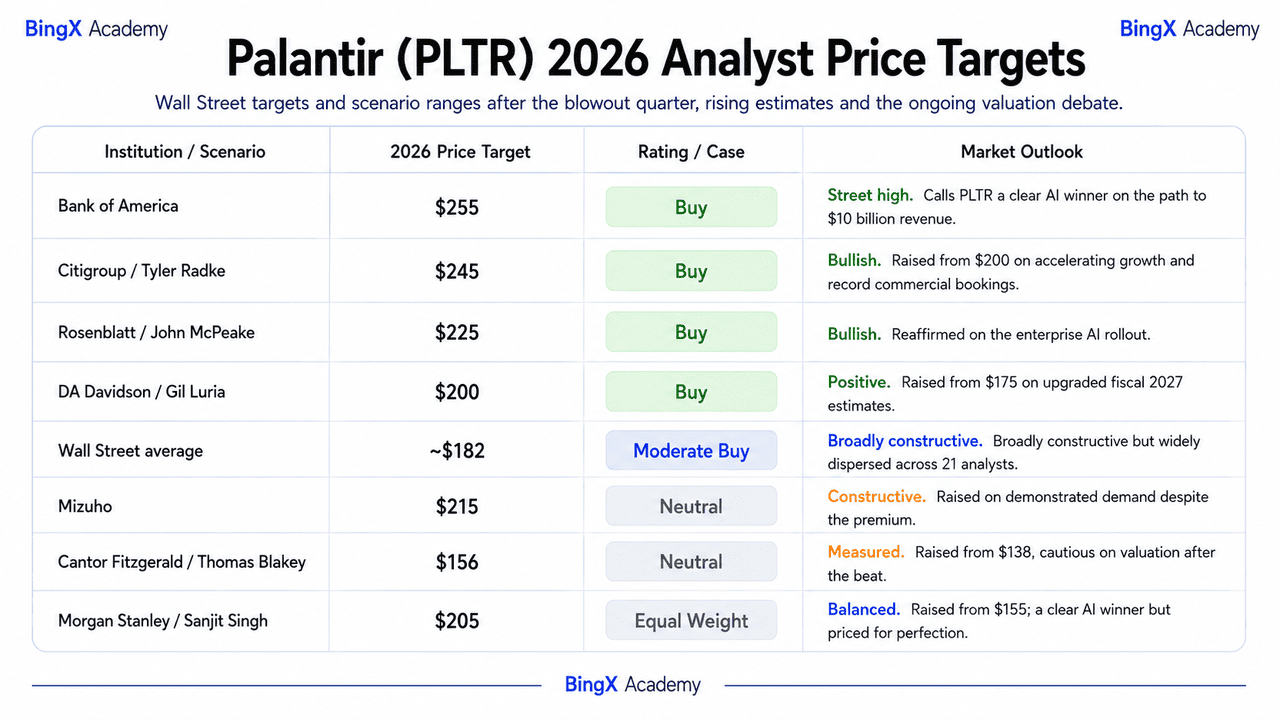
Wall Street holds a Moderate Buy consensus on Palantir, and firms raised targets after the blowout quarter even as the valuation debate persisted. Among roughly 21 analysts the average sits near $182, with targets spanning from the mid-$150s to $260 as bulls and skeptics split on how much to pay for hypergrowth.
|
Institution |
2026 Price Target |
Rating |
Market Outlook |
|
Bank of America |
$255 |
Buy |
Street high. Calls PLTR a clear AI winner on the path to $10 billion revenue. |
|
Citigroup / Tyler Radke |
$245 |
Buy |
Bullish. Raised from $200 on accelerating growth and record commercial bookings. |
|
Rosenblatt / John McPeake |
$225 |
Buy |
Bullish. Reaffirmed on the enterprise AI rollout. |
|
Mizuho |
$215 |
Neutral |
Constructive. Raised on demonstrated demand despite the premium. |
|
Morgan Stanley / Sanjit Singh |
$205 |
Equal Weight |
Balanced. Raised from $155; a clear AI winner but priced for perfection. |
|
DA Davidson / Gil Luria |
$200 |
Buy |
Positive. Raised from $175 on upgraded fiscal 2027 estimates. |
|
Wall Street average |
~$182 |
Moderate Buy |
Broadly constructive but widely dispersed across 21 analysts. |
|
Cantor Fitzgerald / Thomas Blakey |
$156 |
Neutral |
Measured. Raised from $138, cautious on valuation after the beat. |
How to Trade Palantir (PLTR) Stock on BingX
Navigate the volatility of Palantir's earnings cycle using BingX TradFi and BingX AI tools. By leveraging AI-driven predictive analytics, you can better anticipate market sentiment shifts and price action around quarterly releases. BingX offers two routes to PLTR exposure: tokenized stock for direct spot ownership, and perpetual futures for leveraged long or short positions.
Spot Trading: Buy and Own PLTR Tokenized Stocks Directly
Spot trading is the most straightforward way to gain Palantir exposure on BingX. When users buy tokenized PLTR on the spot market, they hold the asset directly in their BingX spot account, with no leverage, no funding costs and no liquidation risk.
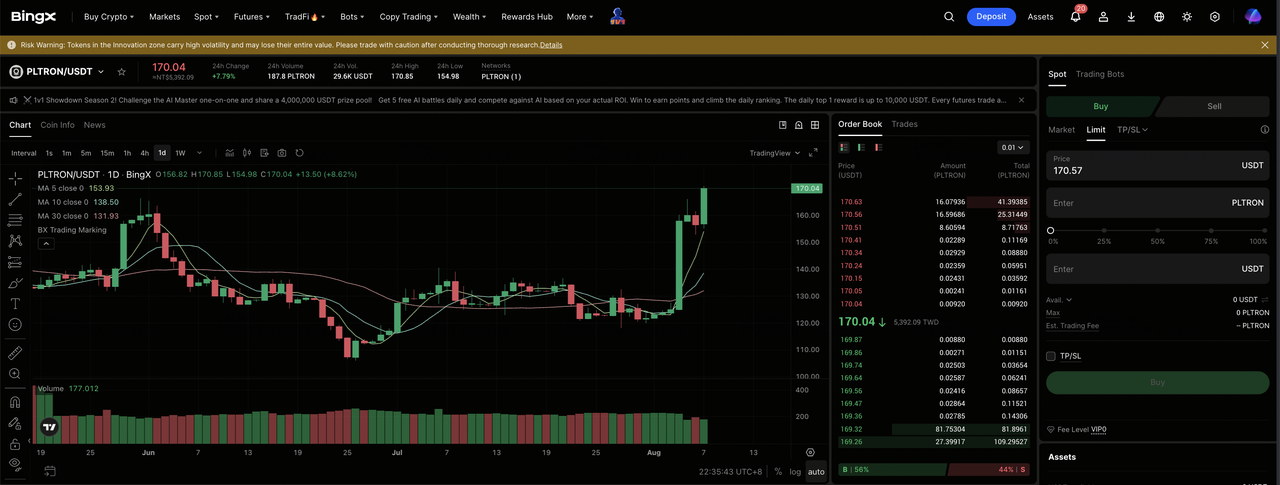
Step 1: Account setup and security. Sign up and log into your BingX account, complete the identity verification (KYC) required in your region, and enable two-factor authentication.
Step 2: Fund your spot account. Deposit USDT or another supported asset into your BingX spot account. Where available, users can also use supported fiat on-ramp options.
Step 3: Navigate to the spot market. Search for the PLTRON/USDT trading pair.
Step 4: Place your order. Choose a market order to buy tokenized PLTR immediately at the current price, or use a limit order to set the price you want to pay. Because Palantir can swing sharply around earnings despite consistent beats, a limit order lets you define your entry rather than chase a post-earnings move.
Step 5: Manage your position. Once filled, your tokenized PLTR appears in your spot account, where it tracks the underlying share price. Spot positions carry no liquidation risk, which makes them suitable for holding through an earnings release.
Futures Trading: Long or Short PLTR on BingX TradFi
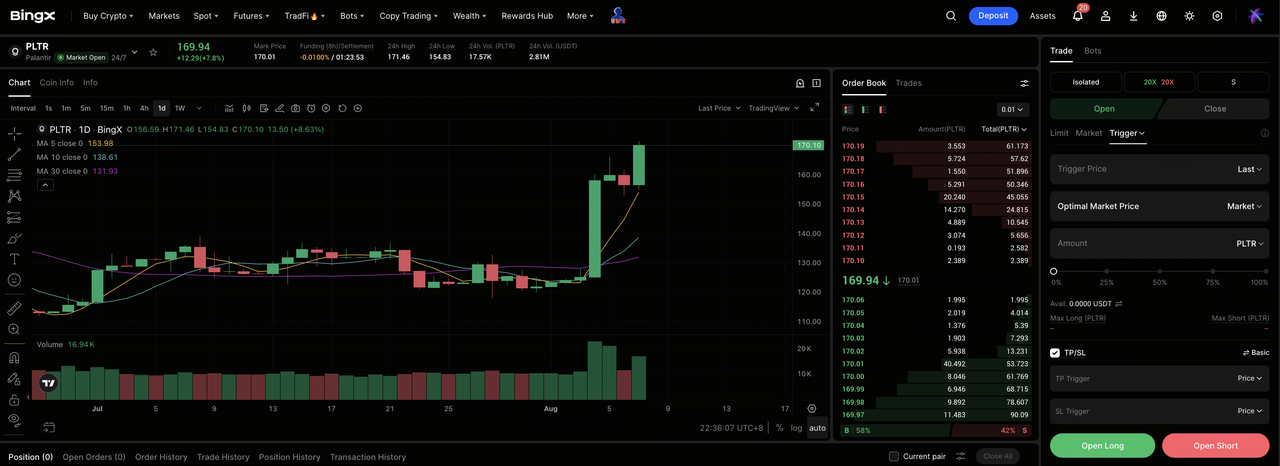
Step 1: Access BingX TradFi. Sign up and navigate to the specialized TradFi section on the main BingX exchange dashboard.
Step 2: Select Palantir Technologies Inc (PLTR). Search for and select the PLTR-USDT perpetual futures contract.
Step 3: Choose your direction. Select Open Long if you expect US commercial demand to keep compounding, government programs to expand, and the Rule of 40 score to stay elevated. Select Open Short if you expect commercial growth to decelerate, the market to re-rate high-multiple software, or a valuation near 138 times forward earnings to compress.
Step 4: Select leverage and margin mode. Choose Isolated or Cross-Margin based on your risk tolerance. Because PLTR moved roughly 9% to 12% after the Q2 print and options priced a swing near 12%, above its historical average, conservative leverage and clear position sizing are important.
Step 5: Execute strict risk protocols. Set Take-Profit and Stop-Loss (TP/SL) levels before or immediately after entering the trade. PLTR can react quickly to quarterly earnings and guidance, US commercial growth disclosures, government contract awards, AI partnership announcements, and shifts in high-multiple software sentiment.
Top 5 Risks to Watch for PLTR Investors in 2026
To navigate the second half of 2026, investors must weigh Palantir's hypergrowth and profitability against these five structural and macro headwinds.
- The valuation leaves no room for error: PLTR trades near 138 times forward earnings and 41 times projected 2026 revenue, so a beat can confirm the baseline without justifying a higher multiple.
- Post-earnings reactions have been negative: Despite eight straight beats, the stock fell after each of the four reports before Q2, showing how sensitive it is to expectations.
- Commercial growth must sustain a high bar: Full-year US commercial guidance above $3.42 billion requires continued rapid growth in the second half.
- High-multiple software is sentiment-driven: PLTR is among the names most exposed to any rotation away from expensive growth stocks.
- Concentration and contract timing matter: Large government and commercial contracts can create lumpiness, and total contract value growth depends on continued large expansions.
Final Thoughts: Should You Invest in Palantir in 2026?
Palantir after the August 3 report is a story of a blowout quarter meeting a persistent valuation debate. Revenue up 92.8%, US commercial up 149%, a Rule of 40 score of 155%, and raised guidance across the board are not in dispute. What is in dispute is what an investor should pay for that growth when the stock trades near 138 times forward earnings and is still down about 30% year to date.
The bull case is that Palantir is the premier AI growth asset, combining hypergrowth with rare profitability and an AI sovereignty position across government and commercial markets. The bear case is that even a blowout quarter confirms the baseline without justifying the multiple, and that any commercial slowdown or software rotation could compress the valuation. Investors who believe the AI adoption cycle has years to run may view the after-hours rally as a re-rating. More conservative traders might wait for commercial growth to prove durable against tougher comparisons, using the average target near $182 and the wide $70 to $255 range as the boundaries of the debate.
Risk Reminder: Trading and investing in equities like PLTR involves a high risk of capital loss. Palantir is exposed to software spending cycles, contract timing, high-multiple sentiment shifts, and a valuation that amplifies any disappointment. Conduct independent research before allocating capital.
Related Reading
- Nvidia (NVDA) Stock Price Outlook for 2026: Can Blackwell and Vera Rubin Take NVDA Back to $300?
- Amazon (AMZN) Stock Price Prediction 2026: Can AWS AI Re-acceleration Offset a $200B CapEx Gamble?
- Meta (META) Stock Price Prediction 2026: Can AI Efficiency and Custom Silicon Drive META to $900?
- Alphabet (GOOGL) Price Prediction 2026: Can 82% Cloud Growth and AI Push GOOGL Stock to $430?
- Broadcom (AVGO) Stock Outlook for 2026: AI Infrastructure King or Margin Victim?
- Reddit (RDDT) Price Outlook for 2026: Can AI Data Licensing Drive RDDT Back to $200?
