



Nebius Group (NBIS) supplies full-stack infrastructure for artificial intelligence developers and enterprises. Its platform combines accelerated compute, networking, AI storage and managed software across purpose-built data centers, while Avride and TripleTen add autonomous-mobility and technology-education exposure. AI cloud is the main growth engine, though the stock remains sensitive to construction schedules, GPU availability, utilization and the cost of financing a global capacity buildout.
The latest quarter showed both the power and expense of that expansion. Nebius Q2 2026 revenue reached $582.3 million, up 454% year over year, and adjusted EBITDA improved from a $21.0 million loss to $236.2 million. However, Nebius spent $5.657 billion on property, equipment and intangible assets during the quarter, making capacity delivery and cash returns as important as headline demand growth.
The NBIS stock forecast for 2026 now centers on two competing views:
- The contracted AI cloud growth case: large customer commitments, new capacity and better utilization could move annualized run-rate revenue toward the $7 billion to $9 billion year-end target and support a higher valuation.
- The capital and execution case: construction delays, weaker utilization or more debt and equity funding could push free cash flow outward and reduce the value assigned to each share.
This guide breaks down the NBIS stock forecast, 2026 price scenarios, key risks and analyst outlooks, drawing on Nebius Group's August 12 Q2 2026 earnings release, interim financial statements and market data through September 11, plus how to trade NBIS stock futures on BingX TradFi with USDT collateral.
Top 5 Things for Nebius Group Investors to Know in September 2026
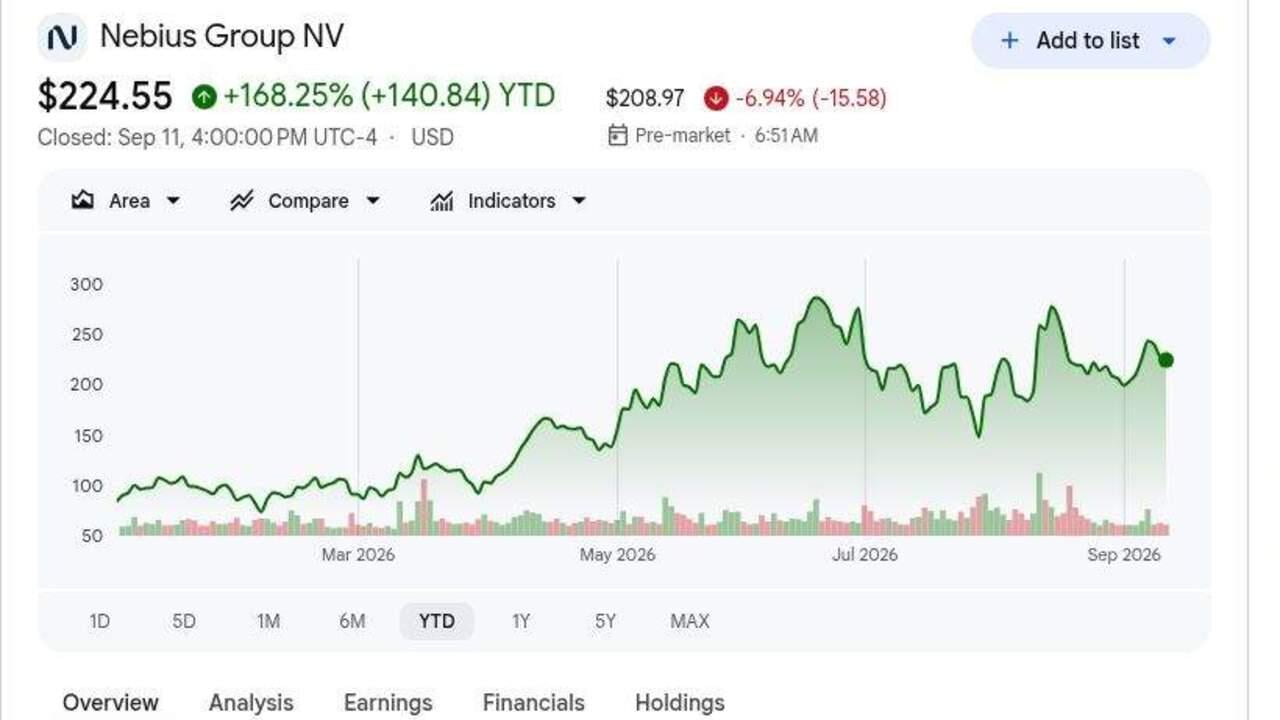
- NBIS closed at USD 224.55 after gaining 168.25% YTD: The rally reflects a major re-rating of Nebius as an AI infrastructure provider. Shares still sit below Arete Research's USD 415 high target, showing that expectations remain wide even after 454% quarterly revenue growth.
- Q2 revenue reached USD 582.3 million, up 454%: Sales increased from USD 105.1 million a year earlier and beat the roughly USD 536 million consensus by about USD 46 million. The result shows contracted compute capacity is converting into reported revenue.
- Adjusted EBITDA improved to USD 236.2 million: Nebius reversed a USD 21.0 million adjusted EBITDA loss from Q2 2025 as utilization and scale improved cloud economics. GAAP operating loss still reached USD 175.9 million after USD 259.7 million of depreciation and amortization.
- Management maintained a USD 7 billion to USD 9 billion end-2026 ARR target: That compares with roughly USD 3 billion of ARR around the Q2 update. Reaching the target depends on deploying contracted GPU capacity and converting customer commitments during the second half.
- Quarterly infrastructure purchases reached USD 5.657 billion: Capital spending rose from USD 510.6 million a year earlier, while six-month purchases totaled USD 8.130 billion. The buildout expands revenue capacity but also raises execution and return requirements.
What Is Nebius Group (NBIS)?
Nebius Group is an Amsterdam-headquartered technology company centered on an AI-native cloud platform. The company designs and operates data-center infrastructure, then combines NVIDIA accelerators with high-performance networking, storage, cluster management, managed inference and developer tools. Customers use the platform for model training, fine-tuning, inference, agents and other compute-intensive workloads. The group also owns Avride, an autonomous-vehicle and delivery-robot developer, and TripleTen, a technology-reskilling platform, plus stakes in ClickHouse and Toloka.
Its long-term strategy is to expand power and GPU capacity through owned sites and infrastructure partnerships that can reduce the amount of capital Nebius funds alone. Microsoft and Meta have supplied large anchor commitments, Reflection AI signed a multi-year computing agreement, and NVIDIA has deepened its commercial and investment relationship with the company. Nebius also became a preferred infrastructure partner for Palantir's sovereign AI offering, broadening its route to government and regulated-enterprise workloads beyond standard public-cloud demand.
Read More: Top AI Data Center Stocks to Buy in 2026: Cloud, Servers, and AI Compute Infrastructure
Nebius Group (NBIS) Q2 2026 Earnings Overview: Revenue Growth, EBITDA and Capacity Spending
Nebius delivered Q2 revenue of $582.3 million versus roughly $536 million expected, diluted loss per share of $0.68 versus a $0.36 expected loss, and adjusted EBITDA of $236.2 million versus a $21.0 million loss a year earlier. Operating cash flow reached $2.246 billion, helped by customer prepayments, though infrastructure purchases rose to $5.657 billion. The quarter confirmed rapid demand and improving adjusted economics, while showing that deployment spending and GAAP profitability remain the main tradeoffs.
Read More: Nebius Group (NBIS) Q2 2026 Earnings Overview: $582.3M Revenue Beat Drives a 34.14% Price Rally
|
Financial Metric |
Guidance / Consensus |
Reported / Actual |
Surprise |
|
Q2 2026 revenue |
$536M consensus |
$582.3M |
Beat. About $46M above consensus; up 454% YoY. |
|
Q2 diluted EPS |
$0.36 loss consensus |
$0.68 loss |
Missed. The loss was $0.32 wider than consensus. |
|
Q2 adjusted EBITDA |
$21.0M loss a year earlier |
$236.2M |
Improved. AI cloud scale moved adjusted EBITDA sharply positive. |
|
Q2 adjusted net loss |
$91.5M loss a year earlier |
$33.2M loss |
Narrowed. The adjusted loss improved 64% YoY. |
|
Q2 operating cash flow |
$167.7M used a year earlier |
$2.246B provided |
Positive. Customer cash and deferred revenue drove the reversal. |
|
Q2 infrastructure purchases |
$510.6M a year earlier |
$5.657B |
Accelerated. Purchases rose more than tenfold. |
|
Cash and equivalents |
$3.678B at Dec. 31, 2025 |
$8.042B |
Expanded. Financing and customer cash funded deployment. |
|
Deferred revenue |
$1.578B at Dec. 31, 2025 |
$5.975B |
Expanded. Contracted demand supplied advance funding. |
|
End-2026 ARR outlook |
Previously reiterated |
$7B-$9B |
Maintained. Requires another material capacity step-up. |
- Revenue of USD 582.3 million beat consensus by about USD 46 million: Sales rose 454% year over year, showing that AI cloud capacity is converting into revenue at scale. Sustaining that pace depends on new clusters entering service without major construction or power delays.
- Diluted loss per share of USD 0.68 missed by USD 0.32: Depreciation and amortization reached USD 259.7 million as new equipment entered service. That explains why adjusted EBITDA can improve before GAAP earnings and free cash flow turn consistently positive.
- Adjusted EBITDA reached USD 236.2 million from a USD 21.0 million loss: The swing points to better utilization and operating leverage. Each new megawatt still needs to generate enough gross profit to cover depreciation, interest and corporate investment.
- Operating cash flow reached USD 2.246 billion as deferred revenue climbed to USD 5.975 billion: Customer prepayments help fund expansion, though USD 1.197 billion of quarterly deferred-revenue growth boosted cash flow. Investors still need to separate service economics from timing benefits.
- Infrastructure purchases of USD 5.657 billion were nearly ten times quarterly revenue: Six-month spending reached USD 8.130 billion and property and equipment rose to USD 13.045 billion. The buildout supports future capacity, but utilization and pricing must remain strong enough to justify the asset base.
Read More: CoreWeave (CRWV) Price Prediction 2026: Can AI Cloud Demand Push CRWV Toward $175?
Nebius Group (NBIS) 2026 Investment Outlook: $350 Bull Case vs. $145 Bear Case
Nebius combines rapid AI cloud growth with a very capital-intensive expansion plan. The upside depends on contracted demand, customer prepayments and improving adjusted EBITDA, while the main risk is that infrastructure spending rises faster than utilization and cash returns.
The Bull Case: Strong AI Cloud Demand Pushes NBIS Toward USD 350
The Bull Case assumes Nebius adds capacity on schedule, converts major contracts with Microsoft, Meta and other customers, and maintains strong pricing on newer accelerator platforms. Revenue grows faster than infrastructure costs, allowing the USD 236.2 million Q2 adjusted EBITDA result to develop into stronger operating leverage.
A move toward USD 350 would require clear progress toward the USD 7 billion to USD 9 billion end-2026 ARR target, stable utilization and more partner capital without heavy dilution. Higher revenue estimates and a narrower gap between operating cash flow and capex would strengthen the case.
The Base Case: Steady AI Cloud Growth Keeps NBIS Between USD 240 and USD 300
The Base Case assumes AI cloud revenue continues growing quickly, while investors remain cautious about returns on USD 8.130 billion of six-month infrastructure purchases. Large customers and advance payments support deployment, though depreciation, interest and execution costs limit further valuation expansion.
Under this scenario, NBIS could trade mainly between USD 240 and USD 300. Continued revenue growth, positive adjusted EBITDA and new capacity entering service would support the range. A lower ARR target or repeated site delays would weaken the upper end.
The Bear Case: Higher Infrastructure Costs Pull NBIS Toward USD 145
The Bear Case assumes new sites open later than planned or operate at lower utilization as customer deployments shift. Nebius continues paying for equipment, power and financing before enough revenue arrives, weakening cash returns.
A move toward USD 145 would become more likely if ARR progress falls short of guidance, adjusted EBITDA turns negative again or Nebius relies on more equity-linked financing. Customer concentration could add further pressure if a major deployment moves into a later period.
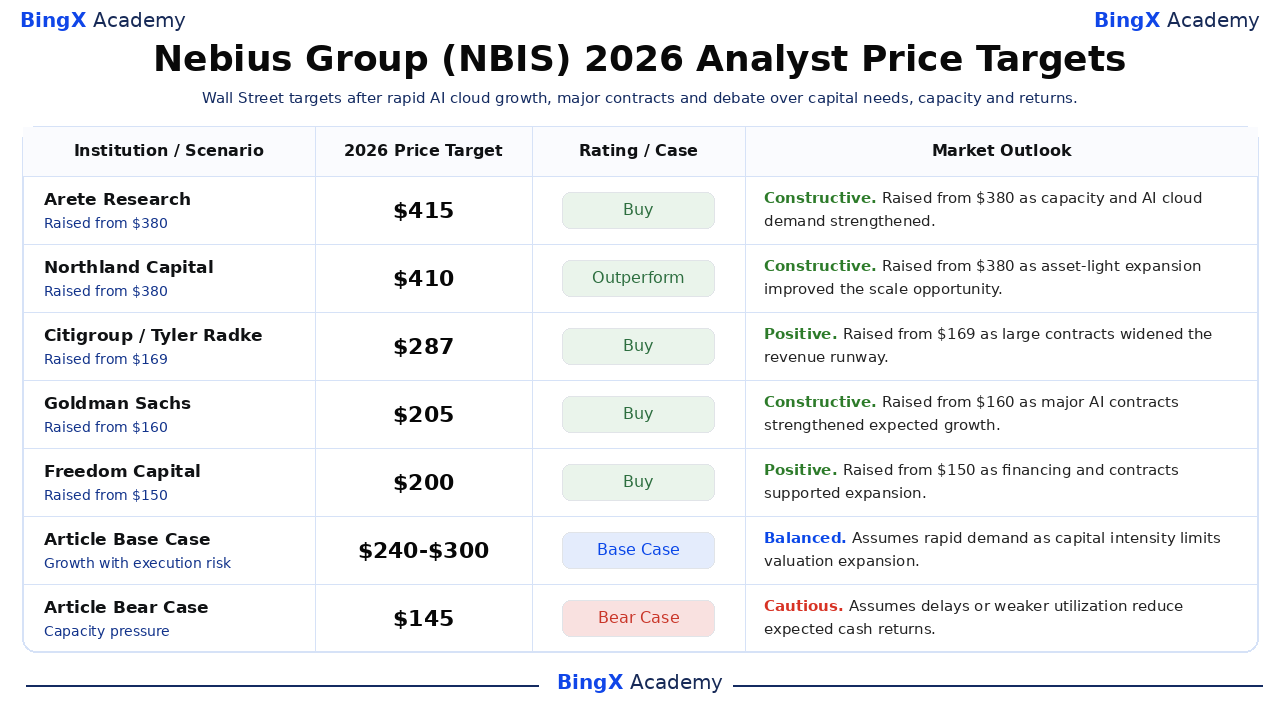
NBIS Stock Price Forecasts for 2026 By Wall Street Analysts
These five dated targets range from $200 to $415 and reflect different assumptions about capacity, market share, financing and utilization. They are third-party reference points rather than price promises. The Article Base and Bear rows are BingX Academy editorial scenarios and are labeled separately.
|
Institution / Scenario |
2026 Price Target |
Rating / Case |
Market Outlook |
|
Arete Research / Richard Kramer |
$415 |
Buy |
Constructive. August 7: raised from $380 as contracted capacity and AI cloud demand strengthened. |
|
Northland Capital / Michael Latimore |
$410 |
Outperform |
Constructive. July 20: raised from $380 as an asset-light model widened the scale opportunity. |
|
Citigroup / Tyler Radke |
$287 |
Buy |
Positive. June 23: raised from $169 as large commitments widened the revenue runway. |
|
Goldman Sachs / George Tong |
$205 |
Buy |
Constructive. April 16: raised from $160 as AI demand and major contracts strengthened growth. |
|
Freedom Capital / Paul Meeks |
$200 |
Buy |
Positive. July 20: raised from $150 as financing and contracts supported expansion. |
|
Article Base Case |
$240-$300 |
Base Case |
Balanced. Assumes rapid growth as capital intensity limits valuation expansion. |
|
Article Bear Case |
$145 |
Bear Case |
Cautious. Assumes delays or weaker utilization reduce expected cash returns. |
How to Trade Nebius Group (NBIS) Stock on BingX
Trade Nebius Group's AI-cloud growth, capacity deployment and financing outlook using BingX TradFi and BingX AI tools. Because NBIS can react sharply to contracts, capacity milestones and capital raises, traders should define both the catalyst and risk limits before entering a position.
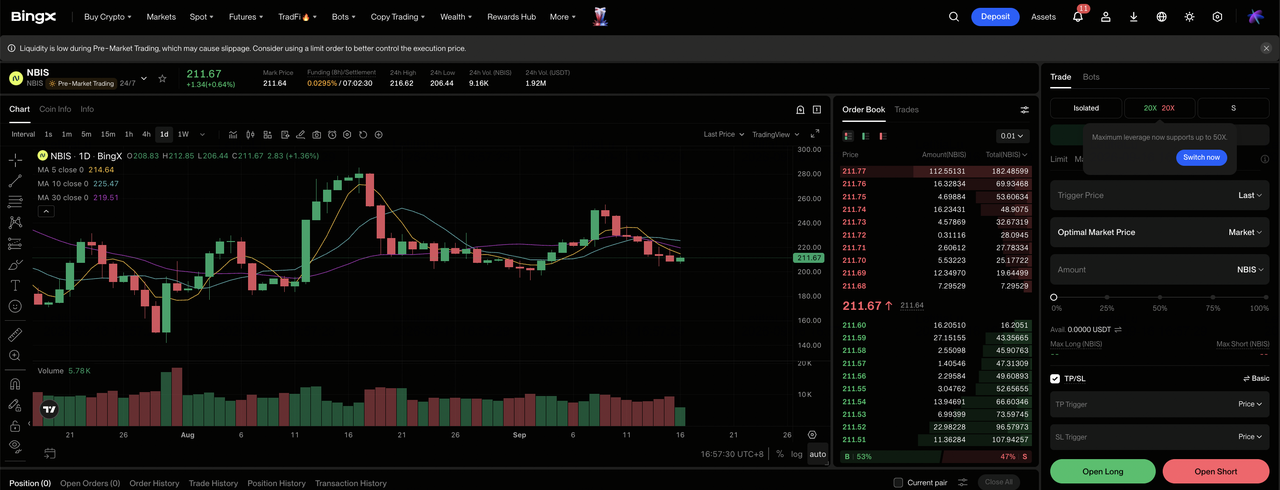
Step 1: Access BingX TradFi. Sign up and navigate to the specialized TradFi section on the BingX exchange dashboard.
Step 2: Select Nebius Group (NBIS). Search for and select the NBIS-USDT perpetual futures contract.
Step 3: Choose your direction. Select Open Long if contracts convert and capacity utilization supports margins. Select Open Short if delays, financing costs or dilution weaken expected returns.
Step 4: Select leverage and margin mode. Choose Isolated or Cross-Margin based on your risk tolerance. A 168.25% YTD gain shows why conservative leverage and clear position sizing are important.
Step 5: Execute strict risk protocols. Set Take-Profit and Stop-Loss (TP/SL) levels before or immediately after entering the trade. NBIS can react quickly to customer contracts, power availability, GPU deployments, earnings and financing.
Top 5 Risks to Watch for Nebius Group Investors in 2026
Nebius's valuation depends on capacity expansion, customer demand, financing and utilization. These risks can affect cash flow, margins and per-share value.
- Heavy infrastructure spending raises the return hurdle: Quarterly infrastructure purchases reached USD 5.657 billion, nearly ten times Q2 revenue. If utilization or pricing disappoints, depreciation and financing costs could rise faster than gross profit.
- The ARR target depends on new capacity coming online: The USD 7 billion to USD 9 billion target requires data centers, power, networking and accelerators to deploy on schedule. Construction or supply delays could push contracted revenue into later periods.
- Large customers increase concentration risk: Microsoft, Meta and other major customers provide strong demand visibility. A delayed deployment or renegotiation could still affect utilization, pricing and cash receipts across several quarters.
- Convertible debt can pressure per-share value: Nebius raised USD 5.75 billion through new convertible notes to support expansion. Interest costs and potential conversion increase financing and dilution risk.
- The 168.25% YTD rally leaves less room for misses: The valuation already reflects rapid growth and successful execution. Lower ARR guidance, weaker margins or customer delays could compress the multiple even if revenue continues rising.
Final Thoughts: Should You Invest in Nebius Group in 2026?
Nebius has established evidence of demand, with Q2 revenue rising 454% to $582.3 million and adjusted EBITDA reaching $236.2 million. Customer prepayments and $5.975 billion of deferred revenue help support expansion. The investment debate now depends less on whether AI demand exists and more on whether the company can deploy capital efficiently enough to produce durable cash returns.
The Bull Case requires capacity and contracts to support $350, while the Bear Case reflects delays, financing and dilution that could pull NBIS toward $145. Conservative traders may monitor progress toward the $7 billion to $9 billion ARR target, utilization, adjusted EBITDA and the gap between operating cash flow and infrastructure spending.
Risk Reminder: Trading and investing in equities like NBIS involves a high risk of capital loss. Construction delays, power constraints, customer concentration, debt, dilution, valuation compression and leveraged trading can produce rapid losses. Conduct independent research before allocating capital.
Related Reading
- Top High-Performance Computing (HPC) Stocks to Watch in 2026: Accelerated Computing Market Leaders
- Top AI Data Center Stocks to Buy in 2026: Cloud, Servers, and AI Compute Infrastructure
- Top AI Cloud Infrastructure Stocks to Buy in 2026 Amid Hyperscaler Capex and the Neocloud Boom
- CoreWeave (CRWV) Price Prediction 2026: Can AI Cloud Demand Push CRWV Toward $175?
- NVIDIA (NVDA) Price Prediction 2026: Can AI Infrastructure Growth Drive NVDA Toward $420?
- Microsoft (MSFT) Stock Outlook for 2026: Can Azure AI and Copilot Growth Drive MSFT Stock to $550+?
