


MARA Holdings (MARA) operates digital-asset compute and energy infrastructure centered on industrial-scale Bitcoin mining. Its sites combine power procurement, specialized mining hardware, data-center operations and treasury management, making revenue sensitive to both production volume and the market value of bitcoin. MARA is also redirecting part of its powered-land portfolio toward AI and high-performance computing, which broadens the opportunity while adding development, financing and customer-conversion risk.
The latest quarter showed stronger operating capacity alongside weaker bitcoin-linked financial results. Mara Holding Q2 2026 revenue fell 26.7% to $174.9 million as the average bitcoin price declined 28%, even though production increased 3% to 2,422 BTC and energized hashrate rose 22% to 70.3 EH/s. A $611.3 million net loss, driven largely by digital-asset fair-value changes, showed why scale alone does not create stable per-share earnings.
The MARA stock forecast for 2026 now centers on two competing views:
- The bitcoin scale and AI conversion case: a recovery in bitcoin economics, continued hashrate efficiency and visible Starwood milestones could lift cash returns and give powered assets a higher infrastructure valuation.
- The volatility and capital-intensity case: weaker bitcoin prices, rising network difficulty or slow data-center conversion could keep earnings volatile and increase financing pressure.
This guide breaks down the MARA stock forecast, 2026 price scenarios, key risks and analyst outlooks, drawing on MARA Holdings’s August 6, 2026 Q2 2026 earnings release, quarterly filing and market data through September 11, plus how to trade MARA stock futures on BingX TradFi with USDT collateral.
Top 5 Things for MARA Holdings Investors to Know in September 2026
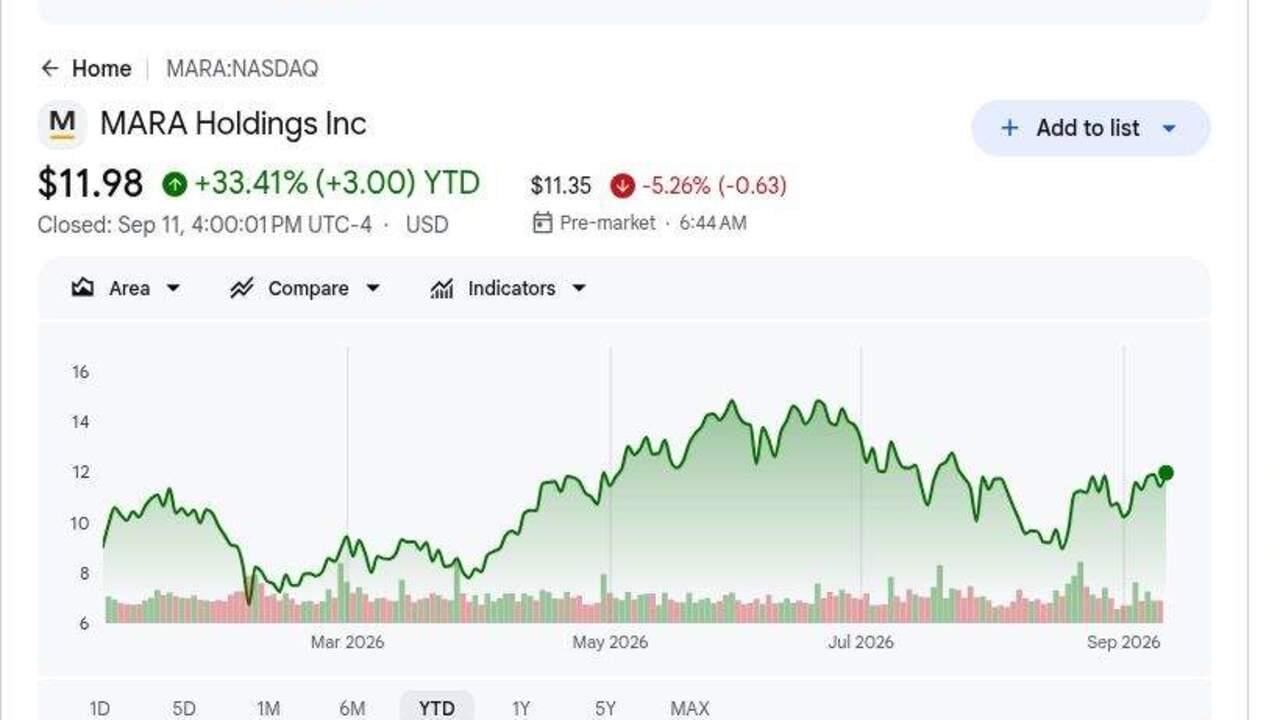
- The $11.94 September 11 close left MARA up 33.41% in 2026: The gain reflects renewed interest in miners with power assets, yet shares remained below several bullish targets. The $18 consensus and $27 BTIG target require better mining economics or measurable AI progress rather than a bitcoin rally alone.
- Q2 revenue fell 26.7% to $174.9 million: Revenue missed the roughly $204 million consensus by about $29 million as bitcoin's average price declined 28%. The result shows that higher production cannot fully offset a materially weaker realized price.
- Energized hashrate reached 70.3 EH/s as production rose 3%: Capacity increased 22% year over year and produced 2,422 BTC. Cost per petahash per day also declined 4% to $27.7, providing operating evidence that scale and efficiency are improving despite weaker accounting earnings.
- MARA held 35,577 BTC and about $2.5 billion of cash plus bitcoin: The treasury supplies liquidity and direct upside to bitcoin, though a $343.0 million unrealized loss helped drive the quarterly net loss to $611.3 million. The same asset base can therefore strengthen liquidity and destabilize reported earnings.
- The Starwood platform targets 1 GW of near-term IT capacity: The partnership outlines a pathway above 2.5 GW by converting powered sites for AI and high-performance computing. Investors still need customer commitments, financing and construction milestones before treating that capacity as contracted revenue.
What Is MARA Holdings (MARA)?

MARA Holdings is a vertically integrated digital-energy and compute operator. The company acquires and develops energy sites, deploys application-specific computing equipment, validates transactions on the Bitcoin network and earns block rewards and transaction fees. Revenue depends on bitcoin produced, bitcoin's market price and the economics created by network difficulty, fleet efficiency and power cost. MARA also manages one of the industry's largest corporate bitcoin treasuries, so balance-sheet marks can dominate quarterly net income.
Its longer-term strategy is to turn energy and infrastructure expertise into a broader compute platform. MARA's strategic relationship with Starwood Capital and Starwood Digital targets about 1 GW of near-term IT capacity with a pathway beyond 2.5 GW, creating an avenue into AI data centers. The company is also integrating the Long Ridge power asset and developing technologies intended to monetize stranded or underused energy. These programs could diversify revenue, though customer contracting and construction must precede any durable AI contribution.
Read More: Top Bitcoin Mining Stocks to Buy in 2026: BTC Hashrate Meets the AI Infrastructure Pivot
MARA Holdings (MARA) Q2 2026 Earnings Overview: Revenue, Operating Scale and Financial Outlook
MARA's Q2 2026 results combined operating expansion with a sharp accounting reversal. Revenue of USD 174.9 million missed the roughly USD 204.0 million consensus and declined 26.7% year over year, GAAP diluted EPS of negative USD 1.60 fell USD 1.77 below consensus, and adjusted EBITDA was negative USD 360.9 million. Energized hashrate nevertheless reached 70.3 EH/s and bitcoin production rose to 2,422 BTC, leaving investors to separate improving mining capacity from volatile bitcoin marks.
|
Financial Metric |
Guidance / Consensus |
Reported / Actual |
Surprise |
|
Q2 2026 revenue |
About $204.0M consensus |
$174.9M |
Missed. About $29.1M below consensus and down 26.7% YoY. |
|
Q2 GAAP diluted EPS |
$0.17 consensus |
$(1.60) |
Missed. $1.77 below consensus versus $1.84 a year earlier. |
|
Q2 net income (loss) |
$808.2M income in Q2 2025 |
$(611.3)M |
Reversed. A $343.0M unrealized bitcoin loss replaced a large prior-year gain. |
|
Q2 adjusted EBITDA |
$1.2B in Q2 2025 |
$(360.9)M |
Declined. Bitcoin fair-value changes overwhelmed operating progress. |
|
Bitcoin production |
2,353 BTC in Q2 2025 |
2,422 BTC |
Improved. Production increased about 3% YoY. |
|
Energized hashrate |
57.4 EH/s in Q2 2025 |
70.3 EH/s |
Expanded. Capacity increased about 22% YoY. |
|
Cost per petahash per day |
$28.9 in Q2 2025 |
$27.70 |
Improved. Unit operating cost declined about 4% YoY. |
|
Bitcoin holdings |
— |
35,577 BTC |
Substantial. Treasury scale amplifies both liquidity and mark-to-market volatility. |
|
Cash and bitcoin holdings |
— |
About $2.5B |
Liquid. The balance supports mining and AI infrastructure investment. |
- Revenue of $174.9 million missed consensus by about $29.1 million: The 26.7% decline came even as production increased 3%, because the average bitcoin price fell 28%. This makes realized bitcoin economics the first variable to monitor in the revenue recovery.
- GAAP diluted EPS of $(1.60) missed the $0.17 estimate by $1.77: A $343.0 million unrealized bitcoin loss helped reverse $808.2 million of prior-year income into a $611.3 million loss. The comparison shows why GAAP EPS can move more than mining operations.
- Energized hashrate increased 22% to 70.3 EH/s: Production rose to 2,422 BTC from about 2,353 BTC, and cost per petahash per day improved to $27.7 from $28.9. Higher scale becomes more valuable if bitcoin prices and network difficulty cooperate.
- Adjusted EBITDA moved to $(360.9) million from $1.2 billion: The decline reflected bitcoin fair-value losses rather than a collapse in installed capacity. Even so, persistent negative adjusted EBITDA would reduce internally generated funding for both mining upgrades and AI conversion.
- Cash and bitcoin holdings totaled about $2.5 billion: The company held 35,577 BTC at June 30, creating financial flexibility for Long Ridge and Starwood projects. That flexibility remains exposed to bitcoin drawdowns and any decision to pledge or sell treasury assets.
MARA Holdings (MARA) 2026 Investment Outlook: $24 Bull Case vs. $7 Bear Case
The following Bull, Base and Bear outcomes are BingX Academy editorial scenarios rather than Wall Street targets. Each range depends on observable operating and financial conditions.
The Bull Case: Stronger Bitcoin Mining Pushes MARA Toward $24
The Bull Case assumes bitcoin prices stabilize, network difficulty remains manageable and MARA sustains more than 70 EH/s with continued cost improvements. Production growth then converts more efficiently into revenue, while Starwood secures customers or financing that gives its powered sites clearer AI infrastructure value.
A move toward $24 would require quarterly revenue above USD 200 million, adjusted EBITDA to turn positive after the negative USD 360.9 million Q2 result and at least one concrete Starwood development milestone. Stable bitcoin holdings and evidence that AI projects can earn attractive returns would strengthen the case.
The Base Case: Steady Mining Output Keeps MARA Between $14 and $18
The Base Case assumes MARA's 70.3 EH/s fleet and 35,577 BTC treasury support value, though bitcoin marks continue to distort earnings and AI data-center development remains early. Efficiency gains partly offset network difficulty, while investors assign limited value to the 1 GW Starwood target until contracts and funding plans become clearer.
MARA could trade mainly between $14 and $18 under these conditions. Production growth, cost per petahash below USD 28 and progress at Long Ridge would support the range. Another large revenue miss or deeply negative adjusted EBITDA quarter would weaken the upper end.
The Bear Case: Lower Bitcoin Prices Pull MARA Toward $7
The Bear Case assumes bitcoin prices fall while network difficulty and power costs rise, reducing revenue per unit of hashrate. AI conversion also moves more slowly, leaving MARA with development costs before meaningful customer revenue.
A move toward $7 would become more likely if revenue stays below USD 175 million, treasury losses reduce liquidity or Starwood milestones slip without replacement demand. Additional debt, convertible financing or bitcoin sales to fund development would add further pressure to per-share value.
MARA Stock Price Forecasts for 2026 By Wall Street Analysts
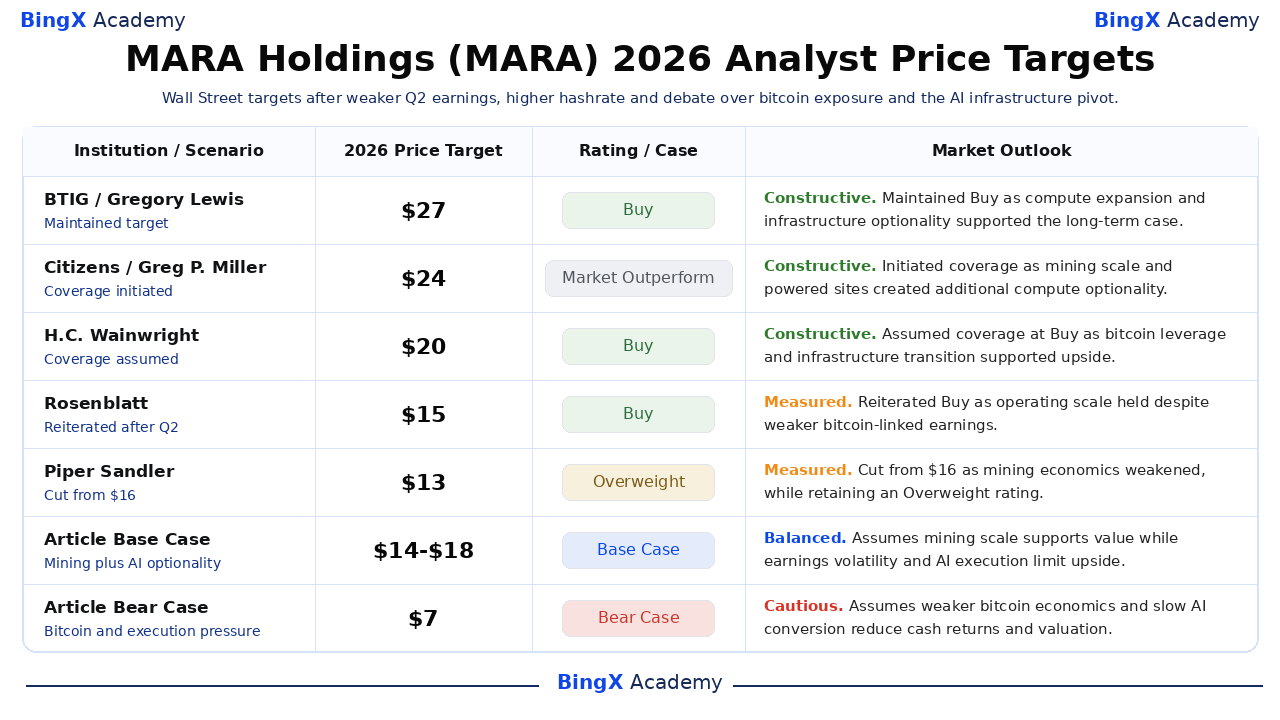
These five dated actions span $13 to $27 and reflect different assumptions about bitcoin prices, mining efficiency and the AI infrastructure pivot. They are third-party reference points rather than a single forecast. The final Base and Bear rows are BingX Academy editorial scenarios.
|
Institution / Scenario |
2026 Price Target |
Rating / Case |
Market Outlook |
|
BTIG |
$27 |
Buy |
Constructive. June 1: Maintained Buy as compute expansion and infrastructure optionality supported the long-term case. |
|
Citizens |
$24 |
Market Outperform |
Constructive. June 24: Initiated coverage as mining scale and powered sites created additional compute optionality. |
|
H.C. Wainwright |
$20 |
Buy |
Constructive. September 11: Assumed coverage at Buy as bitcoin leverage and infrastructure transition supported upside. |
|
Rosenblatt |
$15 |
Buy |
Measured. August 7: Reiterated Buy as operating scale held despite weaker bitcoin-linked earnings. |
|
Piper Sandler |
$13 |
Overweight |
Measured. July 17: Cut from $16 as mining economics weakened, while retaining an Overweight rating. |
|
Article Base Case |
$14-$18 |
Base Case |
Balanced. Assumes mining scale supports value while earnings volatility and AI execution limit upside. |
|
Article Bear Case |
$7 |
Bear Case |
Cautious. Assumes weaker bitcoin economics and slow AI conversion reduce cash returns and valuation. |
How to Trade MARA Holdings (MARA) Stock on BingX
Trade MARA Holdings' bitcoin-production, energy-efficiency and AI-infrastructure outlook using BingX TradFi and BingX AI tools. Because MARA can react quickly to bitcoin prices, network difficulty, financing and data-center milestones, traders should define both the catalyst and risk limits before entering a position.
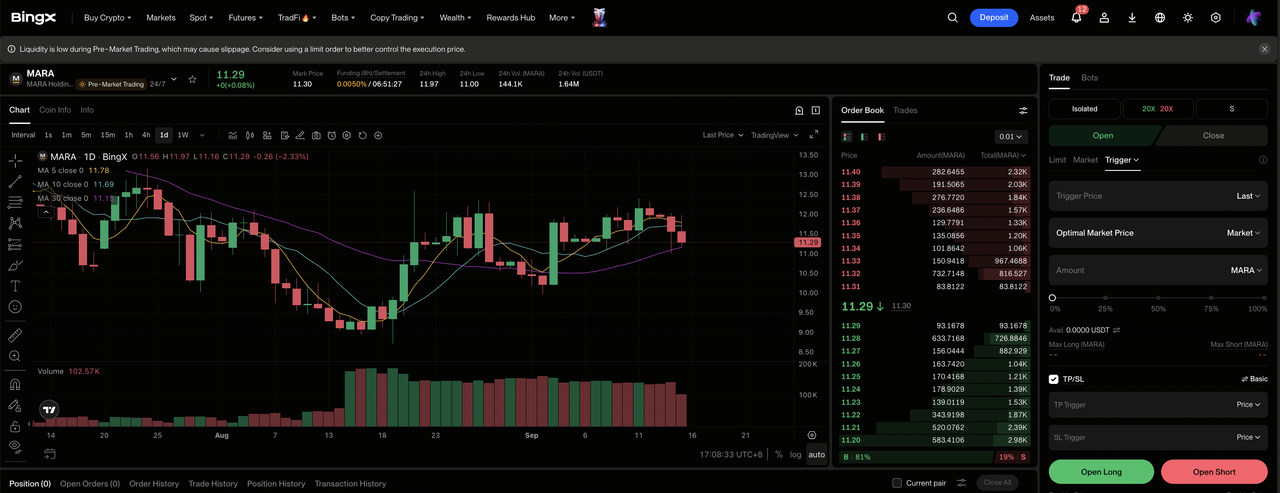
Step 1: Access BingX TradFi. Sign up and navigate to the specialized TradFi section on the BingX exchange dashboard.
Step 2: Select MARA Holdings (MARA). Search for and select the MARA-USDT perpetual futures contract.
Step 3: Choose your direction. Select Open Long if operating milestones improve and profitability advances. Select Open Short if execution delays or weaker demand reduce expected per-share economics.
Step 4: Select leverage and margin mode. Choose Isolated or Cross-Margin based on your risk tolerance. The stock's large 2026 swings show why conservative leverage and clear position sizing are important.
Step 5: Execute strict risk protocols. Set Take-Profit and Stop-Loss (TP/SL) levels before or immediately after entering the trade. MARA can react quickly to earnings, guidance, contracts, financing and sector conditions.
Top 5 Risks to Watch for MARA Holdings Investors in 2026
MARA's valuation depends on linked bitcoin, energy, capital and infrastructure variables. Each can change cash flow or the value assigned to every share.
- Bitcoin fair-value swings can overwhelm operating progress: A $343.0 million unrealized bitcoin loss contributed to a $611.3 million Q2 net loss. A renewed drawdown can reduce treasury value, weaken collateral and compress the stock even if hashrate rises.
- Network difficulty can dilute the benefit of 70.3 EH/s: MARA produced 2,422 BTC despite 22% more energized hashrate. If global capacity expands faster than MARA's efficiency improves, bitcoin earned per unit of compute can fall and reduce gross cash returns.
- Power economics can reverse the $27.7 unit-cost improvement: Cost per petahash per day declined 4%, though electricity markets remain volatile. Higher power prices or outages can reduce production and narrow the spread between bitcoin revenue and site operating costs.
- The 1 GW Starwood target is a development roadmap, not booked sales: AI infrastructure requires customers, grid interconnection, equipment and financing. Delays would leave capital tied up before revenue and could reduce the valuation premium assigned to the 2.5 GW pathway.
- Financing can dilute future per-share economics: Mining equipment, power assets and data centers are capital intensive. If the $2.5 billion cash-and-bitcoin position weakens, debt, convertible securities or equity issuance may fund expansion and reduce each share's claim on future earnings.
Final Thoughts: Should You Invest in MARA Holdings in 2026?
MARA enters the rest of 2026 with stronger physical capacity and a large bitcoin treasury, yet Q2 showed that neither guarantees stable earnings. Hashrate reached 70.3 EH/s and production increased 3%, while revenue fell 26.7% and adjusted EBITDA dropped to $(360.9) million. The investment question is whether efficiency and AI diversification can reduce that dependence.
The Bull Case needs improving bitcoin economics and tangible Starwood milestones to support $24. The Bear Case reflects weaker mining returns, volatile treasury marks and capital commitments that could pull MARA toward $7. Conservative traders may wait for revenue above $200 million, positive adjusted EBITDA and a contracted AI customer before assigning full value to the infrastructure pivot.
Risk Reminder: Trading and investing in equities like MARA involves a high risk of capital loss. Company execution, market volatility, financing and leveraged trading can produce rapid losses. Conduct independent research before allocating capital.
Related Reading
- Top Bitcoin Mining Stocks to Buy in 2026: BTC Hashrate Meets the AI Infrastructure Pivot
- Top High-Performance Computing (HPC) Stocks to Watch in 2026: Accelerated Computing Market Leaders
- Top AI Data Center Stocks to Buy in 2026: Cloud, Servers, and AI Compute Infrastructure
- Top 10 AI Infrastructure Stocks to Buy in 2026: Chip Manufacturing and Design Leaders
- CleanSpark (CLSK) Price Prediction 2026: $27.00 AI Hyperscaler or 32% Short-Squeezed Mining Trap?
- IREN Limited (IREN) Price Prediction 2026: Can the AI Cloud Expansion Drive IREN Higher?
