



IonQ (IONQ) sells access to trapped-ion quantum computers and is expanding into quantum networking, security, sensing and space infrastructure. The company now combines internally developed systems with acquired technology and manufacturing capabilities. That broader platform increases its commercial reach, though it also creates a difficult investment tension between rapid revenue growth and the cost of integrating a collection of early-stage businesses.
IONQ Q2 2026 supplied the strongest financial evidence yet. Revenue reached $80.1 million, up 287% year over year and $13.6 million above the cited consensus, while organic revenue grew 132%. IonQ still recorded a $120.3 million adjusted EBITDA loss. After completing SkyWater, management later lifted full-year revenue guidance to $450 million-$460 million, making revenue composition and cash conversion more important than headline growth alone.
The IONQ stock forecast for 2026 now centers on two competing views:
- The full-stack commercialization case: Superion orders, multi-product adoption and a roughly $485 million backlog support faster revenue conversion across computing, networking and foundry services.
- The integration and valuation case: acquired revenue expands faster than organic quantum demand as operating losses, technical uncertainty and a high sales multiple constrain per-share value.
This guide breaks down the IONQ stock forecast, 2026 price scenarios, key risks and analyst outlooks, drawing on IonQ's August 5 Q2 2026 results, September Investor Day and market data through September 10, plus how to trade IONQ stock futures on BingX TradFi with USDT collateral.
Top 5 Things for IonQ Investors to Know in September 2026
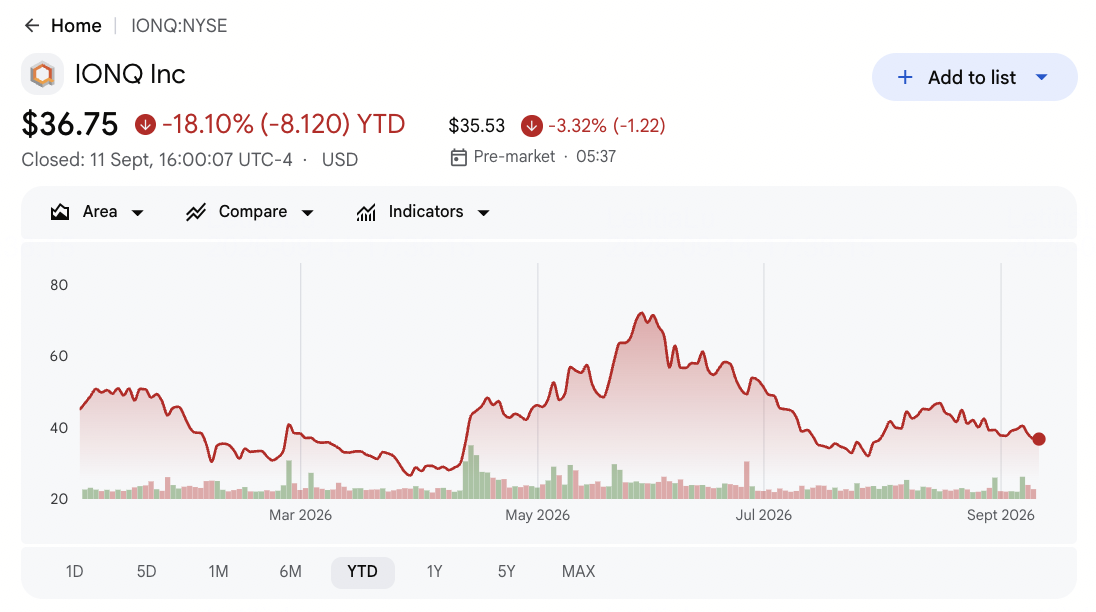
- IONQ was down 17.90% YTD through September 10: Shares closed at $36.84 after trading between $25.89 and $84.64 over the past year. The wide range shows how strongly investors react to quantum milestones, acquisitions and revenue guidance.
- Q2 revenue reached a record $80.1 million, up 287%: The result beat the $66.5 million consensus by $13.6 million. Adjusted EPS of negative $0.33 also beat the negative $0.56 estimate, showing stronger commercial traction despite continued losses.
- Organic revenue grew 132%, with 60% of customers buying multiple products: Tempo demand, cloud access and international expansion supported growth beyond acquisitions. Multi-product adoption can reduce reliance on irregular system deliveries and deepen customer relationships.
- 2026 revenue guidance increased to $450 million–$460 million: The Investor Day range rose from the prior $280 million–$290 million outlook after SkyWater joined the group. Investors still need to separate acquired foundry revenue from organic quantum growth.
- The $1.8 billion SkyWater deal changes IonQ's operating model: Domestic foundry capacity could accelerate processor development and support testing of a planned 200,000-qubit system by 2028. IonQ also introduced the 256-qubit Superion platform for 2027 deployment.
What Is IonQ (IONQ)?
IonQ is a quantum technology company built around trapped-ion computing. Its systems hold charged atoms in electromagnetic fields and manipulate them to run quantum circuits, an approach designed for high fidelity and long coherence. IonQ sells dedicated systems, cloud-based computing access and related applications, then extends the platform into quantum networking, quantum-safe security, atomic sensing and space infrastructure. The company reports 99.99% two-qubit gate fidelity and provides hardware access through all three major public cloud platforms.
IonQ's long-term strategy combines internal research with acquired capabilities. Oxford Ionics contributes electronic qubit-control expertise, ID Quantique and Lightsynq expand networking and security, Vector Atomic adds sensing, Capella Space supports space-based infrastructure and SkyWater provides U.S. semiconductor fabrication. Customers and partners include Amazon Web Services, Microsoft Azure, Google Cloud, AstraZeneca, Nvidia, QuantumBasel and government agencies. These relationships place IonQ across the broader quantum computing stock ecosystem, though the platform must still convert technical progress into repeatable commercial revenue.
Read More: Top 10 Quantum Computing Stocks to Watch in 2026: Companies Driving Next-Gen Computation
IonQ (IONQ) Q2 2026 Earnings Overview: Revenue, Organic Growth and Updated Guidance
IonQ delivered $80.1 million of Q2 revenue, up 287% year over year and above the $66.5 million consensus, as organic revenue grew 132%. Adjusted EPS reached negative $0.33 versus negative $0.56 expected, yet adjusted EBITDA remained negative $120.3 million. Management first raised 2026 revenue guidance to $280 million-$290 million, then increased it to $450 million-$460 million after integrating SkyWater.
Read More: IonQ (IONQ) Q2 2026 Earnings News: 287% Revenue Growth Meets a 0.53% Price Selloff
|
Financial Metric |
Guidance / Consensus |
Reported / Actual |
Surprise |
|
Q2 2026 revenue |
$66.5M consensus |
$80.1M; +287% YoY |
Beat. Revenue exceeded consensus by $13.6M as systems, cloud use and acquired operations expanded. |
|
Q2 adjusted EPS |
-$0.56 consensus |
-$0.33 |
Beat. The loss was $0.23 narrower than expected, though IonQ remained unprofitable. |
|
Q2 organic revenue growth |
Year-ago comparison |
+132% YoY |
Accelerated. Core growth showed that acquisitions did not explain the entire revenue increase. |
|
Q2 adjusted EBITDA |
Continued investment |
-$120.3M |
Cautious. The loss exceeded quarterly revenue as IonQ funded systems and integration. |
|
Cash and investments |
Post-financing liquidity |
About $3.0B |
Positive. Liquidity provides runway for integration, manufacturing and technical milestones. |
|
Backlog / RPO |
Commercial commitments |
About $485M |
Constructive. Contracted work supports visibility, subject to delivery and acceptance timing. |
|
FY2026 outlook at Q2 |
Prior $260M-$270M |
$280M-$290M |
Raised. Record results and commercial demand supported the initial increase. |
|
FY2026 outlook after Investor Day |
Prior $280M-$290M |
$450M-$460M |
Raised. SkyWater added scale, making organic mix the next key test. |
- Revenue of $80.1 million beat consensus by $13.6 million: The 287% year-over-year increase reflected physical systems, cloud usage and a broader product mix. The beat showed stronger demand, though delivery timing can still make quarterly revenue uneven.
- Adjusted EPS of negative $0.33 beat by $0.23: The result was narrower than the negative $0.56 consensus as revenue scaled faster than expected. IonQ remained loss-making, so continued operating leverage is still needed.
- Organic revenue grew 132% despite acquisition-driven expansion: More than half of customers bought multiple products, supporting cross-selling across compute, networking and security. Continued organic growth would show that the platform is strengthening beyond acquired revenue.
- Adjusted EBITDA remained negative $120.3 million: The loss was roughly 1.5 times quarterly revenue, highlighting the cost of research, deployment and integration. Revenue growth must eventually outpace these expenses.
- Revenue guidance rose to $450 million–$460 million: The range increased from $280 million–$290 million after SkyWater closed. The higher target adds scale, though foundry and quantum revenue may receive different valuation multiples.
IonQ (IONQ) 2026 Investment Outlook: $65 Bull Case vs. $25 Bear Case
The central question is whether IonQ can turn SkyWater, Superion and a roughly $485 million backlog into faster organic growth before integration costs and persistent losses compress its valuation.
The Bull Case: Strong Quantum Demand Pushes IONQ Toward $65
The Bull Case assumes organic revenue stays above 100% growth as Tempo deployments, Superion orders and networking contracts convert the roughly $485 million backlog. SkyWater shortens development cycles, while more customers adopt multiple products and revenue grows faster than operating expenses.
A move toward $65 would require IonQ to reach the $450 million to $460 million outlook without relying mainly on foundry revenue. On-time 2027 Superion deployments, larger government or enterprise awards and a smaller adjusted EBITDA loss than Q2's negative $120.3 million would strengthen the case.
The Base Case: Steady Revenue Growth Keeps IONQ Between $38 and $48
The Base Case assumes SkyWater adds predictable foundry sales while core quantum demand grows unevenly. IonQ meets updated guidance, though integration costs keep adjusted EBITDA negative and foundry revenue receives a lower valuation than quantum services.
IONQ could trade mainly between $38 and $48 under these conditions. Organic growth near or above 100%, stable backlog and timely system deliveries would support the range. A weaker organic mix or losses above quarterly revenue would cap the upper end.
The Bear Case: Slower Growth Pulls IONQ Toward $25
The Bear Case assumes SkyWater integration takes longer, Superion deployments slip and organic bookings weaken. Foundry operations account for more of the $450 million to $460 million outlook while adjusted EBITDA losses remain near Q2 levels.
A move toward $25 would become more likely if IonQ cuts guidance, backlog conversion slows or cash usage accelerates despite $3.0 billion of liquidity. A lower growth multiple could then push shares back toward the $25.89 52-week low.
IONQ Stock Price Forecasts for 2026 By Wall Street Analysts
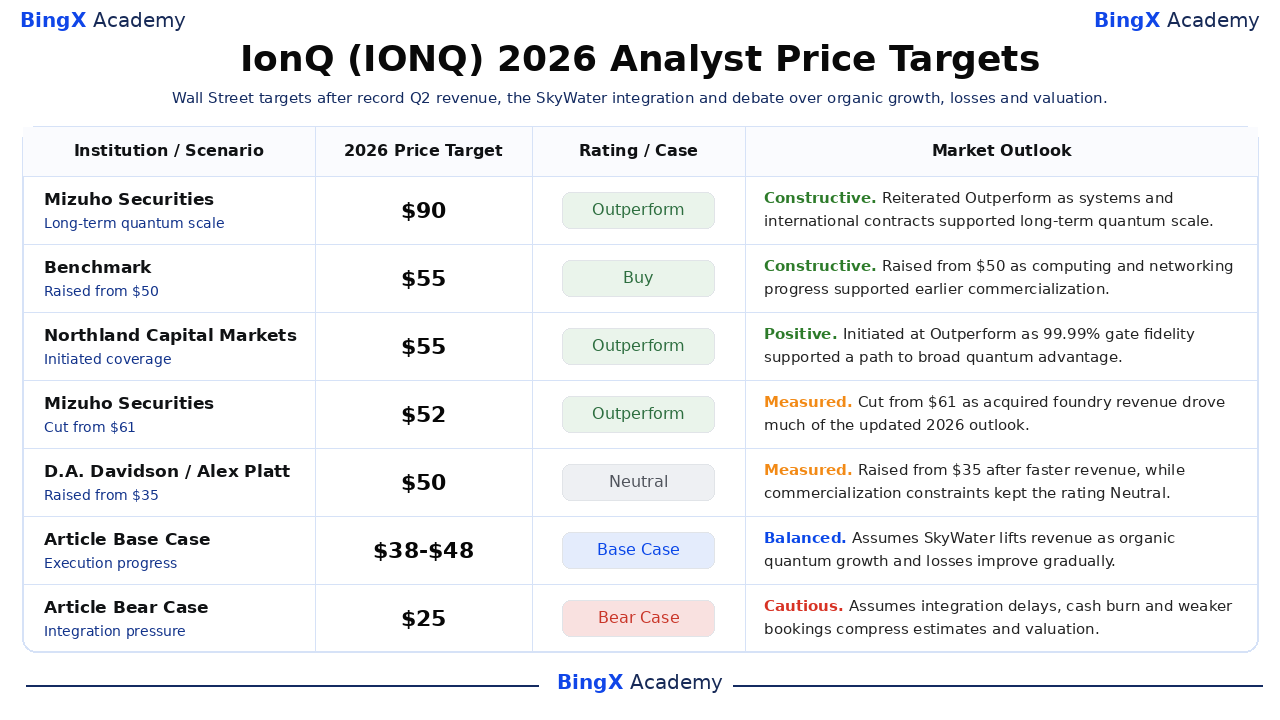
These six dated actions span $45 to $90 and capture unusually wide views on IonQ's technical lead, commercialization timeline and valuation. Several actions preceded the completed SkyWater integration, so dates and rationales matter as much as headline targets. The final Base and Bear rows are BingX Academy editorial scenarios, not Wall Street forecasts or price guarantees.
|
Institution / Scenario |
2026 Price Target |
Rating / Case |
Market Outlook |
|
Mizuho Securities |
$90 |
Outperform |
Constructive. January 13: reiterated a bullish view as system progress and international contracts supported long-term quantum scale. |
|
Benchmark |
$55 |
Buy |
Constructive. July 7: raised from $50 after management discussions highlighted computing and networking commercialization. |
|
Northland Capital Markets |
$55 |
Outperform |
Positive. April 20: initiated coverage as 99.99% gate fidelity supported a path toward broad quantum advantage. |
|
Mizuho Securities |
$52 |
Outperform |
Measured. September 10: cut from $61 as acquired foundry revenue drove much of the updated 2026 outlook. |
|
D.A. Davidson |
$50 |
Neutral |
Measured. May 7: raised from $35 after faster revenue, while commercialization constraints kept the rating Neutral. |
|
Cantor Fitzgerald |
$45 |
Overweight |
Positive. July 7: reiterated confidence that IonQ could capture quantum hardware, services and software share through 2035. |
|
Article Base Case |
$38-$48 |
Base Case |
Balanced. Assumes SkyWater lifts revenue as organic quantum growth and losses improve gradually. |
|
Article Bear Case |
$25 |
Bear Case |
Cautious. Assumes integration delays, cash burn and weaker bookings compress estimates and valuation. |
How to Trade IonQ (IONQ) Stock on BingX
Trade IonQ's quantum-system, SkyWater integration and revenue-conversion outlook using BingX TradFi and BingX AI tools. Because IONQ can react sharply to contract awards, technical milestones and guidance changes, traders should define both the catalyst and risk limits before entering a position.
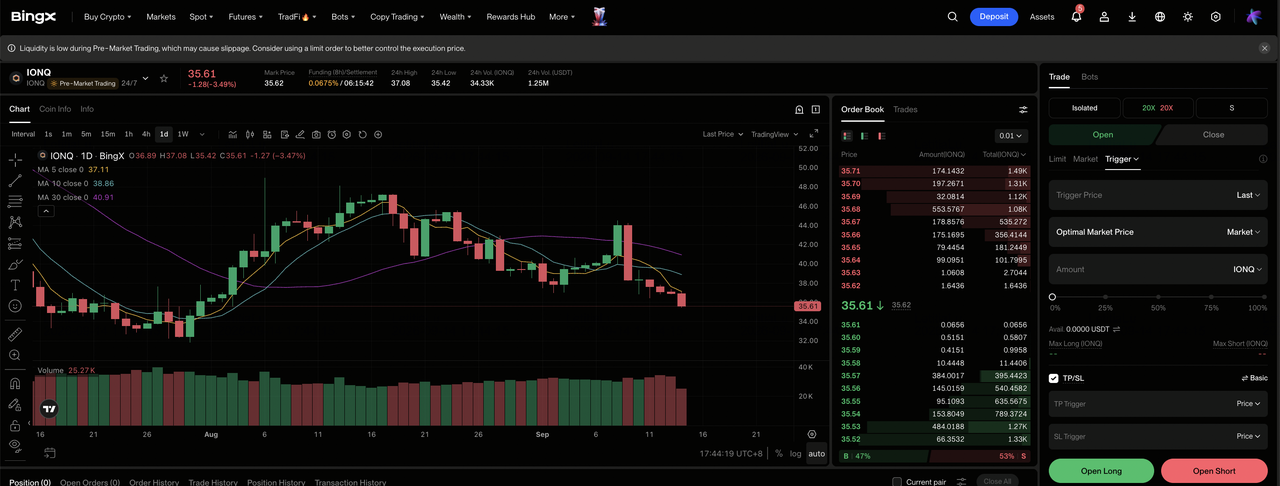
Step 1: Access BingX TradFi. Sign up and navigate to the specialized TradFi section on the BingX exchange dashboard.
Step 2: Select IonQ (IONQ). Search for and select the IONQ-USDT perpetual futures contract.
Step 3: Choose your direction. Select Open Long if Superion orders, organic growth and backlog conversion support the Bull or Base Case. Select Open Short if integration delays, persistent losses or weaker bookings validate the Bear Case.
Step 4: Select leverage and margin mode. Choose Isolated or Cross-Margin based on your risk tolerance. IONQ's $25.89-$84.64 52-week range shows why conservative leverage and clear position sizing are important.
Step 5: Execute strict risk protocols. Set Take-Profit and Stop-Loss (TP/SL) levels before or immediately after entering the trade. IONQ can react quickly to system milestones, government awards, integration updates and revenue guidance.
Top 5 Risks to Watch for IONQ Investors in 2026
IonQ's valuation depends on technical progress, commercialization, integration and funding. Weakness in any area could reduce expected cash flow and pressure the stock's valuation.
- Losses could remain high as IonQ scales: Q2 adjusted EBITDA was negative $120.3 million against $80.1 million of revenue. If costs keep rising quickly, the $3.0 billion liquidity balance could decline without clear progress toward profitability.
- SkyWater integration could add complexity: The $1.8 billion acquisition adds manufacturing control and foundry revenue, but also brings facilities and integration costs. Execution problems could delay processors and reduce the deal's expected benefits.
- Quantum commercialization could take longer than expected: The roughly $485 million backlog provides visibility, but revenue depends on delivery and customer acceptance. Superion or enterprise delays could push revenue and cash flow further out.
- Competition could weaken IonQ's advantage: IBM, Google, Quantinuum, D-Wave and Rigetti are pursuing competing quantum technologies. Faster progress elsewhere could cost IonQ contracts despite its reported 99.99% two-qubit gate fidelity.
- High valuation and dilution could increase volatility: IONQ traded between $25.89 and $84.64 over the past year despite remaining unprofitable. A lower growth multiple or additional shares could limit upside even if revenue reaches $450 million to $460 million.
Final Thoughts: Should You Invest in IONQ in 2026?
IonQ has moved beyond a single-product research story. Q2 revenue of $80.1 million, 132% organic growth, multi-product purchasing and roughly $485 million of backlog provide concrete commercialization evidence. SkyWater and Superion may accelerate the roadmap, though the negative $120.3 million adjusted EBITDA result shows that scale has not yet translated into operating profitability.
The Bull Case requires organic quantum demand and system delivery to justify $65 rather than acquired foundry revenue alone. The Bear Case follows integration delays, persistent losses and multiple compression toward $25. Conservative traders may wait for a clearer breakdown of organic versus SkyWater revenue, timely Superion milestones and sequential improvement in adjusted EBITDA before treating the updated outlook as durable.
Risk Reminder: Trading and investing in equities like IONQ involves a high risk of capital loss. Early-stage technology, technical roadmaps, acquisitions, customer acceptance, valuation and leverage can produce rapid losses. Conduct independent research before allocating capital.
Related Reading
- Top 10 Quantum Computing Stocks to Watch in 2026: Companies Driving Next-Gen Computation
- Top 10 AI Infrastructure Stocks to Buy in 2026: Chip Manufacturing and Design Leaders
- What Is the U.S. CHIPS and Science Act? Its Impact on Semiconductors, Technology, and Crypto in 2026
- Nebius Group (NBIS) Price Prediction 2026: $287 Street-High AI Factory Boom or Stretched Neocloud?
- Nvidia (NVDA) Stock Price Outlook for 2026: Can Blackwell and Vera Rubin Take NVDA Back to $300?
- Alphabet (GOOGL) Price Prediction 2026: Can 82% Cloud Growth and AI Push GOOGL Stock to $430?
