
Firefly Aerospace (FLY) is a space and defense technology company that helps government and commercial customers launch payloads, land equipment on the Moon and operate spacecraft in orbit. Its portfolio spans the Alpha small-launch vehicle, the larger Eclipse rocket under development, Blue Ghost lunar landers, Elytra orbital vehicles and SciTec defense-sensing systems. This breadth reduces dependence on a single mission type, though FLY remains sensitive to launch reliability, program timing and the cost of scaling production.
The latest quarter showed rapid growth without a finished profitability transition. Firefly Aerospace Q2 2026 revenue reached a record $117.7 million, up 659% year over year and 46% sequentially, as spacecraft and mission activity accelerated. Backlog increased from about $1.3 billion to roughly $1.5 billion, yet a $95.2 million operating loss and $81.6 million of operating cash use showed why converting funded programs into repeatable margin remains the central investment test.
The FLY stock forecast for 2026 now centers on two competing views:
- The launch, lunar and defense scale case: revenue at the upper end of $420 million to $450 million guidance, additional Alpha missions and stronger Blue Ghost and SciTec execution could validate the backlog and support a move toward $55.
- The schedule, margin and funding case: launch delays, cost overruns or slower contract conversion could extend losses, consume the $459.8 million cash balance and pull the stock toward $15.
This guide breaks down the FLY stock forecast, 2026 price scenarios, key risks and analyst outlooks, drawing on Firefly Aerospace's August 11 Q2 2026 earnings release, quarterly filing and market data through September 11, plus how to trade FLY stock futures on BingX TradFi with USDT collateral.
Top 5 Things for Firefly Aerospace Investors to Know in September 2026
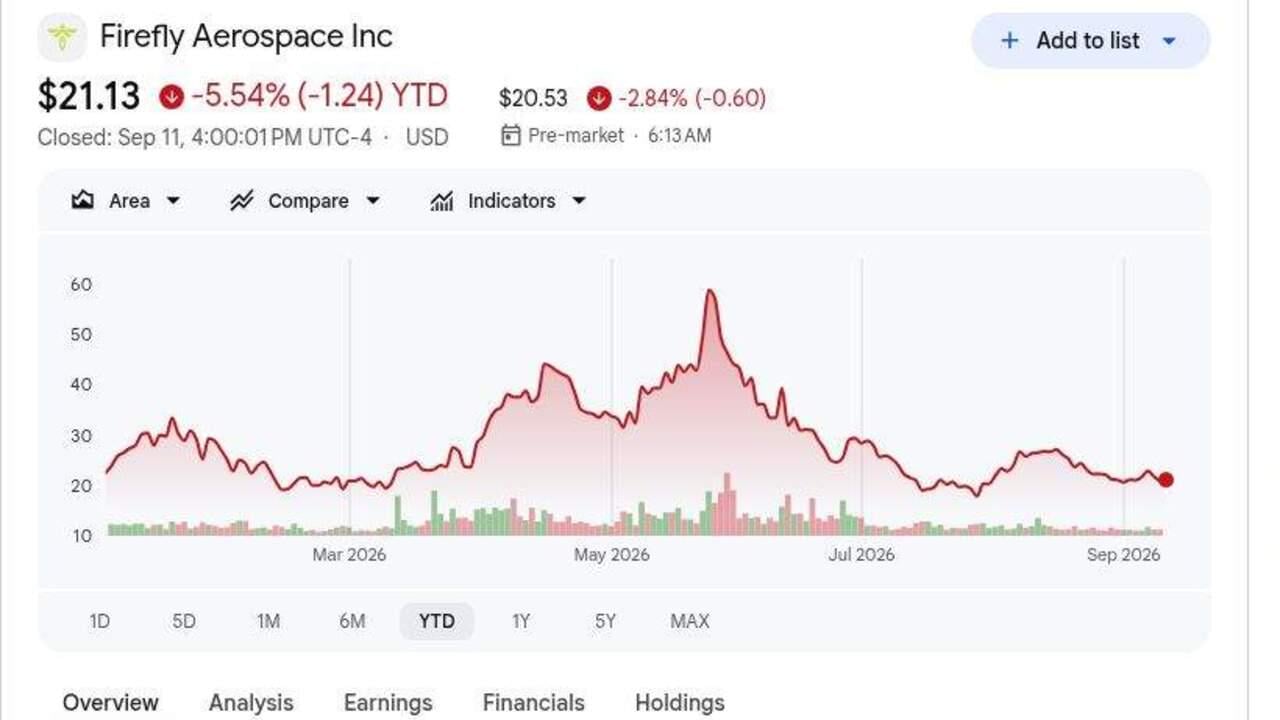
- FLY closed at $21.13 on September 11 and was down 5.54% in 2026: Shares remained more than 50% below the $45 IPO price despite record Q2 revenue. A move toward the $38.60 analyst average depends on backlog converting into revenue and losses narrowing.
- Q2 revenue reached $117.7 million, up 659% year over year: Sales beat the $88.52 million consensus by about $29.2 million and rose 46% from Q1. Growth was strong, though launch and spacecraft revenue can remain uneven because of mission timing.
- Backlog increased to about $1.5 billion from $1.3 billion in Q1: The total supports future work across launch, lunar, orbital and national-security missions. NASA, U.S. Space Force and commercial milestones will determine how quickly that backlog becomes revenue.
- 2026 revenue guidance remained $420 million to $450 million: The $435 million midpoint is about 172% above 2025 revenue. After $198.6 million in first-half sales, Firefly still needs roughly $221 million to $251 million in the second half.
- A $95.2 million operating loss keeps profitability in focus: Gross profit reached $23.9 million, while adjusted EBITDA remained negative USD 61.2 million. Firefly had USD 459.8 million of cash, but USD 81.6 million of quarterly operating cash use keeps funding risk relevant.
What Is Firefly Aerospace (FLY)?

Firefly Aerospace is an integrated space transportation and defense company serving government and commercial mission customers. Alpha provides dedicated small-payload launches, while Eclipse is being developed with greater lift capacity for medium-class missions. Blue Ghost carries scientific and commercial payloads to the Moon, and the Elytra family supports orbital transfer, hosting and in-space operations. Firefly designs, manufactures and tests major systems at co-located Texas facilities, allowing common engines, avionics and structures to support multiple products and revenue streams.
The long-term strategy connects launch, lunar delivery, orbital services and missile-warning technology into a broader mission platform. Blue Ghost Mission 1 completed a successful commercial Moon landing in March 2025, and NASA later awarded Firefly a $176.7 million south-pole mission planned for 2029. Northrop Grumman is the strategic partner on Eclipse, SciTec extends Firefly into missile warning and tracking, and 2026 agreements with SSC Space and Zeno Power added European launch access and lunar-night technology work. These programs position Firefly across civil space, commercial payload and national-security budgets rather than one launch market.
Read More: Top Defense Stocks to Buy in 2026: Primes, Missiles, Drones, Space, and AI-Enabled Warfare
Firefly Aerospace (FLY) Q2 2026 Earnings Overview: Record Revenue, Backlog Growth and Continued Losses
Firefly produced record Q2 revenue of $117.7 million, about $29.2 million above the $88.52 million consensus and 659% higher year over year. The non-GAAP loss of $0.42 per share was $0.08 narrower than expected, gross profit reached $23.9 million and backlog rose to about $1.5 billion. Management retained $420 million to $450 million of 2026 revenue guidance, though a $95.2 million operating loss and $81.6 million of operating cash use showed that revenue scale has not yet translated into durable profitability.
Read More: Firefly Aerospace (FLY) Q2 2026 Earnings Overview: $117.7M Revenue and EPS Beat Lift Shares 0.68%
|
Financial Metric |
Guidance / Consensus |
Reported / Actual |
Surprise |
|
Q2 2026 revenue |
$88.52M consensus |
$117.7M |
Beat. About $29.2M above consensus; up 659% YoY and 46% sequentially. |
|
Q2 non-GAAP loss per share |
$0.50 loss consensus |
$0.42 loss |
Beat. The adjusted loss was $0.08 narrower than expected. |
|
Q2 GAAP diluted loss per share |
$0.61 loss in Q1 2026 |
$0.57 loss |
Improved. The quarterly loss narrowed by $0.04 sequentially. |
|
Q2 gross profit |
$17.5M in Q1 2026 |
$23.9M |
Expanded. Gross profit increased with record quarterly revenue. |
|
Q2 GAAP gross margin |
21.6% in Q1 2026 |
20.30% |
Compressed. Mix and investment reduced margin by 130 basis points. |
|
Q2 GAAP operating loss |
$96.0M in Q1 2026 |
$95.2M |
Improved slightly. Revenue scale did not yet create operating leverage. |
|
Q2 adjusted EBITDA loss |
— |
$61.2M |
Negative. Development and production spending remained ahead of revenue. |
|
Q2 operating cash use |
— |
$81.6M |
Negative. Cash consumption remained material during the production ramp. |
|
Cash and cash equivalents |
— |
$459.8M |
Available. Liquidity supports missions, though losses keep funding risk relevant. |
|
Total backlog |
About $1.3B in Q1 2026 |
About $1.5B |
Expanded. New launch, lunar and defense work increased visibility. |
|
2026 revenue outlook |
$420M–$450M prior guidance |
$420M–$450M |
Reiterated. The $435M midpoint requires substantial second-half delivery. |
- Revenue of USD 117.7 million beat consensus by about USD 29.2 million: Sales rose 659% year over year and 46% sequentially. The sequential gain is the stronger signal that Firefly's mission portfolio is scaling beyond an easy comparison base.
- The adjusted loss of USD 0.42 per share beat consensus by USD 0.08: GAAP loss per share also narrowed to USD 0.57 from USD 0.61 in Q1. The improvement is encouraging, though the USD 92.3 million net loss shows profitability remains distant.
- Gross profit rose to USD 23.9 million as margin slipped to 20.3%: Gross profit increased from USD 17.5 million in Q1, while margin fell from 21.6%. Firefly is generating more gross profit dollars, but future margin expansion remains important.
- The USD 95.2 million operating loss was nearly unchanged from Q1: Revenue grew by USD 36.8 million sequentially, yet adjusted EBITDA remained negative USD 61.2 million and operating cash use reached USD 81.6 million. Higher sales are still being absorbed by engineering and program costs.
- The USD 420 million to USD 450 million outlook requires at least USD 221.4 million in second-half revenue: First-half sales totaled about USD 198.6 million. Contracted work supports the target, but launches and customer milestones must stay on schedule.
Firefly Aerospace (FLY) 2026 Investment Outlook: $55 Bull Case vs. $15 Bear Case
FLY's 2026 valuation depends less on one quarterly beat than on whether launch, lunar and defense programs can turn a $1.5 billion backlog into repeatable revenue and improving margins. The three editorial scenarios below are separate from Wall Street targets and use $21.13 as the September 11 reference close.
The Bull Case: Strong Launch and Defense Growth Pushes FLY Toward $55
The Bull Case assumes Firefly reaches the upper end of USD 420 million to USD 450 million guidance, completes more Alpha missions and advances Blue Ghost and Eclipse without major delays. SciTec strengthens the defense pipeline, while backlog continues growing and gross margin improves from the 20.3% Q2 level.
A move toward $55 would require about USD 251 million of second-half revenue, steady backlog conversion and a smaller operating loss as production scales. Successful missions, larger defense awards and lower cash use would strengthen the case.
The Base Case: Steady Growth Keeps FLY Between $30 and $40
The Base Case assumes annual revenue stays within guidance and launch, lunar and defense programs keep advancing, though mission timing makes quarterly results uneven. Backlog supports demand visibility, but the negative USD 61.2 million adjusted EBITDA result and USD 81.6 million of operating cash use keep profitability in focus.
FLY could trade mainly between $30 and $40 under these conditions. Revenue above the USD 420 million guidance floor, stable backlog and gradual margin improvement would support the range. A full-year miss or limited progress on operating losses would cap the upper end.
The Bear Case: Mission Delays Pull FLY Toward $15
The Bear Case assumes Alpha, Blue Ghost or customer milestones move into later periods, reducing 2026 revenue and delaying cost absorption. Backlog remains large, but cash conversion weakens as Firefly continues funding multiple programs.
A move toward $15 would become more likely if revenue falls below USD 420 million, backlog declines from USD 1.5 billion or operating cash use stays near the Q2 rate of USD 81.6 million. A launch failure, cost overrun or new equity raise would add further pressure.
FLY Stock Price Forecasts for 2026 By Wall Street Analysts
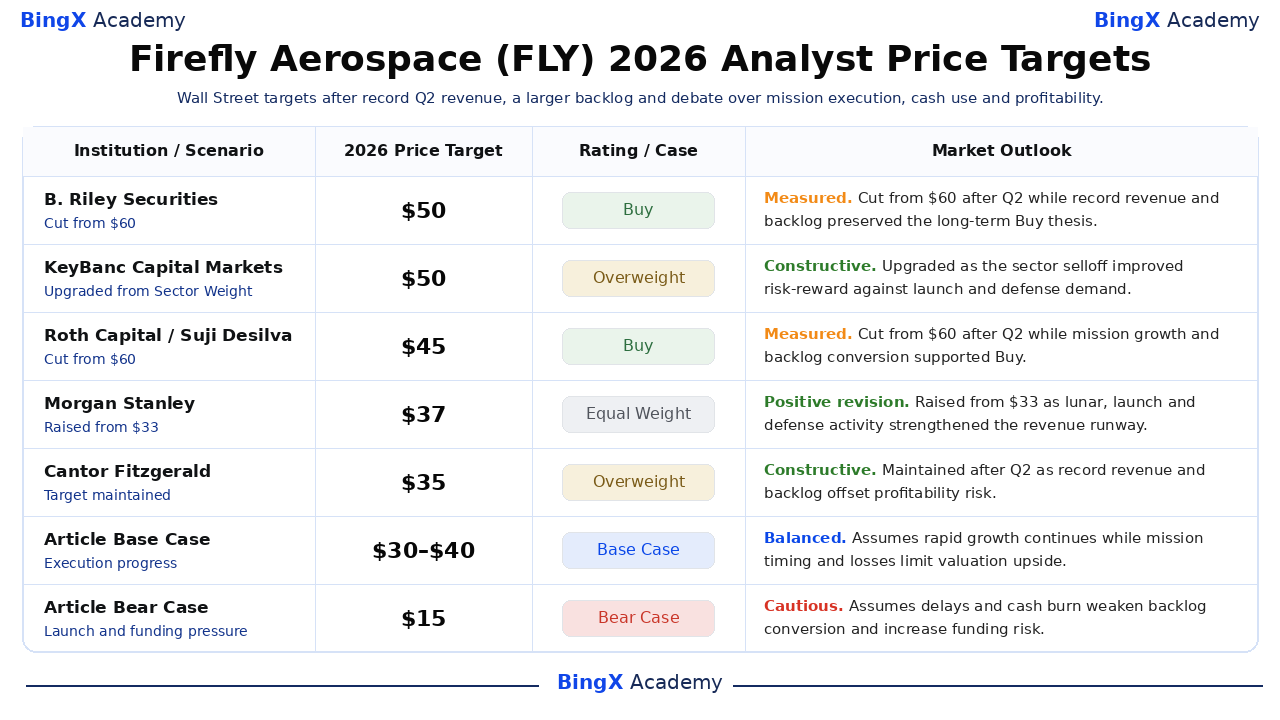
These five dated actions span $35 to $50 and reflect different assumptions about mission reliability, backlog conversion, national-security demand and the path to profitability. They are third-party reference points rather than a single consensus forecast. The final Base and Bear rows are BingX Academy editorial scenarios and are labeled separately.
|
Institution / Scenario |
2026 Price Target |
Rating / Case |
Market Outlook |
|
B. Riley Securities / Mike Crawford |
$50 |
Buy |
Measured. August 12: cut from $60 after Q2 while record revenue and backlog preserved the long-term Buy thesis. |
|
KeyBanc Capital Markets / Michael Leshock |
$50 |
Overweight |
Constructive. June 15: upgraded from Sector Weight as the sector selloff improved risk-reward against launch and defense demand. |
|
Roth Capital / Suji Desilva |
$45 |
Buy |
Measured. August 12: cut from $60 after Q2 while mission growth and backlog conversion supported Buy. |
|
Morgan Stanley / Kristine Liwag |
$37 |
Equal Weight |
Positive revision. May 5: raised from $33 as lunar, launch and defense activity strengthened the revenue runway. |
|
Cantor Fitzgerald / Colin Canfield |
$35 |
Overweight |
Constructive. August 12: maintained after Q2 as record revenue and backlog offset profitability risk. |
|
Article Base Case |
$30–$40 |
Base Case |
Balanced. Assumes rapid growth continues while mission timing and losses limit valuation upside. |
|
Article Bear Case |
$15 |
Bear Case |
Cautious. Assumes delays and cash burn weaken backlog conversion and increase funding risk. |
How to Trade Firefly Aerospace (FLY) Stock on BingX
Trade Firefly Aerospace's launch-cadence, backlog-conversion and margin outlook using BingX TradFi and BingX AI tools. Because FLY can react sharply to mission outcomes, contract awards and financing updates, traders should define both the catalyst and risk limits before entering a position.
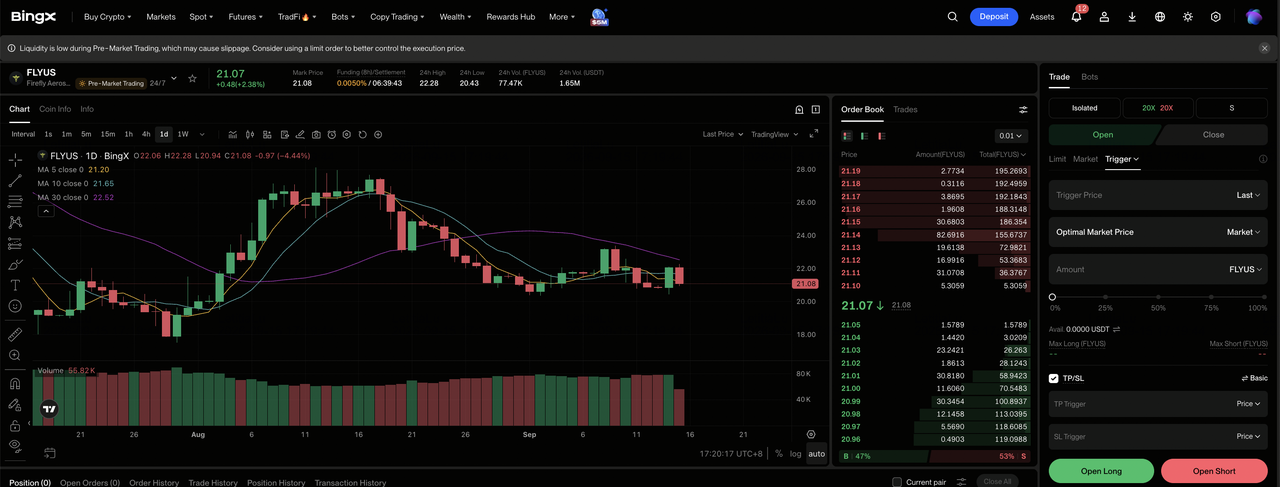
Step 1: Access BingX TradFi. Sign up and navigate to the specialized TradFi section on the BingX exchange dashboard.
Step 2: Select Firefly Aerospace (FLY). Search for and select the FLY-USDT perpetual futures contract.
Step 3: Choose your direction. Select Open Long if mission delivery converts backlog and margins improve. Select Open Short if launch delays, cost overruns or cash burn weaken expected per-share economics.
Step 4: Select leverage and margin mode. Choose Isolated or Cross-Margin based on your risk tolerance. FLY traded more than 50% below its $45 IPO price, showing why conservative leverage and clear position sizing are important.
Step 5: Execute strict risk protocols. Set Take-Profit and Stop-Loss (TP/SL) levels before or immediately after entering the trade. FLY can react quickly to launches, lunar missions, defense awards, guidance, margins and financing.
Top 5 Risks to Watch for Firefly Aerospace Investors in 2026
Firefly's valuation depends on mission execution, backlog conversion, government demand and funding. These risks can delay revenue, increase cash use or reduce per-share value.
- Launch failures could delay revenue: Firefly still needs at least USD 221.4 million of second-half revenue to reach guidance. A mission problem could postpone payments, add investigation costs and weaken confidence in the USD 1.5 billion backlog.
- Backlog may convert more slowly than expected: The USD 1.5 billion backlog depends on technical milestones, funding and customer schedules. Delays can push recognized revenue and cash receipts into later periods even when contracts remain intact.
- High cash burn keeps financing risk relevant: Q2 operating cash use reached USD 81.6 million, equal to about 69% of revenue, while cash stood at USD 459.8 million. Continued losses could require more debt or equity financing.
- Government programs can face budget delays: NASA and defense customers provide important demand, but procurement timing and changing priorities can shift awards and milestones. That could weaken near-term revenue visibility even if long-term demand remains strong.
- A 20.3% gross margin leaves limited room for cost overruns: Margin fell 130 basis points from Q1 as program mix changed. Higher costs across Alpha, Blue Ghost, Eclipse or SciTec could delay the path to positive operating income.
Final Thoughts: Should You Invest in Firefly Aerospace in 2026?
Firefly has moved beyond a single-product launch thesis. Q2 revenue reached $117.7 million, backlog grew to about $1.5 billion and the company retained a $420 million to $450 million annual target. Alpha, Blue Ghost, Elytra, Eclipse and SciTec create several routes to growth, though the $95.2 million operating loss shows that program breadth has not yet produced operating leverage.
The Bull Case requires timely missions, stronger margins and backlog conversion to support $55. The Bear Case reflects schedule slippage, cash burn and financing pressure that could pull FLY toward $15. Conservative traders may wait for annual revenue above the guidance floor, improving gross margin and a meaningful reduction in operating cash use before treating the backlog as durable per-share value.
Risk Reminder: Trading and investing in equities like FLY involves a high risk of capital loss. Launch failures, spacecraft defects, contract delays, cost overruns, cash burn, dilution, government-budget changes and leveraged trading can produce rapid losses. Conduct independent research before allocating capital.
Related Reading
- Top Defense Stocks to Buy in 2026: Primes, Missiles, Drones, Space, and AI-Enabled Warfare
- Top Space Stocks to Buy Ahead of SpaceX IPO
- Rocket Lab (RKLB) Price Prediction 2026: Can New Rocket and Defense Growth Push RKLB Toward $150?
- Redwire (RDW) Price Prediction 2026: Can Space and Defense Orders Push RDW Toward $24?
- Virgin Galactic (SPCE) Price Prediction 2026: Can Delta Testing Push SPCE Toward $5?
- Lockheed Martin (LMT) Price Prediction 2026: Can Record Backlog Push LMT Toward $700?
