
With the imminent mainnet activation of Dash Platform 4.0, the network is shifting from a pure transactional currency into a scalable, Web3-compatible data and decentralized application (dApp) ecosystem. However, this technical leap comes at a time when global compliance protocols are tightening.
By mid-2026, Dash (DASH) finds itself navigating an intense tug-of-war between short-term technical pessimism and long-term fundamental optimism. While the broader cryptocurrency market experiences structural volatility under an Extreme Fear regime in July, with the Crypto Fear and Greed Index sitting at a tense 11, DASH has carved out a stable consolidation range around $32.27, holding a market capitalization of $411.64 million. Daily 24-hour spot volumes remain healthy at $45.64 million, representing an active volume-to-market-cap ratio of 10.97%, confirming that liquidity remains deep despite defensive price action.
The DASH price prediction for 2026 remains highly polarized. Algorithmic trading setups and macro chartists point to a short-term descending channel on the daily charts, warning of a potential breakdown toward the $29.00 support level if the immediate $31.00 floor gives way. Conversely, contrarian analysts view this multi-month compression as a historic accumulation phase, arguing that the impending Platform 4.0 activation and the "Dash-to-Anything" merchant feature will trigger a fundamental demand shock.
This guide breaks down Dash’s technical metrics, institutional forecasts from Changelly and Traders Union, and shifting regulatory frameworks to help you position your capital effectively on BingX.
Top 5 Things to Know About Dash (DASH) in H2 2026
- Imminent Platform 4.0 Mainnet Activation: Following a successful testnet deployment in June 2026, Dash is on the verge of activating Platform 4.0 on mainnet. This introduces decentralized identities (DPNS) and a high-performance indexed database, transitioning Dash into a viable Web3 application layer.
- The Southeast Asian Push: Dash Core Group is actively expanding its digital payment footprint into high-adoption emerging markets, notably anchoring merchant integrations at Philippine Blockchain Week 2026.
- The Privacy Regulatory Paradox: On June 5, 2026, the Bangko Sentral ng Pilipinas (BSP) issued a strict compliance memo banning anonymity-enhancing tokens from licensed Virtual Asset Service Providers (VASPs). Because Dash features an optional CoinJoin-based mixing mechanism (PrivateSend), its compliance classification remains under heavy regulatory scrutiny.
- Defensive Technical Resilience: During recent systemic tech selloffs that triggered over $717 million in altcoin liquidations, Dash demonstrated strong defensive qualities, limiting its losses to under 1% while major altcoins suffered 3% to 6% drawdowns.
- Masternode Governance & Treasury Stability: Dash's decentralized autonomous organization (DAO) framework continues to route 10% of every block reward straight into its self-funded ecosystem treasury, insulating core protocol development from external venture capital reliance.
What Is Dash (DASH)?
Dash is a decentralized, open-source peer-to-peer cryptocurrency originally launched in 2014 with the explicit mission to fulfill the foundational vision of digital cash. Unlike general-purpose smart contract networks or assets optimized purely as speculative stores of value, Dash prioritizes transaction speed, near-zero settlement fees, and friction-free real-world merchant utility.
The architecture achieves this via a unique, incentivized two-tier network. The first tier consists of Proof-of-Work (PoW) miners who secure the ledger's cryptography. The second tier is composed of masternodes, specialized full nodes requiring a collateral lockup of exactly 1,000 DASH.
This dual-layer infrastructure enables three proprietary features that separate Dash from standard UTXO (Unspent Transaction Output) blockchains:
- InstantSend: Utilizes masternode quorums to programmatically lock transactions in under two seconds, rendering it instantly final and immune to double-spend risks at points of sale.
- ChainLocks: Programmatically finalizes blocks immediately upon publication, completely neutralizing the risk of 51% reorganization attacks.
- PrivateSend: Offers users decentralized, on-chain privacy utilizing an integrated CoinJoin mixing protocol to obscure transaction histories on an optional basis.
Read more: What Is Dash (DASH), the Bitcoin-Forked Privacy Coin?
Upcoming Developments in the Dash Roadmap to Watch in 2026
- Mainnet Execution Infrastructure (April 2026): Dash Core Group successfully transitions primary codebase enhancements out of experimental developer phases into live production environments, solidifying network scaling stability.
- Platform 4.0 Testnet Deployment (June 2026): The Evolution upgrade goes live on testnet, introducing an advanced cryptographic proof system and high-performance indexed data layers tailored for developer decentralized applications.
- Merchant Integration Scaling (Mid-2026 Phase): The roll-out of the "Dash-to-Anything" protocol begins, allowing consumers to seamlessly execute transactions at standard merchant terminals even if the venue does not natively support crypto.
- Full Evolution Mainnet Launch (Imminent 2026 Activation): The final activation of the Web3 identity and data storage layer on the live mainnet occurs, structurally changing Dash from a transactional coin to an application ecosystem.
An Overview of DASH Token Utility and Tokenomics
The economic model of Dash is engineered to foster a self-sustaining, long-term ecosystem. The circulating supply matches its total supply at 12.75 million tokens as of July 2026, with a strict mathematical hard cap set at 18.9 million DASH, preventing structural inflation over time.
|
Metric |
Specification |
Strategic Network Function |
|
Circulating Supply |
12.75M DASH |
Represents active float; highly scarce relative to older layer-1 protocols. |
|
Max Supply Cap |
18.90M DASH |
Hard mathematical limit ensuring long-term absolute scarcity. |
|
Masternode Requirement |
1,000 DASH |
Collateral bond required to operate a tier-2 node and receive voting rights. |
|
Block Reward Split |
45% Miner / 45% Masternode / 10% Governance |
Programmatic division aligning security, infrastructure, and ecosystem growth. |
The foundational driver behind Dash’s tokenomics is its built-in treasury system. Every block reward allocates exactly 10% of its value directly to a localized decentralized treasury. Approximately every 30 days, the network executes a 'superblock' to distribute these funds to development, marketing, and community projects that have successfully passed a decentralized vote by masternode operators. This independent funding mechanism ensures that Dash does not require external corporate financing to sustain its operations.
Dash Chain vs. Traditional Layer-1 Blockchains: 3 Key Features
Rather than positioning itself as a direct competitor to high-throughput DeFi chains like Solana or Avalanche, Dash isolates its utility to localized transaction optimization and consumer privacy flexibility.
1. Dual-Price Liquidation Protections
Unlike basic derivative protocols, major integration venues like BingX operate with a sophisticated dual-price mechanism for Dash risk evaluation. Positions are closed only when both the mark price and the latest market price simultaneously touch the liquidation threshold. This specific structural design insulates leveraged traders from catastrophic liquidations caused by temporary, isolated wick anomalies on individual spot books.
2. Optional vs. Mandatory Privacy
Traditional privacy assets face aggressive global exchange delistings because their transaction privacy features are hardcoded and mandatory. Dash navigates this by utilizing an optional privacy architecture. Its PrivateSend feature is an opt-in utility built on user-driven CoinJoin mixing. This design allows users to access privacy when necessary, while still enabling platforms to maintain transparent, standard transaction monitoring for general compliance.
3. Masternode Collateralized Governance
While standard Proof-of-Stake validation allows fluid, un-bonded delegation, Dash requires a firm, localized 1,000 DASH lockup to participate in consensus decision-making. This ensures that those voting on treasury allocations have an irreversible financial stake in the ongoing health and market value of the network.
How Does Dash Differ From Other Privacy Coins?
Unlike monolithic privacy networks like Monero (XMR), where obfuscation is mandatory and hardcoded at the protocol level, Dash employs a hybrid, two-tier architecture that treats privacy as a flexible, opt-in utility. By separating network security into a Proof-of-Work mining tier and an infrastructure tier powered by over 4,000 collateralized masternodes, each requiring exactly 1,000 DASH to operate, Dash executes its decentralized PrivateSend mixing via localized, multi-round CoinJoin protocols.
This structural decoupling allows Dash to maintain complete compliance transparency for standard retail points of sale, enabling sub-two-second settlements via InstantSend, while still providing users with on-chain, non-custodial anonymity when chosen. This dual-layer framework effectively insulates Dash from the aggressive, systemic exchange delistings that frequently target zero-knowledge or fully obscured privacy assets.
DASH 2026 Price Outlook: Technical Compression vs. Regulatory Headwinds
The remaining macro cycles of 2026 present a highly technical setup for DASH, balancing a potential breakout from a multi-year rounded bottom against strict compliance resistance.
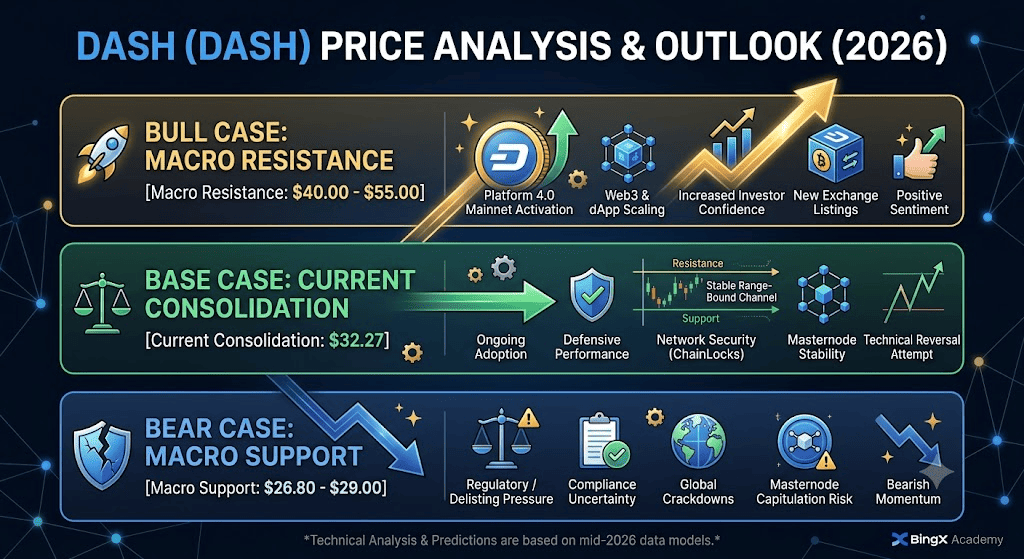
Dash Coin's Bull Case: Technical Reversal and Mainnet Breakout Beyond $40.00
The structural bull case relies on the massive multi-year rounded bottom pattern forming across higher timeframes. The weekly chart shows that DASH has defended its baseline macro support despite severe market corrections, with the weekly MACD holding stable ground above the zero line.
If upcoming mainnet platform integrations trigger capital inflows, a confirmed clean close above the immediate 50-day and 200-day SMAs (positioned at $38.68 and $40.33 respectively) would break the active descending channel. A successful push past the $40.00 psychological resistance zone opens a technical extension channel toward mid-term targets between $55.00 and $69.46. In highly aggressive, structural rotation scenarios, optimistic growth models project a maximum extension toward the $128.84 to $195.54 range by late 2026.
The Base Case for DASH Price: Range-Bound Consolidation Between $30.00 and $38.00
The base case assumes that while the Platform 4.0 launch keeps investor interest steady, the prevailing global risk-off market sentiment and Extreme Fear index levels prevent an immediate parabolic run. In this scenario, Dash's transaction utility in emerging economies provides a reliable valuation floor. The price stabilizes inside a predictable horizontal channel, trading strictly between the $30.00 local support level and the $38.00 overhead resistance through the end of 2026. Volatility remains contained, turning DASH into a defensive asset accumulation play.
Dash Price's Bear Case: Regulatory Exclusions and Breakdown to $26.80
The macro bear case is driven by tightening compliance conditions surrounding privacy-focused networks. If regional watchdogs, such as European regulators enforcing strict DAC8 directives or Southeast Asian central banks enforcing strict anti-anonymity rules, classify Dash's optional CoinJoin features as non-compliant, liquidity could face restrictions.
On the daily chart, the Awesome Oscillator (AO) sits in negative territory, confirming near-term bearish momentum. If selling pressure breaches the immediate classical pivot support at $31.39, the active daily descending channel pattern will validate. This setup would likely trigger automated algorithmic short selling, pushing the asset out of its consolidation bounds down to a historical structural support floor between $26.80 and $29.00.
Dash Price Prediction for 2026: Institutional and Analyst Outlook
Statistical and algorithmic forecasting architectures show a wide divergence in year-end targets, heavily influenced by whether they emphasize near-term technical indicators or long-term fundamental ecosystem updates.
- Changelly Technical Models: Project a highly conservative, range-bound trajectory for the remainder of 2026. Their data suggests an average trading price of $29.72, with localized monthly fluctuations safely bounded within a minimum floor of $26.80 and a local cap of $33.79.
- Traders Union Predictions: Maintain a neutral-to-conservative year-end outlook, targeting a stable consolidation zone hovering around $31.00 to $32.00, assuming broader market indices remain flat.
- Coinbase and Growth Trajectory Models: Apply a steady baseline evaluation, factoring in historical network growth and utility retention across inflation-sensitive regions to project a target average near $43.67.
- Kraken Statistical Forecasters: Focus heavily on historical cyclical rotations back into older, established layer-1 protocols, estimating a maximum potential year-end recovery target touching $52.97.
- CCN Analytical Outlook: Represents the most volatile scenario, highlighting that while short-term indicators lean bearish, an explosive Web3 app adoption cycle post-Platform 4.0 could theoretically drive DASH to a wide macro range between $38.72 on the low end and a maximum price target of $195.54.
How to Trade Dash (DASH) on BingX
Optimize your trading execution in the layer-1 market by utilizing BingX's liquidity infrastructure to manage spot accumulation and advanced derivatives positions.
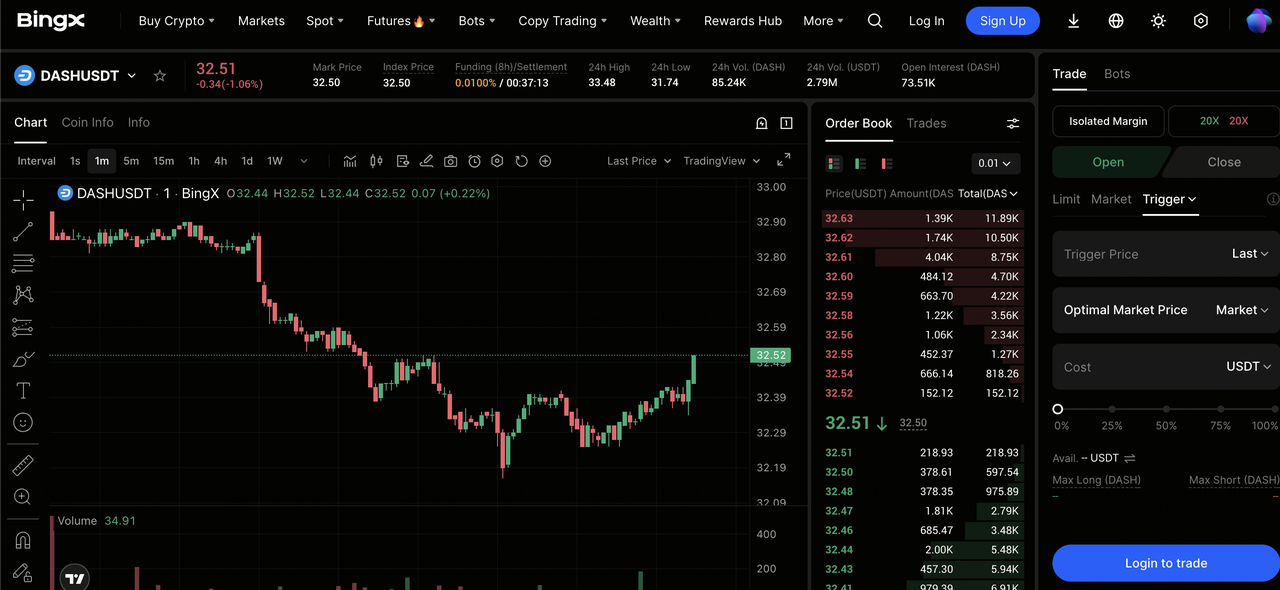
DASH/USDT perpetual contract on BingX futures market
Long or Short DASH Perpetuals with Leverage on the Futures Market
For professional market participants looking to capitalize on high-frequency price swings, manage short-term trend breakdowns, or hedge spot holdings against regulatory developments, BingX supports liquidity-backed perpetual swap contracts.
- Navigate to the top navigation dashboard, select the Futures menu, and enter the Perpetual Futures interface.
- Locate the DASH/USDT perpetual contract dashboard.
- Configure your risk environment: select Isolated Margin to strictly confine risk exposure to a single position, or Cross Margin to deploy your unified account balance as a buffer against volatility.
- Specify your leverage parameters. Due to rapid market swings driven by macro compliance shifts, strict risk protocols (2x–5x) are highly recommended for optimal capital preservation.
- Set your precise entry metrics, ensuring that clear, automated Take-Profit (TP) and Stop-Loss (SL) conditions are locked into the order from inception.
- Click Open Long if you anticipate an upward breakout past the 50-day SMA, or Open Short to capitalize on the active descending channel momentum.
Key Risks to Consider Before Adding Dash to Your 2026 Portfolio
Before allocating capital to Dash in 2026, investors must carefully weigh the network's structural and macroeconomic vulnerabilities against its upcoming technical catalysts.
- Regulatory Classification Strain: The platform's optional PrivateSend feature creates ongoing compliance ambiguity, exemplified by the Bangko Sentral ng Pilipinas issuing strict memos barring anonymity-enhancing tokens from licensed venues.
- Liquidity and Delisting Vulnerabilities: As global watchdogs intensify their crackdowns via frameworks like the EU's DAC8 directive, Dash remains exposed to sudden localized exchange delistings that can severely impact market liquidity and spark sudden downside pressure.
- Developer Adoption Execution Risks: The medium-term success of the Dash Platform 4.0 upgrade relies entirely on whether independent Web3 builders actively onboard to build decentralized applications, rather than relying strictly on the network's legacy digital cash narrative.
- Algorithmic Bearish Structure: Short-term technical momentum remains restricted by a persistent descending channel and a negative Awesome Oscillator reading on the daily charts, indicating that automated trading systems are favoring lower targets near $29.00.
Conclusion: Should You Buy or Trade Dash in 2026?
Determining whether to add Dash (DASH) to your portfolio in 2026 depends heavily on your specific trading horizon and risk tolerance. For short-to-medium-term derivatives traders, DASH functions primarily as a high-velocity momentum vehicle trapped in a tight technical compression. The immediate focus rests on its ability to hold the $31.00 local support level and successfully flip its immediate 50-day and 200-day moving averages into a stable floor. Active market participants looking to trade these short-term swings can capitalize on the elevated volatility of these key ranges, utilizing BingX's dual-price liquidation protections to hedge against sudden market wicks.
For structural, long-term investors, the 2026 thesis hinges entirely on real-world adoption over speculative hype. The project is attempting to transition from a legacy payment coin to a broader Web3 application layer through the activation of Platform 4.0 and the rollout of the "Dash-to-Anything" merchant feature. If the protocol successfully navigates the intensifying global compliance landscape while scaling its payment footprint in emerging markets like the Philippines, it could establish a more robust fundamental value floor. A balanced strategy involves monitoring ongoing on-chain merchant transaction metrics and masternode stability as the ultimate indicators for long-term spot accumulation.
Risk Reminder: Trading digital assets carries exceptional capital risk. The automated utility demand blocks generated by Dash depend directly on network transaction velocity and developer adoption metrics. If mainnet applications encounter friction or if regional exchange access faces compliance delistings, the asset remains exposed to deep downside pressure. Manage leverage safely and always use stop-loss orders to insulate your trading capital from sudden market movements.
