Gold has long been used to hedge risk and diversify portfolios, and traders can now gain exposure without buying or storing physical bullion. On BingX, three main options are Gold CFDs, Gold Perpetual Futures, and Tokenized Gold (XAUT). Each follows the gold market, but the structure, costs, and level of ownership differ.
The key distinction is trading versus holding. Gold CFDs and Gold Perpetual Futures are leveraged derivatives that let traders speculate on gold price movements without owning the metal. Tokenized Gold, by contrast, is a blockchain-based asset backed by physical gold that users can buy, hold, and transfer. This guide compares their ownership structure, leverage, fees, funding costs, trading hours, and risks to help traders choose the approach that best fits their strategy on BingX.
Key Takeaways
- Gold CFDs and Gold Perpetual Futures are leveraged derivatives: On BingX, both provide exposure to gold price movements without ownership of the underlying metal.
- Their trading mechanics differ: BingX Gold CFDs run through MT5 with swap fees and traditional market hours, while Gold Perpetual Futures use the native BingX interface, funding rates, and 24/7 trading.
- Both track gold through different contract structures: Gold CFDs follow XAUUSD, while Gold Perpetual Futures use the XAU perpetual contract available through BingX TradFi.
- Tokenized Gold (XAUT) is the holding option: XAUT represents physical gold and can be bought, held, transferred, and stored without leverage or funding payments.
- The main choice is between active trading and ownership: CFDs and perpetual futures are designed for leveraged price trading, while XAUT provides direct exposure through a gold-backed digital asset.
What Are Gold CFDs, Gold Perpetual Futures, and Tokenized Gold?
Gold CFDs, Gold Perpetual Futures, and tokenized gold all provide exposure to gold, but they differ in ownership, trading structure, trading hours, and costs.
- Gold CFDs are contracts based on changes in the spot gold price, so traders gain price exposure without owning physical gold. On BingX, Gold CFDs are available through BingX TradFi and use the MetaTrader 5 engine (MT5), tracking XAUUSD prices aggregated from institutional liquidity providers. They support leverage and both long and short positions, but follow traditional gold market hours and pause on weekends.
- Gold Perpetual Futures are leveraged derivatives with no fixed expiry date. On BingX, the XAU perpetual contract trades through the native perpetual futures interface and lets traders go long or short without owning the underlying metal. Unlike Gold CFDs, Gold Perpetual Futures trade 24/7 and use periodic funding payments to help keep the contract price aligned with the gold market.
- Tokenized Gold (XAUT) is Tether Gold, a blockchain-based token backed by physical gold. Each XAUT represents one fine troy ounce of gold held in Swiss vaults and can be bought, held, transferred, and stored like other digital assets. On BingX, users can access XAUT alongside other crypto assets for spot-style gold exposure without using leverage. Unlike CFDs and perpetual futures, XAUT has no funding payments or leverage-related liquidation risk by default. Physical redemption may also be available under Tether Gold’s terms.
Gold CFDs vs. Gold Perpetual Futures vs. Tokenized Gold: Key Differences Explained
The table below sets the three products side by side across the factors that matter most when choosing between them.
|
Feature |
Gold CFD |
Gold Perpetual Future (XAU) |
Tokenized Gold (XAUT) |
|
Product type |
Leveraged derivative |
Leveraged derivative |
Gold-backed token |
|
Ownership |
No |
No |
Yes, through the token |
|
Price exposure |
XAUUSD spot gold |
XAU perpetual contract |
Physical gold |
|
Leverage |
Yes |
Yes |
None by default |
|
Main cost |
Swap fees |
Funding payments |
Trading fees |
|
Liquidation risk |
Yes |
Yes |
No leverage-related liquidation |
|
Trading hours |
Market hours (Mon-Fri) |
24/7 |
24/7 |
|
BingX access |
TradFi through MT5, app, and web |
BingX TradFi through the native futures interface |
BingX Spot or Convert |
|
Best suited to |
Broker-style gold trading |
Crypto-native leveraged trading |
Holding gold exposure |
Gold CFDs vs. Gold Perpetual Futures vs. Tokenized Gold: Which Gold Product Should You Choose?
The choice mainly comes down to how you want to access gold, how actively you plan to trade, and whether you want leverage or ownership.
Gold CFDs: For MT5-Based Leveraged Trading
Best for: Active gold or forex traders who prefer traditional-market pricing, lot-based order sizing, and MT5 tools.
Gold CFDs suit traders who want leveraged exposure to XAUUSD through a traditional trading setup, with the flexibility to go long or short without owning physical gold. On BingX TradFi, traders can access Gold CFDs directly through the app or web, or connect the same CFD account to MT5 for advanced charting, technical indicators, Expert Advisors, and lot-based order sizing. BingX also aggregates pricing from multiple institutional liquidity providers and supports near 5×24-hour gold trading in line with the underlying market. Overnight positions may incur swap fees, and leverage introduces liquidation risk.
Read More: What Is BingX CFD and How to Trade CFD on BingX? A Beginner's Guide (2026)
Gold Perpetual Futures: For 24/7 Leveraged Trading
Best for: Crypto derivatives traders who want continuous gold exposure and are comfortable with leverage, funding rates, and perpetual contracts.
Gold Perpetual Futures suit traders who want leveraged gold exposure without expiry dates or traditional market-hour restrictions. On BingX TradFi, the XAU perpetual contract uses the native BingX contract interface, allowing traders to open long or short positions 24/7 and manage gold exposure with a workflow similar to crypto perpetual futures. This makes it easier to trade gold alongside other leveraged markets within BingX. Instead of CFD-style swap fees, positions are subject to periodic funding payments, and leverage can result in liquidation if the market moves sharply against the position.
Read More: Spot vs. Futures Gold Trading: Key Differences Every Trader Should Know
Tokenized Gold (XAUT): For Holding Gold Exposure
Best for: Longer-term holders and portfolio diversifiers who want gold exposure in token form without leverage or ongoing funding costs.
Tokenized Gold (XAUT) suits users who want to hold gold exposure as a digital asset rather than trade it through a leveraged contract. On BingX, users can buy and hold XAUT alongside other crypto assets, giving them a straightforward way to add gold-backed exposure to the same portfolio. XAUT can be transferred and stored like other tokens and does not involve funding payments or leverage-related liquidation risk. The main considerations are issuer and custody risk, market liquidity, and the terms attached to physical gold redemption.
Read More: What Is Tether Gold (XAUT)? A Beginner's Guide to Tokenized Gold
How to Trade Gold CFDs, Gold Perpetual Futures, and XAUT on BingX
All three products are accessible from a BingX account, though through different parts of the platform. The steps below walk through each one in turn.
How to Trade Gold CFDs on BingX
Gold CFDs are traded under TradFi with leverage, using a dedicated CFD account funded in USDx.
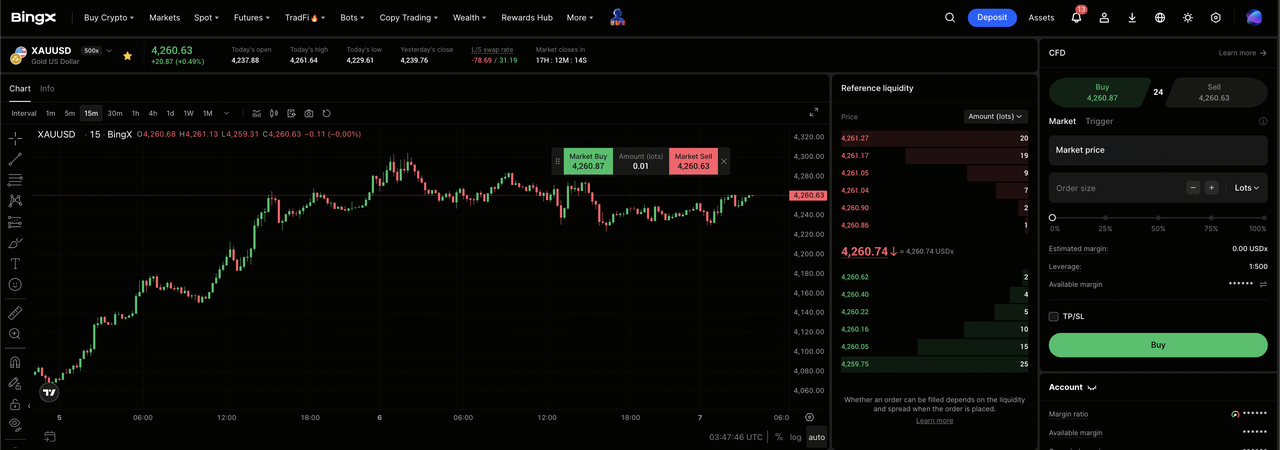
Step 1: Account setup and security. Sign up and log into your BingX account, complete the identity verification (KYC) required in your region, and enable two-factor authentication.
Step 2: Open the CFD trading page. Go to "TradFi" > "CFD" from the BingX navigation bar, then open the CFD trading page. If you have not used CFDs before, activate your dedicated CFD account before continuing.
Step 3: Fund your CFD account. Select "Transfer" and move USDT from another BingX account into the CFD account. The funds are converted to USDx at a 1:1 ratio and used as margin for CFD positions.
Step 4: Find Gold CFD. Search for "XAUUSD" or browse the "Metals" category to locate gold. Open the XAUUSD trading page to view the chart, current pricing, and order panel.
Step 5: Place your trade. Choose a "Market Order" for immediate execution or a "Trigger Order" to enter at a specified price. Enter your position size in lots, then select "Buy" to go long or "Sell" to go short.
Step 6: Manage and close the position. Monitor the trade under "Positions," including floating profit or loss and margin status. You can close the position manually or manage risk using take-profit, stop-loss, or trigger settings.
How to Trade Gold Perpetual Futures on BingX
Gold Perpetual Futures are traded through the BingX native contract interface, using your existing contract account funded with USDT.
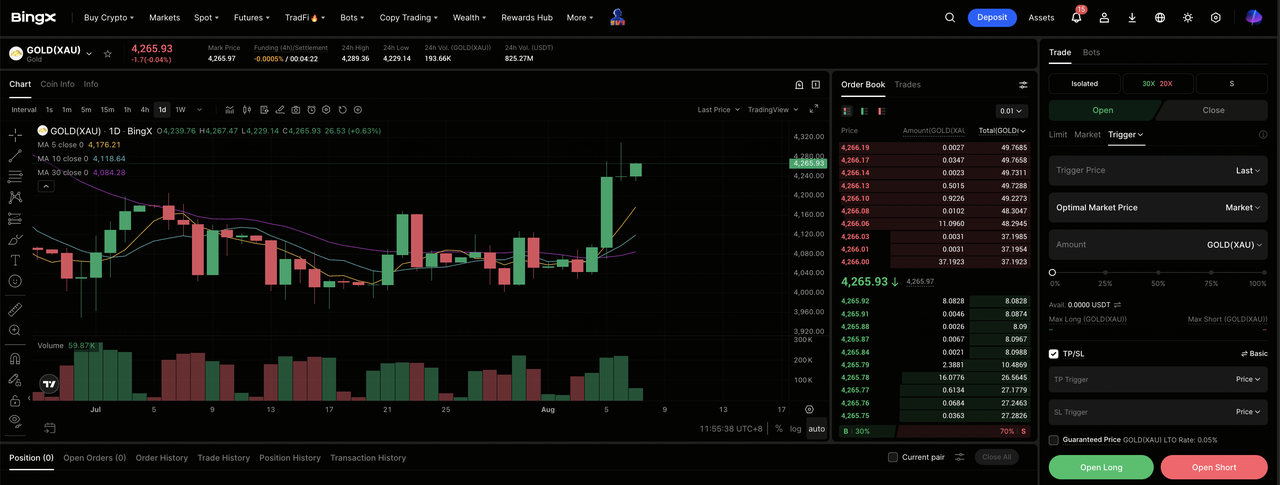
Step 1: Access BingX TradFi. Sign up and navigate to the specialized TradFi section on the main BingX exchange dashboard.
Step 2: Open the Gold Perpetual Futures market. Go to "TradFi" and open the perpetual futures section, then search for Gold (XAU) perpetual contract to access its trading page.
Step 3: Fund your contract account. Transfer USDT into your contract account if needed. Perpetual futures use USDT as margin and for settlement, so your account needs sufficient available balance before opening a position.
Step 4: Set leverage and margin mode. Choose the leverage level and margin mode for the trade before placing an order. Higher leverage reduces the margin required upfront but also increases liquidation risk.
Step 5: Place your trade. Choose a "Market Order" for immediate execution or a "Limit Order" at a specified price. Enter your position size, then select "Open Long" if you expect gold to rise or "Open Short" if you expect it to fall.
Step 6: Manage the position. Monitor your position, funding payments, margin, and liquidation price in the positions panel. You can close the trade manually or set Take-Profit and Stop-Loss (TP/SL) levels to manage risk.
How to Buy Tokenized Gold (XAUT) on BingX
Because Tokenized Gold is bought and held like a digital asset rather than traded with leverage, there is no margin or liquidation price to manage.
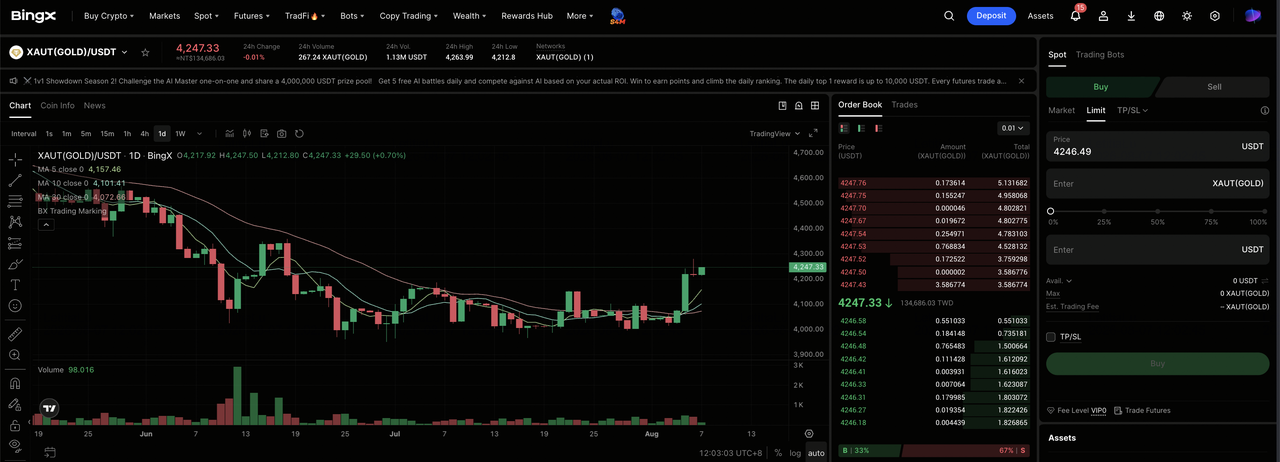
Step 1: Fund your BingX account. Deposit USDT or another supported asset into your BingX spot account. Where available, users can also use supported fiat on-ramp options.
Step 2: Find XAUT. Go to the "Spot" market and search for the XAUT/USDT trading pair.
Step 3: Enter the amount to buy. Choose how much USDT you want to spend or enter the quantity of XAUT you want to purchase.
Step 4: Place your order. Use a "Market Order" to buy immediately at the available market price, or a "Limit Order" to set the price at which you want the trade to execute, then confirm the order.
Step 5: Hold or sell your XAUT. Once the order is completed, the XAUT balance appears in your account. You can continue holding it for gold exposure or sell it later through the Spot market or Convert function.
Gold Trading Costs Explained: Swap Fees, Funding Rates, and Trading Fees
Holding costs are one of the clearest differences between Gold CFDs, Gold Perpetual Futures, and Tokenized Gold. CFDs and perpetual futures can generate recurring costs when positions remain open, while XAUT mainly incurs costs when entering or exiting a trade. Leverage also makes CFDs and perpetual futures more sensitive to adverse price moves and introduces liquidation risk.
|
Factor |
Gold CFD |
Gold Perpetual Future (XAU) |
Tokenized Gold (XAUT) |
|
Main cost |
Spread/commission + swap fee |
Trading fee + funding payment |
Trading fee + spread |
|
BingX fee |
1. Zero-commission mode: cost built into spread 2. low-spread mode: tighter spread + commission |
1. Standard perpetual fee schedule applies 2. VIP users may receive lower rates |
1. Spot trading fee applies 2. VIP users may receive lower rates |
|
Recurring cost |
Swap when held overnight |
Funding at scheduled intervals |
None |
|
Leverage |
Yes |
Yes |
No by default |
|
Liquidation risk |
Yes |
Yes |
No leverage-related liquidation |
|
Main risk |
Leverage and financing costs |
Leverage and funding costs |
Issuer, custody, and liquidity risk |
|
Better suited for |
Active trading |
Active leveraged trading |
Longer-term holding |
- Gold CFD Main Cost: Swap Fee. Gold CFDs use margin, so part of the position is effectively financed rather than paid in full upfront. If the trade stays open overnight, that financing cost is reflected in the swap rate. Long and short swap rates can differ depending on financing conditions, market carry, and liquidity-provider pricing. On BingX, the default zero-commission mode includes the trading cost in the spread, while the ultra-low-spread mode uses tighter spreads plus a commission. Overnight positions may also incur swap fees, with current rates shown in the contract details.
- Gold Perpetual Futures Main Cost: Funding Payment. Perpetual futures have no expiry date, so funding rate is used to keep the contract price close to spot gold. When the perpetual trades above spot, funding is typically positive and longs pay shorts; when it trades below spot, funding can turn negative and shorts pay longs. On BingX, the standard perpetual futures trading fee is 0.02% for maker orders and 0.05% for taker orders, with lower rates available for eligible VIP tiers. Funding is separate from the trading fee and is exchanged directly between long and short traders.
- Tokenized Gold (XAUT) Main Cost: Trading Fee and Spread. XAUT is bought and held as an asset, so there is no recurring financing cost simply for keeping the position open. Traders mainly pay when buying or selling through the trading fee and the bid-ask spread, which is the difference between the available buy and sell prices. On BingX Spot, XAUT/USDT currently carries a 0.1% trading fee, with no recurring swap or funding payment for simply holding XAUT.
Risks and Considerations Before Trading Gold With Different Financial Products
The risks of trading gold depend heavily on the product you use. Gold CFDs and Gold Perpetual Futures add leverage and financing costs, while Tokenized Gold (XAUT) removes liquidation risk but introduces issuer, custody, and liquidity considerations.
1. Gold CFDs: Watch Leverage, Swap Fees, and Market Hours
Gold CFDs allow traders to control a larger position with a smaller amount of margin, which magnifies both gains and losses. Positions can be liquidated if margin falls too low, and swap fees can accumulate when trades are held across daily settlement. Gold CFDs also follow the underlying gold market rather than trading continuously through weekends, so gaps can occur when the market reopens.
2. Gold Perpetual Futures: Watch Funding Rates and Liquidation Risk
Gold Perpetual Futures also use leverage, so sharp price moves can quickly reduce available margin and trigger liquidation. Funding rates can become an additional cost when a position is held across multiple funding intervals, especially when market positioning becomes heavily skewed toward longs or shorts. Traders should also monitor leverage and position size closely during periods of high volatility.
Read More: How to Calculate Futures Trading Costs: Decoding Opening Fees, Funding Rates and Slippage on BingX
3. Tokenized Gold (XAUT): Watch Issuer, Custody, and Liquidity Risk
XAUT does not carry leverage-related liquidation or recurring funding costs when held without borrowing. Its main risks come from relying on the issuer and custodian to maintain the underlying gold reserves, as well as liquidity conditions when buying or selling the token. Traders should also understand the issuer’s redemption terms and any requirements attached to converting XAUT into physical gold.
Final Thoughts: Which Gold Product Is Right for You?
Gold CFDs, Gold Perpetual Futures, and Tokenized Gold all provide exposure to gold, but they answer different needs. Gold CFDs and Gold Perpetual Futures are for traders who want to trade gold's price movements with leverage, with the choice between them coming down to whether the MetaTrader 5 toolset and traditional market hours of a CFD, or the native interface and around-the-clock access of a perpetual, fit better. Tokenized Gold is for traders who want to own gold in tokenized form and hold it over time without leverage.
Because both derivatives use leverage, small market moves can cause significant losses or trigger liquidation. Traders should understand the fees, margin rules, and trading hours of each product, size positions carefully, and trade only with funds they can afford to lose. Used deliberately, the three products can play complementary roles, with the derivatives for shorter-term trading and hedging and Tokenized Gold for holding.
Related Reading
- What Is BingX CFD and How to Trade CFD on BingX? A Beginner's Guide (2026)
- How to Trade Crude Oil CFDs on BingX: WTI, Brent and Oil Market Trading Guide (2026)
- How to Trade Index CFDs on BingX: S&P 500, Nasdaq 100, Nikkei 225, and More (2026)
- Bitcoin vs. Gold: What’s a Better Investment in 2026?
- Is Gold a Good Investment in 2026? Risks & Returns Explained
- Top Ways to Invest in Gold in 2026: Physical Gold vs. ETFs vs. Futures vs. Tokenized Gold?
- How to Trade Commodities With Crypto in 2026 as Oil, Gold, Silver, and TradFi Go On-Chain
FAQs About Gold CFDs, Gold Perpetual Futures, and Tokenized Gold
1. Do Gold CFDs and Gold Perpetual Futures track the same gold price?
They both provide exposure to gold, but their pricing mechanisms differ. Gold CFDs typically track XAUUSD spot gold, while Gold Perpetual Futures use a perpetual contract linked to a gold reference price. Their prices usually move closely together, although spreads, funding, liquidity, and contract pricing can create small differences.
2. Can I lose more than I invest with Tokenized Gold?
When XAUT is bought without leverage, losses are limited to the value of the tokens held and there is no leverage-related liquidation. Its price can still fall with gold, and holders also face issuer, custody, and liquidity risks. Gold CFDs and Gold Perpetual Futures use leverage and therefore carry liquidation risk.
3. Which gold product is cheaper to hold long term?
Tokenized Gold is generally more suitable for longer holding periods because there is no recurring swap or funding payment simply for holding XAUT. Gold CFDs can incur swap fees when positions remain open overnight, while Gold Perpetual Futures may incur funding payments at scheduled intervals.
4. Can I short gold with these products?
Gold CFDs and Gold Perpetual Futures support both long and short positions, allowing traders to trade falling gold prices or hedge other exposure. XAUT is primarily designed for holding gold exposure, so buying the token itself does not provide a short position.
5. Which gold product is more suitable for beginners?
For users who simply want gold exposure without managing leverage or liquidation risk, Tokenized Gold may be easier to understand. Traders considering Gold CFDs or Gold Perpetual Futures should first understand margin, leverage, swap or funding costs, and liquidation before opening a position.
