


Cerebras Systems (CBRS) builds wafer-scale processors, AI systems and cloud services for training and inference. Its Wafer Scale Engine places compute, memory and communication resources on one very large chip, reducing the networking overhead found in conventional multi-GPU clusters. Hardware remains part of the model, while cloud inference is becoming more important to long-term growth. This transition broadens Cerebras' role in AI infrastructure, though it also leaves the stock sensitive to customer concentration, data-center deployment and profitability.
The latest quarter showed both sides of that transition. Cerebras Systems Q2 2026 GAAP revenue reached $180.1 million, up 74% year over year, while core revenue increased 103% to $209.9 million and GAAP cloud and other services revenue rose 281% to $126.0 million. Core gross margin improved to 40.6%, yet the company recorded a $450.5 million GAAP net loss and guided to only $214 million to $216 million of Q3 core revenue.
The CBRS stock forecast for 2026 now centers on two competing views:
- The fast-inference and capacity case: a $25.4 billion remaining-performance-obligation balance, more than 600 megawatts of live or contracted capacity and partnerships with OpenAI, AWS and AMD could support a multi-year cloud expansion.
- The concentration and profitability case: customer dependence, heavy infrastructure commitments and a wide gap between GAAP and core results could keep earnings below the level required for a durable valuation recovery.
This guide breaks down the CBRS stock forecast, 2026 price scenarios, key risks and analyst outlooks, drawing on Cerebras Systems' August 12 Q2 2026 earnings release, quarterly filing and market data through September 11, plus how to trade CBRS stock futures on BingX TradFi with USDT collateral.
Top 5 Things for Cerebras Systems Investors to Know in September 2026
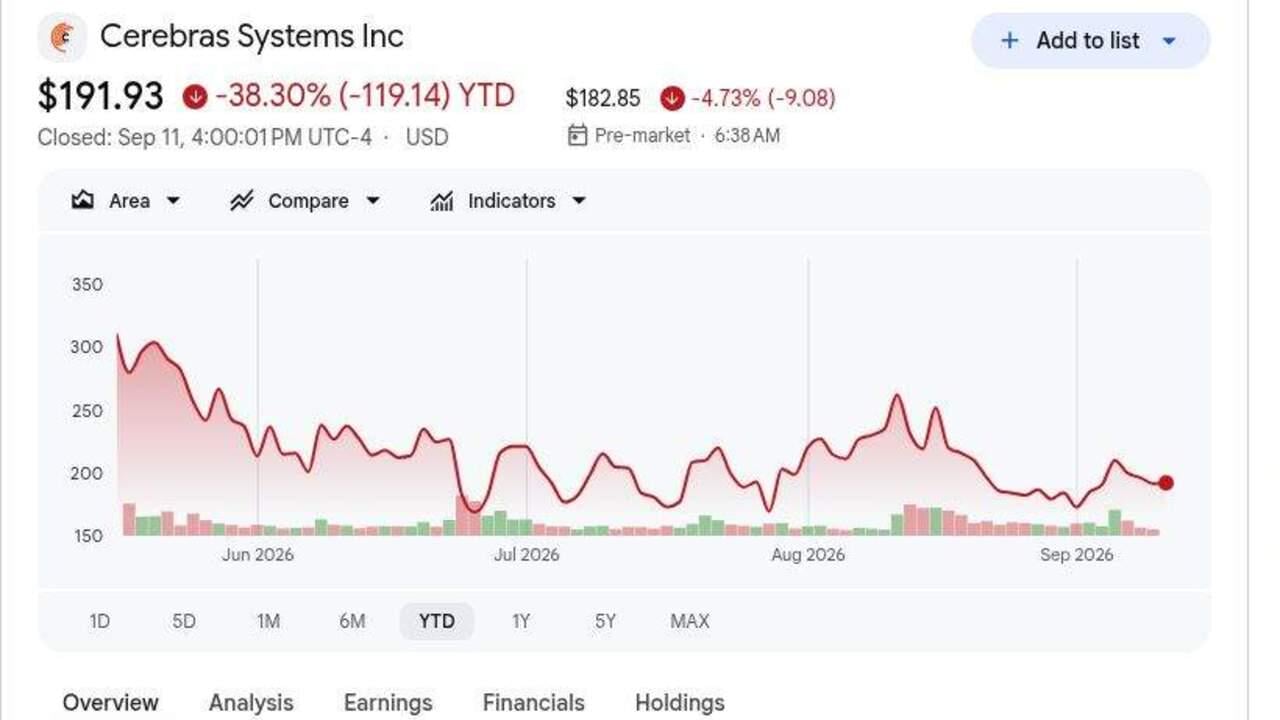
- CBRS closed at $191.93 on September 11 and was down 38.30% YTD: Shares finished only $6.93 above the $185 IPO price after opening at $350 and reaching $385 on debut. The reversal shows how quickly valuation can compress when strong AI growth meets high expectations.
- Q2 GAAP revenue reached $180.1 million, up 74%: The result missed the $194.0 million consensus by about $13.9 million, while core revenue of $209.9 million beat the roughly $191 million estimate. The gap makes reported versus core performance important to valuation.
- GAAP cloud and services revenue rose 281% to $126.0 million: Core cloud revenue increased 287% to $127.7 million, compared with $54.1 million of hardware revenue. The mix shift supports a more recurring business model, though capacity and data-center costs still matter.
- Remaining performance obligations reached $25.4 billion: The balance increased from $24.6 billion at the end of 2025 and includes a large multi-year OpenAI commitment. Deployment schedules and capacity availability will determine how quickly that backlog converts into revenue and cash.
- Capacity under contract exceeded 600 megawatts: Cerebras expects manufacturing capacity to increase more than tenfold in 2026 through Flex, Sanmina and Rocket EMS, with TSMC wafer supply secured. The opportunity is large, though utilization and margins still need to justify the investment.
What Is Cerebras Systems (CBRS)?
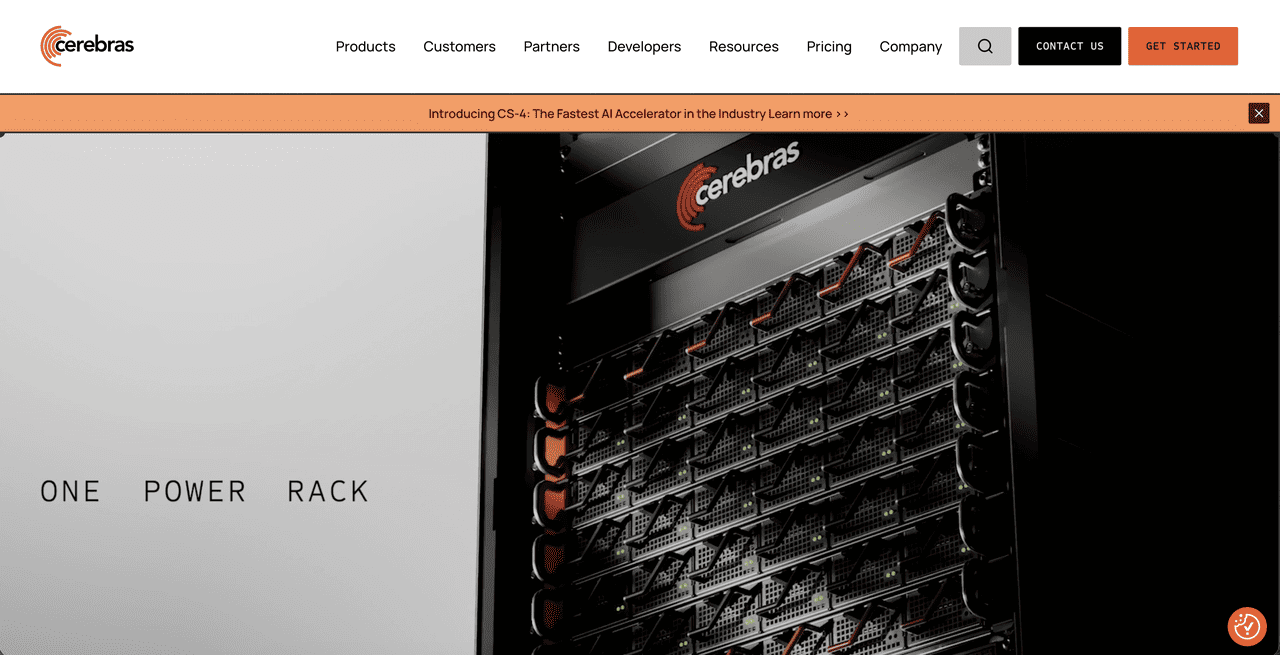
Cerebras Systems is an AI infrastructure company that designs processors, complete computer systems, software and cloud services. Its Wafer Scale Engine uses an entire silicon wafer as one processor, combining dense compute cores, on-chip SRAM and high-bandwidth communication to reduce the interconnect bottlenecks of distributed GPU clusters. Customers can buy CS systems for on-premises use or access Cerebras compute through training and inference cloud APIs. Revenue therefore comes from hardware, cloud capacity and related services, with inference becoming the main growth engine.
The long-term strategy centers on scaling fast inference across owned and partner infrastructure. OpenAI selected Cerebras for a multi-year capacity program and used its systems for GPT-5.6 Sol at 750 tokens per second. TSMC manufactures Cerebras' wafer-scale processors, giving the company access to advanced semiconductor production as it expands system and cloud capacity. Cerebras is also developing disaggregated inference with AMD for production in Q4 2026 and plans to extend that architecture to Amazon Bedrock through AWS in early 2027. Named users and partners include CrowdStrike, Cognition, Lovable, Block, Figma, AlphaSense and GSK, giving the platform exposure across coding, security, finance and life sciences.
Read More: Top AI Compute and GPU Stocks to Buy in 2026: The Shift to Inference and Custom Silicon
Cerebras Systems (CBRS) Q2 2026 Earnings Overview: Cloud Growth, Margin Progress and Raised Guidance
Cerebras reported $180.1 million of Q2 GAAP revenue versus the $194.0 million consensus, while core revenue of $209.9 million exceeded the roughly $191 million estimate and grew 103% year over year. The adjusted loss of $0.05 per share was narrower than the $0.17 loss expected, GAAP cloud revenue rose 281% to $126.0 million and core gross margin improved about 940 basis points to 40.6%. Management raised full-year core revenue guidance to $880 million to $890 million, though a $450.5 million GAAP net loss and modest Q3 sequential growth kept profitability in focus.
|
Financial Metric |
Guidance / Consensus |
Reported / Actual |
Surprise |
|
Q2 2026 GAAP revenue |
$194.0M consensus |
$180.1M |
Missed. About $13.9M below consensus; up 74% YoY. |
|
Q2 2026 core revenue |
$191.0M consensus |
$209.9M |
Beat. About $18.9M above consensus; up 103% YoY. |
|
Q2 adjusted loss per share |
$0.17 loss consensus |
$0.05 loss |
Beat. Loss was $0.12 narrower than expected. |
|
Q2 GAAP net loss |
$309.5M net income in Q2 2025 |
$450.5M loss |
Reversed. IPO-related stock compensation widened the loss. |
|
Q2 GAAP cloud and services revenue |
$33.0M in Q2 2025 |
$126.0M |
Accelerated. Revenue increased 281% YoY. |
|
Q2 core gross margin |
31.2% in Q2 2025 |
40.60% |
Expanded. Improved about 940 basis points YoY. |
|
Remaining performance obligations |
$24.6B at year-end 2025 |
$25.4B |
Increased. Multi-year contracted demand expanded by about $0.8B. |
|
Q3 2026 core revenue outlook |
Q2 core revenue of $209.9M |
$214M-$216M |
Higher. Implies only about 2%-3% sequential growth. |
|
FY2026 core revenue outlook |
Prior $855M-$865M |
$880M-$890M |
Raised. Midpoint increased by $25M. |
- GAAP revenue grew 74% to USD 180.1 million but missed consensus by USD 13.9 million: The result confirms rapid growth, though pass-through items and warrant amortization created a wide gap versus USD 209.9 million of core revenue. Both measures matter when judging growth and shareholder economics.
- The adjusted loss of USD 0.05 per share beat by USD 0.12: Core operating margin improved about 2,600 basis points year over year to negative 16%. Operating leverage is improving, though the business still needs more growth and cost discipline to reach sustainable earnings.
- Cloud revenue of USD 126.0 million increased 281%: Cloud and services generated about 70% of GAAP revenue, while hardware fell to USD 54.1 million from USD 70.3 million. The mix shift improves recurring potential but raises the importance of data-center utilization and power costs.
- Core gross margin improved 940 basis points to 40.6%: Management said temporary system rentals reduced margin by about 500 basis points. New capacity could ease that pressure, making margin recovery a key test of infrastructure efficiency.
- Full-year core revenue guidance rose to USD 880 million to USD 890 million: The USD 885 million midpoint is USD 25 million above the prior midpoint, while Q3 guidance of USD 214 million to USD 216 million implies only 2% to 3% sequential growth. A stronger Q4 ramp is still needed to reach the annual target.
Cerebras Systems (CBRS) 2026 Investment Outlook: $330 Bull Case vs. $150 Bear Case
The investment debate is whether Cerebras can convert fast-inference demand and $25.4 billion of obligations into profitable cloud revenue quickly enough to justify a premium growth multiple.
The Bull Case: Strong AI Inference Demand Pushes CBRS Toward $330
The Bull Case assumes OpenAI deployments, AWS distribution and AMD inference partnerships drive higher utilization across more than 600 megawatts of live or contracted capacity. Cloud revenue keeps growing quickly, manufacturing output rises more than tenfold and core gross margin improves from Q2's 40.6% as temporary rental costs fade.
A move toward $330 would require Cerebras to reach the USD 880 million to USD 890 million annual target without another margin setback, followed by credible progress toward management's plan to more than triple revenue in 2027. Rising estimates, a broader customer mix and better operating leverage would strengthen the case.
The Base Case: Steady AI Demand Keeps CBRS Between $240 and $290
The Base Case assumes inference demand remains strong and contracted capacity continues growing, while investors wait for proof that new data centers can be financed and filled efficiently. OpenAI remains a major customer, though concentration and the gap between GAAP and core results limit the valuation.
CBRS could trade mainly between $240 and $290 under these conditions. Core revenue near the USD 885 million annual midpoint, remaining performance obligations above USD 25 billion and improving gross margin would support the range. Weak utilization or slower 2027 growth would cap the upper end.
The Bear Case: Higher Costs and Customer Concentration Pull CBRS Toward $150
The Bear Case assumes capacity comes online more slowly or at weaker utilization, leaving Cerebras with infrastructure costs before enough revenue arrives. A delay or renegotiation by OpenAI or another major customer would weaken backlog conversion and cash flow.
A move toward $150 would become more likely if core revenue misses the USD 880 million guidance floor, core gross margin falls below 38% or remaining performance obligations decline materially. Persistent losses and additional share supply could add further pressure.
CBRS Stock Price Forecasts for 2026 By Wall Street Analysts
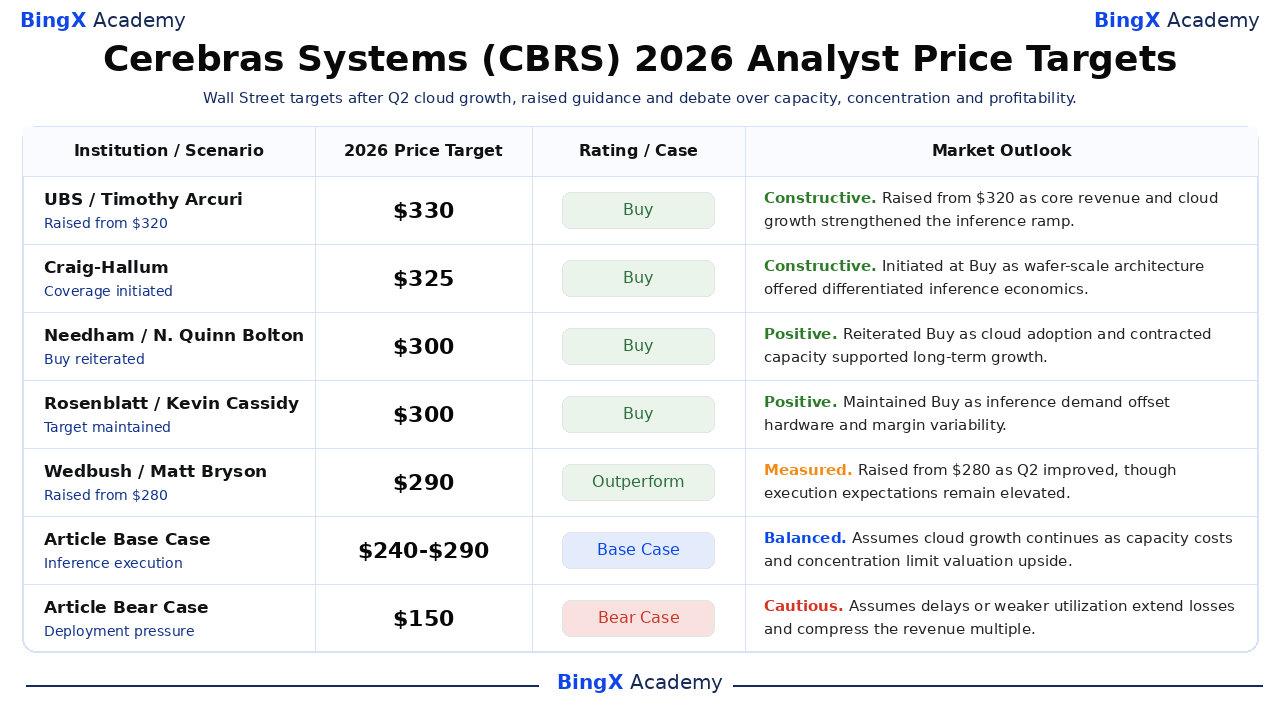
These five dated analyst actions range from $290 to $330 and reflect constructive views on differentiated inference performance, cloud adoption and contracted capacity. The narrow range also shows that Street models share similar growth assumptions. They are third-party reference points, not price promises. The Base and Bear rows are BingX Academy editorial scenarios.
|
Institution / Scenario |
2026 Price Target |
Rating / Case |
Market Outlook |
|
UBS / Timothy Arcuri |
$330 |
Buy |
Constructive. August 13: raised from $320 after core revenue, cloud growth and guidance supported the inference ramp. |
|
Craig-Hallum / Richard Shannon |
$325 |
Buy |
Constructive. June 9: initiated coverage on differentiated wafer-scale architecture and fast-inference demand. |
|
Needham / N. Quinn Bolton |
$300 |
Buy |
Positive. August 19: reiterated Buy as cloud adoption and contracted capacity supported long-term growth. |
|
Rosenblatt / Kevin Cassidy |
$300 |
Buy |
Positive. August 19: maintained Buy as inference demand offset hardware and margin variability. |
|
Wedbush / Matt Bryson |
$290 |
Outperform |
Measured. August 13: raised from $280 as Q2 improved, though execution expectations remained elevated. |
|
Article Base Case |
$240-$290 |
Base Case |
Balanced. Assumes cloud growth continues as capacity costs and concentration limit valuation upside. |
|
Article Bear Case |
$150 |
Bear Case |
Cautious. Assumes delays or weaker utilization extend losses and compress the revenue multiple. |
How to Trade Cerebras Systems (CBRS) Stock on BingX
Trade Cerebras Systems' inference-growth, capacity-deployment and margin outlook using BingX TradFi and BingX AI tools. Because CBRS can react sharply to customer announcements, guidance and post-IPO share supply, traders should define both the catalyst and risk limits before entering a position.
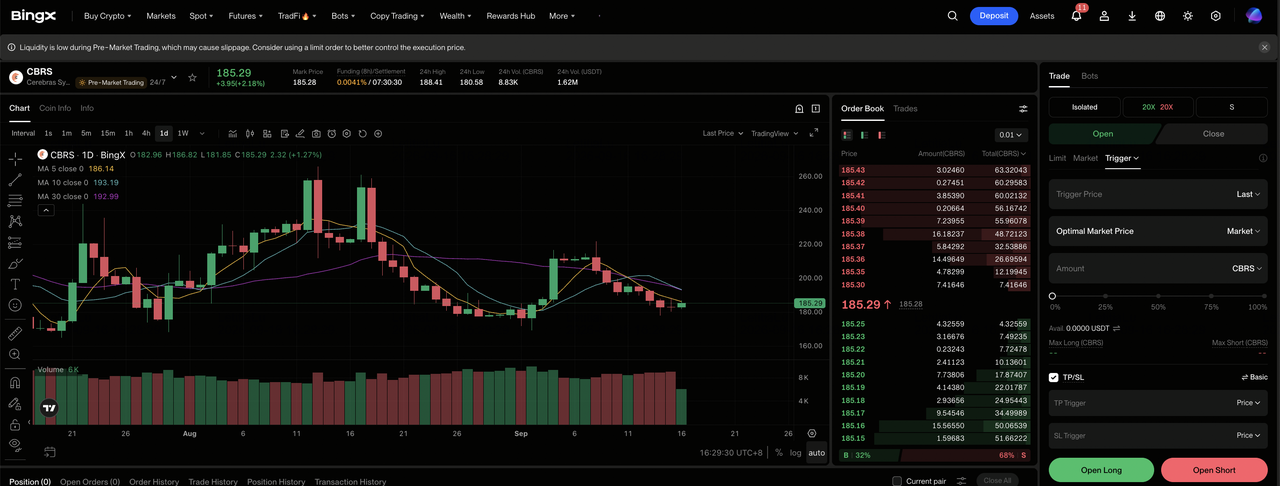
Step 1: Access BingX TradFi. Sign up and navigate to the specialized TradFi section on the BingX exchange dashboard.
Step 2: Select Cerebras Systems (CBRS). Search for and select the CBRS-USDT perpetual futures contract.
Step 3: Choose your direction. Select Open Long if inference demand converts into higher utilization and margins. Select Open Short if capacity delays, customer concentration or losses weaken per-share economics.
Step 4: Select leverage and margin mode. Choose Isolated or Cross-Margin based on your risk tolerance. The 38.30% YTD decline shows why conservative leverage and clear position sizing are important.
Step 5: Execute strict risk protocols. Set Take-Profit and Stop-Loss (TP/SL) levels before or immediately after entering the trade. CBRS can react quickly to deployments, customer deals, guidance, margins, analyst actions and share unlocks.
Top 5 Risks to Watch for Cerebras Systems Investors in 2026
Cerebras' valuation depends on customer demand, capacity expansion, accounting and competition. These risks can affect revenue conversion, cash needs and per-share value.
- Customer concentration could delay backlog conversion: Remaining performance obligations reached USD 25.4 billion, with OpenAI representing a large share of contracted demand. Delays or renegotiations could push revenue into later periods and reduce the value assigned to the backlog.
- Capacity expansion requires heavy upfront investment: Cerebras has more than 600 megawatts of live or contracted capacity. If utilization ramps slowly, depreciation and operating costs could rise before enough gross profit arrives.
- GAAP and core revenue can differ significantly: Q2 GAAP revenue was USD 180.1 million versus USD 209.9 million of core revenue. Warrant amortization and pass-through adjustments can make headline growth harder to compare across periods.
- NVIDIA and custom chips could pressure demand: Cerebras offers differentiated wafer-scale inference, but customers can still choose GPUs or internal accelerators. Better rival economics or performance could reduce utilization and pricing power.
- Large losses keep dilution risk relevant: Q2 GAAP loss reached USD 450.5 million, partly due to IPO-related compensation. Continued losses, future equity issuance or post-IPO share unlocks could pressure per-share value and increase volatility.
Final Thoughts: Should You Invest in Cerebras Systems in 2026?
Cerebras has established a measurable growth case. Core revenue doubled to $209.9 million, cloud revenue nearly quadrupled and obligations reached $25.4 billion. Partnerships with OpenAI, AWS and AMD reinforce the technology's commercial relevance, while more than 600 megawatts of capacity creates room for larger deployments. The unresolved question is whether that infrastructure can produce durable margins.
The Bull Case requires contracted demand to become profitable revenue, supporting $330. The Bear Case reflects deployment delays, concentration and persistent losses that could pull CBRS toward $150. Conservative traders may monitor Q3 core revenue against the $214 million-$216 million range, core gross margin against 38%-40% and evidence that customer mix is broadening.
Risk Reminder: Trading and investing in equities like CBRS involves a high risk of capital loss. Customer concentration, capacity delays, accounting adjustments, competition, share supply and leveraged trading can produce rapid losses. Conduct independent research before allocating capital.
Related Reading
- Top 10 AI Infrastructure Stocks to Buy in 2026: Chip Manufacturing and Design Leaders
- Top AI Cloud Infrastructure Stocks to Buy in 2026 Amid Hyperscaler Capex and the Neocloud Boom
- Top AI Server Stocks to Buy in 2026: Rack-Scale Systems, GPU Servers, and AI Servers Infrastructure
- What Is OpenAI Pre-IPO and How to Trade It on BingX?
- AMD Price Prediction 2026: Can AI Growth Push AMD Toward $700?
- TSMC (TSM) Price Prediction 2026: Can Record AI Demand Lift TSM Stock to $527?
