Trading cryptocurrencies in Brazil has become significantly more complex in recent years. With more than 10 million Brazilians investing in digital assets, according to Brazil’s Federal Revenue Service data from 2024, the number of platforms has grown alongside demand—and making the wrong choice can be costly: hidden fees, insufficient liquidity during critical moments, and lack of Portuguese-language support are daily issues affecting traders of all profiles.
The difference between a good exchange and the right exchange for you lies in the details: if you trade spot with smaller ticket sizes, transaction costs matter more than available leverage. If you are day trading futures contracts, order book depth and execution speed are what separate profit from loss.
Quick Answer: The best cryptocurrency exchanges for Brazilians are those that combine competitive fees, BRL support, liquidity in popular trading pairs, and tools for both spot and futures trading. For the Brazilian retail trader, BingX stands out for its accessible interface, futures trading with integrated copy trading, and localized support.
What Is a Cryptocurrency Exchange and Why Your Choice Matters
A cryptocurrency exchange is a platform that allows users to buy, sell, and trade digital assets. They operate similarly to traditional brokerage firms, but with some important differences: they run 24 hours a day, 7 days a week, and most offer both spot markets and futures contracts with leverage.
In the spot market, you buy and sell the actual asset. If you buy 0.1 BTC, that Bitcoin is held in custody on the platform (or you can transfer it to your own private wallet). In futures, you trade contracts that track the asset’s price without necessarily owning it. This allows you to short the market and increase exposure with leverage, but it also proportionally amplifies the risks.
For Brazilian users, choosing an exchange requires an extra layer of analysis: most global platforms operate in U.S. dollars, so BRL deposits and withdrawals depend on conversion or local partners. Exchanges that accept PIX directly through the P2P market reduce friction in the process, but not all offer this feature with the same level of efficiency.
How to Evaluate an Exchange: The Criteria That Actually Matter
Before getting to the list, it is worth understanding what separates an average exchange from a truly good one. There are five main criteria:
Trading fees: the most common model is maker/taker, where users who add liquidity to the order book (makers) pay less than those who remove liquidity (takers). On tier 0 platforms, fees typically range between 0.02% and 0.10% for makers. The difference may seem small, but on a monthly trading volume of R$100,000, a 0.05% reduction represents R$600 annually directly in your pocket.
Liquidity and market depth: high liquidity means tighter spreads between bid and ask prices, and less slippage on large orders. Exchanges with low volume may have an attractive interface, but they can be expensive when it comes to execution.
BRL support and payment methods: PIX, TED, bank transfers in BRL, or reliable P2P partners make a real difference in daily operations. Converting dollars every time you want to deposit or withdraw adds both cost and time.
Security and reputation: exchanges that have suffered hacks, insolvencies, or regulatory restrictions represent real risks. The collapse of FTX in 2022 wiped out billions of dollars from users worldwide and remains the clearest reminder that custody and transparency matter. Platforms with audited Proof of Reserves provide a verifiable layer of trust.
Tools for your trading profile: a beginner trader does not need 500 available pairs. A professional scalper cannot rely on an interface that freezes during periods of high volatility.
The Best Cryptocurrency Exchanges for Brazilians in 2026
BingX: The Most Complete Choice for the Brazilian Retail Trader
BingX has positioned itself in recent years as one of the most accessible exchanges for traders who want to start trading futures without giving up advanced features. The platform offers spot trading and perpetual futures with leverage of up to 150x on selected pairs, but the feature that resonates most with Brazilian users is its integrated copy trading.
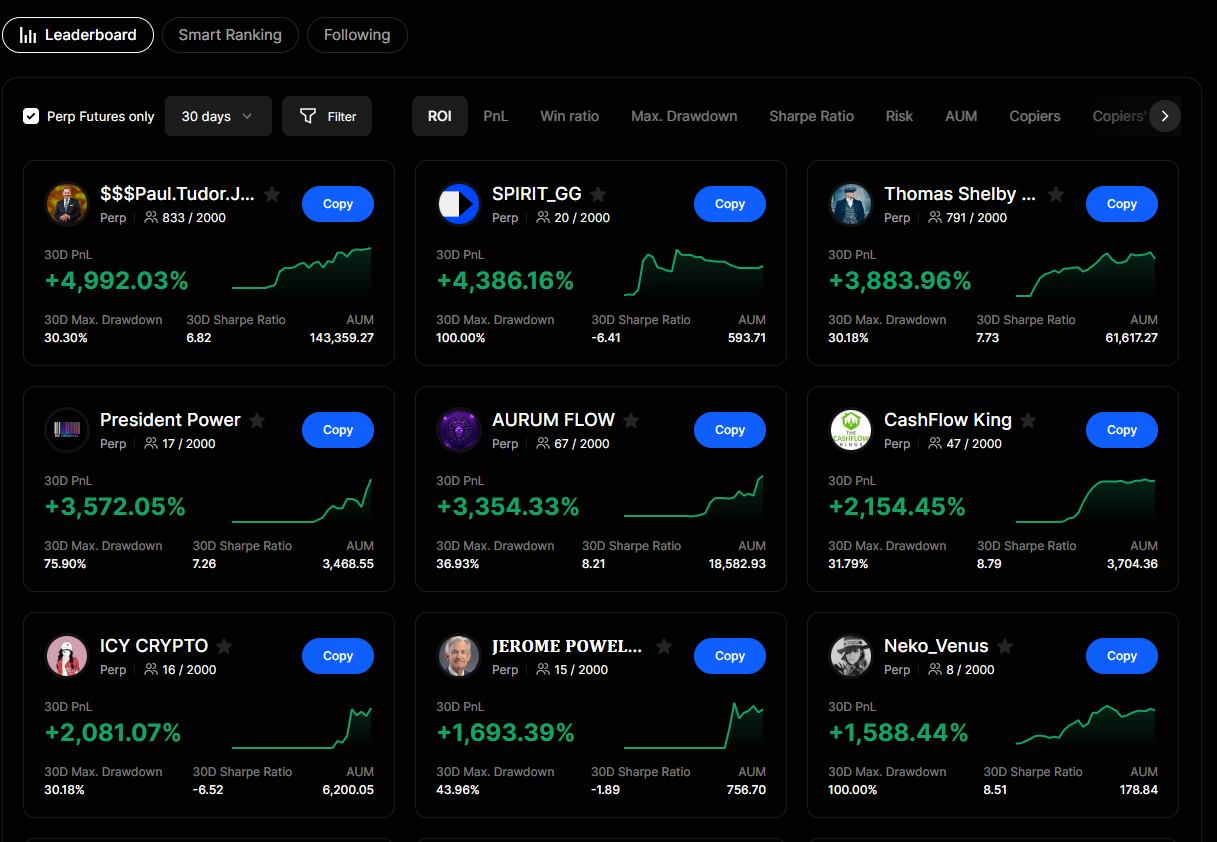
BingX Copy Trading / Social Trading
BingX copy trading allows beginner traders to automatically follow the positions of experienced traders registered on the platform, with full control over allocated capital and the ability to close positions at any time. This is not new in the market, but BingX was one of the first global exchanges to integrate it natively, without requiring third-party tools.
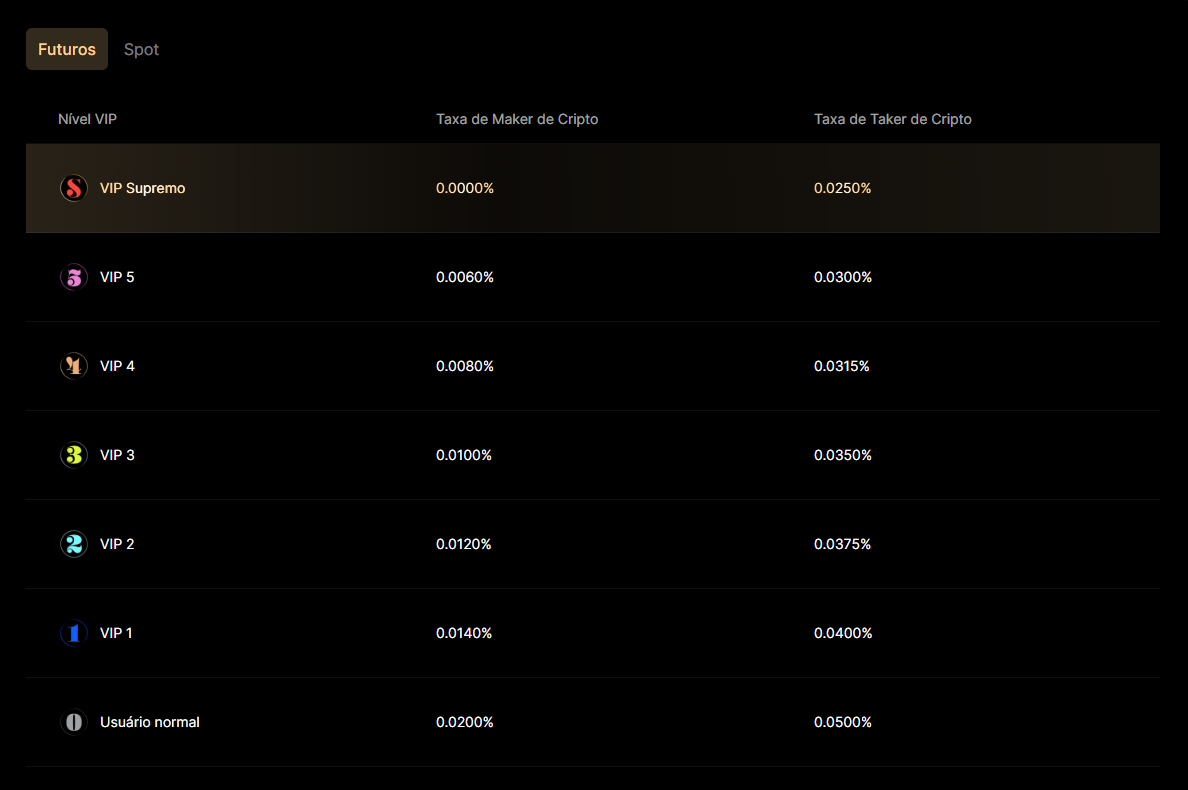
In terms of fees, BingX’s maker/taker structure starts at 0.045% for spot trading and can decrease as trading volume increases. Check the BingX fee guide to understand the VIP tier progression. For futures, fees start at 0.02% (maker) and 0.05% (taker), which are competitive with global standards.
The interface is available in Portuguese, customer support includes localized service, and the platform accepts BRL deposits via P2P, reducing friction for traders who prefer not to deal with manual FX conversion. The platform also offers automated trading bots for users who want to trade 24/7 without being constantly in front of the screen.
For traders focused on swing trading, those looking to explore futures with moderate leverage, or those who want to learn from other traders before trading independently, BingX is currently the most balanced option available for Brazilians.
Binance
For Brazilian traders, Binance offers P2P transactions in BRL with active sellers, enabling deposits and withdrawals without mandatory currency conversion. Spot trading fees start at 0.10% and decrease progressively with higher trading volume or by using BNB to pay fees, reaching as low as 0.075% for regular users.
The downside of Binance for many traders is the platform’s complexity. There are so many features, products, and options that the learning curve can be intimidating for beginners. In addition, customer support is not Binance’s strongest point, especially for basic-tier users.
Bybit
For Brazilian users, access is mainly through crypto deposits, as BRL support is less robust than on BingX or Binance. This makes Bybit more suitable for traders who already hold crypto on other platforms and want to transfer funds to trade futures with greater sophistication.
Coinbase
Coinbase is the best-known exchange among investors who prioritize security and simplicity above all else. Coinbase’s weak point is cost. Fees are significantly higher than the competitors mentioned above, especially for users trading smaller ticket sizes. For an investor who buys R$500 worth of Bitcoin once a month and does not need futures trading, Coinbase works well. For an active trader, however, the cost per trade quickly becomes unfeasible.
BRL support is limited, and direct deposits in Brazilian reais are not available with the same ease as on other platforms.
Other Options for Specific Trading Profiles
Gate.io: attracts traders looking for lower-cap altcoins that have not yet been listed on larger exchanges. Liquidity risk in less popular trading pairs is an important consideration.
Kraken: an option for traders handling larger volumes and prioritizing relationships with audited exchanges.
Spot vs. Futures: Which Market Makes More Sense for You?
Spot Market
In the spot market, you trade the actual asset. The process is simple: you buy BTC, and you receive BTC in your account. Risk is limited to the invested amount. There is no forced liquidation, no funding fee, and you can hold the position indefinitely.
The spot market is ideal for those building a long-term position (a strategy commonly known as holding), for beginners learning how the market works, or for traders who prefer to avoid the complexity of derivatives.
Futures Market
Futures allow you to trade with leverage, meaning you can control a larger position than the capital you actually have available. With 10x leverage and R$1,000, you control a R$10,000 position. If the asset rises 5%, the profit is R$500 on the original capital—50%. If it drops 10%, you lose your entire capital.
In addition, perpetual contracts include a funding fee, charged every 8 hours, which balances the difference between the contract price and the asset’s spot price. During highly bullish market conditions, traders holding long positions pay this fee to those holding short positions, and vice versa.
Futures are suitable for traders with experience in risk management, who trade with clearly defined stop losses and understand that leverage amplifies both gains and losses. Also explore BingX TradFi, which allows users to trade global indices and commodities using USDT as margin.
Comparison Table: Exchanges for the Brazilian Market
|
Exchange |
Spot Fees (Taker) |
Futures Fees (Taker) |
BRL Support |
Futures |
Copy Trading |
PT Interface |
|
BingX |
0.10% |
0.05% |
P2P |
Yes |
Yes (native) |
Yes |
|
Binance |
0.10% |
0.05% |
P2P |
Yes |
Yes |
Yes |
|
Bybit |
0.10% |
0.055% |
Limited |
Yes |
Yes |
Partial |
|
Coinbase |
0.60% |
No |
No |
No |
No |
Yes |
|
Kraken |
0.26% |
0.05% |
No |
Yes |
No |
No |
Fees are subject to change depending on each platform’s volume tier and promotional campaigns.
How to Calculate the Real Cost of Your Trades
Knowing the nominal fee is not enough. The real cost of a trade includes the trading fee plus the spread and, in the case of futures, the funding fee.
Trading cost formula:
Total cost = (Trading volume x Taker fee) + Spread
Practical example:
You trade R$5,000 in BTC/USDT with a 0.10% taker fee and an average spread of 0.05%:
- Trading fee: R$5,000 x 0.10% = R$5.00
- Spread impact: R$5,000 x 0.05% = R$2.50
- Total cost per trade: R$7.50
If you place 20 trades per month at this volume, your monthly cost is R$150. Reducing the taker fee from 0.10% to 0.05% would save R$75 per month, or R$900 per year, without changing anything else in your trading strategy.
For futures, add the funding fee:
Total cost = (Volume x Taker fee) + (Position size x Funding rate x Number of periods)
During heated market conditions, the funding rate can exceed the trading fee on positions held for many hours, especially when using high leverage.
Security: What to Check Before Depositing
The collapse of FTX in November 2022 resulted in more than US$8 billion in customer losses, according to data from the company’s bankruptcy proceedings. The key lesson: the fact that an exchange appears large and legitimate does not guarantee that funds are safe.
Before depositing on any platform, check:
Proof of reserves: reputable exchanges publish reserve audits proving that customer assets are actually held in custody. BingX publishes proofs of reserves periodically.
Incident history: research whether the exchange has suffered any major hacks or outages and how it responded to those events. How an exchange handles a problem is just as revealing as the fact that it occurred.
Regulation: in Brazil, exchanges operating as virtual asset service providers must register with the Central Bank, according to Law 14,478/2022. Checking whether the platform complies with this legislation is an important step.
Two-factor authentication: any exchange that does not offer 2FA via an authenticator app (not only via SMS) is already below the minimum acceptable security standard.
Cryptocurrency Taxation in Brazil: The Basics Every Trader Needs to Know
Since 2019, Brazil’s Federal Revenue Service has required the declaration of cryptocurrency gains. The main rules are:
Transactions with gains of up to R$35,000 per month are tax-exempt, provided they are not carried out on Brazilian exchanges (for foreign exchanges, the exemption applies). Above this amount, the tax rate is progressive, starting at 15% and reaching 22.5% for gains above R$5 million.
The taxpayer is responsible for payment through DARF, with the deadline being the last business day of the month following the transaction. Foreign exchanges do not withhold tax automatically.
Failure to report can result in tax audit scrutiny, fines, and interest. For traders with significant volume, consulting an accountant specialized in crypto assets is an investment that pays for itself.
FAQ: Frequently Asked Questions
1. What is the best exchange for beginners in Brazil?
For beginners, BingX offers the best balance between an accessible interface, Portuguese-language support, and educational resources. Binance is also a valid option due to its brand familiarity, but the number of features can confuse users who have never traded crypto before. Also see our guide on the best exchanges for beginners in 2026.
2. Is it safe to trade on foreign exchanges in Brazil?
Yes, as long as you choose platforms with a proven track record, published proof of reserves, and a strong market reputation. Brazilian laws allow users to trade on international exchanges, and taxation follows the same rules regardless of where the platform is registered.
3. Which exchange charges the lowest fees for futures?
Among the popular options in Brazil, BingX is among the most competitive for futures, with maker fees starting from 0.02%. The funding rate, which varies according to market conditions, can have a greater impact than the trading fee on long-duration positions. See how to trade on the BingX perpetual futures market.
4. Can I deposit Brazilian reais directly on international exchanges?
Most international exchanges do not accept direct BRL bank deposits. The most common alternative is P2P, where you buy crypto from another user using PIX or bank transfer. BingX and Binance both have active BRL P2P markets. Check the BingX PIX deposit tutorial to get started.
5. What is leverage and what is the risk for Brazilian traders?
Leverage is the ability to control a larger position than the capital you have available. With 10x leverage, R$1,000 controls R$10,000 in exposure. The risk is liquidation: if the asset moves against your position beyond a certain threshold, the platform automatically closes the position to prevent your balance from going negative. Trading with leverage without understanding risk management and stop-loss and take-profit orders is one of the most common and costly mistakes in the crypto market.
6. What is the difference between a centralized exchange (CEX) and a decentralized exchange (DEX)?
In a CEX, the platform controls the funds and executes orders through an internal system. You do not have access to the private keys of your assets while they are held on the platform. On a DEX, orders are executed by smart contracts on the blockchain, and you retain control of your keys at all times. CEXs offer greater speed, support, and ease of use for beginners. DEXs offer more autonomy and access to assets that have not yet reached centralized platforms.
7. Is KYC mandatory on exchanges?
Most exchanges require identity verification (KYC) to unlock withdrawals above certain limits or access all platform features. In Brazil, the 2023 regulatory framework reinforced this requirement. Exchanges offering full access without any verification should be treated with caution.
Key Takeaways
- Choosing the right exchange depends on the trader’s profile: beginners, swing traders, and futures day traders all have different needs
- BingX is the most balanced option for Brazilian retail traders, with native copy trading, a Portuguese-language interface, and BRL P2P support
- Fees matter more than they seem: the difference between a 0.10% and 0.05% taker fee can represent hundreds of reais per month for traders with meaningful volume
- Security comes before any other consideration: check proof of reserves, incident history, and regulatory compliance before depositing
- Crypto taxation in Brazil is the taxpayer’s responsibility: gains above R$35,000 per month require tax payment via DARF. Use BingX’s trading report tools to simplify your annual tax declaration
