
As the global residential Internet of Things (IoT) landscape expands past tipping points, standard architectures have encountered a critical limitation. Today's smart home environments suffer from acute fragmentation, severe privacy exposures, and silent data monopolies. Centralized smart home applications act as closed digital silos, extracting user behavior patterns while requiring manual, fragile configuration routines to achieve basic multi-brand synchronization.
DataVLT reconfigures this paradigm by introducing an intelligent layer driven by the convergence of Web3 and Artificial Intelligence. Operating natively on the Optimism L2 network, DataVLT replaces the traditional centralized cloud server with a trustless distributed decision network. By deploying neural evolution algorithms at the edge, DataVLT allows cross-brand IoT hardware matrices to communicate securely, trade data assets, and adapt continuously to human behavioral habits without compromising private localized data structures.
This article explores how DataVLT (DVLT) integrates Web3 and AI technologies to create a secure, self-optimizing IoT ecosystem, utilizing Decentralized Home IDs (DIDs) and neural evolution algorithms for autonomous device interoperability while explaining how to trade DVLT on BingX.
What Is DataVLT (DVLT)?
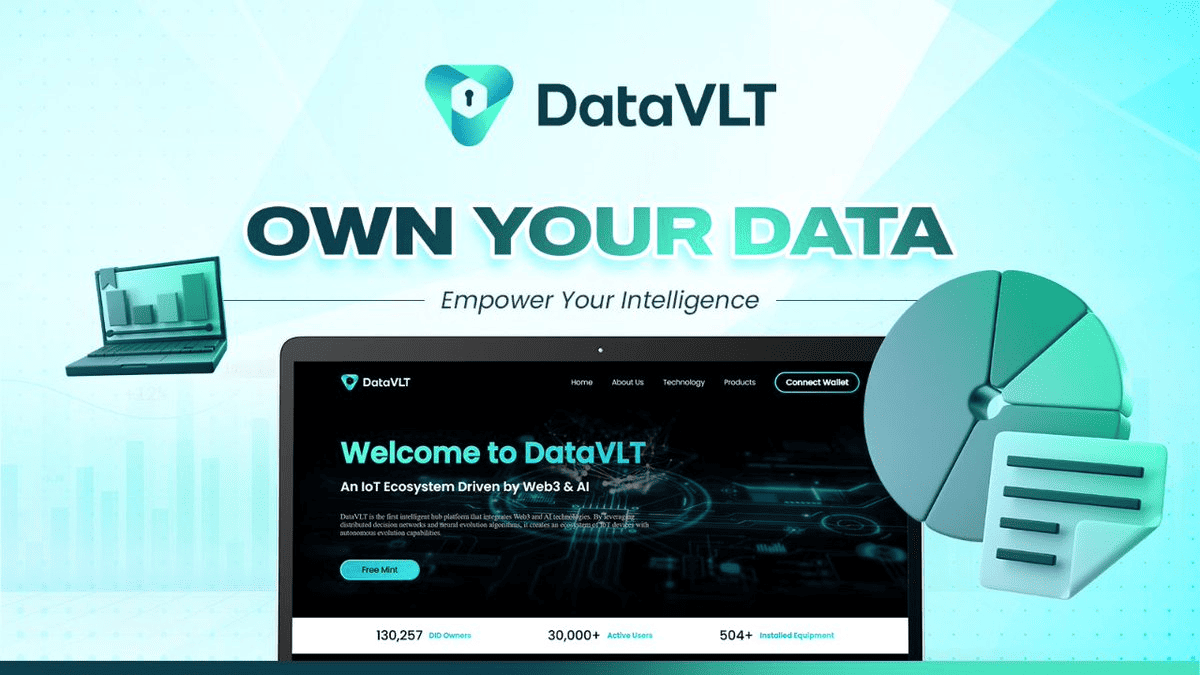
Source: DataVLT on X
DataVLT is a security-first Web3 and AI-integrated ecosystem engineered to build an autonomous, hyper-personalized infrastructure for residential and enterprise IoT spaces. At its core, the network resolves the three foundational dilemmas that inhibit modern smart device deployments:
- Ecosystem Fragmentation: While standard smart systems maintain a cross-brand compatibility rate below 35%, DataVLT leverages dynamic protocol translation engines to build seamless interoperability bridges.
- Rigid Interaction Silos: Traditional smart routines demand manual scenario orchestration. DataVLT applies distributed neural networks to evaluate environments and proactively execute device workflows.
- Data Sovereignty Infringement: Instead of channeling home activity logs to corporate databases, DataVLT wraps user profiles into programmable digital identifiers, giving individuals direct ownership and monetization rights.
How Does DataVLT Work?
The system operationalizes its intelligent framework through a multi-layered infrastructure consisting of decentralized nodes, zero-knowledge computation environments, and structural crypto-incentive loops.
1. Distributed Decision Networks and Neuroevolution
Unlike basic cloud automations, DataVLT runs an advanced AI architecture backed by neural evolution algorithms. The network continuously runs adaptive loops, evaluating real-time atmospheric, temporal, and user biometric markers. This mechanism ensures the local environment adapts dynamically, processing changes in climate and behavioral shifts within sub-second thresholds.
2. Decentralized Home ID (DID) and Tokenized Assets
The foundation of DataVLT’s security layer is the Decentralized Home ID (DID), constructed as a programmable NFT matching the ERC-723 standard. The Home DID assigns a unique, immutable digital cryptographic fingerprint to every home network environment, abstracting all sub-device metadata behind secure on-chain credentials.
This shifts privacy dynamics fundamentally: instead of exposing raw transaction or usage logs, the DID uses advanced zero-knowledge proofs (ZKP) to confirm data validity while keeping identity metrics invisible to public network nodes.
3. Privacy Framework and Secure Edge Analytics
DataVLT secures local data pipelines by combining federated learning and differential privacy protocols, setting a strong mathematical threshold for anonymization (ϵ=0.8). This architecture allows the platform to build an interactive digital twin of a residence, tracking over 300 daily telemetry events entirely inside a local privacy sandbox. AI models are trained across distinct edge nodes using federated learning frameworks; the central hub compiles model improvements without ever gaining visibility into raw personal records.
What Is DataVLT (DVLT) Tokenomics: Fueling Autonomous Spaces
The $DVLT token serves as the native utility, settlement, and governance fuel of the ecosystem, deployed on the Optimism network with a total max supply of 100,000,000,000 units.
DVLT Token Utility
- Staking Node Operations: To validate transactions and run edge protocol translation engines, node operators must maintain an active pledge of at least 50,000 $DVLT. Distributed rewards are balanced relative to total tokens locked.
- Data Marketplace Settlement: Corporate entities or AI labs acquiring datasets for model optimization settle data validation invoices directly using $DVLT.
- Ecosystem Governance: Token holders can lock $DVLT assets to accumulate voting power within the decentralized governance module, voting on network updates and standard index evaluations.
Data Assetization and Identity Rewards Matrix
DataVLT implements an automated incentive mechanism where users minting a Decentralized Home ID expend a baseline entry cost of 500 DVLT tokens. This activates a data ledger tracking behavioral contributions across distinct vertical pools, distributing rewards via an automated smart contract matrix:
|
Functional Module |
Technical Realization |
Entitlement System |
Incentive Model |
|
Identity Minting |
Programmable ERC-723 DID |
Cross-platform identity pass & data credentials |
Fixed activation cost / reward trigger |
|
Data Banking |
Distributed Storage + Value Engine |
Access right benefits & AI model training dividends |
0.5% - 3.0% daily variance reward |
|
Scenario Pools |
Smart Contract Automation |
Health tracking and environmental data index |
Quarterly Top 100 receive 200% bonus boost |
DataVLT vs. Traditional IoT Solutions: Key Differences
|
Feature |
DataVLT Ecosystem |
Legacy IoT Platforms |
Standard Smart Homes |
|
Primary Architecture |
Web3 + Distributed AI Hub |
Centralized Corporate Cloud |
Localized Manual Hubs |
|
Interoperability Rate |
98% (Multi-protocol Bridge) |
Proprietary Ecosystem Only |
Limited Standard Matrix |
|
Data Ownership |
Sovereign (ERC-723 DID NFT) |
Corporate Owned & Monetized |
Fragmented Across Vendors |
|
AI Adaptability |
Continuous Neuroevolution |
Static Scripted Routines |
None (Trigger-Based) |
|
Privacy Safeguards |
Federated Learning & ZKP |
Standard Transit Encryption |
Basic Local Sign-In Only |
Traditional smart home architectures remain constrained by an ecosystem compatibility rate below 35%, forcing users to manually configure cross-brand hardware and exposing behavioral telemetry within vulnerable corporate databases. DataVLT dismantles these silos by deploying a protocol conversion framework over the Optimism L2 network, reducing cross-protocol latency, such as between Matter, Thread, and Zigbee, to under 80 milliseconds. While legacy platforms rely on static, trigger-based scripts, DataVLT runs adaptive edge-based loops powered by neural evolution algorithms that update three times per day, achieving a 92% user scenario adaptation rate without routing raw personal records to centralized servers.
From a practical and economic standpoint, the platform shifts the industry paradigm from a corporate data monopoly to absolute spatial intelligence and user monetization. Instead of relinquishing data sovereignty, users mask their entire telemetry footprint behind a Decentralized Home ID (DID) matching the ERC-723 token standard. This enables a secure local privacy sandbox protected by strict differential privacy thresholds, allowing over 300 daily telemetry events to be tracked safely. Users can then selectively contribute this verified data to AI training marketplaces via ERC-1155 asset vouchers, earning automated daily yields ranging from 0.5% to 3.0% based on data quality multipliers.
How to Trade DataVLT (DVLT) on BingX
BingX offers a robust trading environment for the DataVLT ecosystem, integrating advanced institutional analytics to track network node staking flows and sentiment indicators with high precision.
Buy, Sell, or HODL DVLT on the Spot Market
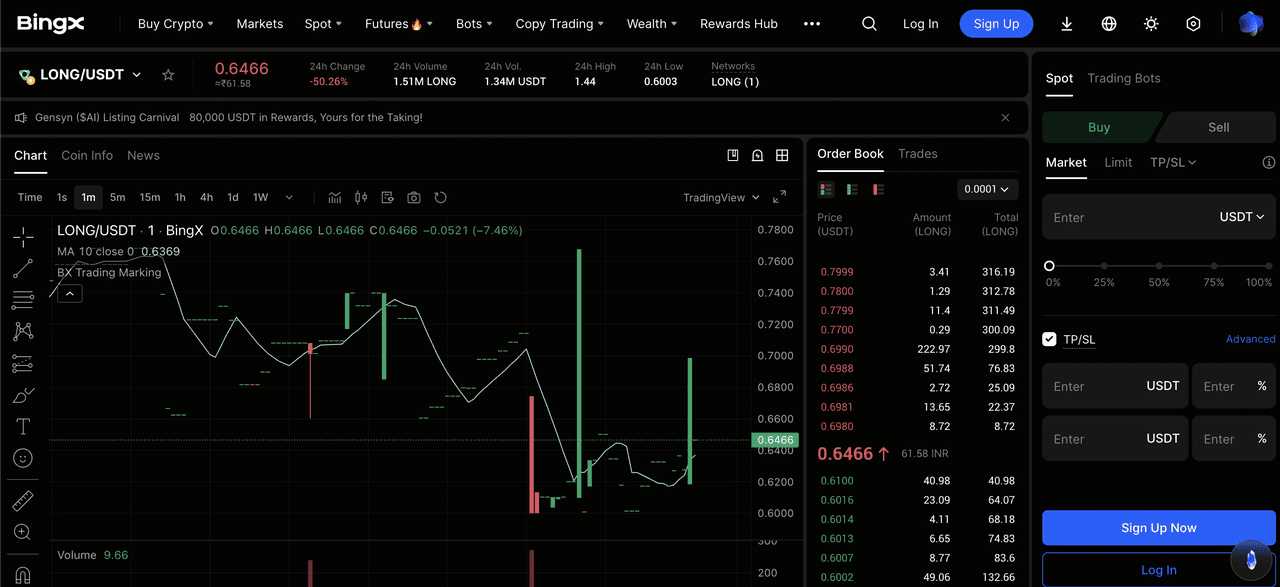
Data VLT (LONG/USDT) trading pair on BingX spot market
Note: BingX has listed DataVLT (DVLT) under the ticker LONG on spot market.
- Access the Asset: Log into your verified BingX account, navigate to the Spot Trading section, and input LONG into the asset lookup panel. Select the LONG/USDT trading pair.
- Configure Parameters: Analyze structural market charts via integrated BingX AI-powered technical indicators, select your target execution type, such as Market or Limit Order, and specify the total USDT allocation.
- Execute Transaction: Click the Buy LONG action button to finalize your settlement. The tokens will settle instantly into your integrated secure spot portfolio.
5 Key Considerations Before Investing in DataVLT
Before allocating capital to this Web3-powered DePIN infrastructure, it is essential to evaluate the operational requirements and structural market risks unique to the ecosystem.
- Node Performance Requirements: Maintaining staking eligibility requires node runners to meet strict local uptime metrics. Falling below performance thresholds triggers automated penalty parameters.
- Computational Hardware Limits: Deploying neural evolution matrix algorithms locally demands capable edge processing hardware. Users with older gateway systems may face performance constraints.
- Network Dependency: Operating over the Optimism L2 framework provides excellent efficiency but ties transaction throughput and gas dynamics to the broader Ethereum scalability landscape.
- Data Validation Weights: Automated yields fluctuate between 70% and 130% based on the freshness and structure of data inputs. Lower-quality streams yield reduced rewards.
- Ecosystem Onboarding Pace: Long-term asset value is tied to strategic alliances with hardware manufacturers. Investors should monitor real-world developer integration rates closely.
Final Thoughts: Should You Buy DataVLT (DVLT)?
DataVLT ($DVLT) introduces a major shift in spatial intelligence by resolving the conflict between ecosystem connectivity and private data sovereignty. By combining decentralized identity architectures with self-optimizing neural networks at the edge, the platform transitions smart homes from manual control systems into proactive, autonomous environments. As its footprint expands across multi-protocol environments, DataVLT offers a practical, web3-native alternative to legacy cloud infrastructures.
Ultimately, the long-term viability of the project depends on its ability to align incentives between independent node operators, product manufacturers, and users through its dual-token ecosystem structure. This design ensures that as smart spaces scale globally, data ownership remains tokenized and securely distributed. For investors looking to participate in the convergence of Web3, AI, and DePIN infrastructures, DataVLT offers an intriguing ecosystem at the center of smart space automation.
Risk Reminder: IoT, AI, and DePIN digital asset allocations carry high technical and market volatility risks. Always review the status of the DataVLT network and perform extensive independent research. BingX assumes no liability for trading losses. This publication does not constitute direct financial advice.
Related Reading
- What Are the Top 10 DePIN Crypto Projects to Know in 2026?
- What Is QIE Blockchain (QIE) Identity Layer of Web3 and How Does It Work?
- What Is ShareX Network (SHARE) DePIN Protocol for the Sharing Economy and How to Buy?
- What Is XPIN Network (XPIN) AI-Powered DePIN and How Does It Work?
- What Is Spacecoin (SPACE) DePIN Project and How to Buy It?