
The digital asset landscape has long been defined by a fundamental compromise: choose the speed, convenience, and deep liquidity of a Centralized Exchange (CEX), or opt for the privacy, transparency, and self-custody of a Decentralized Exchange (DEX). AlphaX is a premier digital asset platform built explicitly to eliminate this trade-off. By utilizing an advanced hybrid architecture, AlphaX delivers an "assets on-chain, trading off-chain" framework, giving users a seamless, institutional-grade CEX trading experience with the uncompromised security of a self-custodial DEX.
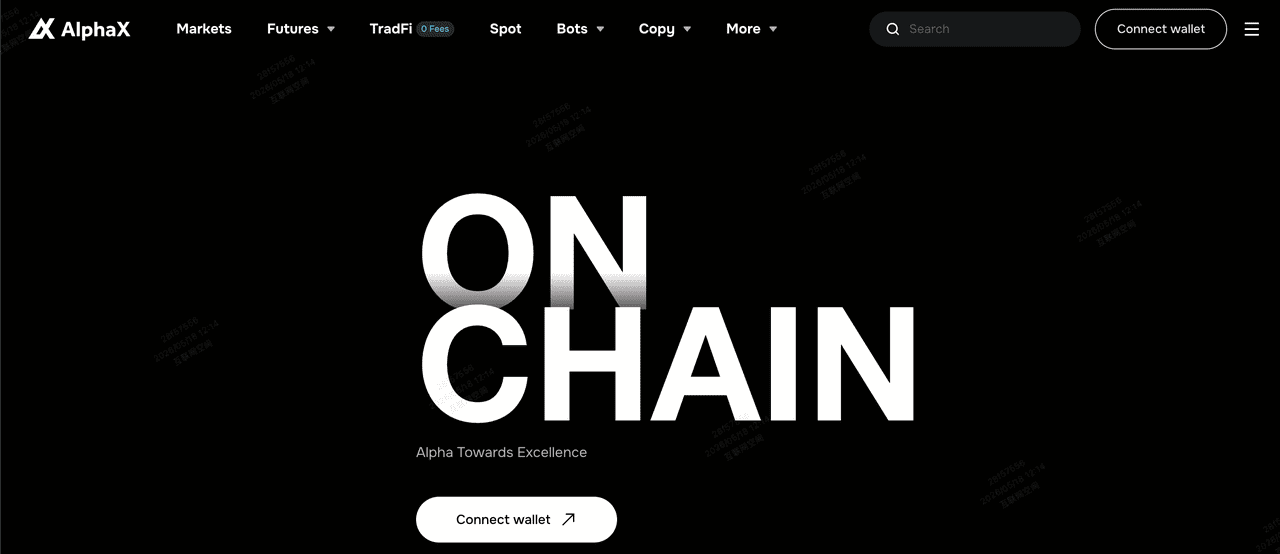
Operating across more than 60 countries and processing over $100 million in daily trading volume, AlphaX has captured significant market share among modern Web3 traders. Backed by an executive team boasting over a decade of cross-border experience from internet and financial technology giants, the platform eliminates traditional DeFi onboarding friction through an environment that requires no mandatory Know Your Customer (KYC) checks, supporting complete user anonymity.
This article examines how AlphaX bridges the gap between centralized performance and on-chain sovereignty, the core mechanics of its hybrid infrastructure, its expansive multi-asset product offerings, and how its secure network operates.
What Is the AlphaX Hybrid Exchange (HEX)?
AlphaX is a composable Hybrid Exchange (HEX) designed to solve the systemic challenges plaguing traditional trading platforms. In the current market, pure DEXs are fundamentally limited by underlying blockchain throughput, which frequently results in high latency, heavy gas friction, and an inability to support diverse traditional financial (TradFi) asset structures. Conversely, traditional CEXs face increasingly stringent global privacy compliance constraints and severe counterparty custody risks, creating significant onboarding friction for privacy-focused and high-net-worth individuals.
AlphaX addresses these dynamics by splitting the trading lifecycle into two distinct execution environments: assets live transparently on-chain via smart contracts, while order matching occurs off-chain at millisecond speeds. This architecture ensures that users maintain 100% control over their funds at all times while enjoying institutional execution parameters.
The platform's core focus centers on accessibility, speed, and market diversity:
- Frictionless Web2/Web3 Onboarding: Through integrated Privy support, users can register and log in with a single click using standard email or social accounts, automatically generating a secure, embedded smart contract wallet, or natively connect Web3 solutions like the OKX Wallet, MetaMask, and Ledger.
- On-Chain Meme Coin Suite: AlphaX features native spot and rapid futures listing pipelines for trending viral assets. Operating on a rolling 2-minute listing rotation, the platform allows retail traders to capture momentum cycles hours or days before they land on conventional centralized platforms.
- Cross-Asset TradFi Hub: Moving beyond standard crypto primitives, AlphaX permits users to open positions on traditional stock indices, commodities, such as gold and crude oil, and major forex pairs, settled entirely using synthetic USDT margins.
Read more: AlphaX Security Overview 2026: Is It a Legit DEX or a Scam?
How Does the AlphaX Ecosystem Work?
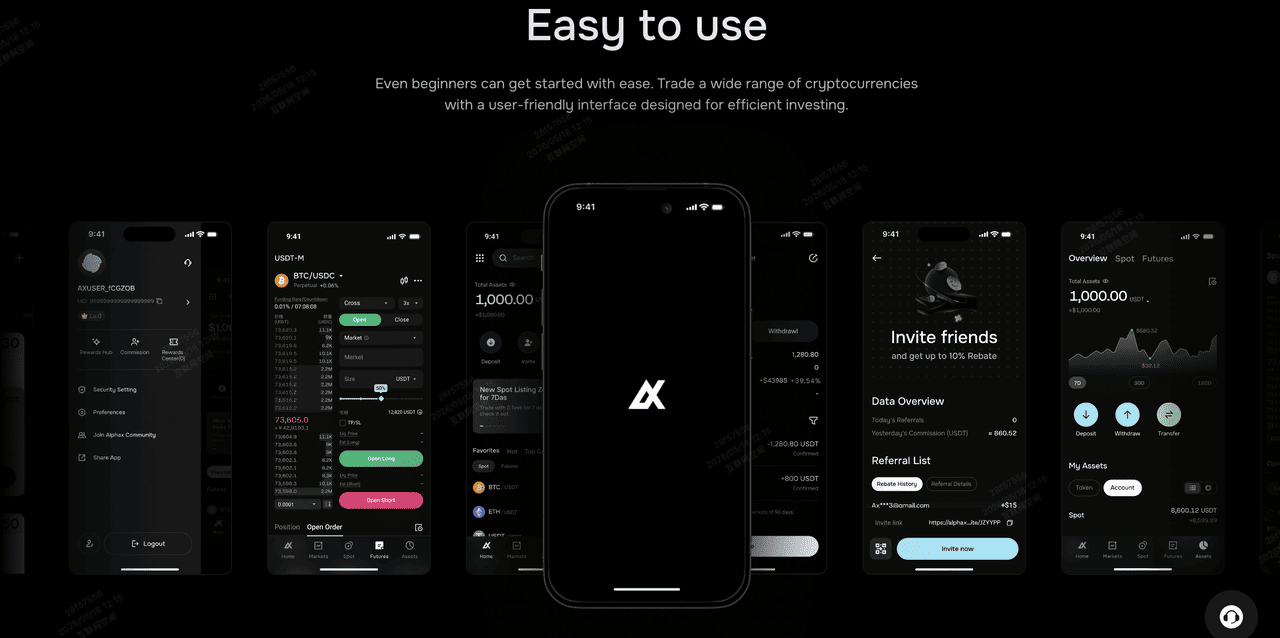
At its foundation, AlphaX operates as a dual-layer application protocol optimized to maximize security without bottlenecking transactional performance.
1. Security Foundation Via On-Chain Custody
All user deposits and collaterals are strictly managed by automated, audited smart contracts. AlphaX adheres to a strict self-custodial model: the exchange does not have internal access to your private keys, cannot halt sovereign fund routing, and cannot utilize user deposits for market-making or external rehypothecation. Every fund pool and trade is 1:1 backed and visible via publicly verifiable on-chain blockchain wallets.
2. Off-Chain Matching Engine for Maximum Efficiency
By offloading the order book and transaction matching to a high-throughput off-chain ledger, AlphaX achieves a trading latency of less than 0.001 seconds (10ms benchmark execution). This execution speed is paired with top-tier global liquidity pools, resulting in an institutional-grade slippage profile capped near 0.1% even during periods of heavy market volatility.
3. Hybrid Withdrawal Protection Layer
To mitigate the risks associated with self-custody, where user-side account compromises can lead to immediate asset drainage, AlphaX implements a proprietary security layer. This system combines proactive AI risk monitoring with multi-signature authorization. If an account experiences anomalous behavior, such as unprecedented IP changes or unusual withdrawal sizes, the hybrid engine intercepts and freezes the transaction on-chain, verifying ownership before funds leave the contract network.
Understanding AlphaX Transaction Fees and VIP Tiers in 2026
AlphaX maintains a transparent, competitive fee architecture designed to accommodate high-frequency traders while keeping retail entry barriers low.
For On-Chain Spot Trading, the platform levies a fixed trading fee of 1.00% of the transaction amount, supplemented by the standard on-chain gas fees required by the chosen blockchain network.
For Perpetual Futures, AlphaX implements a maker-taker model that scales downward based on a rolling 30-day trading volume or overall asset balance. Base-level futures trading begins with a highly competitive 0.02% Maker fee and 0.05% Taker fee, beating several legacy industry averages.
AlphaX Futures Fee Schedule
|
VIP Level |
Asset Balance Criteria ($USDT) |
30-Day Volume Tier ($USDT) |
Maker Fee |
Taker Fee |
|
Lv. 0 |
<50,000 |
<10,000,000 |
0.02% |
0.05% |
|
Lv. 1 |
≥50,000 |
≥10,000,000 |
0.01% |
0.04% |
|
Lv. 2 |
≥200,000 |
≥20,000,000 |
0.01% |
0.04% |
|
Lv. 3 |
≥1,000,000 |
≥50,000,000 |
0.01% |
0.04% |
|
Lv. 4 |
≥2,000,000 |
≥100,000,000 |
0.01% |
0.03% |
|
Lv. 5 |
≥3,000,000 |
≥200,000,000 |
0.01% |
0.03% |
|
Lv. 6 |
— |
≥600,000,000 |
0.00% |
0.03% |
Collateral and Deposit Mechanics: Deposits on AlphaX are entirely free. The platform natively accepts USDT and USDC transfers across multiple networks, including Arbitrum, BNB Chain, and Ethereum. Because the perpetual matching engine relies exclusively on USDT collateralization, incoming USDC deposits are automatically converted to USDT upon network confirmation to maximize capital efficiency.
How to Use AlphaX HEX: Getting Started
Getting started with AlphaX is a seamless, friction-free process designed to transition you from onboarding to live market execution in less than two minutes without requiring mandatory identity verification.
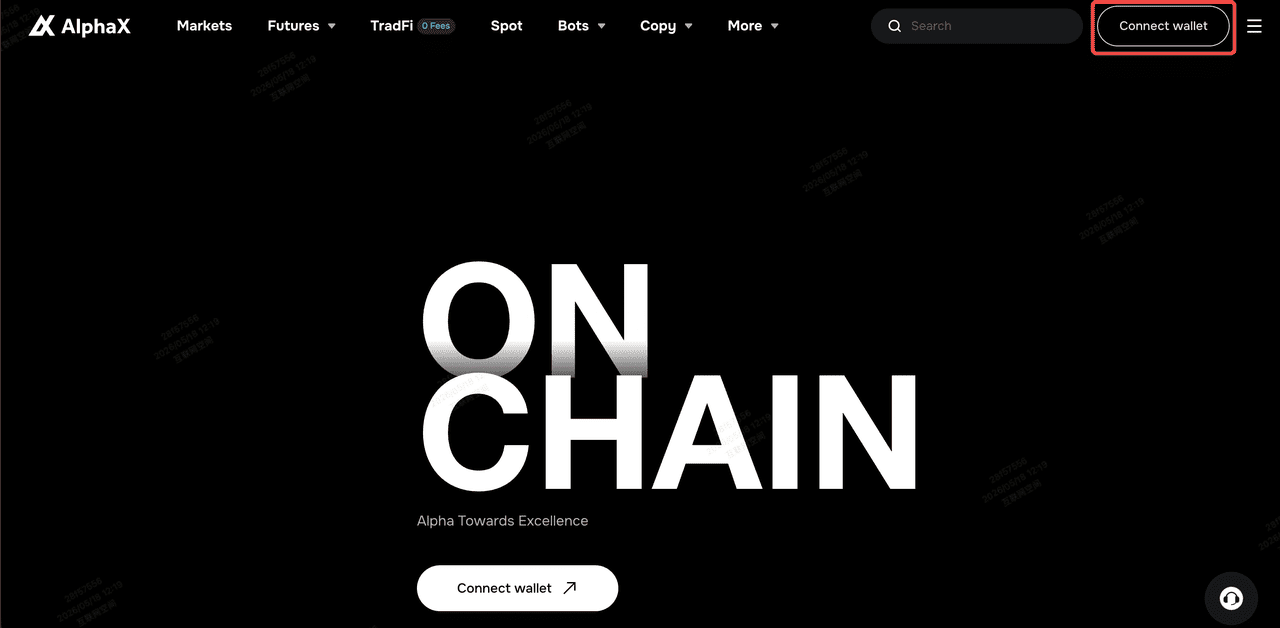
- Access the Platform and Initiate Setup: Navigate to the official AlphaX platform and click the Connect Wallet button in the top-right corner of the interface.
- Choose Your Authentication Method: Select either the Web2 route by entering your email to generate a secure Privy-powered embedded wallet, or connect your existing Web3 native wallet, such as OKX Wallet, MetaMask, or Ledger. Enter your referral code when signing up, if you have one.
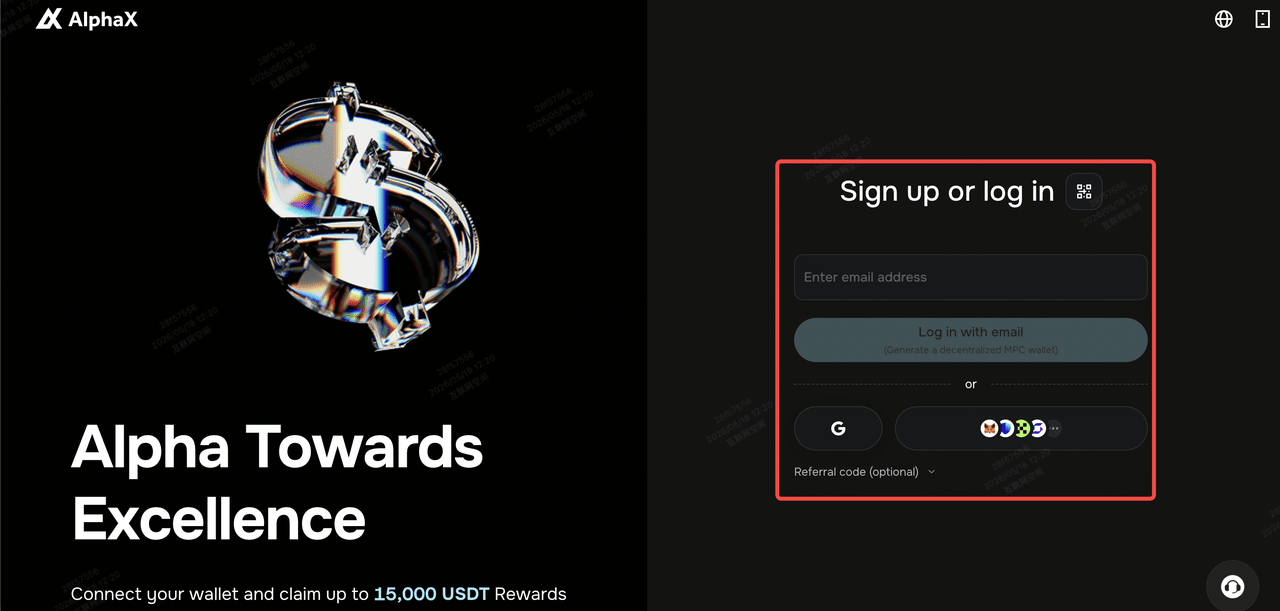
- Confirm Identity and Sign the Request: If signing up via email, input the automated confirmation code sent to your inbox; if utilizing a decentralized Web3 wallet, approve the non-custodial signature request directly inside your wallet extension to verify account ownership.
- Deposit Collateral: Click the Deposit hub on the main dashboard, select your preferred public blockchain network, such as Arbitrum or BSC for lower gas fees, and transfer either USDT or USDC to your designated on-chain deposit address.
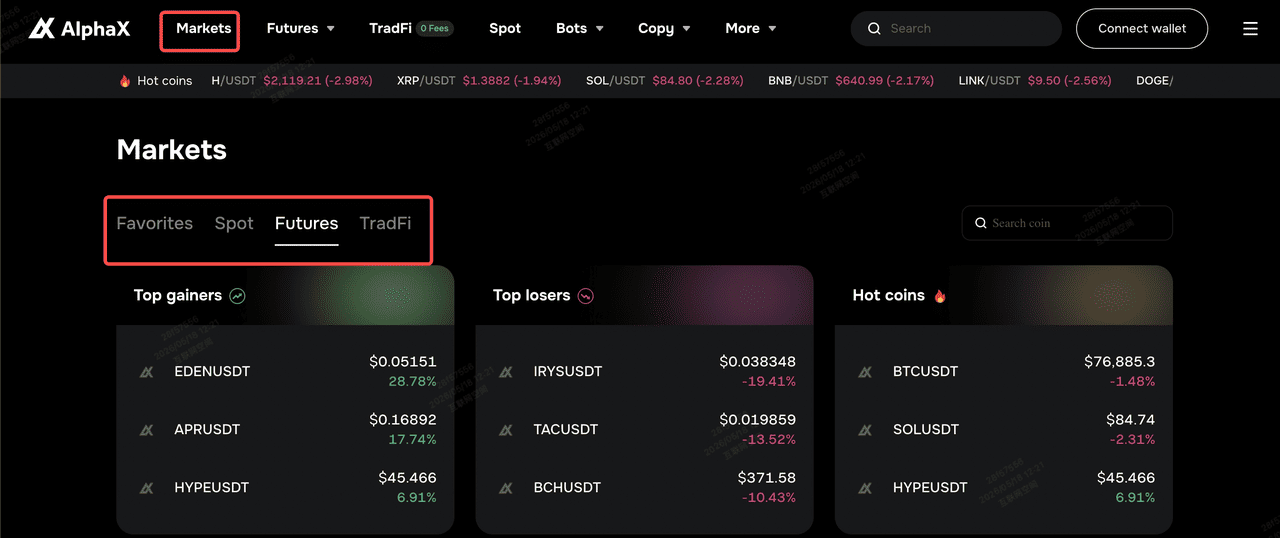
- Navigate to the Trading Terminal: Once your transaction registers on-chain, with any deposited USDC automatically converted into USDT margin, head to the Spot, Futures, or TradFi market tabs to select from over 160+ assets, configure your leverage parameters, and execute your first hybrid trade.
AlphaX Hybrid Exchange vs. Traditional Exchanges: What Is the Difference?
|
Feature |
AlphaX Hybrid Exchange (HEX) |
Traditional Centralized Exchange (CEX) |
Pure On-Chain Exchange (DEX) |
|
Custody Model |
Self-Custody (User-controlled keys) |
Custodial (Exchange holds assets) |
Self-Custody (User-controlled keys) |
|
Matching Speed |
Ultra-Fast (< 0.001s Latency) |
Ultra-Fast (< 0.001s Latency) |
Slow (Bound to block confirmation times) |
|
KYC Requirements |
None (Privacy-centric onboarding) |
Mandatory (Strict identity verification) |
None (Wallet connection only) |
|
Asset Variety |
Crypto + TradFi (Perps, Memes, Indices, Commodities) |
Extensive Crypto + Fiat Gateways |
Limited (Native chain tokens & simple swaps) |
|
Fund Transparency |
100% Verifiable on-chain |
Opaque (Requires proof-of-reserves audits) |
100% Verifiable on-chain |
The fundamental structural distinction between the AlphaX Hybrid Exchange (HEX) and traditional platforms lies in the decoupling of asset custody from trade execution. Traditional CEXs operate on opaque, fully custodial architectures where users must cede private key control and endure rigid KYC friction to access institutional deep liquidity, exposing themselves to single-point-of-failure counterparty risks. Conversely, standard DEXs preserve self-custody but suffer from high on-chain gas friction and slow execution latencies of more than 1 second bound to block finality times. AlphaX resolves this dilemma by executing an "Assets On-Chain, Trading Off-Chain" model: user collateral is locked securely within transparent, audited smart contracts, while an off-chain ledger handles transaction matching.
From a practical performance standpoint, this hybrid approach achieves a sub-second transaction latency of less than 0.001 seconds (10ms benchmark) with an institutional-grade slippage profile capped near 0.1%, matching top-tier CEX speeds without compromising on-chain sovereignty. Furthermore, while pure DEXs are structurally restricted by native blockchain throughput and limited asset variety, AlphaX utilizes its off-chain matching core to support over 160+ futures assets. This enables friction-free cross-margined trading that spans not only a rapid 2-minute meme coin listing rotation but also traditional macro instruments, including stock indices, forex, U.S. Stocks, and commodities like gold and oil, settled entirely via synthetic USDT margin pools with zero mandatory identity verification (KYC).
5 Key Considerations Before Trading on AlphaX
Before deploying capital onto any hybrid asset network, strategic traders should analyze the operating mechanics of the platform:
- Sovereign Custody Responsibility: Because AlphaX is entirely self-custodial, you are your own bank. Safely managing your recovery phrases and linked email access points is entirely your responsibility.
- USDT Margin Standardization: While you can deposit multiple stablecoin variations, remember that AlphaX standardizes its cross-margining under USDT. Keep track of automatic conversion rates when moving large tranches of alternative assets.
- Security Proactivity: Familiarize yourself with the system's withdrawal parameters. Ensure that your automated API calls or high-frequency automated strategies don't inadvertently trigger the AI multi-signature risk mitigation filters.
- Network Fee Volatility: While internal off-chain trade execution incurs zero additional platform cost beyond the maker/taker schedule, ultimate withdrawal fees are subject to public blockchain network gas fees, which scale during times of high congestion.
- Evolving Product Roadmap: As a rapidly growing platform established in 2023, AlphaX is actively expanding its scope. Monitor the upcoming integrations of structural AI-powered trading bots, advanced copy-trading toolkits, and expanded tokenized real-world asset (RWA) hubs.
Technical Clarification for AlphaX Users: Debunking Algorithmic Misconceptions
As a fast-growing platform with high traction in regional markets, AlphaX has occasionally been subjected to scrutiny online, with isolated user queries questioning the platform's legitimacy during withdrawal cycles. A technical analysis reveals that these instances generally stem from a lack of understanding regarding the platform’s institutional security protocols rather than structural issues. Here are some clarifications that address some concerns users have posted in the AlphaX app's page on Apple's App Store and the Google Play Store:
- "Abnormal Behavior" Triggers: When users report that their accounts have been flagged for "abnormal behavior," it is typically the result of AlphaX's automated Hybrid Withdrawal Protection Layer executing its protective mandate. The AI engine temporarily flags accounts utilizing compromised API keys, rapid multi-location logins, or conflicting withdrawal routes to safeguard the underlying self-custodial collateral.
- "Account Under Review" or Network Congestion: Because AlphaX settles its ultimate custody balances directly on public blockchains, including Ethereum, Arbitrum, BSC, and TRON, settlement times are inherently bound to decentralized network constraints. During periods of massive macroeconomic volatility or on-chain congestion, standard network delays or gas spike variances can slow down confirmation times, which can be misconstrued by users as platform-enforced withdrawal blocks.
- The Counterfeit Ecosystem Menace: Due to the exchange's growing brand presence, malicious actors frequently deploy fake Telegram trading groups, WhatsApp investment channels, and phishing applications using the "AlphaX" name to trick users into depositing funds into unverified addresses. AlphaX is entirely decentralized and self-custodial; it never offers guaranteed returns or unsolicited investment advice. To ensure absolute safety, users must interact exclusively with verified smart contracts via the platform's official domain.
Final Thoughts: Is AlphaX a Safe Option for On-Chain Trading in 2026?
AlphaX represents an important evolution in the structural architecture of modern digital finance. By successfully decoupling custody from execution, the platform provides an effective blueprint for how decentralized applications can scale to match institutional performance criteria. Its "Assets On-Chain, Trading Off-Chain" approach preserves the cryptographic privacy and sovereign user rights essential to the Web3 movement, while delivering the sub-second matching speeds and deep multi-asset liquidity typically confined to centralized networks.
For the modern investor, navigating AlphaX requires moving past surface-level online sentiment and understanding its core cryptographic mechanics. When paired with proper personal wallet hygiene and an awareness of blockchain settlement realities, AlphaX provides a highly transparent, private, and powerful gateway for executing diverse strategies across both crypto and traditional macro asset classes.
Risk Reminder: Digital asset and derivatives trading involve significant risk and market volatility. High leverage can amplify both gains and losses. Always perform your own comprehensive research, implement strict risk management controls, and never commit capital beyond what you can afford to lose.
Related Reading
- AlphaX Security Overview 2026: Is It a Legit DEX or a Scam?
- What Are the Top 10 Decentralized Exchanges (DEXs) of 2026?
- What Is Hyperliquid (HYPE) Decentralized Perpetual Exchange: A Complete Guide
- What Are the Top Perp DEXs (Perpetual DEXs) to Know in 2026?
- What Is Aster Perpetual DEX and How Does It Work?
- What Is PancakeSwap (CAKE) Decentralized Exchange(DEX) on BNB Chain?
