

As decentralized finance matures toward global internet capital markets, the structural conflict between high-yield generation and risk mitigation has reached a critical juncture. Most conventional DeFi protocols generate yield by extending credit against highly volatile collateral or routing speculative trading flows. When market cycles turn, these organic yields compress, causing protocol liquidity to contract sharply. Solstice Finance solves this systemic vulnerability by introducing an institutional-grade infrastructure layer that abstracts complex, market-neutral asset management into highly composable on-chain products.
Backed and incubated by Deus X Capital, a prominent $1 billion+ AUM (assets under management) institutional investor, Solstice Finance bridges the deep liquidity pools of traditional finance (TradFi) with the high-throughput infrastructure of the Solana blockchain. By wrapping licensed, off-chain strategies into standard on-chain containers, Solstice allows retail users and institutional allocators alike to access sophisticated, market-neutral returns without managing complex derivative positions or trading desk perimeters.
What Is Solstice Finance (SLX)?
Solstice Finance is a security-first yield protocol built on Solana that delivers stable, risk-adjusted returns uncorrelated to directional crypto market movements. At its core, the project addresses three fundamental challenges in the decentralized asset management space:
- Yield Compression: Traditional DeFi yields decline rapidly in bearish market conditions; Solstice captures structural market inefficiencies that persist across all market cycles.
- Access Barriers: Institutional trading strategies typically mandate millions in minimum capital requirements and strict compliance setups; Solstice brings these strategies on-chain, accessible from as little as $1.
- Liquidity Fragmentation: Yield-bearing assets are frequently locked and illiquid; Solstice issues fully transferable and composable liquid tokens that can be utilized across the wider Solana DeFi ecosystem.
How Does Solstice Finance Work?
The protocol operates as a modular, three-layer architecture, Settlement, Wrapper, and Application, ensuring that structural risk mitigation is hardcoded into every capital transaction.
1. The USX Settlement Layer
USX is the foundational capital unit and the sole entry and exit point of the protocol. It is an overcollateralized synthetic stablecoin soft-pegged 1:1 to the US dollar. Unlike uncollateralized or algorithmically stabilized assets, USX is backed >100% by a audited reserve consisting of tokenized US Treasuries, cash, and delta-neutral hedged digital asset positions (BTC, ETH, SOL). Reserves are continuously verified in real time using an Accountable Proof of Solvency dashboard.
2. The YieldVault Wrapper Primitive
YieldVault is the general contract surface that turns licensed off-chain strategies into composable SPL tokens on Solana. When users deposit USX into a YieldVault, they receive a yield-bearing token, such as eUSX.
eUSX is a non-rebasing token, meaning the quantity in your wallet stays the same, but its underlying value appreciates relative to USX as investment returns accrue. The protocol generates these stable returns through three main market-neutral strategies executed primarily on top-tier venues like Binance:
- Funding Rate Arbitrage: Shorting perpetual futures contracts while holding equivalent spot assets to capture positive funding rates without directional price exposure.
- Hedged Staking: Capturing native blockchain staking rewards using bare-metal, enterprise validator infrastructure via Solstice Staking AG while simultaneously using derivatives to offset the underlying asset's price volatility.
- Tokenized T-Bills: Directing capital into short-term US Treasury securities to anchor the portfolio with low-risk sovereign yields while maintaining instant on-chain liquidity.
3. The Solstice Nexus Application Layer
Nexus is the protocol’s consumer-facing intelligence layer, a mobile-first super-dApp launching in four successive phases:
- Yield Optimiser: A deterministic rate engine allocating capital across pre-vetted DeFi venues according to user-selected risk profiles.
- AI Copilot: An automated assistant that monitors positions, surfaces idle capital, and flags yield drift via explainable prompts.
- Credit Market and Yield Card: Allowing users to borrow against their USX-denominated assets and spend capital via major card networks, including Apple Pay and Google Pay.
- Progressive Autonomy: User-configured rule automation gated by native token locks.
Solstice Finance vs. Traditional DeFi Protocols: Key Differences
|
Feature |
Solstice Finance (USX/eUSX) |
Conventional DeFi Lending |
Algorithmic Stablecoins |
|
Primary Yield Source |
Delta-neutral arbitrage & Treasuries |
Speculative borrower demand |
Native token inflation / seigniorage |
|
Directional Exposure |
Market-neutral (Zero directional risk) |
Dependent on asset valuations |
High systemic asset dependency |
|
Collateral Structure |
Overcollateralized (>100% audited) |
Overcollateralized (Volatile crypto) |
Undercollateralized / Reflexive |
|
Solvency Verification |
Continuous Accountable Proof of Solvency |
On-chain smart contract queries |
Complex off-chain/on-chain loops |
|
Redemption Window |
7-day standard cooldown (or instant via SLX) |
Instant (subject to pool utilization) |
Instant (highly volatile during bank runs) |
Traditional DeFi protocols fail to sustain attractive yields during market downturns because their underlying borrow demand evaporates as trading volume drops. This reliance creates an inherently cyclical environment where capital is mercenary.
In contrast, Solstice Finance utilizes sophisticated funding rate capture and basis trading, allowing it to maintain a stable performance track record. Because the underlying execution shorts perpetual contracts while holding matching spot positions, it captures yield from high market volatility without suffering downside price exposure.
Furthermore, Solstice expands its ecosystem through Yield-as-a-Service (YaaS), a bidirectional B2B distribution layer. This allows external platforms like fintechs, neobanks, and corporate payroll providers to natively embed institutional yield into their applications using USX as the core settlement denominator, decoupling the protocol's TVL growth from standard retail crypto speculation.
What Is Solstice Finance Tokenomics: Driving the Protocol Flywheel
The SLX token is the native utility, access, and governance token of Solstice Finance, acting as the primary coordination asset for the entire ecosystem.
SLX Token Utility
Value flows to the SLX token through a strict access-gating design that rewards long-term alignment:
- Staking (stSLX): Depositing SLX into the staking vault mints liquid non-rebasing stSLX tokens, which steadily appreciate in value as protocol rewards stream through a smoothing buffer vault.
- Instant Unlocks: Holding and locking stSLX allows users to completely bypass the standard 7-day redemption cooldown on YieldVault products like eUSX and strcUSX, granting fee-free, instant liquidity.
- Credit Market Access: Borrowing limits against USX collateral inside the Nexus super-app scale proportionally with the amount of SLX a user has locked.
- Operational Governance: Staked SLX grants voting weight over crucial protocol variables, including YieldVault capacity caps, asset allocation bands, collateral parameters, and treasury deployments.
The Yield Smoothing Formula: > Staking rewards are counter-cyclical by design to maintain system stability:
stSLX APY=Cycle Base Rate−eUSX APY (7-day rolling average)
When organic delta-neutral yields are exceptionally high, fewer treasury incentives are distributed; when market yields compress, treasury rewards expand to stabilize stSLX staker returns.
SLX Token Distribution
The SLX token has a fixed maximum supply of 1,000,000,000 tokens, with an initial circulating supply of approximately 24% at its Token Generation Event (TGE) on May 25, 2026. Notably, there are no early VC token allocations.
- Community Incentives (37.71%): 377,145,777 tokens allocated toward liquidity programs, ecosystem milestones, and integration grants, vesting linearly over 36 months.
- Foundation Treasury (24.00%): 240,000,000 tokens for protocol liquidity, market-making, and reserve operations; 50% unlocked at TGE, remainder over 30 months.
- Team & Advisors (20.00%): 200,000,000 tokens reserved for core contributors, subject to a strict 12-month cliff followed by a 24-month linear monthly vest.
- Airdrops / Flares Campaigns (10.00%): 100,000,000 tokens distributed to early users based on historical interaction, subject to structured rank-based unlocks and choice-driven 3-month or 9-month vesting contracts.
- Strategic TVL Partners (8.00%): 80,000,000 tokens allocated to institutional allocators delivering structural USX liquidity, with 25% unlocked on day one.
- Public Sale (0.29%): 2,854,223 tokens distributed via the Legion public sale platform, 100% unlocked at TGE.
How to Claim the Solstice Finance (SLX) Airdrop
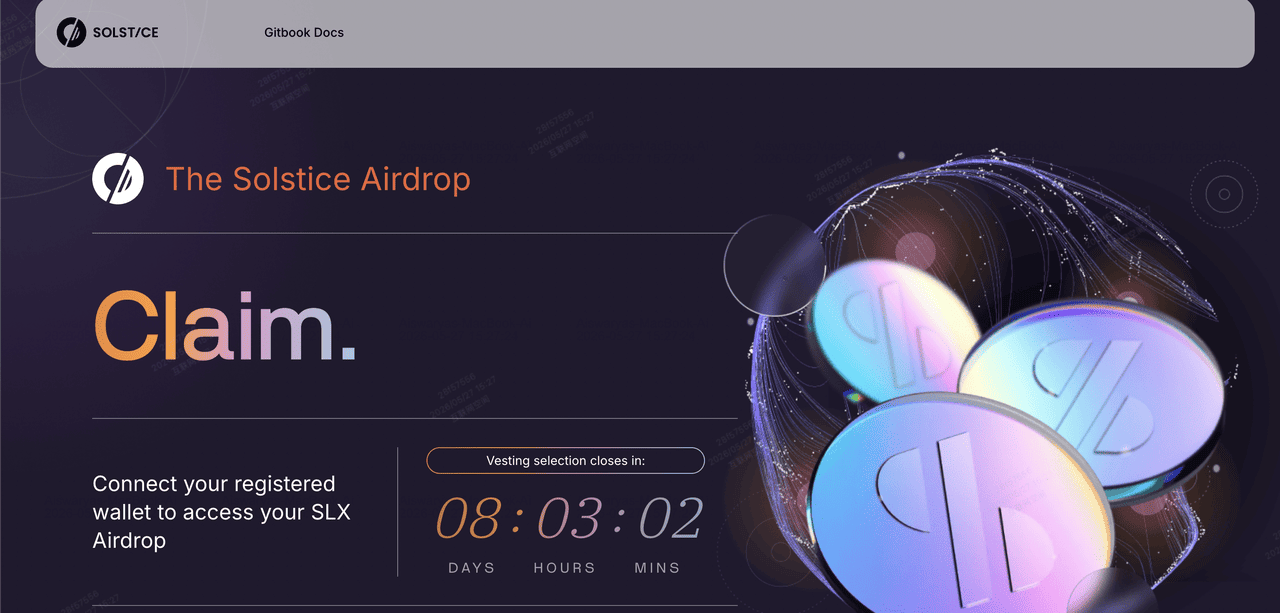
Following the official Token Generation Event (TGE) on Monday, May 25, 2026, Solstice Finance opened its highly anticipated community airdrop claims portal. The distribution serves to transition the protocol toward its decentralized Yield Layer blueprint, rewarding early capital providers while embedding long-term supply guardrails.
What Is the Solstice Finance Airdrop?
The airdrop is the final distribution phase of Flares Season 1, an ecosystem campaign designed to bootstrap liquidity for Solstice’s overcollateralized stablecoin (USX). Rather than deploying a generic token handout, Solstice allocates up to 10% of the fixed 1 billion SLX supply via Dynamic Distributions, a mechanic where the total allocation pool scales in direct proportion to the protocol's Total Value Locked (TVL).
Furthermore, due to unclaimed tokens from unregistered wallets, the remaining SLX was reallocated dynamically, ensuring every verified participant received a baseline of 702 SLX on top of their standard allocation.
Who Is Eligible for the $SLX Airdrop?
Eligibility for the primary on-chain airdrop is tied directly to your wallet's historical Flares Profile. To have qualified for the launch claims portal, you must meet the following criteria:
- Season 1 Active TVL: Wallets that held native USX, locked assets in eUSX YieldVaults, or supplied liquidity to official partner pools like Orca, Raydium, Kamino, or Exponent, prior to the Season 1 final snapshot.
- Completed Pre-Registration: Due to strict anti-Sybil measures, users must have completed the mandatory 7-day pre-registration phase in mid-April 2026.
Note: Unregistered wallets have permanently forfeited their Season 1 allocations.
- Binance Alpha Event Eligibility: Separately, users holding at least 215 Binance Alpha Points can claim a flat allocation of 250 SLX on a first-come, first-served basis via the dedicated Binance Alpha app event page.
When Is the Solstice Finance Airdrop Snapshot and Key Dates?
The deployment timeline is highly synchronized to ensure uniform liquidity access across centralized (CEX) and decentralized (DEX) venues:
|
Time (UTC) |
Calendar Date |
Event / Portal Milestone |
|
12:00 |
Monday, May 25, 2026 |
Binance Alpha trading goes live |
|
13:00 |
Monday, May 25, 2026 |
Claims Portal & Vesting Registration Open |
|
14:00 |
Monday, May 25, 2026 |
Secondary CEX listings & DEX pools open |
|
TGE + 10 Days |
Thursday, June 4, 2026 |
Vesting selection window closes (Defaults to 9-Month plan if unselected) |
|
TGE + 41 Days |
Sunday, July 5, 2026 |
Unlock 2 Event: First 31 days of daily vesting, reallocated SLX, and flat social bonuses release |
How to Claim Your SLX Token Airdrop: Step-by-Step Guide
To claim your tokens securely and configure your preferred distribution architecture, follow this official operational walkthrough:
- Connect Your Solana Wallet: Navigate to the official Solstice airdrop claim portal. Connect the specific Solana wallet, e.g., Phantom, Solflare) utilized during the Season 1 farming and registration process. Ensure you have a small balance of native SOL to cover transaction network fees.
- Verify Your Allocation Status: The dashboard will parse your data and display your total finalized SLX allocation. It will explicitly show your Unlock 1 balance available to claim on day one, ranging from 5% to 25% depending on your leaderboard rank, alongside the remaining balance earmarked for downstream vesting.
- Select Your Vesting Plan: An interaction modal will appear presenting two distinct vesting tracks. You have a strict 10-day window to lock in your selection:
- Option A (9-Month Vesting): Your remaining allocation unlocks smoothly day-by-day over a 9-month horizon. This track carries zero ongoing liquidity or TVL requirements.
- Option B (3-Month Vesting): An accelerated schedule where tokens unlock daily over just 3 months.
- Requirement: You must maintain your individual Time-Weighted Average (TWA) baseline TVL from Season 1 throughout the entire 3 months.
- Confirm and Process the Transaction: Review your choice and click Confirm Claim. Sign the resulting transaction partition inside your wallet extension. Your upfront Unlock 1 tokens will be routed instantly to your spot wallet, and your chosen vesting path will lock on-chain.
Critical Risk Warning for Option B (3-Month Vesting): If you select the accelerated 3-month vesting plan, the claims portal will not display your live liquidity metrics. You must monitor your capital levels via the Flares Season 2 Dashboard. A 10% market volatility buffer is applied to your baseline.
If your TVL drops below your required threshold, you will receive a 24-hour dashboard warning and a strict 72-hour grace period to restore the capital. Failure to restore liquidity within 72 hours results in the permanent forfeiture of all unvested SLX tokens. If you do not intend to keep your liquidity working inside Solstice, select Option A.
How to Trade Solstice Finance (SLX) on BingX
BingX offers an institutional-grade trading ecosystem to monitor and trade SLX tokens, featuring advanced charts, depth analysis, and security features.
Long or Short SLX Perpetuals in the Futures Market
- Access Futures Dashboard: Navigate to the Futures drop-down menu and select Perpetual Futures, locating the SLX/USDT perpetual contract.
- Select Margin Mode: Choose Isolated Margin to isolate your risk parameters to a single position, or Cross Margin to utilize your entire available balance as collateral.
- Calibrate Leverage: Carefully adjust the leverage slider to match your strict risk profile. Remember that high leverage amplifies both potential profits and liquidation risks.
- Open Order: Submit an Open Long market or limit entry if your data points toward structural price appreciation, or an Open Short order to benefit from market downside or hedge spot allocations.
5 Key Considerations Before Investing in Solstice Finance
Before committing capital to the Solstice ecosystem, carefully assess these critical project elements:
- Vesting and Release Horizons: Following the May 2026 TGE, a substantial amount of reallocated public airdrop tokens and early daily vesting contracts unlock around day 41 for Unlock 2. Monitor circulating supply expansion closely.
- Execution Counterparty Dependencies: While strategies are market-neutral, their automated trades are executed across major off-chain platforms and settled via off-exchange custodians like Ceffu and Copper, introducing localized counterparty risks.
- Vesting TVL Commitments: Users participating in the accelerated 3-month airdrop vesting schedule are mandated to maintain their specific Time-Weighted Average (TWA) capital baseline. Dropping below this baseline for more than 72 hours leads to permanent forfeiture of unvested assets.
- Dynamic Staking Yields: The 20% Base Rate for stSLX Staking applies strictly to Cycle 1, ending June 30, 2026. Subsequent cycles will have parameters adjusted through public multi-sig governance updates.
- Strategy Performance Variability: Delta-neutral strategies thrive on high market volatility and structural inefficiencies. Periods of prolonged market stagnation or heavily compressed perpetual funding rates can temporarily lower eUSX returns.
Final Thoughts: Should You Buy Solstice Finance (SLX)?
Solstice Finance establishes a vital infrastructure primitive by translating complex corporate delta-neutral management into simple, on-chain financial instruments. By anchoring its architecture around the overcollateralized USX stablecoin and enforcing automated proof-of-solvency disclosures, the protocol shifts the industry paradigm away from inflationary token incentives and toward real, sustainable yield generation.
Ultimately, the protocol's long-term value is backed by its institutional infrastructure, deep backing from Deus X Capital, and a clear product roadmap that spans across consumer super-apps and embedded fintech APIs. As Solana cements its status as a primary settlement layer for global finance, Solstice offers an efficient framework for capital allocation that remains resilient across both bull and bear market cycles.
Risk Reminder: Decentralized asset management and stablecoin protocols carry smart contract, operational execution, and protocol counterparty risks. Always perform your own continuous research, track governance cycles, and never risk more capital than you can afford to lose. BingX assumes no responsibility for external trading or investment allocations.
