


AST SpaceMobile (ASTS) is building a low-Earth-orbit cellular broadband network designed to connect standard smartphones without specialized terminals. BlueBird satellites, ground gateways and mobile-network integrations form the core system, with commercial operators and government agencies providing the initial demand base. The opportunity is large, though the stock remains sensitive to launch execution, regulatory approvals and the cost of building a global constellation.
The latest quarter showed rapid revenue growth alongside the expense of reaching commercial scale. AST SpaceMobile Q2 2026 revenue reached $31.5 million, up from $1.16 million a year earlier, as gateway deliveries and U.S. government milestones produced sales. Contracted backlog grew to about $1.3 billion, yet a $230.9 million net loss showed why converting launches and commitments into recurring service revenue remains the central investment test.
The ASTS stock forecast for 2026 now centers on two competing views:
- The constellation and commercialization case: successful BlueBird launches, operator activation and backlog conversion could establish recurring service revenue across a distribution network covering more than 3 billion subscribers.
- The deployment and financing case: schedule slippage, regulatory delays and continuing losses could push commercial revenue outward and require more equity-linked funding.
This guide breaks down the ASTS stock forecast, 2026 price scenarios, key risks and analyst outlooks, drawing on AST SpaceMobile's August 10 Q2 2026 earnings release, quarterly filing and market data through September 10, plus how to trade ASTS stock futures on BingX TradFi with USDT collateral.
Top 5 Things for AST SpaceMobile Investors to Know in September 2026
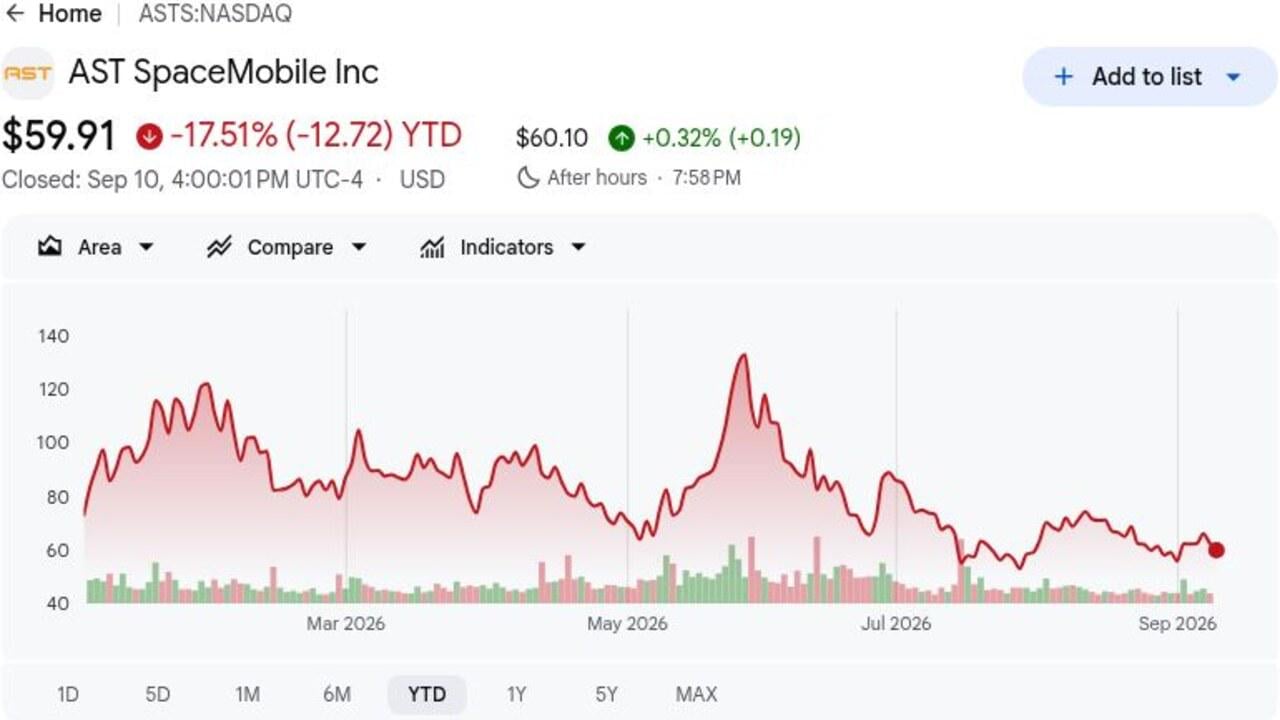
- ASTS closed at $59.91 on September 10 and remained down 17.51% YTD: Shares were more than 55% below the $133.86 52-week high, showing how quickly satellite milestones and financing concerns can reshape the valuation.
- Q2 revenue reached $31.5 million, up from $1.16 million: Sales increased more than twentyfold year over year through gateway deliveries and U.S. government milestones, but missed the $34.5 million FactSet consensus by about $3.0 million.
- Contracted revenue backlog expanded to about $1.3 billion: The total includes commercial partner commitments and more than $125 million of incremental U.S. government awards. Launch and coverage milestones will determine when that backlog converts into revenue and cash.
- Pro forma liquidity exceeded $3.7 billion after financing: AST SpaceMobile raised $1.15 billion through convertible notes, extending the runway for satellites, gateways and launches. The funding reduces near-term liquidity pressure but adds dilution risk.
- Continuous selected-market coverage requires roughly 45 to 60 satellites: AST SpaceMobile reported 13 satellites in orbit after recent deployments. Manufacturing and launch cadence must close that gap before broader commercial service can scale.
What Is AST SpaceMobile (ASTS)?
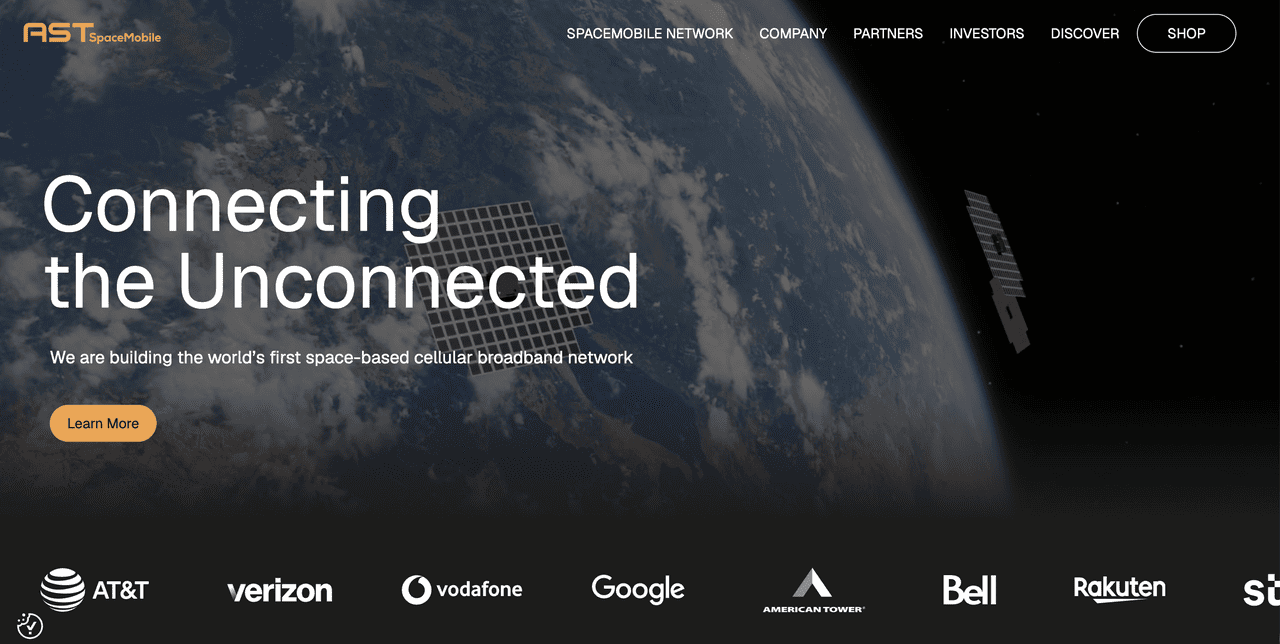
AST SpaceMobile is a satellite communications company developing the SpaceMobile network, a direct-to-device platform intended to extend cellular broadband beyond terrestrial towers. Its large BlueBird satellites communicate with ordinary smartphones using mobile spectrum supplied through operator partners. Revenue currently comes from gateway equipment and government contract milestones, while the longer-term model depends on sharing service economics with mobile-network operators. The platform targets rural, maritime, aviation, emergency-response and defense use cases without asking consumers to replace their phones.
The long-term strategy combines vertically integrated satellite production with operator-led distribution. AST SpaceMobile works with nearly 60 mobile-network operators representing more than 3 billion subscribers, with relationships including AT&T, Verizon, Vodafone and stc group. Vodafone's commercial arrangement extends through 2034, and the stc agreement includes a $175 million prepayment commitment. SpaceX and Blue Origin provide launch capacity even as Starlink competes in direct-to-device service, making manufacturing diversity, launch access and partner integration central to the company's expansion.
Read More: Top Space Stocks to Buy Ahead of SpaceX IPO
AST SpaceMobile (ASTS) Q2 2026 Earnings Overview: Revenue Growth, Backlog and Deployment Spending
AST SpaceMobile reported Q2 revenue of $31.5 million versus the $34.5 million FactSet consensus, up from $1.16 million a year earlier, while GAAP loss per share of $0.77 was wider than the roughly $0.32 expected. Net loss reached $230.9 million and operating expenses rose to $329.1 million, partly because of a $125.9 million involuntary-conversion loss. Backlog expanded to about $1.3 billion, liquidity exceeded $3.7 billion and management maintained $150 million to $200 million of 2026 revenue guidance, leaving second-half execution as the main tension.
|
Financial Metric |
Guidance / Consensus |
Reported / Actual |
Surprise |
|
Q2 2026 revenue |
$34.5M FactSet consensus |
$31.5M |
Missed. About $3.0M below consensus; up from $1.16M YoY. |
|
Q2 GAAP diluted loss per share |
$0.32 loss consensus |
$0.77 loss |
Missed. Loss was $0.45 wider than expected. |
|
Q2 GAAP net loss |
$99.4M loss in Q2 2025 |
$230.9M loss |
Widened. Loss increased by $131.5M YoY. |
|
Q2 operating expenses |
$164.1M in Q1 2026 |
$329.1M |
Higher. Included a $125.9M involuntary-conversion loss. |
|
Contracted revenue backlog |
More than $1.2B previously |
About $1.3B |
Expanded. Includes commercial commitments and government awards. |
|
Incremental U.S. government awards |
— |
More than $125M |
Added. Government work broadened pre-commercial visibility. |
|
Pro forma liquidity |
— |
More than $3.7B |
Strengthened. Financing extended the constellation-build runway. |
|
2026 revenue outlook |
$150M–$200M prior guidance |
$150M–$200M |
Maintained. The $175M midpoint requires a heavily weighted second half. |
- Revenue increased from $1.16 million to $31.5 million: Gateway deliveries and government milestones drove the growth, though revenue still missed consensus by $3.0 million. More consistent delivery timing is needed for a steadier sales base.
- The $0.77 loss per share was $0.45 wider than expected: Net loss rose to $230.9 million from $99.4 million a year earlier. Satellite production, engineering and financing costs still outweigh the rapid revenue growth.
- Backlog reached $1.3 billion, including more than $125 million of government awards: Commercial and public-sector commitments diversify future revenue. Their value depends on deployment, milestone completion and cash collection.
- Operating expenses doubled sequentially to $329.1 million: The total included a $125.9 million involuntary-conversion loss. Even excluding that item, satellite manufacturing and network investment keep operating leverage limited.
- The $150 million to $200 million annual outlook was maintained: The $175 million midpoint compares with $46.2 million of first-half revenue. Gateway deliveries, government work and launch progress must accelerate in the second half.
AST SpaceMobile (ASTS) 2026 Investment Outlook: $120 Bull Case vs. $40 Bear Case
The central test is whether BlueBird deployment can turn operator reach and $1.3 billion of backlog into recurring service revenue before losses and financing dilute the opportunity.
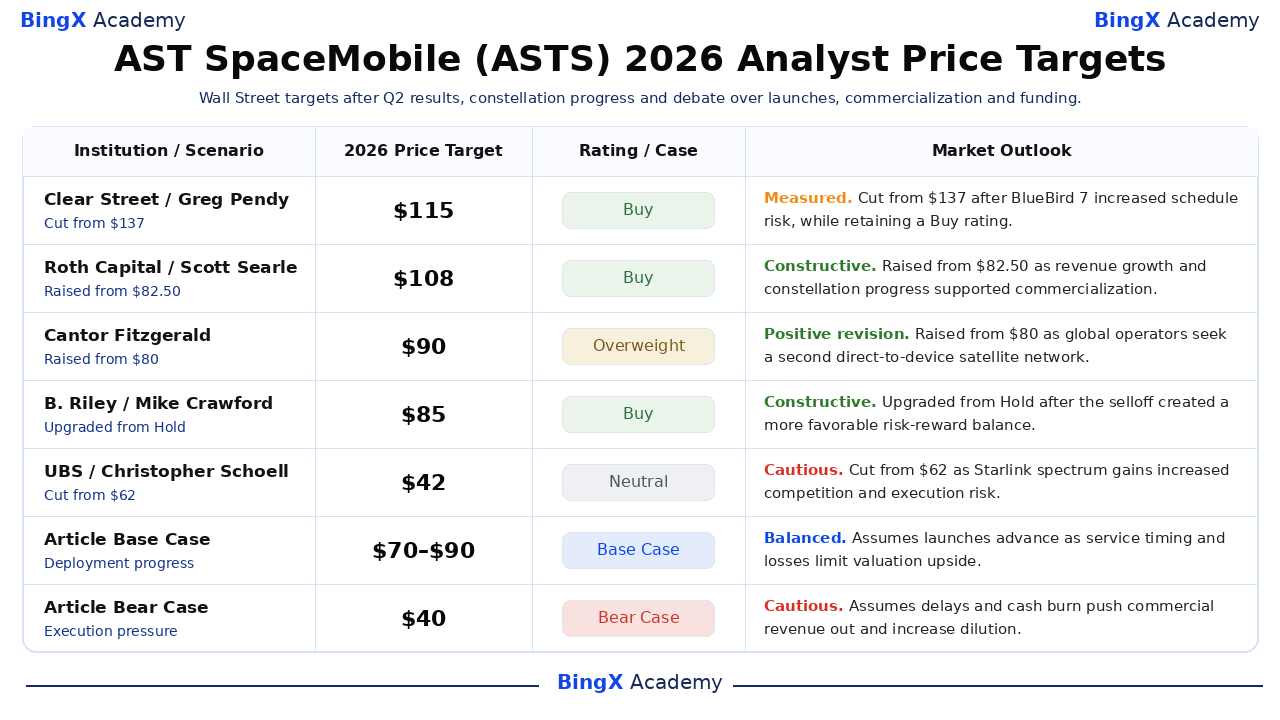
AST SpaceMobile (ASTS) 2026 analyst price targets and article scenarios. Third-party targets are reference points, not price promises. Updated September 11, 2026.
The Bull Case: Faster Satellite Deployment Pushes ASTS Toward $120
The Bull Case assumes launches remain frequent, satellites operate as planned and operator testing progresses into paid service. Backlog above $1.3 billion begins converting, government awards expand and the network moves closer to the 45 to 60 satellites needed for continuous coverage in selected markets.
A move toward $120 would require 2026 revenue near or above the $200 million guidance ceiling, service activation with AT&T, Verizon or Vodafone, and a clear path from $3.7 billion of liquidity to a commercially useful constellation. Higher revenue estimates and lower cash use per satellite would strengthen the case.
The Base Case: Steady Satellite Deployment Keeps ASTS Between $70 and $90
The Base Case assumes BlueBird production and launches advance, gateway and government revenue support the annual outlook, and mobile operators continue integration work. Commercial activation remains uneven, while the $230.9 million quarterly loss keeps the $1.3 billion backlog from translating quickly into earnings.
ASTS could trade mainly between $70 and $90 under these conditions. Revenue within the $150 million to $200 million range, successful satellite commissioning and stable backlog would support the range. Major launch delays or guidance below $150 million would weaken the upper end.
The Bear Case: Launch Delays and Dilution Pull ASTS Toward $40
The Bear Case assumes launch or satellite failures delay continuous coverage, slowing operator activation and revenue recognition. Costs remain elevated as manufacturing continues, while additional convertible or equity financing adds dilution.
A move toward $40 would become more likely if second-half revenue falls well short of the $103.8 million needed to reach the annual guidance floor, satellite deployment misses the coverage plan or regulators delay spectrum access. Stronger Starlink competition could add further pressure before AST reaches positive cash flow.
ASTS Stock Price Forecasts for 2026 By Wall Street Analysts
These five dated actions span $42 to $115 and reflect sharply different assumptions about launch cadence, operator demand, competition and financing. They are third-party reference points rather than a single consensus forecast. The final Base and Bear rows are BingX Academy editorial scenarios and are labeled separately.
|
Institution / Scenario |
2026 Price Target |
Rating / Case |
Market Outlook |
|
Clear Street / Greg Pendy |
$115 |
Buy |
Measured. April 20: cut from $137 after BlueBird 7 increased schedule risk, while retaining Buy. |
|
Roth Capital / Scott Searle |
$108 |
Buy |
Constructive. March 3: raised from $82.50 as revenue growth and constellation progress supported commercialization. |
|
Cantor Fitzgerald / Colin Canfield |
$90 |
Overweight |
Positive revision. August 11: raised from $80 as global operators seek a second direct-to-device satellite network. |
|
B. Riley / Mike Crawford |
$85 |
Buy |
Constructive. July 17: upgraded from Hold after the selloff created more favorable risk-reward. |
|
UBS / Christopher Schoell |
$42 |
Neutral |
Cautious. September 9: cut from $62 as Starlink spectrum gains increased competition and execution risk. |
|
Article Base Case |
$70–$90 |
Base Case |
Balanced. Assumes launches advance as service timing and losses limit valuation upside. |
|
Article Bear Case |
$40 |
Bear Case |
Cautious. Assumes delays and cash burn push commercial revenue out and increase dilution. |
How to Trade AST SpaceMobile (ASTS) Stock on BingX
Trade AST SpaceMobile's BlueBird-deployment, operator-activation and backlog-conversion outlook using BingX TradFi and BingX AI tools. Because ASTS can react sharply to launch outcomes, regulatory decisions and financing updates, traders should define both the catalyst and risk limits before entering a position.
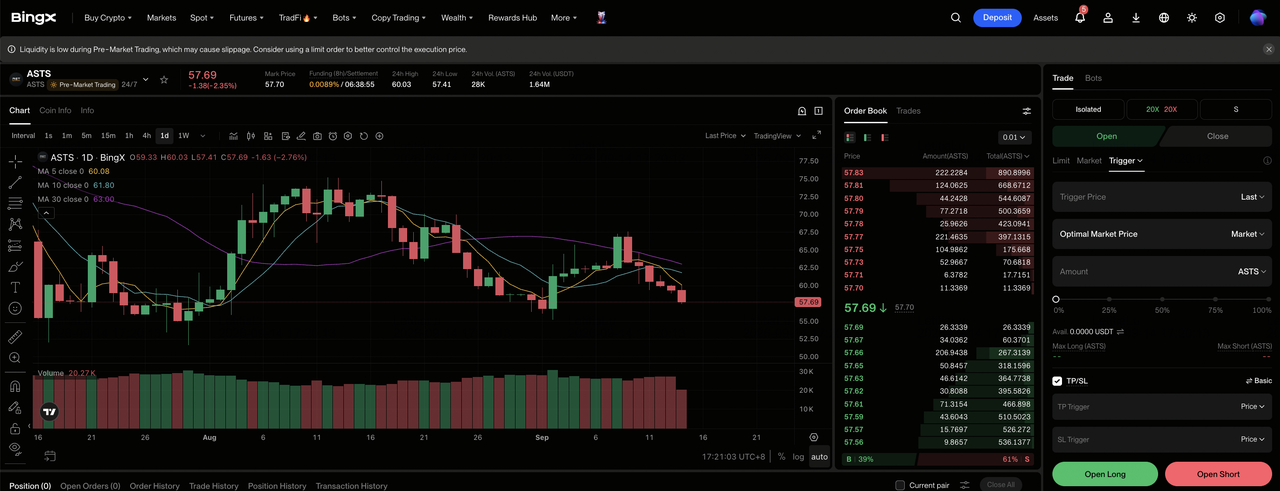
Step 1: Access BingX TradFi. Sign up and navigate to the specialized TradFi section on the BingX exchange dashboard.
Step 2: Select AST SpaceMobile (ASTS). Search for and select the ASTS-USDT perpetual futures contract.
Step 3: Choose your direction. Select Open Long if launches remain on schedule, backlog converts and operators activate service. Select Open Short if delays, cash burn or competition weaken expected per-share economics.
Step 4: Select leverage and margin mode. Choose Isolated or Cross-Margin based on your risk tolerance. ASTS traded more than 55% below its $133.86 52-week high, showing why conservative leverage and clear position sizing are important.
Step 5: Execute strict risk protocols. Set Take-Profit and Stop-Loss (TP/SL) levels before or immediately after entering the trade. ASTS can react quickly to launches, satellite commissioning, carrier agreements, spectrum approvals, guidance and financing.
Top 5 Risks to Watch for AST SpaceMobile Investors in 2026
AST SpaceMobile's valuation depends on deployment, commercialization and financing milestones that can change the timing and value of future cash flow.
- Launch or deployment failures could delay coverage: The network had 13 satellites in orbit and needs roughly 45 to 60 for continuous coverage in selected markets. A failed satellite would delay revenue and add replacement costs.
- The $1.3 billion backlog may convert slowly: Revenue depends on gateways, satellite deployment, regulatory approvals and customer acceptance. Delays could push revenue and cash receipts into later periods.
- A $230.9 million quarterly loss keeps dilution risk high: More than $3.7 billion of pro forma liquidity supports expansion, but the $1.15 billion convertible-note raise shows external funding remains important. More securities could dilute future per-share earnings.
- Spectrum approvals could slow market expansion: Nearly 60 operator relationships span multiple jurisdictions with different telecom rules. Delays in major markets could reduce the reachable subscriber base and weaken partner economics.
- Starlink could pressure adoption and pricing: SpaceX operates a much larger constellation and has strengthened its spectrum position. Faster deployment or stronger carrier deals could reduce AST's market share and pressure service economics.
Final Thoughts: Should You Invest in AST SpaceMobile in 2026?
AST SpaceMobile has moved beyond a purely technical concept. Q2 revenue reached $31.5 million, backlog grew to about $1.3 billion and operator relationships cover more than 3 billion subscribers. Those figures establish demand and distribution, though the $230.9 million net loss and remaining satellite requirement show how much execution still sits ahead.
The Bull Case requires launches and operator activation to turn backlog into recurring revenue, supporting $120. The Bear Case reflects schedule delays, competition and financing pressure that could pull ASTS toward $40. Conservative traders may wait for revenue at the annual guidance floor, successful commissioning of additional BlueBirds and clearer commercial-service timing.
Risk Reminder: Trading and investing in equities like ASTS involves a high risk of capital loss. Launch failures, satellite defects, spectrum delays, cash burn, dilution, competition and leveraged trading can produce rapid losses. Conduct independent research before allocating capital.
Related Reading
- Top Space Stocks to Buy Ahead of SpaceX IPO
- Top Defense Stocks to Buy in 2026: Primes, Missiles, Drones, Space, and AI-Enabled Warfare
- SpaceX (SPCX) Price Prediction 2026: $227 Street-High AI Fusion or Trillion-Dollar Valuation Bubble?
- Rocket Lab (RKLB) Price Prediction 2026: Can New Rocket and Defense Growth Push RKLB Toward $150?
- Firefly Aerospace Stock Outlook 2026: Can Launch Vehicles, Spacecraft Services Drive FLY to $45+?
- Lockheed Martin (LMT) Price Prediction 2026: Can Record Backlog Push LMT Toward $700?
