

Investing in Ethereum (ETH) versus XRP (XRP) represents a fundamental strategic choice between banking on the foundational infrastructure of the on-chain Web3 economy and backing a highly streamlined, institutionally adopted global payment rail. While both assets are trading at multi-month discounts, their core mechanics, value drivers, and recovery paths could not be more distinct.
Through the first half of 2026, Ethereum faced severe short-term sentiment headwinds. Despite boasting massive developer activity and hosting the lion's share of decentralized applications, heavy liquidations from prominent whale addresses and consecutive weeks of outflows from U.S. spot Ether ETFs pushed ETH's price down into a consolidation zone around $1,550–$1,600. Yet, beneath the bearish price action, Ethereum's core developers are executing rapid technical upgrades to prepare the network for unprecedented transaction scalability.
Concurrently, XRP is navigating a massive structural evolution of its own. Having cleared its multi-year SEC legal overhang, the token has established a solid psychological baseline around the $1.04 support line. Rather than remaining a pure cross-border remittance asset, the XRP Ledger (XRPL) has experienced an explosive institutional pivot in 2026, capturing significant market share in stablecoin issuance and Real-World Asset (RWA) tokenization.
As macro liquidity conditions tighten across the digital asset sector, choosing where to deploy capital requires looking past temporary price volatility. Investors must analyze real-time on-chain demand, track institutional product inflows, and understand how to leverage advanced trading systems on BingX to navigate the next phase of this crypto market cycle.
Introduction: Understanding Ethereum and XRP
To construct an effective investment thesis for the remainder of 2026, we must first trace the unique operational mandates, historical milestones, and overarching market footprints of these two prominent networks.
Ethereum (ETH), the World Computer and Settlement Layer
Ethereum was proposed in late 2013 by programmer Vitalik Buterin and officially went live in July 2015. It fundamentally changed the blockchain landscape by introducing a Turing-complete decentralized computer, the Ethereum Virtual Machine (EVM), which allowed developers to write self-executing smart contracts. This breakthrough shifted the narrative of crypto from simple digital peer-to-peer payments to a global programmable infrastructure layer.
Over its lifespan, Ethereum has consistently driven the industry's primary structural cycles. It served as the launchpad for the Initial Coin Offering (ICO) boom, birthed Decentralized Finance (DeFi), pioneered Non-Fungible Tokens (NFTs), and successfully transitioned from Proof-of-Work to an energy-efficient Proof-of-Stake (PoS) model during The Merge in September 2022. Today, Ethereum handles the vast majority of the on-chain global economy, acting as the primary secure settlement layer for an array of highly liquid Layer 2 (L2) scaling rollups like Arbitrum, Optimism, and Base.
XRP, the High-Speed Enterprise Settlement Asset
XRP was launched in 2012 by tech visionaries David Schwartz, Jed McCaleb, and Arthur Britto, who subsequently co-founded the entity now known as Ripple Labs. Built as an open-source, energy-efficient alternative to the structural latencies and heavy hardware requirements of Bitcoin, the XRP Ledger (XRPL) was specifically optimized to replace the fragmented, slow-moving legacy SWIFT network for global banking institutions and cross-border payment corridors.
XRP's market journey has been profoundly shaped by institutional partnerships and landmark legal battles. Ripple successfully built an enterprise payment network with hundreds of global banks, but faced a major setback in December 2020 when the U.S. SEC initiated a high-profile lawsuit. The final resolution of this multi-year legal conflict in late 2025 established clear legal boundaries for the token on public exchanges. By mid-2026, XRP's narrative has decoupled from past legal anxieties, re-anchoring itself to institutional decentralized financial infrastructure and direct enterprise application.
Ethereum vs. XRP: Key Technical Differences At a Glance
Evaluating these assets for a 2026 portfolio requires a clear side-by-side comparison of their underlying network parameters, structural throughput, and native tokenomics.
|
Factor |
Ethereum (ETH) |
XRP (XRP) |
|
Primary Use Case |
Smart contracts, dApps, DeFi, and Web3 economy |
Cross-border institutional payments & bridge liquidity |
|
Consensus Mechanism |
Proof-of-Stake (PoS) |
Federated Byzantine Agreement (FBA) |
|
Transaction Capacity |
15–30 TPS (Base layer) / Millions on L2 rollups |
1,500+ TPS (Native layer scale) |
|
Transaction Settlement |
~12 seconds to propose (variable finality) |
3–5 seconds (Near-instant absolute finality) |
|
Fee Architecture |
Dynamic (EIP-1559 base fee burn + priority tip) |
Predictable, ultra-low (Typically ~$0.0002) |
|
Supply Dynamics |
Uncapped max supply / Deflationary under high load |
Hard-capped fixed supply of 100 billion XRP |
|
Ecosystem Drivers |
Total Value Locked (TVL), gas burning, dApp utility |
Institutional settlement flows, escrow management |
1. Architectural Consensus: Scalability vs. Absolute Decentralization
Ethereum secures its global computing network through a highly robust Proof-of-Stake architecture. Over 35 million ETH are currently staked by validators worldwide, who are randomly selected every 12 seconds to propose blocks and attest to data validity. This model achieves high economic security, but limits base-layer throughput, necessitating a rollup-centric scaling model to distribute high transaction volume to secondary networks.
The XRP Ledger bypasses capital-heavy staking entirely. It uses a Federated Byzantine Agreement (FBA) protocol, where independent validation nodes communicate iteratively to uniformly sort transaction sequences. Consensus requires a rigid 80% or greater agreement across a node's Unique Node List (UNL). Because this mechanism requires zero computational competition or capital lockup, it settles transactions in 3 to 5 seconds with minimal resource draw and completely eliminates the risk of frontrunning or Maximal Extractable Value (MEV) exploits.
Read more: How to Stake Ethereum (ETH) in 2026: Top Ways to Know
2. Supply Dynamics and Fee Tokenomics
Ethereum utilizes a dynamic supply curve. There is no hard cap on the total amount of ETH that can exist, but its supply is directly governed by network usage. Under the EIP-1559 fee structure, the base gas fee paid in ETH for every on-chain interaction is programmatically destroyed (burned). When transaction volume scales across DeFi, stablecoins, and RWAs, the burn rate surpasses daily validator issuance, rendering ETH structurally deflationary.
XRP employs a hard-capped, pre-minted economics structure. All 100 billion XRP tokens were brought into existence at genesis. To maintain market transparency and prevent sudden supply diluting, Ripple locked 55 billion tokens into programmatic time-locked escrows in 2017. Every month, up to 1 billion tokens are released to finance global liquidity corridors and institutional integrations, with any unused portion immediately returned to the escrow smart contract. Transaction fees on the XRPL are ultra-low and programmatically burned to protect the ledger from spam.
Read more: Who Owns the Most XRP in 2026? Top 10 XRP Rich List Revealed
ETH, XRP Institutional Momentum and ETF Capital Flows in 2026
Institutional capital allocator trends have emerged as the primary price discovery drivers for both digital assets in 2026. Reviewing real-time fund flows reveals a stark divergence in market behaviors.
Ethereum Spot ETFs: Managing Short-Term Volatility
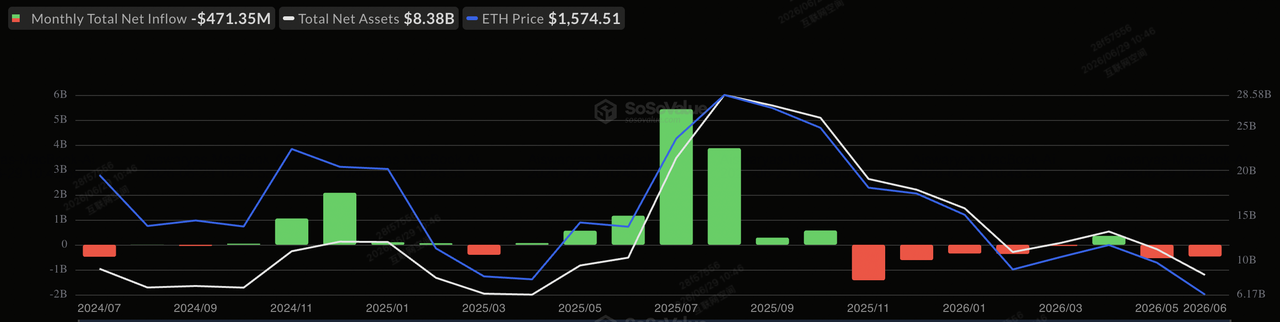
Monthly flows in spot Ethereum ETFs | Source: SoSoValue
Following a monumental launch phase, U.S. spot Ether ETFs hit a turbulent stretch in mid-2026. Driven by a macro-driven risk-off posture among Wall Street desks, Ethereum investment vehicles saw consecutive weeks of red territory, including over $273 million in net outflows in late June. Despite this near-term capital contraction, net assets held within regulated spot ETH vehicles remain structurally resilient at over $8.4 billion, reflecting a sticky base of institutional holders who view ETH as essential digital commodity exposure.
XRP Spot ETFs: The Contrarian Accumulation Sprint
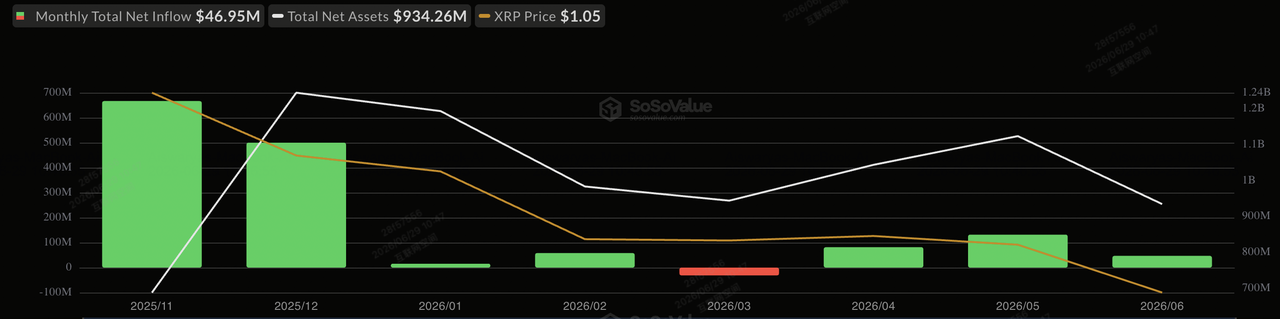
Monthly flows in spot XRP ETFs | Source: SoSoValue
While the largest crypto assets faced intense capital liquidations, spot XRP ETFs defied the broader market trend to demonstrate historic relative strength. In late June 2026, spot XRP funds registered an impressive $15.63 million in positive daily net inflows, extending a green-only weekly inflow streak to 8 consecutive weeks. Backed by issuers like Bitwise and Franklin Templeton, cumulative net inflows into spot XRP products have climbed to an all-time high of $1.47 billion, signaling aggressive accumulation by institutional buyers who are using the market dip to build long-term positions.
Portfolio Position Sizing for Ethereum and XRP: Bull and Bear Cases for 2026
Weighing whether to concentrate your portfolio in Ethereum or XRP for the remainder of 2026 requires assessing their primary structural growth catalysts alongside the localized risks that could cap their price performance.
Why Invest in Ethereum (ETH) in 2026?
The Bull Case: Price Target $4,500–$7,500
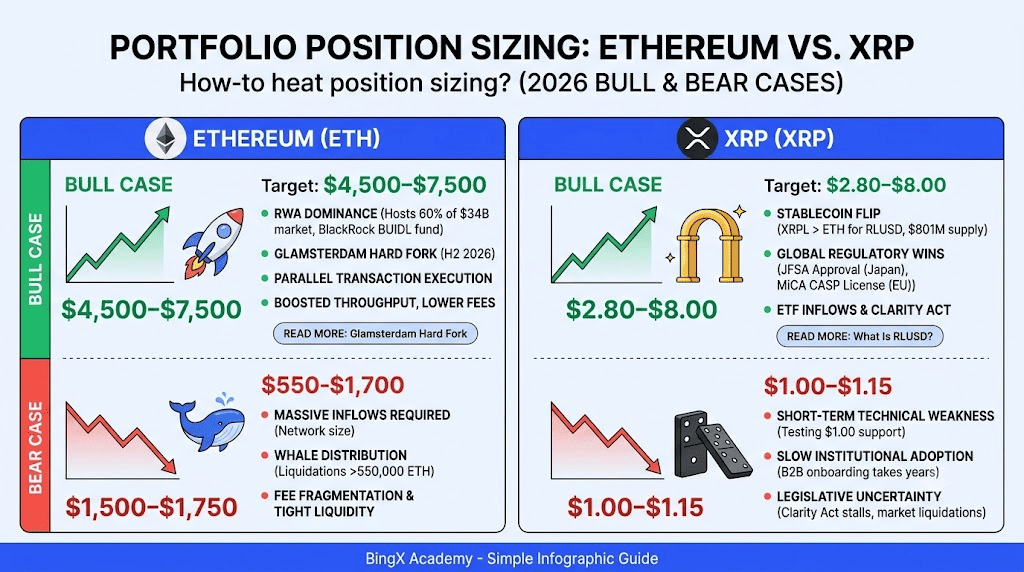
The underlying demand engine for Ethereum remains incredibly strong. The platform dominates the rapidly growing tokenized RWA sector, hosting 60% of a total $34 billion market that includes BlackRock’s flagship BUIDL fund. Structurally, the network is preparing to launch its highly anticipated Glamsterdam hard fork in the back half of 2026.
Glamsterdam will implement parallel transaction execution and raise the block gas limit, drastically boosting transaction throughput and lowering gas fees on the base layer. If the Glamsterdam upgrade matches engineering expectations and triggers a resurgence in DeFi capital deployment, analysts project an institutional bull target expanding toward $7,500.
Read more: What Is Ethereum Glamsterdam Upgrade in H1 2026 and What Changes Does the Hard Fork Bring?
ETH's Bear Case: Price Target $1,500–$1,750
Ethereum's massive size means it requires massive inflows to lift its valuation significantly. In a tight macroeconomic environment where global liquidity is constrained, ETH faces immediate price pressure from ongoing whale distribution. On-chain data indicates that major holders liquidated over 550,000 ETH valued around $880 million during recent support tests. If market sentiment remains depressed and fee fragmentation across competing Layer 2 chains continues to reduce the amount of ETH burned on the mainnet, ETH could remain trapped within its current consolidation floor between $1,500 and $1,750.
Why Buy XRP (XRP) in 2026?
The Bull Case for XRP: Price Target $2.80–$8.00
XRP is experiencing a dramatic fundamental transformation. For the first time in its history, the XRP Ledger has flipped Ethereum to become the primary host for Ripple's dollar-backed stablecoin, holding $801 million in RLUSD supply compared to Ethereum's $795 million. This milestone is supercharged by critical international regulatory milestones, including full approval from the Japan Financial Services Agency (JFSA) via SBI Group and a preliminary Markets in Crypto-Assets (MiCA) CASP license through Luxembourg, allowing Ripple to passport its payments stack across 30 European countries. Backed by sustained ETF inflows and legislative momentum from the advancing U.S. Digital Assets CLARITY Act, Standard Chartered maintains a technical bull case target of $8.00 by year-end, with conservative models placing a base case at $2.80.
Read more: What Is RLUSD? A Beginner's Guide to Ripple's USD-backed Stablecoin
XRP's Bear Case: Price Target $1.00–$1.15
XRP's short-term price action remains technically weak, having broken down from its previous $1.30–$1.50 range to test the crucial $1.00 psychological support zone. Skeptics highlight that capturing multi-trillion-dollar institutional banking flows is a multi-year onboarding process, meaning near-term transactional utility cannot immediately neutralize market-wide selling pressure. If legislative progress on the CLARITY Act encounters friction in Congress or the broader altcoin market faces deeper liquidations, XRP could break below $1.00 to establish a temporary capitulation floor near $1.05.
How to Trade Ethereum (ETH) and XRP on BingX
BingX offers an advanced suite of trading interfaces, quantitative options, and algorithmic execution mechanisms to streamline your capital allocation across both major assets.
Buy, Sell, or HODL ETH and XRP on the Spot Market
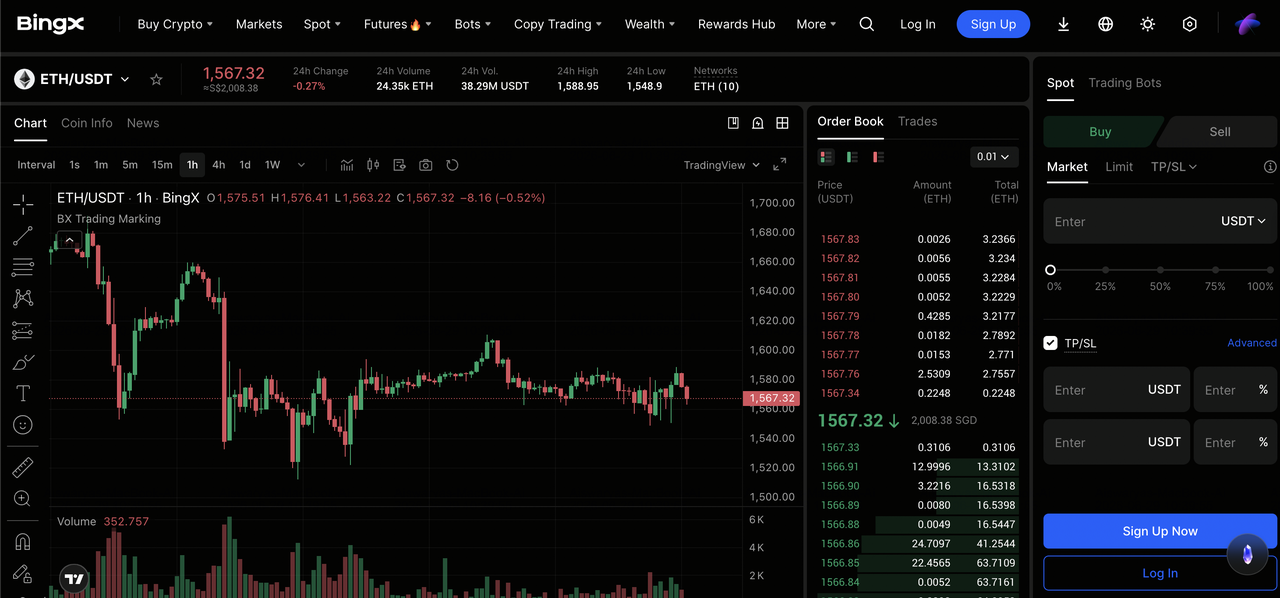
ETH/USDT trading pair on BingX spot market
- Log in to your BingX account, navigate to the main dashboard menu, hover over Spot, and click Spot to initialize the live spot trading platform.
- Use the left-side asset selection panel to search for either ETH/USDT or XRP/USDT to load the real-time asset charting terminal.
- Review the live order book dynamics and choose your execution type: select a Market Order for immediate entry at the best prevailing price, or a Limit Order to specify a precise entry target.
- Input your designated investment capital size in USDT, click Buy ETH or Buy XRP, and view your purchased tokens securely inside your integrated spot asset account.
Trade ETH, XRP Perpetual Contracts with Managed Leverage on the Futures Market
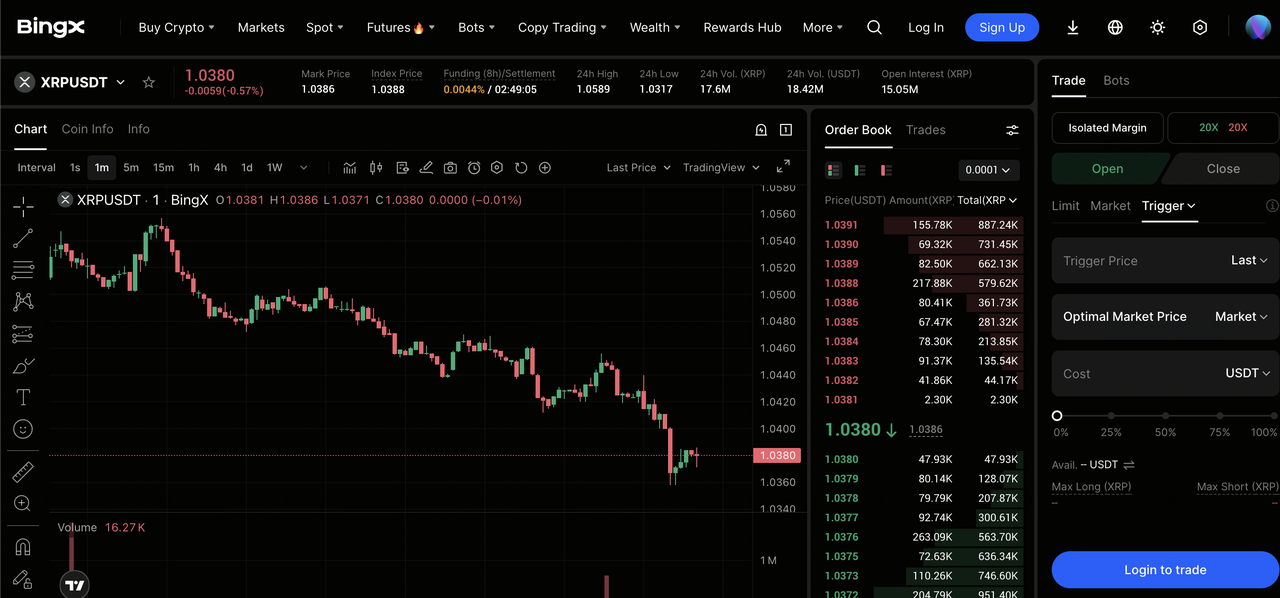
XRP/USDT perpetual contract on BingX futures market
- Navigate to the top menu bar, hover over Futures, and click Perpetual Futures to open the high-liquidity derivatives console.
- Click the contract pair selection dropdown in the upper-left corner of the interface and select the ETH/USDT Perpetual or XRP/USDT Perpetual contract.
- Configure your desired margin parameters: select Isolated Margin to limit position risk to an individual trade, or Cross Margin to utilize your broader collateral account pool. Adjust your leverage sliders to a disciplined 2x to 5x setting.
- Open the trade execution terminal to choose Long if your technical analysis indicators predict an upward breakout, or select Short to position for a downside macro market correction.
- Program your precise risk mitigation parameters by inputting specific Take-Profit (TP) and Stop-Loss (SL) trigger thresholds in the order module before clicking the trade confirmation button.
DCA ETH and XRP: Automate Your Strategy with BingX Recurring Buy
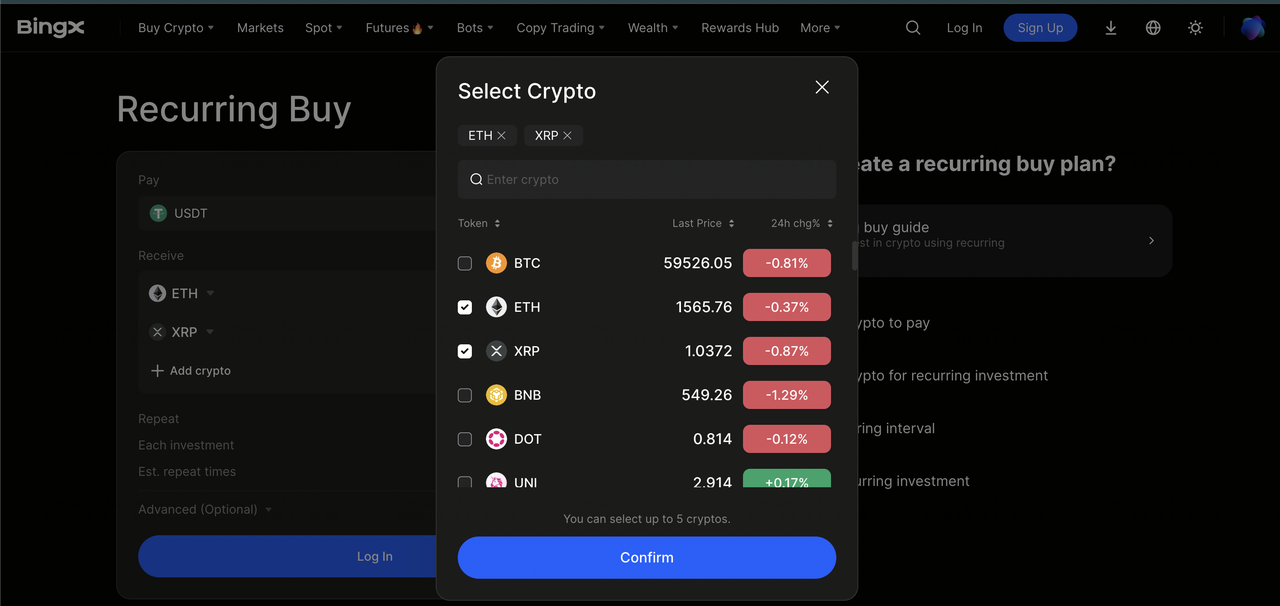
DCA ETH and XRP on BingX Recurring Buy
- Navigate to the BingX automated tools ecosystem and select Recurring Buy to initialize programmatic, emotion-free Dollar-Cost Averaging (DCA).
- Create a customized asset basket configuration to simultaneously accumulate both tokens, allocating specific target percentage splits across your portfolio.
- Select your primary funding stablecoin engine, such as USDT or USDC, and designate your automated purchase capital limit per individual execution interval, starting from as low as 1 USDT.
- Fine-tune your programmatic timing cadence by selecting an automated execution routine from the checklist, including Daily, Weekly, Bi-Weekly, or Monthly frequencies.
- Verify your automated DCA blueprint settings, check the platform protocol agreement box, and click Create Plan to launch automatic purchases that smooth out market-wide volatility.
5 Key Considerations for Adding ETH or XRP to Your Portfolio in 2026
Determining how to split your capital between Ethereum and XRP for the remainder of 2026 requires a balanced assessment of broad market parameters.
- Ecosystem Activity vs. Specialized Payment Utility: Ethereum is an expansive, general-purpose platform whose value scales directly with on-chain Web3 economic activity, gas consumption, and application deployment. XRP functions as a highly specialized, ultra-efficient financial primitive optimized explicitly for high-velocity B2B capital movement.
- Technical Upgrade Execution Risk: Ethereum's 2026 investment thesis is heavily tied to the engineering success of the complex Glamsterdam and Hegotá upgrades to scale its base layer. XRP's core technical infrastructure is already hardened, processing high-throughput volumes natively without relying on secondary layers.
- Institutional Product Lifecycles: Spot Ether ETFs represent a larger, highly liquid investment vehicle backed by over $8.4 billion in assets, though they are currently experiencing a period of market fatigue. Spot XRP ETFs are newer and smaller, but possess significant contrarian momentum with 8 straight weeks of positive capital inflows.
- Regulatory Clarity Milestones: XRP possesses a uniquely clear regulatory profile globally following its 2025 settlement and accelerating European MiCA compliance. Ethereum remains highly secure as an established commodity, but faces ongoing regulatory discussions regarding the addition of native staking features to its ETF structures.
- Beta Multipliers and Market Capitalization: Ethereum behaves as a classic large-cap blue-chip digital asset, offering lower overall volatility but requiring substantial capital flows to shift its macro price trend. XRP possesses a market cap roughly one-third the size of Ethereum's, making it a higher-beta play that can deliver sharper percentage moves during an altcoin market recovery.
Conclusion: What’s a Better Investment for 2026, ETH or XRP?
There is no single answer to the Ethereum vs. XRP question, as both digital assets address completely non-overlapping sectors of the blockchain economy.
Ethereum remains the safer, structurally superior foundation for long-term Web3 exposure. If your goal is to invest in the primary settlement engine of global decentralized finance, digital asset tokenization, and the broader dApp ecosystem, Ethereum's deep network effects and structural deflationary burning mechanics make it the premium choice for long-term capital appreciation.
XRP represents a compelling, high-upside utility play for growth-oriented portfolios. If you are looking to capitalize on immediate institutional momentum, accelerating spot ETF inflows, and real-world cross-border payment integration under a highly favorable global regulatory landscape, XRP's lower absolute market capitalization offers asymmetric percentage upside as traditional banking rails migrate on-chain.
Many sophisticated market participants employ a balanced satellite allocation model: designating Ethereum as a core portfolio holding to capture the steady expansion of the decentralized economy, while maintaining a dedicated satellite position in XRP to capture the significant percentage gains triggered by accelerating global fintech adoption.
Related Reading
- Who Owns the Most XRP in 2026? Top 10 XRP Rich List Revealed
- Who Owns the Most Ethereum in 2026? Top 10 ETH Rich List Revealed
- Bitcoin vs. XRP: What’s a Better Investment in 2026?
- Spot XRP ETFs to Launch on November 13: What Is a Spot XRP ETF?
- What Are the Top Spot Ethereum ETFs to Buy in 2026?
FAQs on Ethereum (ETH) vs. XRP (XRP)
1. Is XRP built to compete directly with Ethereum?
No. Ethereum is designed as a decentralized, general-purpose smart contract platform for building open-source applications, DeFi protocols, and tokenized real-world assets. XRP is engineered as a high-speed, low-cost asset designed explicitly to serve as bridge liquidity for international fiat currencies and cross-border bank settlements.
2. Why is the RLUSD stablecoin supply flipping toward the XRP Ledger significant?
For the first 18 months following its launch, the vast majority of Ripple USD (RLUSD) was issued on Ethereum. The flip to the XRP Ledger hosting more supply ($801M vs. $795M) demonstrates that major international financial institutions are actively choosing the native XRPL infrastructure for stablecoin settlements due to its superior speed, ultra-low costs, and regulatory compliance.
3. How do Ethereum's 2026 upgrades affect transaction costs?
The upcoming Glamsterdam upgrade will introduce parallel transaction processing capabilities and expand the base-layer gas limit limit beyond 100 million per block. This engineering milestone is designed to significantly expand Layer 1 scaling capacity, reducing network congestion and lowering transaction costs for end-users.
4. Can I convert my ETH directly into XRP on BingX?
Yes. You can instantly swap your assets by executing a spot market transaction to sell your ETH for USDT and using the proceeds to purchase XRP, or you can leverage the native BingX asset conversion module to quickly rotate capital between different altcoin strategies.
5. Does the XRP Ledger require computational mining?
No. The XRPL completely abandons the energy-intensive computational mining models used by Proof-of-Work blockchains. Instead, it relies on a Federated Byzantine Agreement consensus protocol where trusted validator nodes uniformly sort and confirm transaction sequences in 3 to 5 seconds.
