

Mantle sits at the intersection of Ethereum scaling and on-chain finance, but its approach is broader than most Layer 2 projects. Rather than simply building a faster version of Ethereum, Mantle is developing a full-stack financial ecosystem that includes a modular rollup network, liquid staking, a Bitcoin wrapper, an institutional index product, and payments infrastructure. The network positions itself as a “Banking Chain,” where institutional capital and DeFi users can interact on low-cost, EVM-compatible infrastructure.
It is important to separate the main parts of the Mantle ecosystem. Mantle Network is the Ethereum Layer 2 blockchain. MNT is the native token used for gas fees and governance. Mantle DAO manages the Mantle Treasury and guides ecosystem development. Mantle Group is the broader product umbrella that includes mETH Protocol, FBTC, Mantle Index Four (MI4), and UR, a unified payments product. This guide explains what Mantle is, how Mantle Network works, how the ecosystem has grown, how MNT tokenomics function, the main risks to consider, and how to trade MNT on BingX.
What Is Mantle (MNT)?
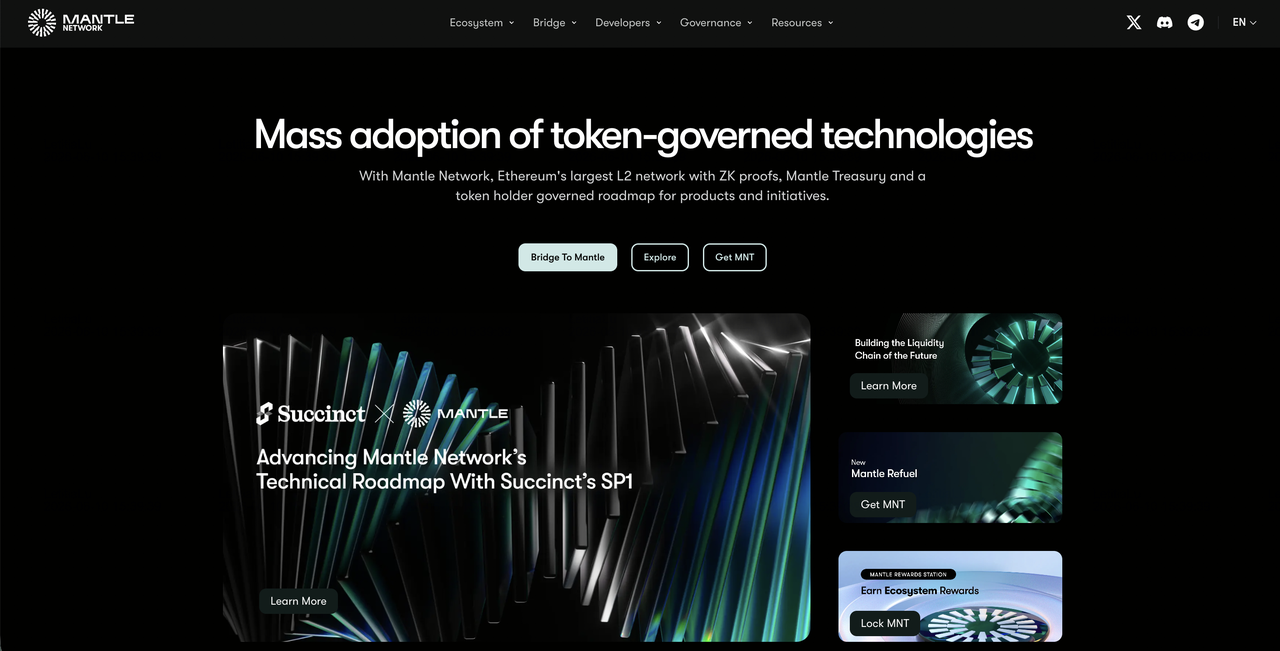
Mantle (MNT) is a modular Ethereum Layer 2 blockchain built for low-cost, high-speed, EVM-compatible applications. It emerged from BitDAO after a 2023 governance vote and launched following a 1:1 token migration from BIT to MNT. Unlike company-led networks, Mantle is DAO-governed, with the Mantle Treasury funding ecosystem growth and protocol development.
Mantle combines Ethereum settlement with lower-cost execution on its own Layer 2 network. Its main difference is the way it pairs rollup infrastructure with a treasury-backed financial ecosystem, including mETH Protocol, FBTC, Mantle Index Four, and UR payments. This makes Mantle more than a scaling network. It is also an on-chain finance ecosystem built around staking, liquidity, institutional products, and payments.
MNT Token vs. Mantle Network vs. Mantle DAO: What Are the Differences?
- MNT token: MNT is the native cryptocurrency of Mantle. It is used for gas fees on Mantle Network, governance voting, and DAO participation. MNT has a maximum supply of about 6.22 billion tokens.
- Mantle Network: Mantle Network is the modular Ethereum Layer 2 blockchain. It uses optimistic rollup technology, settles transactions on Ethereum, and uses EigenDA for data availability. It is EVM-compatible, so developers can use Ethereum smart contract tools.
- Mantle DAO: Mantle DAO is the governance body behind Mantle. MNT holders vote on protocol decisions, ecosystem proposals, and treasury use. Its large DAO treasury is one of Mantle’s biggest differences from other Layer 2 projects.
How Does Mantle Work?
Mantle works by using a modular Layer 2 design. Instead of handling execution, settlement, and data availability in one place like Ethereum mainnet, Mantle separates these functions to reduce costs, improve speed, and still settle back to Ethereum.
- Optimistic rollup execution: Mantle executes transactions off-chain, batches them together, and submits the results to Ethereum for settlement. Transactions are assumed valid unless challenged through a fraud-proof process, which helps keep fees lower than Ethereum mainnet.
- Modular data availability: Mantle separates data availability from execution and settlement. Its architecture has used EigenDA to reduce the cost of storing transaction data, making the network more efficient than a traditional rollup design.
- EVM compatibility: Mantle supports the Ethereum Virtual Machine, so developers can deploy Ethereum smart contracts without rewriting code. Users can also access Mantle through familiar wallets like MetaMask and Rabby.
- Faster withdrawals: Mantle uses MPC-based infrastructure to shorten withdrawal times compared with the standard optimistic rollup challenge period. This improves the user experience when moving assets between Mantle and Ethereum.
Mantle vs. Ethereum vs. Arbitrum vs. Optimism: Modular Layer 2 Comparison
|
Network |
Category |
Main Role |
Key Strength |
Main Difference |
|
Ethereum |
Base settlement and smart contract layer |
Deepest liquidity, security, and developer ecosystem |
Most secure and established, but often more expensive during high demand |
|
|
Layer 2 rollup |
Scaling Ethereum apps and DeFi |
Large DeFi ecosystem and strong developer adoption |
Focuses mainly on scaling Ethereum with a broad app ecosystem |
|
|
Layer 2 rollup |
Ethereum scaling and OP Stack ecosystem |
Strong rollup infrastructure and Superchain strategy |
Focuses on building a shared Layer 2 network ecosystem |
|
|
Mantle |
Modular Layer 2 |
Ethereum scaling plus on-chain finance |
Large DAO treasury, mETH, FBTC, MI4, and payment products |
Combines rollup infrastructure with a treasury-backed financial ecosystem |
Major Mantle Developments: From BitDAO to the Banking Chain
Mantle’s history shows how the project evolved from a large DAO treasury into a broader on-chain finance ecosystem. Its major milestones combine governance, Layer 2 infrastructure, liquid staking, institutional products, and the Banking Chain strategy.
|
Milestone |
Date |
Main Purpose |
|
BitDAO Founded |
August 2021 |
DAO launched with multi-billion dollar treasury and backing from Bybit, Founders Fund, Pantera |
|
Mantle Testnet |
January 2023 |
First public testnet of the Mantle Ethereum Layer 2, processed over 14 million testnet transactions |
|
BIP-21 Rebrand Vote |
May 2023 |
BitDAO community voted to rebrand to Mantle and migrate BIT tokens to MNT at a 1:1 ratio |
|
Mainnet Alpha Launch |
July 2023 |
Mantle Network went live with a $200 million ecosystem fund; MNT began trading as successor to BIT |
|
mETH Protocol Launch |
January 2024 |
Mantle launched its liquid staking protocol, which grew to over $1 billion in TVL |
|
cmETH and Restaking |
2024 |
Introduced cmETH, a liquid restaking token built on mETH, reaching the top 5 in Ethereum liquid staking TVL |
|
MI4 Launch |
April 2025 |
Mantle Index Four launched with Securitize, backed by up to $400 million from the treasury, offering diversified institutional crypto exposure |
|
Mantle 2.0 / Banking Chain |
Mid-2025 |
Mantle reoriented around the "Banking Chain" identity, integrating mETH, cmETH, FBTC, MI4, and UR into a unified financial platform |
- BitDAO Foundation and Mantle Testnet (2021-2023): BitDAO launched in 2021 with backing from Bybit, Founders Fund, Pantera Capital, and Dragonfly Capital. Mantle later emerged from this treasury-backed ecosystem, with its public testnet validating the network before mainnet.
- BIP-21 Rebrand and MNT Migration (May 2023): The BitDAO community voted to unify the brand, governance, and token under Mantle. BIT holders migrated to MNT at a 1:1 ratio, consolidating the ecosystem under Mantle.
- Mantle Mainnet Alpha and Ecosystem Fund (July 2023): Mantle Network launched mainnet alpha alongside a $200 million ecosystem fund, opening the Layer 2 network to real users, developers, and dApps.
- mETH and cmETH Expansion (2024): Mantle launched mETH Protocol for liquid staking, allowing users to stake ETH while keeping liquidity through mETH. It later introduced cmETH, adding restaking exposure through EigenLayer and related platforms.
- Mantle Index Four (April 2025): Mantle launched MI4 with Securitize, creating an institutional crypto index product backed by Mantle Treasury capital and offering exposure to BTC, ETH, SOL, stablecoins, and DeFi yield strategies.
- Mantle 2.0 and the Banking Chain Strategy (Mid-2025): Mantle repositioned itself as the “Banking Chain,” combining Mantle Network, mETH, cmETH, FBTC, MI4, and UR into a full-stack on-chain finance platform.
Read More: BingX vs. Bybit 2026: Which Is Better for Spot and Futures Trading? Pros, Cons and Fees Compared
Mantle Ecosystem and Adoption: DeFi Growth, Liquid Staking, and Institutional Finance
Mantle’s adoption is driven less by raw Layer 2 activity and more by its product ecosystem. Its strongest demand drivers are liquid staking, treasury-backed financial products, Bybit integration, and institutional tokenization.
1. mETH and cmETH Drive Core Ecosystem Activity
mETH and cmETH are Mantle’s strongest adoption drivers. They allow users to access ETH staking and restaking yield while keeping liquidity, making them central to Mantle’s DeFi activity. Their integrations with Aave, Pendle, Merchant Moe, and other protocols also extend Mantle’s reach beyond its own chain and give these assets more use cases across DeFi.
2. Treasury-Backed Products Support Institutional Demand
Mantle’s large DAO treasury gives it a clear advantage over many Layer 2 ecosystems. The treasury funds ecosystem growth, strategic incentives, and institutional products such as Mantle Index Four (MI4). Mantle’s tokenization strategy also includes partnerships with issuers such as Ondo Finance, World Liberty Financial, and SBI Holdings, while FBTC adds Bitcoin liquidity across multiple chains.
3. Bybit Gives Mantle a Distribution Advantage
Bybit remains one of Mantle’s most important distribution channels. MNT trading pairs, fee benefits, collateral support, and FBTC integration give Mantle access to a large retail and institutional user base. This exchange connection helps Mantle reach users without relying only on organic DeFi discovery.
4. Complexity and Liquidity Concentration Remain Risks
Mantle’s product stack is powerful but complex, covering bridging, restaking, data availability, modular infrastructure, and multiple financial products. DeFi liquidity is also concentrated in a few major protocols, which makes broader dApp diversity important. For Mantle’s adoption case to strengthen, it needs sustained activity beyond its core treasury-backed products.
What Are the Mantle (MNT) Tokenomics?
Mantle tokenomics center on a fixed supply cap and a DAO-controlled treasury. MNT has a maximum supply of approximately 6.22 billion tokens, with no ongoing mining, staking emissions, or Bitcoin-style block rewards. New MNT does not enter circulation through inflation. Instead, supply is split between public circulating tokens and the Mantle Treasury, which is governed by MNT holders through the Mantle DAO.
MNT Token Utilities and Supply Mechanisms
MNT is the core economic asset of the Mantle ecosystem. It is used for gas fees, governance, treasury coordination, and ecosystem incentives.
- Pay gas fees: MNT is used to pay transaction fees on Mantle Network, creating utility demand when on-chain activity grows.
- Governance participation: MNT holders can vote on Mantle DAO proposals, including treasury allocation, ecosystem funding, product development, and protocol updates.
- Treasury coordination: The Mantle Treasury holds a large portion of MNT alongside ETH, stablecoins, and other assets. Treasury decisions, such as MI4 capital deployment or ecosystem grants, can affect MNT’s long-term value and market dynamics.
- Ecosystem incentives: MNT is used to support grants, developer incentives, liquidity programs, and other initiatives designed to grow Mantle’s dApp ecosystem.
- Fixed supply cap: MNT has a maximum supply of approximately 6.22 billion tokens, with no inflationary issuance mechanism.
MNT Token Allocation
MNT tokenomics are unusual because there is no traditional founder or investor vesting schedule. Instead, MNT supply is split between public circulating supply and a large DAO-controlled treasury.
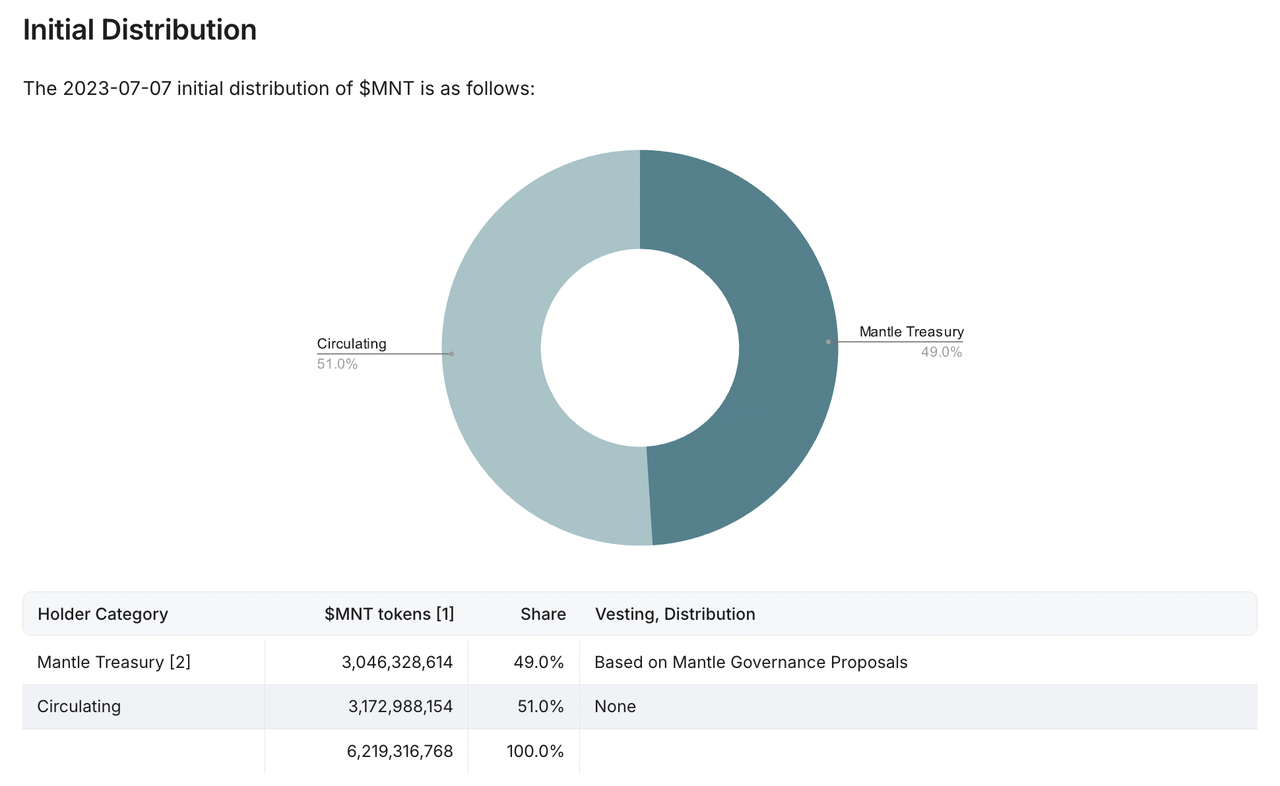
- Public circulating supply: 51%. This portion is available to holders, traders, and ecosystem participants. It represents the MNT already circulating in the market.
- Mantle Treasury: 49%. his portion is controlled by Mantle DAO and used for ecosystem growth, grants, product development, liquidity programs, and strategic initiatives.
The Mantle Treasury is what makes MNT tokenomics different from many other Layer 2 projects. Treasury decisions, such as MI4 capital deployment or ecosystem fund grants, are voted on publicly by MNT holders. This means large-scale supply movements require governance approval rather than being controlled by a traditional company, founder team, or private investors.
How to Trade Mantle (MNT) on BingX
BingX offers two practical ways to gain exposure to Mantle, depending on whether the goal is direct ownership or short-term trading. Spot trading is better suited for users who want to buy and hold MNT directly, and futures trading is designed for active traders who want long or short exposure to MNT price movements.
Spot Trading: Buy and Own MNT Directly
Spot trading is the most straightforward way to buy Mantle on BingX. When users buy MNT on the spot market, they own the asset directly and can hold it in the BingX spot account, transfer it, or withdraw it to a self-custody wallet.
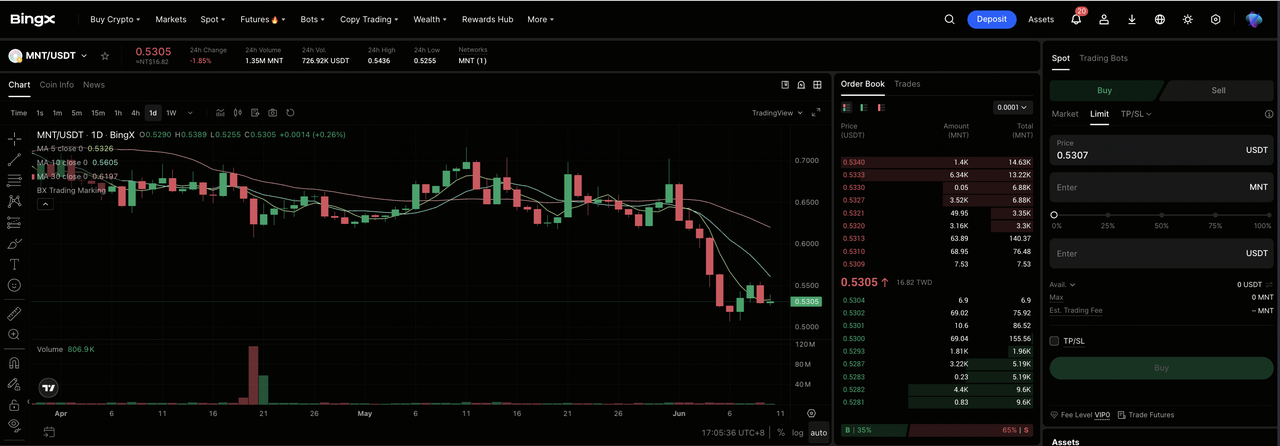
Step 1: Account setup and security. Sign up and log into your BingX account, complete the identity verification (KYC) required in your region, and enable two-factor authentication.
Step 2: Fund your spot account. Deposit USDT or another supported asset into your BingX spot account. Where available, users can also use supported fiat on-ramp options.
Step 3: Navigate to the spot market. Search for the MNT/USDT trading pair.
Step 4: Place your order. Choose a market order to buy MNT immediately at the current price, or use a limit order to set the price you want to pay.
Step 5: Manage your MNT. Once filled, your MNT appears in your spot account. You can keep it on BingX for convenience or withdraw it to a personal wallet for self-custody.
Futures Trading: Trade MNT Price Movements
For active traders, BingX offers USDT-margined MNT perpetual futures. Futures allow users to trade MNT price movements without holding the underlying asset, with the flexibility to open long positions if they expect MNT to rise or short positions if they expect MNT to fall.
Because futures involve leverage, they can amplify both gains and losses. This approach is more suitable for traders who already have a clear risk plan and understand liquidation risk, particularly for an asset like MNT that is sensitive to both Ethereum ecosystem sentiment and broader Layer 2 market cycles.
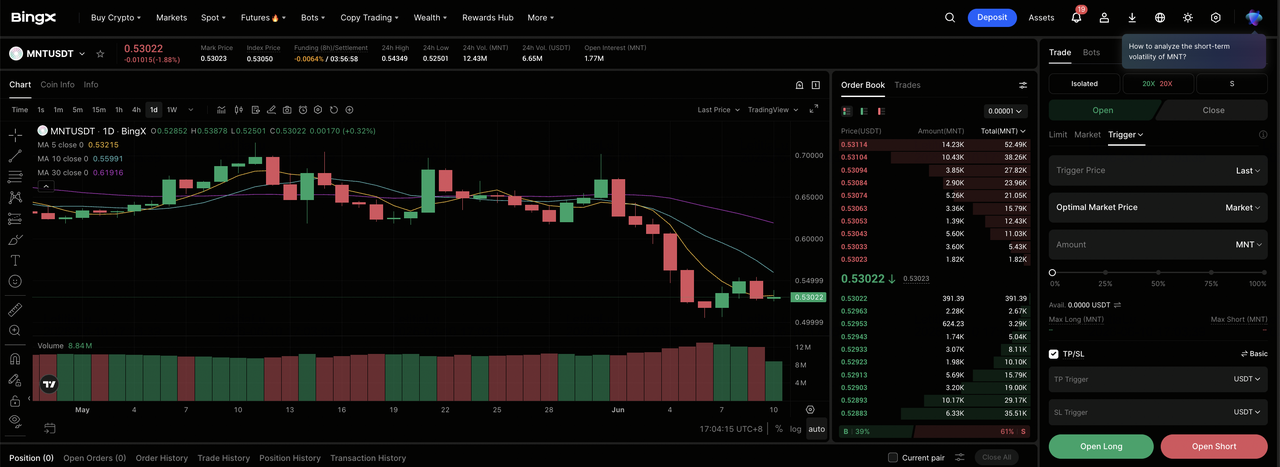
Step 1: Transfer collateral. Move USDT from your spot account into your futures account, where it will serve as margin.
Step 2: Select the contract. Search for the MNT-USDT perpetual contract.
Step 3: Set direction and leverage. Open long if you expect MNT to rise, or open short if you expect MNT to decline. Choose leverage based on your risk tolerance and position size.
Step 4: Execute the trade. Enter the order amount and choose a market or limit order depending on your trading plan.
Step 5: Manage risk. Set stop-loss and take-profit orders before or immediately after entering the position. Profit and loss settle dynamically in USDT.
Risks and Considerations Before Investing in Mantle (MNT)
Mantle has a strong product ecosystem and a large DAO treasury, but MNT also carries risks tied to technical maturity, governance, competition, and demand sustainability.
- Sequencer centralization: Like many Layer 2 networks, Mantle still relies on a centralized sequencer to order and submit transactions. This creates potential censorship or downtime risk until further decentralization is implemented.
- Proof system maturity: Mantle’s proof architecture is still evolving. Less mature proof systems can create additional infrastructure and smart contract risk compared with more established rollups.
- Treasury and governance risk: The Mantle Treasury holds a large share of MNT supply. Governance decisions around treasury deployment can affect market dynamics, liquidity, and investor confidence.
- DeFi liquidity concentration: Mantle’s DeFi activity remains concentrated in a few major protocols. If leading venues such as Merchant Moe or Agni lose liquidity, overall chain activity could decline.
- Layer 2 competition: Mantle competes with Arbitrum, Optimism, Base, zkSync, and other Ethereum Layer 2 networks with larger developer ecosystems. Its treasury-backed strategy is a strength, but market share is not guaranteed.
- MNT demand and Bybit dependency: MNT demand depends on real Mantle Network usage and treasury-backed ecosystem activity. Its close relationship with Bybit provides distribution, but also creates concentration risk if that relationship weakens.
Final Thoughts: Should You Invest in Mantle in 2026?
Mantle is one of the more strategically distinct Ethereum Layer 2 projects. With a large DAO treasury, mETH and cmETH for liquid staking and restaking, MI4 for institutional index exposure, and FBTC for wrapped Bitcoin liquidity, Mantle has built a financial product ecosystem that goes beyond a standard rollup.
For anyone evaluating MNT in 2026, the key question is whether Mantle can turn treasury-backed products, staking TVL, and Bybit distribution into sustained network activity and real MNT demand. The strategy is coherent, but the risks are also clear: technical complexity, sequencer centralization, competition from larger Layer 2s, and the gap between ecosystem growth and token value. Whether users buy MNT through spot, build a position gradually, or trade futures, understanding that difference is essential before investing.
Related Reading
- What Is Ethereum (ETH)? A Beginner's Guide to How Ethereum Works (2026)
- What Are the Top Ethereum Layer-2 Projects of 2026?
- What Is ZKsync (ZK) Ethereum Layer-2 Network and How Does It Work?
- What Are the Top Liquid Staking Protocols to Know in 2026?
- What Is DeFi (Decentralized Finance)? 8 Types of DeFi Protocols to Know
