

According to data from DefiLlama, Ethereum commands around $55 billion in Total Value Locked (TVL) across DeFi protocols, while Solana operates with approximately $8 billion in the same metric. Even so, Solana surpassed Ethereum in weekly DEX trading volume, clocking roughly $11.4 billion compared to the rival network's $7.6 billion over the same period. This contrast perfectly sums up the battle: one network concentrates capital, while the other concentrates activity.
For traders deciding where to allocate capital or which network to use for daily operations, understanding this distinction is far more important than picking an absolute "winner."
Quick answer: Ethereum and Solana are the two leading smart contract blockchains in 2026. Ethereum leads in TVL, security, and institutional adoption, while Solana dominates in speed, transaction costs, and trading volume. To choose between them, consider: 1) your goal (store of value vs. high-frequency trading), 2) your fee tolerance, 3) the maturity of the dapp ecosystem you intend to use, and 4) the available liquidity for the specific asset you want to trade.
What is Ethereum and What is Solana
Ethereum is the market's oldest and most established smart contract blockchain, launched in 2015. Think of it as the traditional stock exchange of the crypto world: slower to roll out new listings, but backed by deep liquidity, a proven track record, and institutional trust built over nearly a decade.
Solana is a newer blockchain, built from the ground up with a focus on ultra-high speed and near-zero transaction costs. It operates more like a bustling street market: fast, cheap, and bursting with activity, though it carries a history of network downtime that has only recently begun to stabilize.
The core technical difference lies in their architecture. Ethereum runs a monolithic Layer 1 (L1) mainnet but delegates most of its processing execution to Layer 2 (L2) networks like Base and Arbitrum. Solana processes everything directly on its own L1 mainnet without relying on L2s to scale.
Speed and Costs: The Difference That Hits Your Wallet
This is the area where the distinction between the two networks becomes most apparent for anyone moving crypto on a daily basis.
In practice, Solana currently processes between 3,000 and 5,500 transactions per second (TPS) with finality times of around 100 to 150 milliseconds, thanks to the Firedancer client implemented in 2026. The average fee per transaction hovers around $0.00025, even during periods of heavy congestion.
Meanwhile, Ethereum L1 handles between 15 and 30 TPS, with gas fees ranging from $0.10 to $3.00 for simple transfers, which can skyrocket past $15 for more complex DeFi interactions. Ethereum's L2 networks have significantly mitigated these costs following the Pectra upgrade, bringing fees down to the $0.10 to $0.50 range.
A practical breakdown: Imagine you execute 20 token swaps per month on a DEX.
- On Solana: 20 x $0.00025 = $0.005 in total fees
- On Ethereum L1: 20 x $2.00 (a conservative average) = $40.00 in total fees
- On an Ethereum L2 like Base: 20 x $0.30 = $6.00 in total fees
For retail traders managing smaller positions with high trading frequency, these fee discrepancies compound rapidly over the course of a year.
TVL, Liquidity, and Where Institutional Capital Lives
Total Value Locked (TVL) measures the volume of capital locked within a network's DeFi protocols, serving as a key indicator of trust and liquidity depth.
Ethereum accounts for roughly 68% of global DeFi TVL, driven by legacy protocols like Aave and Uniswap, alongside restaking via EigenLayer. Institutions like BlackRock and Franklin Templeton primarily build tokenized products on Ethereum, leveraging this deep liquidity for large-scale operations.
Despite its much lower TVL, Solana processes around $650 billion per month in stablecoin transaction volume, positioning itself as a premier settlement layer for payments and retail trading. Protocols like Kamino and Jupiter Lend have gained genuine traction, proving the ecosystem extends far beyond mere speculation.
TVL and DEX volume are not the same thing. TVL shows how much capital is parked and ready to be used as collateral or loaned out. DEX volume indicates how much money is actively circulating through trades. Ethereum wins on the first metric, Solana wins on the second, and this distinction is often what confuses newcomers studying the space. Explore the top DEXs in the market to understand where each network holds the ultimate advantage.
Security and Stability Track Record
Ethereum L1 has never suffered an unplanned network outage since its inception, a track record that carries massive weight for institutions managing substantial capital. Solana, on the other hand, faced multiple network outages between 2021 and 2023, though the Firedancer client has drastically minimized these incidents since 2025.
This does not mean Solana is insecure today. Rather, it means it is still building the battle-tested historical resilience that Ethereum has solidified over nearly a decade. Regardless of which network you choose, reviewing a platform's Proof of Reserves and practicing proper self-custody remain essential criteria when deciding where to store your assets.
Developers and the Pace of Innovation
Ethereum boasts approximately 31,869 active developers compared to Solana's 17,708, according to the Electric Capital Developer Report. This metric matters because more developers typically translate to more applications, rigorous security audits, and a more resilient ecosystem over the long term.
Conversely, Solana has seen consistent growth in daily active addresses, currently sitting at around 3.6 million compared to Ethereum’s roughly 530,000, signaling a far more active retail user base on a day-to-day basis.
Spot ETFs and Institutional Adoption
Both Ethereum and Solana now feature approved spot ETFs in the United States, throwing the doors wide open for regulated institutional capital on both networks. Spot Solana ETFs began trading in October 2025, making SOL the third crypto asset to receive such approval following Bitcoin and Ether.
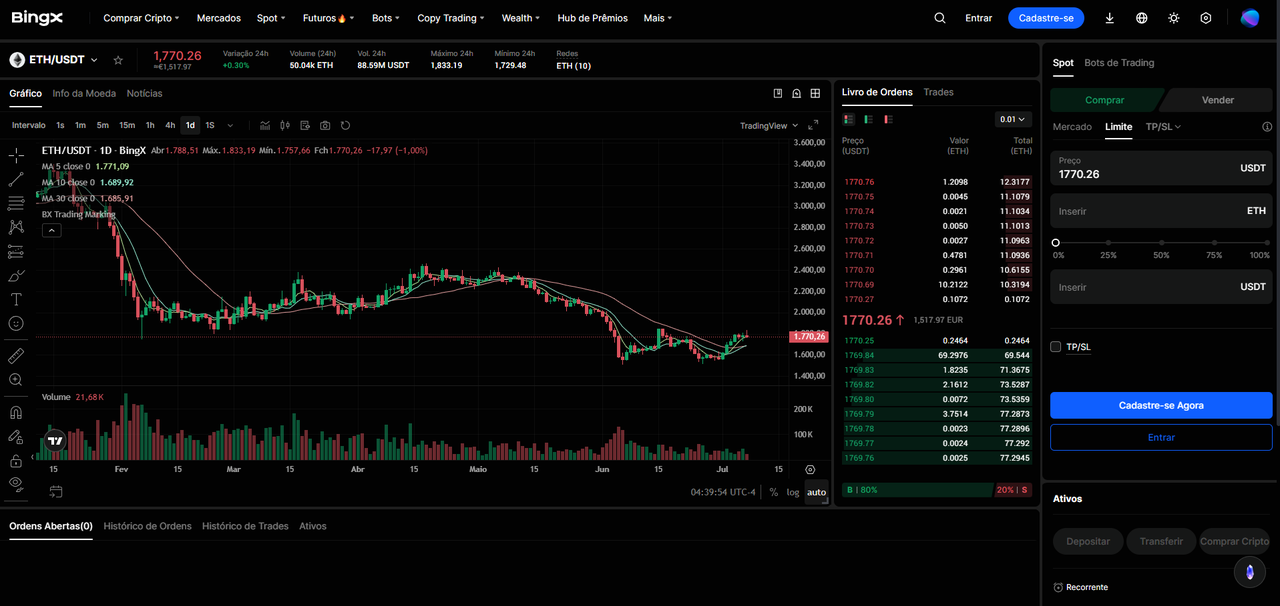
This regulatory greenlight removes one of the final major hurdles that separated Solana from Ethereum in terms of compliant institutional access. For traders looking for seamless exposure, the ETH/USDT pair is readily available on BingX via both spot and perpetual contracts, making it easy to trade without needing to interact directly with the blockchains.
Where to Securely Trade SOL and ETH
For users looking for exposure to these two networks, the most common entry point is a centralized exchange (CEX), which differs from interacting directly with a DEX.
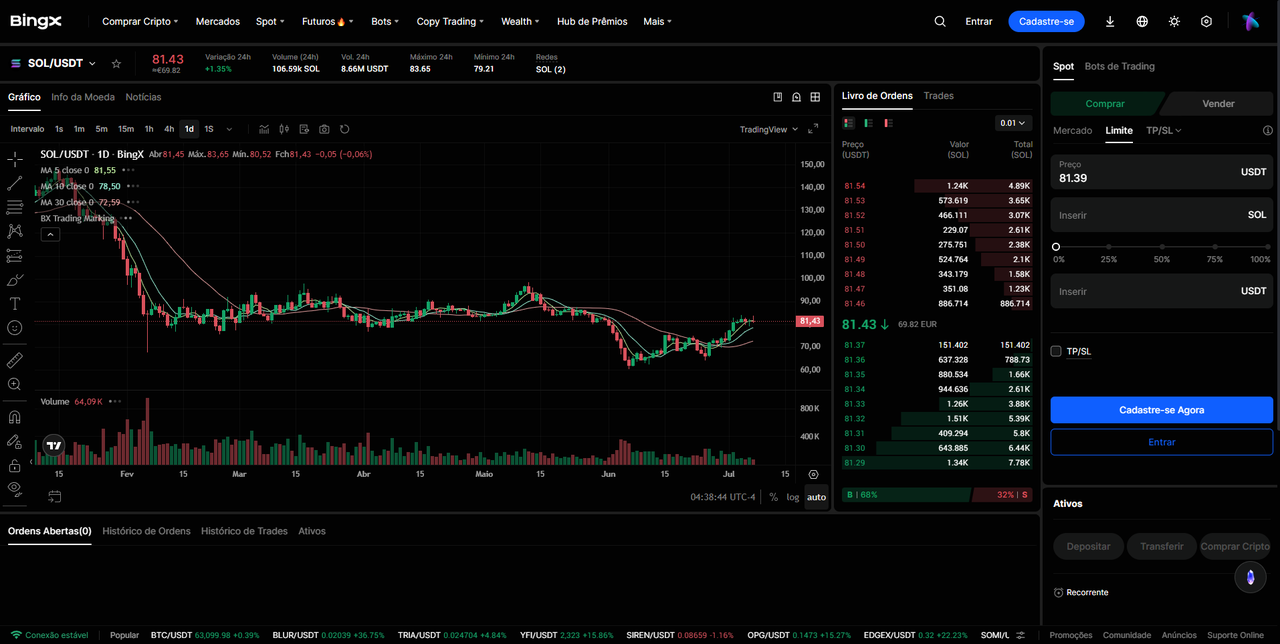
On BingX, you can trade SOL and ETH via both the spot market and futures contracts, as well as access staking to generate passive income on your ETH and SOL positions without the need to run a validator node or manage self-custody wallets. For beginners, this intermediary layer substantially mitigates the technical complexity of interacting directly with either blockchain.
A quick overview comparing CEX and DEX trading:
|
Metric |
CEX (e.g., BingX) |
DEX (Uniswap, Jupiter) |
|
Custody |
Exchange holds the assets |
You retain your own private keys |
|
Ease of Use |
Streamlined user interface |
Requires a self-custody wallet |
|
Staking Access |
Directly on the platform |
Varies by protocol |
|
Network Fees |
Not applicable to the end-user |
You pay gas fees directly |
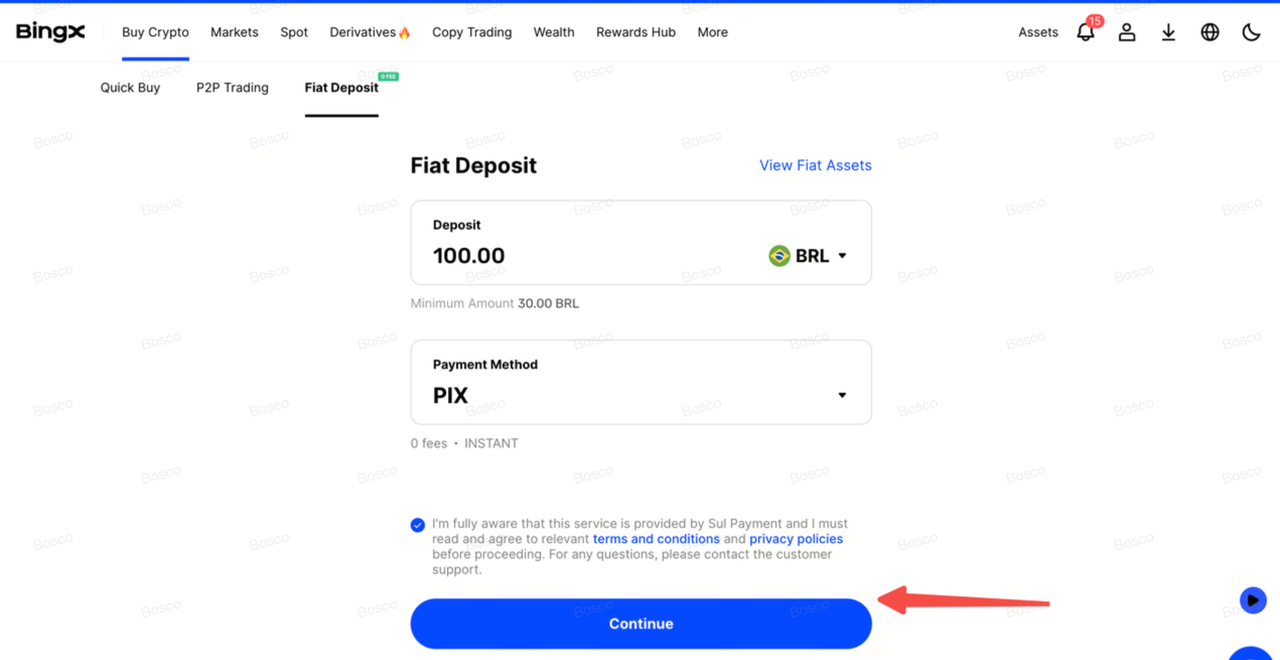
For local fiat deposits, BingX offers a zero-fee P2P market, enabling seamless entry into ETH or SOL without conversion premiums. Refer to the official fiat deposit tutorial to get started.
Frequently Asked Questions
1. Solana vs. Ethereum: which is more likely to appreciate in 2026?
There is no definitive answer. Ethereum features a longer track record and deep-rooted institutional adoption, while Solana is growing at a faster clip in terms of retail on-chain activity. Your investment decision should hinge on your specific time horizon and risk tolerance, rather than near-term market hype. Executing sound risk management protocols is vital before deploying capital to either network.
2. Why are Solana's transaction fees so much cheaper than Ethereum's?
Solana processes transactions monolithically using an architectural design optimized for massive throughput, which inherently drives down per-transaction execution costs. Conversely, Ethereum L1 prioritizes robust security and strict decentralization, which historically pushed network costs up—though Layer 2 networks have now significantly narrowed this gap.
3. Can I use both Ethereum and Solana simultaneously?
Yes, and that is exactly how most major DeFi players operate in 2026. Numerous protocols deploy across both chains simultaneously, linked by interoperability bridges like Wormhole and LayerZero, allowing users to leverage Ethereum’s base-layer security alongside Solana’s low-latency speed. Interacting with these cross-chain protocols requires a Web3 wallet compatible with both ecosystems.
4. Is Solana safe enough for storing large amounts of capital?
The network has drastically improved its liveness and stability since the integration of the Firedancer validator client, but it has yet to match the flawless zero-downtime historical track record that Ethereum L1 has maintained since its inception. For high-volume, long-term positions, many institutional investors still prefer Ethereum for this reason. In either case, consider utilizing hardware wallets to secure meaningful balances off-exchange.
5. Which network boasts a larger selection of DeFi applications?
Ethereum, inclusive of its L2 landscape, hosts the most extensive and mature DeFi ecosystem, featuring blueprints like Aave, Uniswap, and Curve that have been battle-tested for years. While Solana is aggressively bridging this gap with capital-efficient protocols like Jupiter and Kamino, it still commands a smaller aggregate of fully-audited applications tested over multiple market cycles.
6. Do I have to choose only one of the two networks to invest in?
Not at all. Many market participants maintain allocations in both assets precisely because they represent distinct investment theses: Ethereum as the foundational institutional finance rail, and Solana as the high-performance retail adoption play. Platforms like BingX Copy Trading let you mirror the strategies of top traders who trade both assets concurrently, reducing the need to make every single portfolio decision yourself.
Key Takeaways From This Article
- Ethereum leads in TVL (roughly $55 billion) and institutional adoption, whereas Solana dominates DEX trading volumes and execution speeds.
- Solana processes transactions for around $0.00025, compared to $0.10 to $3.00 on Ethereum L1 mainnet.
- Ethereum L1 has never suffered unplanned downtime, while Solana continues to establish its uptime track record following recent infrastructural upgrades.
- Both assets now have approved spot ETFs trading in the United States.
- Choosing between the two depends on your exact use case: institutional-grade security and large-scale positions favor Ethereum, while frequent execution and ultra-low overhead favor Solana.
- You can trade SOL and ETH via spot markets, futures, and staking on BingX without managing on-chain wallets. Implement stop-loss and take-profit orders to manage downside risk across both assets.
Related Articles
- What is Ethereum Staking and Is It Worth It in 2026?
- Who Owns the Most Ethereum in 2026? Top 10 ETH Rich List Revealed
- Top 7 AI Agent Crypto Projects in the Solana Ecosystem for 2026 amid the Rise of the Machine Economy
- What Is On-Chain TradFi (Traditional Finance) and How Does It Work: A Beginner's Guide
- Best AI Crypto Coins to Watch for Investment in 2026
