XDC Network is an enterprise-grade, EVM-compatible blockchain built specifically for trade finance and real-world asset tokenization. Founded by Singapore-based XinFin in 2017 and live since 2019, it uses XDPoS 2.0 consensus to deliver 6-second transaction finality, 2,000+ TPS, and sub-cent fees. It is the only blockchain invited to join the Trade Finance Distribution Initiative (TFDi) and has processed over $1 billion in tokenized real-world assets.
Most blockchains were built to disrupt finance in the abstract. XDC Network was built to solve a specific, concrete problem: the $2.5 trillion to $5 trillion annual gap in global trade finance that leaves small and medium enterprises unable to access the financing they need to conduct international trade.
Seven years after its mainnet launch, XDC has processed over $1 billion in tokenized real-world assets, connected more than 100 financial institutions through the Contour Network, and become the only public blockchain embedded in the world's leading trade finance consortia. This guide explains exactly how it works, why it is structurally different from other enterprise blockchains, and what it actually does in practice in 2026.
XDC Network Technical Specifications at a Glance
|
Specification |
Value |
|
Mainnet Launch |
June 2019 |
|
Consensus Mechanism |
XDPoS 2.0 (Chained HotStuff BFT, upgraded Q4 2024) |
|
Transaction Finality |
6 seconds |
|
Throughput |
2,000+ transactions per second |
|
Block Time |
~2 seconds |
|
Transaction Cost |
Fractions of a cent |
|
EVM Compatible |
Yes: supports Solidity, Remix, MetaMask, Hardhat |
|
Validator Masternodes |
108 active (300+ candidates as of Jan 2025) |
|
Total Transactions Processed |
800 million+ |
|
RWA Processed |
$1 billion+ |
|
RWA TVL |
$700 million+ (Q2 2026) |
|
Key Compliance Standards |
ISO 20022, MLETR |
|
Architecture |
Hybrid public/private (public mainnet plus permission subnets) |
The XinFin Origin Story: From Singapore Fintech to Enterprise Blockchain
In 2017, two Singapore-based entrepreneurs set out to build something specific rather than something general. Ritesh Kakkad, a serial tech entrepreneur with decades of experience in cloud computing, and Atul Khekade, a computer engineer who had helped build one of the first permissioned blockchain networks for a consortium of major trade finance institutions through MonetaGo, co-founded XinFin (an acronym for Exchange InFInance).
The founding thesis was precise: global trade finance was broken at its infrastructure layer. SMEs in emerging markets were paying 20% to 30% annually for short-term trade credit, if they could access it at all. Banks were spending enormous sums on paper-based documentation: letters of credit, bills of lading, invoices that had to be physically moved between counterparties across borders. The process was slow, expensive, and rife with fraud. Blockchain, if properly designed for enterprise requirements, could fix it.
The XDC mainnet went live in June 2019. Unlike the wave of blockchains that launched with vague promises about decentralizing everything, XDC launched with specific use-case integrations already in progress and technical architecture designed around enterprise compliance requirements rather than retrofitted for them afterward.
Why 'XinFin Digital Contract': What the Name Actually Means
The token's full name, XinFin Digital Contract (XDC), reflects the founding vision. In trade finance, the 'contract' is not just a legal document but a complex web of instruments: the purchase order, the invoice, the letter of credit, the bill of lading, the insurance certificate. Each of these has historically been a paper document that moves through a chain of banks, freight forwarders, customs agents, and insurers before a single payment is released.
XDC was designed to make each of these instruments a programmable, tokenized, on-chain object, a digital contract, that settles automatically when conditions are met, can be verified by any counterparty in real time, and cannot be fraudulently duplicated or altered.
XDPoS 2.0: How Technology Actually Works
XDC's consensus mechanism, XDPoS 2.0 (XinFin Delegated Proof of Stake), is the technical foundation for its enterprise positioning. Understanding why it matters requires understanding what enterprise finance actually needs from a blockchain.
Enterprise financial applications need three properties that most public blockchains cannot reliably provide: fast, irreversible finality; predictable, low transaction costs; and accountability mechanisms for the validators who secure the network.
XDPoS 2.0, upgraded in Q4 2024 with Chained HotStuff Byzantine Fault Tolerant consensus developed by a protocol team led by Professor Pramod Viswanath from Princeton University, delivers all three.
The Three Technical Advantages of XDPoS 2.0
- Six-second finality (not confirmation): Bitcoin takes 60 minutes for high-confidence settlement. Ethereum takes minutes. XDC reaches mathematical finality in 6 seconds, meaning a transaction cannot be reversed after that point. For a letter of credit or a trade settlement, reversibility is not acceptable. Six-second irreversibility is the property that makes XDC viable for real institutional settlement.
- Chained HotStuff BFT (Byzantine fault tolerance): The network can withstand up to one-third of validators acting maliciously or going offline without compromising consensus or finality. This is the theoretical maximum security for a BFT system. It means that even if 35 of XDC's 108 active masternodes were compromised simultaneously, the network would continue processing transactions correctly.
- Built-in validator forensics: XDPoS 2.0 introduced an automated accountability system that monitors validator behavior and can flag or penalize masternodes for protocol violations without requiring human intervention. This is a direct response to one of the criticisms of earlier DPoS systems, where validator misconduct was difficult to detect and address in real time.
How Masternodes Work on XDC Network
XDC's network security is maintained by a system of masternode validators. To run an active masternode, an operator must stake a significant XDC position (typically 10 million XDC) as collateral. This stake is at risk if the masternode behaves dishonestly, creating a direct financial incentive for honest operation.
As of early 2025, there were 108 active masternodes and over 300 candidates. The masternode operator set includes not only independent validators but institutional participants: Deutsche Telekom joined as an infrastructure provider and validator, and Republic and Clearpool have also confirmed validator status.
Institutional validator participation is significant because it represents large XDC positions being staked and locked, reducing liquid supply.
Hybrid Architecture: Public Chain Plus Private Subnets
One of XDC Network's most important technical features for enterprise adoption is its hybrid architecture: a public mainnet combined with a permissioned subnet system that allows institutions to run private or semi-private blockchain environments that inherit the security of the XDC mainnet.
|
Layer |
What It Is |
Who Uses It |
|
Public Mainnet |
Fully open, globally accessible XDC blockchain. All transactions are publicly verifiable. |
Open DeFi applications, public RWA tokens, retail users, on-chain auditing |
|
Private Subnet |
Permissioned side chain with controlled access. Inherits mainnet security. Transactions visible only to authorized participants. |
Government agencies, financial institutions, supply chain consortia requiring confidential workflows |
|
Interoperability |
Assets and data can move between subnet and mainnet via secure bridging. |
Allows private workflows to settle publicly when required for audit or liquidity purposes |
This architecture solves a problem that has blocked enterprise blockchain adoption for years: institutions need privacy for competitive and regulatory reasons, but they also need public verifiability for audit, counterparty trust, and liquidity access.
XDC's hybrid model lets institutions have both, by running confidential operations on a subnet while anchoring settlements to the public mainnet for final verification.
ISO 20022 Compliance: The Bridge to Traditional Finance
ISO 20022 is the global financial messaging standard being adopted by SWIFT and central banks worldwide for cross-border payments and securities settlement. It defines a common language for financial data that banks, central banks, and clearing houses all speak.
XDC Network's communications and settlement infrastructure are designed to be ISO 20022 compatible, meaning XDC-settled transactions can be represented in a format that traditional banking systems understand and accept.
The completion of ISO 20022 migration across major financial institutions in 2025 significantly expanded XDC's addressable market. Banks that previously would have needed to build translation layers between their systems and XDC can now integrate more directly.
This is not a marketing claim but a technical alignment that reduces the engineering cost of adopting XDC for institutional settlement.
What Does XDC Network Do? Core Use Cases in 2026
XDC Network's primary function is enabling the tokenization and settlement of trade finance instruments and real-world assets on a public blockchain. In practice, this covers four distinct but overlapping use cases in 2026.
1. Trade Finance Tokenization
The flagship use case. Trade finance instruments invoices, letters of credit, bills of lading, trade receivables are tokenized as XRC-20 or XRC-721 tokens on XDC's mainnet. Once on-chain, these instruments can be traded, used as collateral, financed by multiple lenders simultaneously, and settled automatically when delivery conditions are met.
The Tradeteq integration, which produced the world's first trade finance-based NFT on XDC Network in 2021, demonstrated that technology works. The $500 million Brazilian agricultural debt issuance confirmed it could work on institutional scale.
XDC is also the only blockchain that is a member of both the Trade Finance Distribution Initiative (TFDi) and the International Trade Finance Association's Digital Negotiable Instruments Initiative (ITFA DNI), the two most authoritative industry bodies shaping the legal and operational framework for digital trade finance.
2. Real-World Asset (RWA) Tokenization
Beyond trade finance instruments, XDC hosts a growing range of tokenized real-world assets. The most notable early example was USTY: launched in 2023 by Tradeteq and Securitize, USTY is the first compliant U.S. Treasury token representing blockchain-based shares in a U.S. Treasury bond ETF. USTY demonstrated that XDC's compliance infrastructure was capable of hosting regulated financial products, not just experimental blockchain projects.
USDC integration brought $12.7 billion in stablecoin transactions through the XDC ecosystem via the Clearpool validator integration. The Commodities Trading Club membership alongside S&P Global, CME Group, and LSEG positions XDC as the public blockchain of record for commodity RWA tokenization, a market that extends from agricultural products to energy contracts and metals.
3. Enterprise and Government Subnets
Financial institutions and government agencies that need blockchain settlement without public visibility run private XDC subnets. The XDC subnet model allows these institutions to build permissioned environments for specific workflows KYC processing, regulatory reporting, interbank settlement while anchoring final settlement to the public mainnet for audit and interoperability.
The R3 Corda inter-business settlement proof of concept, completed in 2022, demonstrated that XDC could bridge between Corda's permissioned DLT (used by the DTCC and major banks) and a public blockchain, enabling institutional assets managed on Corda to access public blockchain liquidity through XDC.
4. NFTs and Digital Trade Documents
Trade finance NFTs are a distinct category from speculative art NFTs. When Tradeteq tokenized the first trade finance NFT on XDC in 2021, the token represented a real financial instrument: a trade receivable with specific counterparties, a maturity date, and a known settlement value. The NFT standard was used because it captures the unique, non-fungible nature of individual trade finance contracts. No two invoices or letters of credit are identical.
In 2026, this use case expanded to tokenizing cacao trade finance (detailed in XDC's Tokenizing the Cacao Trade case study), energy certificates, and cross-border supply chain documents. The MLETR framework, as jurisdictions adopt it, creates the legal basis for treating these digital instruments as legally equivalent to their paper counterparts.
XDC Network vs. Other Enterprise Blockchains
XDC does not compete with Bitcoin or Ethereum for retail adoption. Its competition is the small set of blockchains targeting the same institutional and trade finance market.
|
XDC Network |
Stellar (XLM) |
Ripple (XRP) |
Ethereum L2s |
|
|
Primary Focus |
Trade finance and RWA |
Cross-border payments, RWA |
Cross-border payments, CBDC |
General DeFi, some RWA |
|
Finality |
6 seconds |
3 to 5 seconds |
3 to 5 seconds |
Varies (minutes on base) |
|
TFDi Membership |
Yes (only blockchain) |
No |
No |
No |
|
ISO 20022 |
Yes |
Partial |
Yes |
No |
|
Hybrid Architecture |
Yes (public plus subnets) |
No |
No |
No |
|
Institutional Validators |
Deutsche Telekom, Clearpool, Republic |
Anchor Protocol (defunct) |
Banks on RippleNet |
Institutional staking pools |
|
EVM Compatible |
Yes |
No |
No (EVM sidechain planned) |
Yes |
How to Buy XDC on BingX
XDC is available on BingX's spot market. Visit BingX to get started.
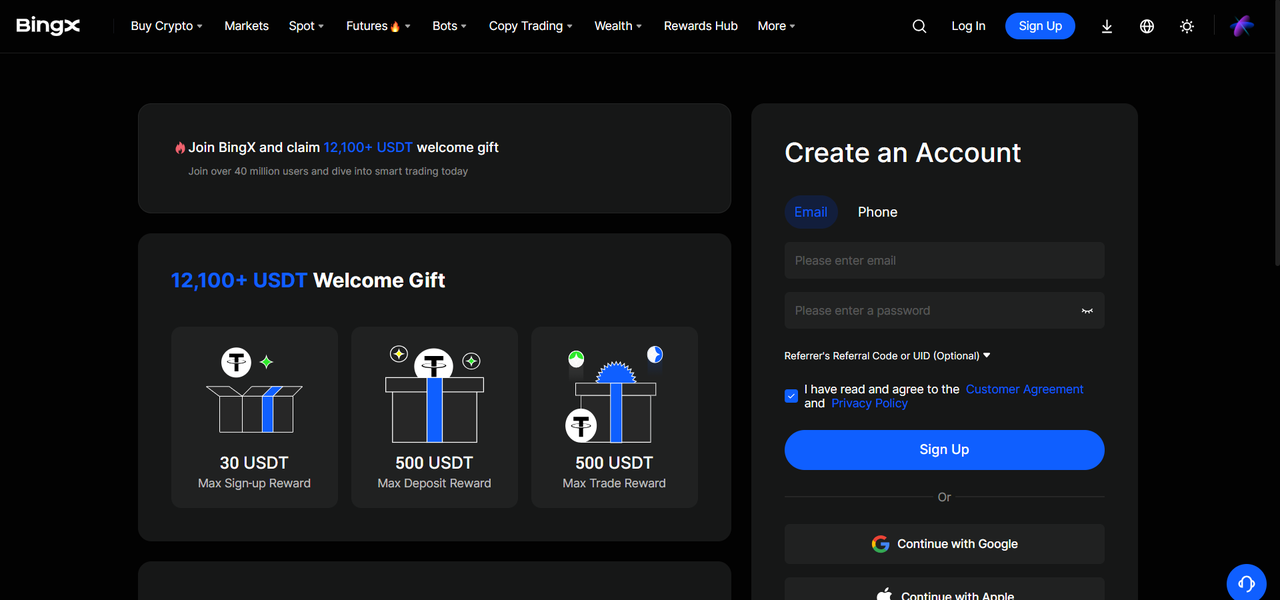
1. Create or Log Into Your Account
Register with your email or phone number, then complete identity verification (KYC) to access the full spot market and futures trading.
2. Deposit USDT
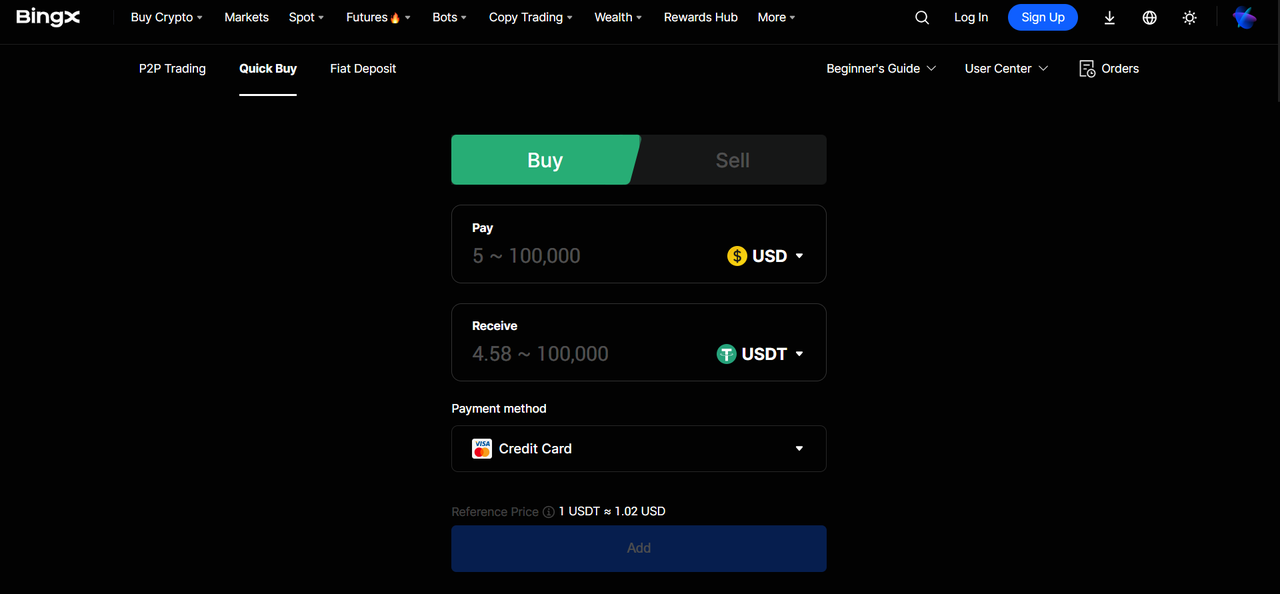
Transfer USDT from an external wallet to your BingX Spot account, or use Quick Buy to convert fiat via credit or debit card (Visa/Mastercard, supported regions). USDT is the standard base currency for the XDC/USDT pair.
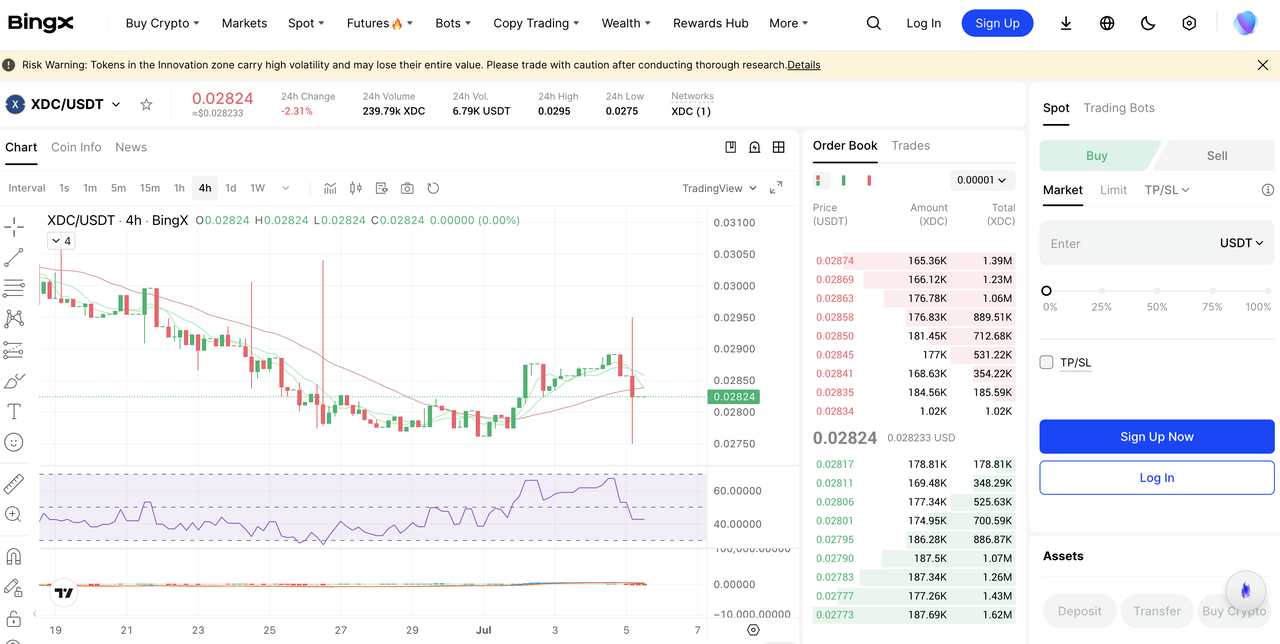
3. Search XDC/USDT
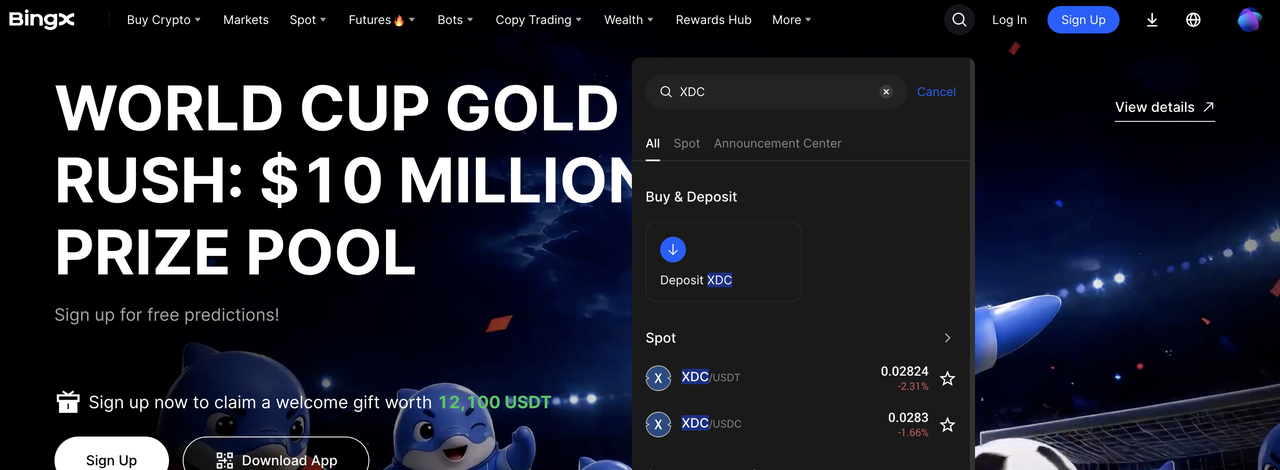
Use the search bar to open the XDC/USDT spot pair. XDC is an infrastructure asset with moderate daily volume relative to its market cap, so avoid navigating away mid-session during fast-moving institutional news events.
4. Place a Limit Order
XDC's order book is thinner than major-cap assets. A Limit order lets you set your exact entry price rather than accepting market execution.
5. Set Stop-Loss and Take-Profit at Order Entry
Configure your Stop-Loss and Take-Profit levels before confirming the order. XDC moves sharply on specific catalysts: exchange listing announcements, large RWA deal confirmations, and institutional validator additions. Pre-set your exits before those events, not after the price has already moved.
Conclusion
Most blockchains ask you to imagine a world where finance runs on-chain. XDC is building that world in a market that already exists, with institutions that are already paying to participate. The Trade Finance Distribution Initiative membership, the Contour Network acquisition, the Deutsche Telekom validator, the $500 million Brazilian agricultural debt issuance . These are not pilots or announcements of intent. They are production deployments on a network that has processed over $1 billion in real-world assets.
The risk is not that technology does not work. XDPoS 2.0's 6-second finality and ISO 20022 alignment are legitimate technical advantages. The risk is that adoption timelines in institutional finance are slow and the competition from Stellar, Ripple, and Ethereum Layer 2 ecosystems is genuine and well-funded.
For traders and investors, XDC sits in an unusual position: an asset with verifiable institutional utility and a price that has not yet reflected widespread recognition of that utility. Whether the recognition arrives in 2026 or takes until 2028 depends on which bank or consortium makes the next large-scale deployment announcement. What the on-chain data confirms is that the deployments are already happening. XDC is not waiting for adoption, it is processing it.
Related Articles
- Buy XDC Network (XDC) on BingX in Minutes
- Making Every Trade Efficient: A Guide to Stable Spot Portfolio Growth
- Risk Management in Crypto Trading: 7 Rules Every Trader Must Know
- How to Keep a Trading Journal: A Complete Guide for Crypto Traders
- Implied Volatility in Crypto: What It Means and How to Trade It
- Altcoin Season: What It Is, How to Spot It, and How to Trade It
FAQs on XCD Network
1. What is XDC Network?
XDC Network is an enterprise-grade, EVM-compatible blockchain built for trade finance and real-world asset tokenization. It uses XDPoS 2.0 consensus for 6-second finality, supports 2,000+ TPS, and is the only blockchain member of the Trade Finance Distribution Initiative. It has processed over $1 billion in tokenized real-world assets since its mainnet launch in 2019.
2. What does XDC Network do?
XDC Network tokenizes and settles trade finance instruments (invoices, letters of credit, trade receivables), real-world assets (US Treasury tokens, commodity assets), and enterprise financial workflows. It connects SMEs with institutional financiers through a blockchain infrastructure that reduces trade finance costs from 20% to 30% per year down to potentially 10% or less, while providing real-time verifiability for all counterparties.
3. What is XinFin?
XinFin (Exchange InFinance) is the Singapore-based fintech company founded in 2017 by Ritesh Kakkad and Atul Khekade that created and launched XDC Network. XinFin provides enterprise-grade blockchain solutions for international trade and finance. The XDC mainnet went live in June 2019.
4. What is XDPoS 2.0?
XDPoS 2.0 is XDC Network's consensus mechanism, an upgraded Delegated Proof of Stake system incorporating Chained HotStuff Byzantine Fault Tolerant consensus developed with a protocol team from Princeton University. It provides 6-second transaction finality, theoretical maximum BFT security (tolerating up to one-third malicious validators), and automated forensics monitoring for validator accountability. The upgrade deployed in Q4 2024.
5. How is XDC different from Ethereum?
XDC is EVM-compatible (it can run Ethereum smart contracts using Solidity) but is purpose-built for enterprise finance rather than general-purpose DeFi. Key differences: XDC finalizes transactions in 6 seconds vs. Ethereum's minutes; XDC fees are fractions of a cent vs. Ethereum's variable gas costs; XDC includes a hybrid subnet architecture for institutional privacy; and XDC is ISO 20022 compliant for integration with traditional banking systems.
6. Is XDC Network a good investment?
XDC has structural utility that most altcoins lack, including confirmed institutional partnerships, measurable on-chain RWA volume, and a specific market focus in trade finance. It also carries risks: competition from Stellar and Ripple, dependence on institutional adoption timelines, and correlation with broader crypto market cycles. This answer does not constitute financial advice. Read the XDC Price Prediction 2026 to 2030 guide for a detailed investment framework.
7. What is XDC's relationship to ISO 20022?
ISO 20022 is the global financial messaging standard used by SWIFT and major central banks. XDC Network's settlement infrastructure is designed to be ISO 20022 compatible, meaning XDC-settled transactions can be represented in formats that traditional banking systems recognize. This compatibility reduces the engineering cost of institutional XDC integration and was a deliberate design choice from XinFin's founding team.
