Navigating the volatile 2026 crypto markets requires a strategy that breathes with the market. On BingX futures market, the Trailing Stop (TS) is designed for traders who want to "let their winners run," capturing the meat of a trend while ensuring a win doesn't turn into a loss. Unlike a standard Stop-Loss, which is a fixed line, a Trailing Stop is a dynamic shadow that follows your profit, automatically tightening your safety net as the price moves in your favor.
As a top 5 global derivatives exchange, BingX provides professional-grade risk tools that eliminate the exit anxiety common in high-leverage trading. By mastering callback rates and activation prices, you can step away from the charts, knowing your position will only close if the trend truly reverses.
This guide breaks down exactly what a Trailing Stop is, how the mechanics of callbacks work, and how to deploy them with professional precision on the BingX platform.
What Is a Trailing Stop and How Does It Work in Futures?
A Trailing Stop Order is an automated instruction to close a position at a specific distance or percentage away from the market’s highest (for long) or lowest (for short) price point.
In practice, if you are in a Long position and the price rises, the Trailing Stop trails behind it, maintaining the gap you defined. If the market reverses and hits that trailing price, the order executes. However, if the price continues to moon, the stop keeps climbing, effectively turning your Stop-Loss into a Dynamic Take-Profit.
Pro Tip: In the trending markets of 2026, Trailing Stops are the primary way traders handle blow-off tops in memecoins or major breakouts in Bitcoin, ensuring they exit near the peak rather than at a pre-set target that might have been too conservative.
How Do Trailing Stops Work on BingX Futures?
BingX has engineered its Trailing Stop functionality to be both intuitive for beginners and robust for pros. Here are the core mechanics:
- Callback Rate and Trailing Distance: You define the gap between the market price and your stop, e.g., a 2% Callback Rate or a 100 USDT Trailing Distance.
- Unidirectional Movement: The stop price only moves in the direction of your profit. If the price stalls or dips, the stop remains fixed at the highest point reached.
- Price Update Sensitivity: The system updates the stop price after the market moves significantly beyond the minimum price unit to ensure a smooth tracking experience.
- Market Order Execution: Once the price reverses by your specified callback amount, the system triggers a Market Order. This ensures the position is closed immediately, though the final transaction price may vary based on market liquidity.
Read more: What Are the Different Order Types Supported on BingX Futures?
Understanding the Dual-Condition Setup: Activation vs. Trigger
In 2026, BingX users often utilize a more advanced version: the Trailing TP/SL. This allows for a two-stage execution that prevents premature stops.
- Activation Price (Optional): This is your Go signal. The Trailing Stop won't start tracking the price until the market reaches this level. This is perfect for ensuring a trade is in the green before the trailing logic kicks in.
- The Trigger Condition: Once the price hits the Activation Price, the system starts monitoring for the Callback Rate.
How a Dual-Condition Trailing Stop Order Works: An Example
- Entry: Long BTC at $60,000.
- Activation Price: $65,000.
- Callback Rate: 2%.
- Result: If BTC hits $64,900 and drops, the trailing stop (TS) remains inactive. Once BTC reaches the $65,000 activation price, the TS goes live. If BTC continues to climb to a peak of $70,000 and then retraces by 2% ($1,400), your position automatically triggers a market exit at $68,600, securing your profit.
Trailing Stop vs. Standard Stop-Loss: Key Differences
|
Feature |
Standard Stop-Loss |
Trailing Stop |
|
Price Level |
Static (Fixed) |
Dynamic (Moves with Profit) |
|
Primary Goal |
Capital Protection |
Profit Protection & Trend Following |
|
Manual Input |
Must be moved manually as price rises |
Moves automatically |
|
Best For |
Initial risk management |
Trending markets & deep breakouts |
The fundamental distinction between a Standard Stop-Loss and a Trailing Stop lies in the transition from a static defense to a dynamic offense. A standard stop-loss is a fixed price point, a line in the sand, that remains stagnant regardless of how high your unrealized PnL climbs, meaning a trade that was once up 20% can still hit a break-even or negative stop if not manually adjusted. In contrast, a Trailing Stop on BingX functions as a sliding floor that automatically maintains a set Callback Rate (e.g., 5%) or Trailing Distance below the asset's peak price. This allows a position to breathe during a trend while ensuring that as the market hits new highs, your exit trigger moves up in tandem, effectively locking in profit without capping the upside potential.
In parabolic markets, a static stop-loss is vital for initial protection but fails to lock in gains as prices climb. A trailing stop-loss solves this by automatically climbing with the price at a set Callback Rate, e.g., 2%, securing profits during a rally and ensuring an exit near the local high. This automation replaces emotional hesitation with mechanical precision, allowing you to follow a trend as far as it goes without needing to manually adjust your price targets or fear getting shaken out by minor market wiggles.
When to Use Trailing Stops on BingX: Top 3 Scenarios
Professional traders on BingX utilize Trailing Stops in three specific 2026 scenarios:
- Riding Parabolic Moves: When an asset is in price discovery mode and there are no clear resistance levels above, a Trailing Stop allows you to captimgure as much of the move as possible.
- Volatile Breakouts: During high-impact events like CPI data and ETF approvals, Trailing Stops help you exit if a wick reverses sharply.
- Passive Management: If you cannot monitor the charts 24/7, a Trailing Stop acts as a smart manager that locks in gains while you sleep.
How to Place a Trailing Stop on BingX: Step-by-Step
How to Set Trailing Stop on BingX Web
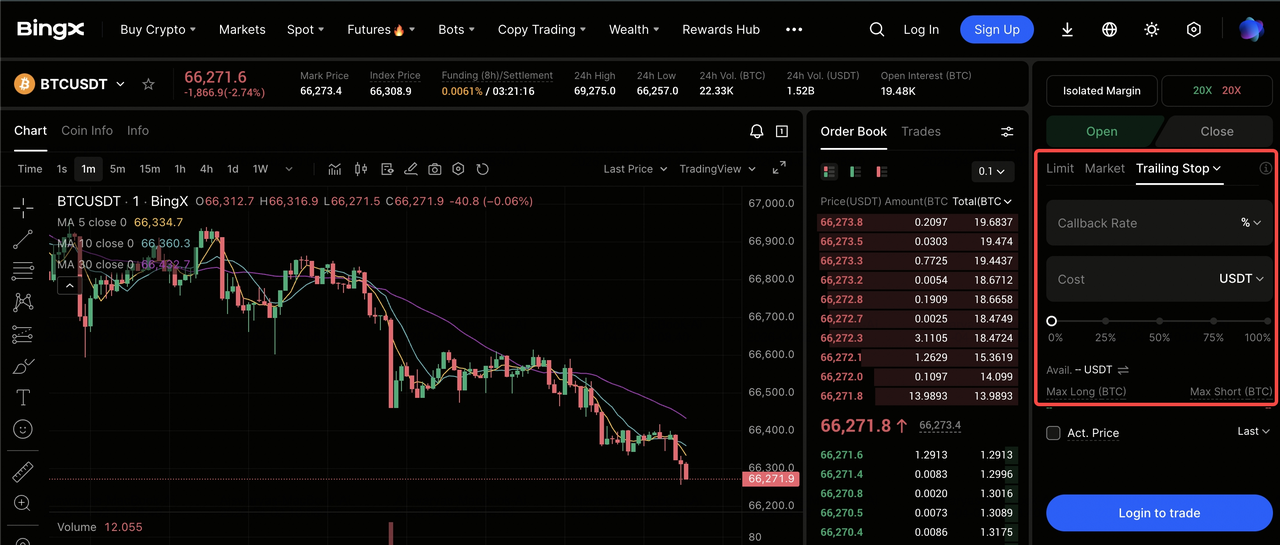
- Open Position: Go to the Positions tab at the bottom of the Perpetual Futures page.
- Add TS: Click on Trailing Stop in the TP/SL column for your open trade.
- Enter Distance: Input your Trailing Distance (e.g., 50 USDT) or Callback Rate.
- Confirm: Save the settings. You will see the TS Price update live on your position line.
How to Place Trailing TP/SL on the BingX App
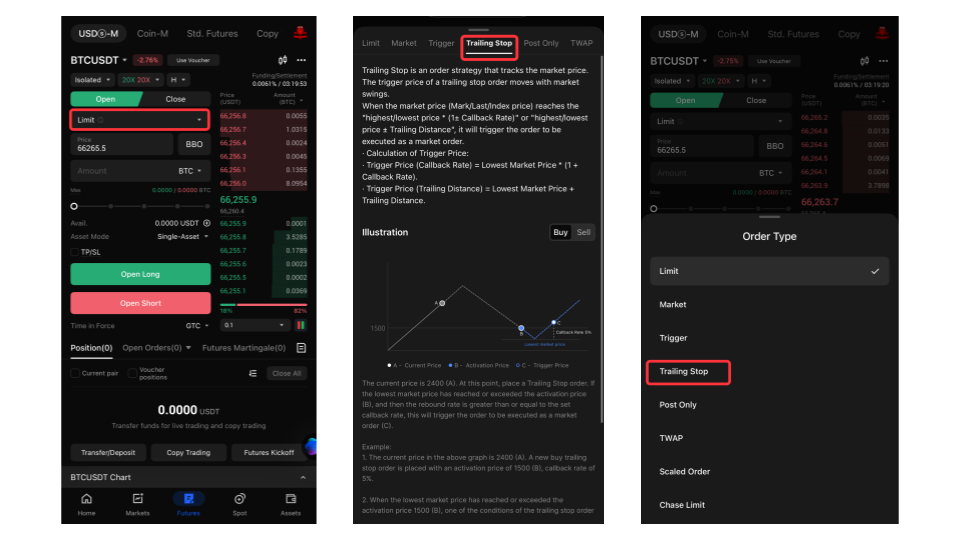
- Order Menu: When opening a new trade, or in the Open Orders tab, select Trailing TP/SL.
- Set Parameters: Fill in the Callback Rate, Quantity, and Activation Price (optional).
- Monitor: Check the Trailing TP/SL tab to view or edit your active orders.
What Are the Pros and Cons of Using Trailing Stop Orders in the Futures Market?
Integrating trailing stop orders into a 2026 trading strategy requires a balance between automated capital preservation and the inherent volatility of the crypto derivatives market.
The Pros
- Dynamic Profit Capture: In an ideal one-way trend, a well-set trailing stop helps you exit near the peak of a move without having to time the absolute top manually.
- Mitigation of Flash Crash Exposure: In high-leverage environments, trailing stops act as an automated emergency brake that tightens as your PnL grows, ensuring that a winning trade doesn't retracing into a liquidation event during sudden liquidity gaps.
- Elimination of Exit Hesitation: By pre-defining a Callback Rate, e.g., 2% or 5% based on the asset's historical volatility, traders remove the emotional burden of trying to time the top, which often leads to late exits and diminished returns.
- Operational Efficiency: Trailing stops reduce the need for 24/7 screen monitoring; once the Activation Price is hit, the system manages the exit logic autonomously, allowing traders to scale their portfolio across multiple pairs without manual stop-loss adjustments.
The Cons
- Susceptibility to 'Whipsaw' Exits: Setting a callback rate tighter than the asset’s normal volatility often results in a shock exit, where you are stopped out by a minor dip before the trend continues upward.
- Execution Slippage in Low Liquidity: Because trailing stops trigger Market Orders, the final fill price in thin order books (especially in mid-cap altcoins) may be significantly worse than the trigger price during high-volatility events, leading to unexpected slippage cost.
- No 2% Protection Guarantee: Unlike some limited order types, Trailing Stops do not guarantee a specific execution price. In extreme market conditions, the gap between your trigger price and the actual transaction price can exceed 2% depending on market depth.
- Incompatibility with Range-Bound Markets: In sideways or choppy market phases where the price oscillates within a narrow horizontal channel, trailing stops are frequently triggered by non-directional volatility, leading to a death by a thousand cuts through repeated small losses and trading fees.
Top 5 Pro Tips for 2026 Trailing Stop Strategies
Optimizing a trailing stop on BingX in 2026 requires a data-driven approach that balances current market volatility with the specific technical mechanics of your chosen trading pair.
- Match Volatility with Callback Rates: Avoid arbitrary percentages. Study the asset's recent price swings and set a callback rate wide enough to absorb normal market noise while still protecting your capital from a true trend reversal.
- The Break-Even Milestone: Set your Activation Price just beyond your first major resistance level; this ensures that once the trailing logic kicks in, your worst-case scenario is a locked-in profit rather than a loss on a volatile retrace.
- Mind the Liquidity Gap: On mid-cap altcoins with thin order books, use a wider callback rate of 5% or above to account for scam wicks that can trigger market orders and cause significant slippage during low-volume hours.
- Test with VST Demo: Use BingX’s Virtual Support Token (VST) environment to observe how specific assets react to callback rates before risking real capital.
- Account for Taker Fees: Remember that trailing stops trigger Market Orders; ensure your expected profit margin comfortably covers the higher Taker fee tier to maintain a positive expectancy over hundreds of trades.
Conclusion: Leveraging Automated Precision with Trailing Stops in 2026
The Trailing Stop serves as a technical bridge between aggressive profit-taking and disciplined risk management, allowing BingX traders to capture extended market trends without manual intervention. By shifting from static price targets to a dynamic callback model, you effectively neutralize the emotional impulse to exit a winning trade too early. In the high-velocity markets of 2026, this automation ensures your strategy remains anchored to real-time price action and volatility metrics rather than reactive decision-making.
To implement this effectively, prioritize testing your callback rates in the BingX VST Demo Trading environment to observe how specific assets react during high-volatility windows. Refining your Activation Price and Trailing Distance allows for a more surgical exit strategy that protects realized gains while providing the trade sufficient room to fluctuate. Always align your trailing parameters with your overall portfolio risk tolerance and the specific liquidity profile of the futures contract you are trading.
Risk Reminder: Trading futures involves significant risk, and the use of a Trailing Stop does not guarantee protection against losses. Because these orders execute as Market Orders upon being triggered, they are subject to slippage, especially during periods of extreme volatility or low liquidity. Traders should monitor their positions regularly and understand that a Trailing Stop may be triggered by short-term price fluctuations that do not represent a long-term trend reversal.
Related Reading
- How to Get Started with Perpetual Futures Trading on BingX: A 2026 Beginner's Guide
- What Are the Different Order Types Supported on BingX Futures and How to Use Them?
- Cross Margin vs. Isolated Margin to Master Your Risk on BingX Futures: A 2026 Beginner's Guide
- What Is Limit Order in Futures Trading and How to Use It on BingX Futures? A 2026 Guide
- What Is Market Order in Futures Trading and How to Use It on BingX Futures? A 2026 Guide
FAQs on Trailing Stop Orders in Futures Trading
1. Why didn't my Trailing Stop move?
The price must move in your favorable direction by the Trigger Step size. If the move is too small, the system won't update the stop to avoid excessive lag.
2. Can I use a Trailing Stop for an entry?
Yes. A Buy Trailing Stop can be used for short-covering or entering a breakout once a rebound is confirmed.
3. Does a Trailing Stop guarantee a price?
No. Because it triggers a Market Order, in extremely thin liquidity or flash crashes, your fill price might be slightly different from the trigger price due to slippage.
