


June 2026 marks a major moment for AI investing. OpenAI and Anthropic, two of the world’s leading frontier AI labs, have both moved toward public-market access through confidential S-1 filings with the U.S. Securities and Exchange Commission. For most retail investors, direct pre-IPO access remains out of reach because both companies are still private, with shares typically limited to institutional backers, venture funds, and accredited investors.
BingX offers OpenAI-related exposure through two separate synthetic futures products. OPENAI (VNTL) is a USDT-margined synthetic RWA derivative listed on BingX TradFi Futures, designed to track OpenAI-related VNTL valuation exposure through a perpetual futures contract. It gives traders long or short exposure to OpenAI’s implied private-market valuation without requiring access to private shares. OPENAI (Pre-IPO) is a separate futures contract launched closer to OpenAI’s formal IPO process and more directly tied to the active listing timeline. This article explains how both products work, how OPENAI (VNTL) differs from OPENAI (Pre-IPO), how OpenAI compares with Anthropic, and how to trade these contracts on BingX.
Neither OPENAI (VNTL) nor OPENAI (Pre-IPO) gives traders OpenAI shares, equity ownership, voting rights, dividends, or any legal claim on the company. Both are synthetic derivatives, and their prices are determined by market demand on BingX rather than direct transactions in OpenAI private shares. Traders should understand the product structure, margin rules, and risks before opening a position.
What Is OpenAI and What Is the Importance of the Open AI IPO?
OpenAI was founded in December 2015 in San Francisco as an AI research lab focused on developing artificial general intelligence for broad human benefit. Its early backers and co-founders included Sam Altman, Greg Brockman, Ilya Sutskever, Elon Musk, and other technology leaders. The company later shifted from a nonprofit research model to a capped-profit structure in 2019, allowing it to raise large-scale capital while keeping nonprofit oversight.
OpenAI’s rise accelerated after the launch of ChatGPT in November 2022. The product turned OpenAI from a leading AI research company into one of the most important consumer and enterprise technology platforms in the world. By 2026, OpenAI operates across several major areas:
- Consumer AI: ChatGPT has become a mainstream AI assistant with hundreds of millions of weekly users.
- Enterprise and API services: Businesses use OpenAI models through API access, enterprise subscriptions, and developer tools.
- AI infrastructure: OpenAI is expanding into agents, browsers, hardware, and large-scale compute partnerships.
- Strategic investors: Microsoft remains OpenAI’s most important long-term partner, while other major technology and investment firms have also backed the company.
The OpenAI IPO matters because it could become one of the largest AI listings in history. A public debut would give investors direct exposure to one of the companies defining the frontier AI market, while also creating a benchmark valuation for the broader AI sector. For traders, the IPO timeline matters because OpenAI-related synthetic products, pre-IPO contracts, and AI infrastructure stocks may become more volatile as the listing process develops.
What Is the OpenAI IPO Valuation: Key Reported Metrics Before Listing
Note: The figures below are based on press reporting and private funding disclosures, not an audited public prospectus. A confidential S-1 does not disclose financials publicly. Treat all numbers as reported estimates subject to revision when the public filing becomes available.
|
OpenAI Metric |
Figure |
Source |
|
Last Private Valuation |
$852 billion |
March 2026 $122B funding round (CNBC, WSJ) |
|
Target IPO Valuation |
Up to $1 trillion |
Goldman Sachs / Morgan Stanley process (WSJ) |
|
2025 Annual Revenue |
$13.1 billion |
CFO Sarah Friar (Reuters, January 2026) |
|
Monthly Revenue Run Rate |
~$2B ($24B annualized) |
March 2026 disclosure (Bloomberg) |
|
Weekly Active Users |
900+ million |
OpenAI, 2026 |
|
Projected 2026 Operating Loss |
~$14 billion |
Internal projections (reported by WSJ) |
|
Confidential S-1 Filed |
June 8, 2026 |
OpenAI announcement; WSJ |
|
Target IPO Window |
September 2026 |
Goldman Sachs / Morgan Stanley process (WSJ) |
|
Profitability Outlook |
~2030 |
Internal projections (reported by Bloomberg) |
OpenAI IPO Date: When Will OpenAI Go Public?
OpenAI filed a confidential draft S-1 with the SEC on June 8, 2026, with Goldman Sachs and Morgan Stanley reported as joint lead underwriters. A confidential filing allows the company to begin SEC review before publicly disclosing its financials, usually ahead of a formal roadshow and listing process.
Current reporting points to a possible September 2026 Nasdaq debut, but OpenAI has not confirmed a final IPO date. The company has said the filing gives it the option to go public sooner if that becomes the best path. Before any listing, OpenAI still needs to complete its Public Benefit Corporation transition, clarify Microsoft’s post-restructuring ownership stake, and satisfy SEC disclosure requirements, especially around infrastructure spending and operating losses.
What Is OpenAI Venture Futures (OPENAI VNTL) on BingX?
Source: app.ventuals.com
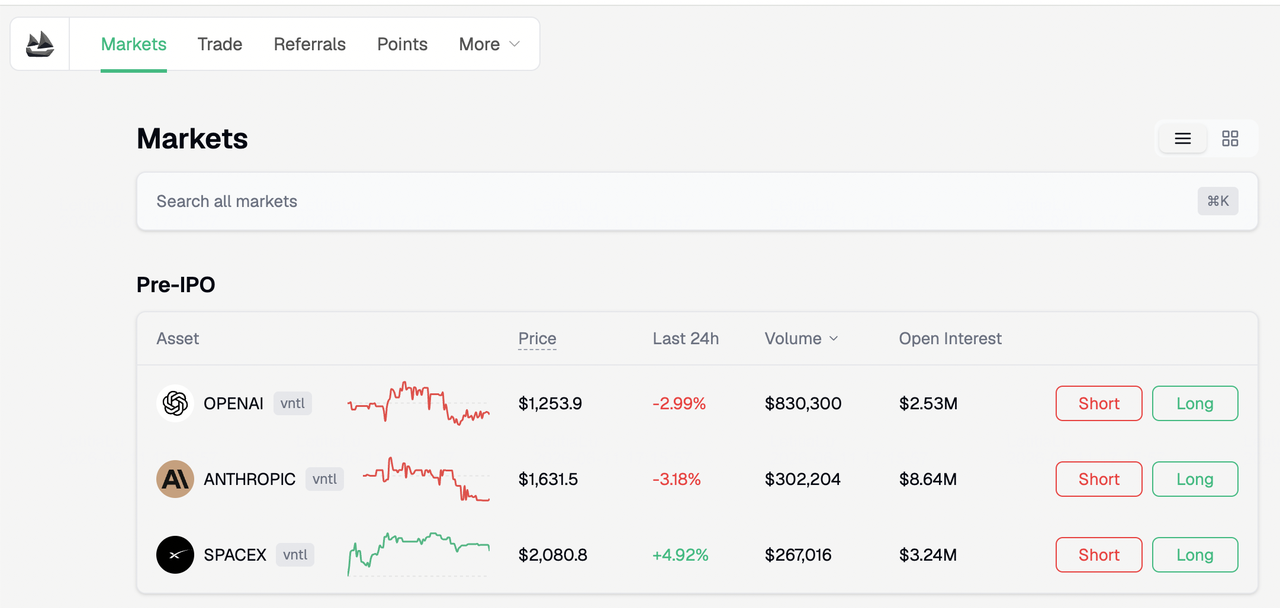
Ventuals is a private-company valuation market that lets traders gain synthetic exposure to companies before they go public. Instead of buying private shares, users trade valuation perpetuals tied to companies such as OpenAI, SpaceX, and Anthropic. Ventuals describes these markets as trading valuations, not shares, which means the product is built for pre-IPO price exposure rather than equity ownership.
OPENAI (VNTL) on BingX is a synthetic RWA derivative listed on BingX TradFi Futures. It is based on the vntl:OPENAI valuation market and gives traders exposure to OpenAI’s implied private-market valuation through a USDT-margined perpetual futures contract. The contract has no expiry date, settles in USDT, and allows traders to open long or short positions with leverage.
Its price reflects market demand on BingX and may be influenced by secondary-market signals, private funding round data, and sentiment around OpenAI’s IPO timeline. OPENAI (VNTL) is not OpenAI stock, not a tokenized share, and not affiliated with or endorsed by OpenAI. It is best understood as synthetic futures exposure to OpenAI’s private-market valuation sentiment.
How Does OpenAI VNTL Work on BingX?
OPENAI (VNTL) works as a synthetic RWA derivative on BingX TradFi Futures. It gives traders futures-based exposure to OpenAI’s implied private-market valuation without requiring access to private shares.
- Tracks OpenAI’s implied private valuation: OPENAI (VNTL) is designed to reflect market expectations around OpenAI’s pre-IPO valuation. Its price may be influenced by secondary-market signals, funding round data, investor demand, and sentiment around the IPO timeline. It is not a direct feed from OpenAI’s financial statements.
- No equity or ownership rights: Holding OPENAI (VNTL) does not give traders OpenAI shares, voting rights, dividends, or any legal claim on the company. It is a derivative contract for price exposure, not direct pre-IPO equity.
- USDT-margined perpetual futures contract: OPENAI (VNTL) settles in USDT, has no expiry date, and can be traded long or short. Traders can use leverage, which increases both potential gains and potential losses.
- 24/7 access with lower entry size: Unlike private secondary-market shares, which are usually limited to institutions or accredited investors, OPENAI (VNTL) trades continuously on BingX with smaller position sizes. This makes OpenAI-related valuation exposure more accessible, while still carrying futures trading and leverage risk.
OPENAI (VNTL) vs. OPENAI (Pre-IPO) vs. Owning OpenAI Shares: Key Differences
|
Feature |
OPENAI (VNTL) |
OPENAI (Pre-IPO) |
OpenAI Private / IPO Shares |
|
Product type |
Synthetic RWA derivative on BingX TradFi Futures |
Pre-IPO futures contract on BingX |
Actual OpenAI equity |
|
Market focus |
Tracks OpenAI’s implied private-market valuation |
Tracks OpenAI’s IPO-related valuation sentiment |
Represents direct ownership in OpenAI |
|
Accessibility |
Available to eligible BingX users |
Available to eligible BingX users |
Usually limited to institutional or accredited investors before IPO |
|
Trading hours |
24/7 futures trading |
24/7 futures trading |
Private markets before IPO; exchange hours after listing |
|
Minimum entry |
From small USDT position sizes |
From small USDT position sizes |
Often high minimums in private markets |
|
Equity rights |
No shares, voting rights, or dividends |
No shares, voting rights, or dividends |
Equity ownership, voting rights, and potential shareholder benefits |
|
Liquidity |
On-platform futures liquidity |
On-platform futures liquidity |
Limited before IPO; public-market liquidity after listing |
OPENAI (VNTL) and OPENAI (Pre-IPO) are two separate BingX futures products that offer synthetic exposure to OpenAI’s valuation, but they serve slightly different trading purposes. OPENAI (VNTL) is better understood as a VNTL-linked synthetic RWA derivative focused on OpenAI’s broader private-market valuation. OPENAI (Pre-IPO) is more directly tied to the company’s active IPO timeline and listing momentum.
Neither product gives traders OpenAI shares or legal ownership in the company. Both are USDT-margined futures contracts with no equity transfer. For active traders, the choice depends on the catalyst being traded: OPENAI (VNTL) may suit longer-term private valuation sentiment, while OPENAI (Pre-IPO) may better reflect near-term IPO expectations.
OpenAI vs. Anthropic: The 2026 AI Lab IPO Race
OpenAI and Anthropic are not only competing in frontier AI models. In 2026, they are also moving toward the public markets at nearly the same time. Anthropic filed its confidential S-1 on June 1, followed by OpenAI on June 8. Anthropic’s latest $65 billion Series H round reportedly lifted its post-money valuation to $965 billion, putting both companies at the center of the AI IPO cycle.
Note: The figures below are based on press reporting and private funding disclosures, not audited public prospectuses. Confidential S-1 filings do not disclose financials publicly, so all numbers should be treated as reported estimates until formal filings are released.
|
Metric |
OpenAI |
Anthropic |
|
Last private valuation |
$852B, March 2026 funding round |
$965B, May 2026 Series H |
|
Revenue run rate |
~$24B annualized |
~$47B annualized |
|
Core products |
ChatGPT, GPT-5, Codex, Operator, API |
Claude, Claude Code, Claude for Work |
|
Confidential S-1 filed |
June 8, 2026 |
June 1, 2026 |
|
Target IPO window |
September 2026 |
October 2026 |
|
Lead underwriters |
Goldman Sachs, Morgan Stanley |
J.P. Morgan, Bank of America |
|
Path to profitability |
Around 2030 |
Around 2028 |
The comparison is now split. OpenAI still leads in consumer reach, with 900 million weekly active users and more than 50 million paid subscribers. Anthropic has gained ground through enterprise adoption, Claude, and Claude Code, with reported revenue growth and an earlier profitability timeline. For BingX traders, the key question is whether capital flows toward OpenAI’s consumer platform scale or Anthropic’s enterprise-focused growth story as the IPO window develops.
How to Trade OPENAI (VNTL) on BingX
OPENAI (VNTL) is traded through the BingX Perpetual Futures interface. The contract is USDT-margined, has no expiry date, and allows traders to open long or short positions around OpenAI’s implied valuation and IPO-related catalysts.
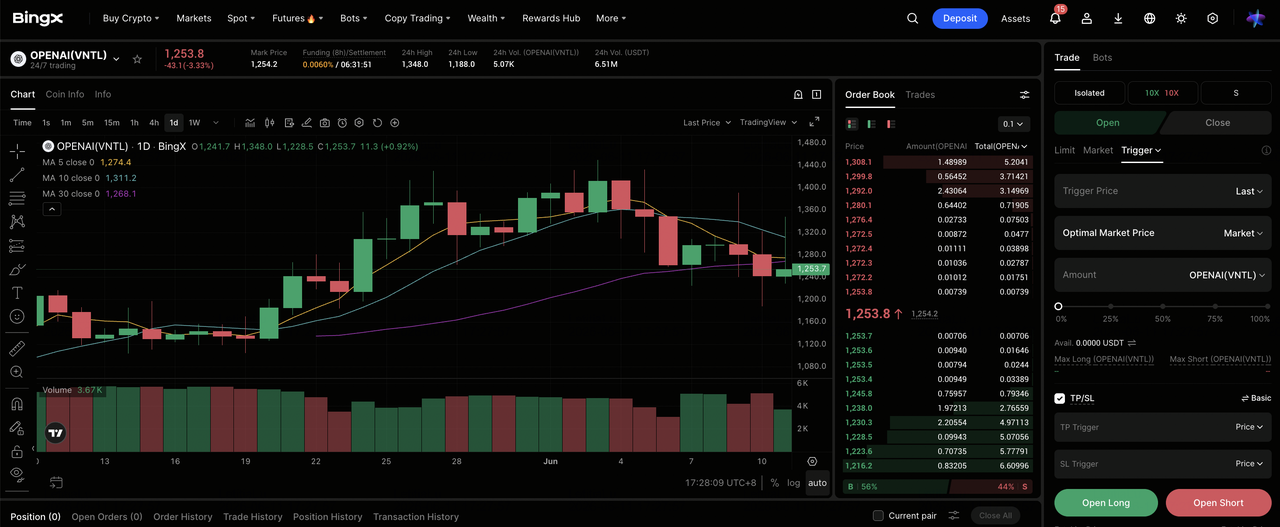
Step 1: Open the BingX Futures interface. Sign up or log in to your BingX account, complete any required KYC, and go to the Futures tab on the app or desktop platform. Search for OPENAI(VNTL)-USDT or access it through the Pre-IPO Trading Zone.
Step 2: Fund your Futures account. Make sure you have USDT available. Use the Transfer function to move USDT from your Spot or Fund account into your Futures account. This USDT will be used as margin collateral.
Step 3: Choose margin mode and leverage. Select Isolated Margin if you want to limit risk to the margin assigned to this position, or Cross Margin if you want to use your broader futures balance as a buffer. Because pre-IPO derivatives can be highly volatile, lower leverage such as 2x to 5x is generally more suitable than aggressive leverage.
Step 4: Open a long or short position. Choose Open Long if you expect OpenAI’s implied valuation to rise as IPO momentum builds. Choose Open Short if you expect valuation pressure from high cash burn, competition, weaker tech sentiment, or IPO timeline uncertainty. Use a market order for immediate execution or a limit order to enter at a specific price.
Step 5: Set take-profit and stop-loss orders. Set take-profit and stop-loss levels after opening the position. OPENAI (VNTL) can move sharply on private-market news, SEC updates, OpenAI product announcements, or changes in IPO expectations. Profit and loss are settled in USDT, so position sizing and risk controls are essential.
Risks to Consider Before Trading OPENAI (VNTL)
OPENAI (VNTL) gives traders synthetic exposure to OpenAI’s pre-IPO valuation, but it also carries risks that are different from standard crypto spot trading or owning public stocks.
- No OpenAI equity ownership: OPENAI (VNTL) does not represent OpenAI shares, voting rights, dividends, or any claim on company assets. It is a derivative contract, so gains and losses come from price movements on BingX rather than direct ownership of OpenAI.
- Valuation estimates may change: OpenAI’s reported private valuation, revenue run rate, and IPO expectations are based on press reports and private funding disclosures, not audited public filings. When the public S-1 becomes available, the official numbers may differ and could trigger sharp repricing.
- IPO timeline uncertainty: A confidential S-1 does not guarantee an IPO date, valuation, or listing price. SEC review, market conditions, OpenAI’s governance structure, Microsoft-related ownership questions, or weaker tech sentiment could delay the listing or change market expectations.
- Leverage and liquidation risk: OPENAI (VNTL) is a leveraged perpetual futures product. Small price moves can create large gains or losses, especially around SEC updates, funding news, IPO rumors, OpenAI product launches, or Anthropic-related developments.
- Platform and product risk: OPENAI (VNTL) is traded on BingX as an exchange-specific futures product. Traders should understand the contract rules, margin requirements, risk disclosures, and platform terms before opening a position.
Final Thoughts: Should You Trade OPENAI (VNTL) in 2026?
OPENAI (VNTL) gives BingX users a way to trade OpenAI’s pre-IPO valuation narrative before a public listing. With OpenAI reportedly targeting a September 2026 Nasdaq debut, it has become one of the most watched names in the 2026 AI IPO cycle.
For traders, the key question is whether OpenAI’s implied valuation can keep rising as the IPO approaches, or whether audited financials, infrastructure costs, competition, and broader tech sentiment lead to a repricing. OPENAI (VNTL) may suit traders who want early, leveraged exposure to this valuation debate, but it should be understood as a synthetic futures product rather than OpenAI equity.
Disclaimer: OPENAI (VNTL) does not provide OpenAI shares, voting rights, dividends, or legal ownership in the company. Pre-IPO derivatives can be highly volatile, and all reported valuation or financial figures should be treated as estimates until public filings are released. Traders should review product rules, margin requirements, and risk disclosures before opening a position.
Related Reading
- What Is Anthropic Pre-IPO and How to Trade It on BingX?
- How to Trade SpaceX Pre-IPO on BingX Pre-IPO: SPACEX (VNTL), SPACEX (PreStocks), and SPCX
- Should You Participate in SpaceX IPO: Pros and Cons
- Top AI Hyperscaler Stocks to Watch in 2026: The $700 Billion Cloud Infrastructure Race
- Microsoft (MSFT) Stock Outlook for 2026: Can Azure AI and Copilot Growth Drive MSFT Stock to $550+?
