

Aptos (APT) is a high-performance Layer 1 blockchain built for fast, secure, and scalable on-chain applications. Instead of relying on Ethereum-style sequential execution, Aptos uses a Move-based architecture designed to process transactions more efficiently while improving smart contract safety. Its roots are in Meta’s Diem project, giving the network a technical foundation that was developed before Aptos launched as a public blockchain in 2022.
As demand for faster blockchain infrastructure grew across DeFi, payments, real-world assets, and institutional finance, Aptos expanded from a “Diem successor” into a broader Layer 1 ecosystem. The network has several key parts: Aptos is the blockchain, APT is the native token used for gas fees, staking, and governance, Aptos Labs builds core technology and products, and the Aptos Foundation supports grants, partnerships, and ecosystem growth. This guide explains what Aptos is, how the network works, how APT tokenomics function, the main risks to consider, and how to trade APT on BingX.
What Is Aptos (APT)?
Aptos (APT) is the native token of Aptos, a high-speed Layer 1 blockchain built for scalable on-chain applications. The network is designed for developers and institutions that need fast settlement, reliable execution, and safer smart contract infrastructure for use cases such as DeFi, payments, gaming, real-world assets (RWA), and on-chain trading. Aptos was founded by Mo Shaikh and Avery Ching, two former Meta engineers who worked on Diem, Meta’s earlier blockchain project, before launching Aptos as an independent public network in October 2022.
Aptos started with a technical foundation inherited from the Diem research stack, especially the Move programming language and a parallel execution design built to process transactions more efficiently. By 2026, the network had expanded beyond its original “Diem successor” narrative, gaining attention from DeFi protocols, institutional finance partners, and tokenized asset initiatives. Aave’s first non-EVM deployment on Aptos, along with integrations tied to BlackRock, Franklin Templeton, and Mastercard, helped position Aptos as a Layer 1 focused on high-speed financial infrastructure rather than only general-purpose smart contracts.
The core idea behind Aptos is simple: blockchain applications need to become faster, safer, and more reliable before they can support mainstream financial activity at scale. Aptos approaches this through Move-based smart contracts, parallel transaction processing, and fast finality. APT powers this ecosystem by paying gas fees, supporting staking and validator security, and giving holders a role in network governance.
Key components of the Aptos ecosystem include:
- Aptos blockchain: The Layer 1 network built with Move, Block-STM, and AptosBFT.
- APT token: The native token used for gas fees, staking, validator security, and governance.
- Aptos Labs: The main development company behind Aptos protocol upgrades and products such as Decibel.
- Aptos Foundation: The independent organization supporting grants, partnerships, and ecosystem growth.
- Move: The programming language originally developed for Meta's Diem project and now used by Aptos.
Read More: What Are the Top Layer-1 (L1) Blockchains to Know in 2026?
How Does Aptos Network Work?
Aptos works as a high-performance Layer 1 blockchain. Developers build applications using Move, transactions are processed through parallel execution, validators secure the network, and APT is used to pay fees, support staking, and participate in governance.
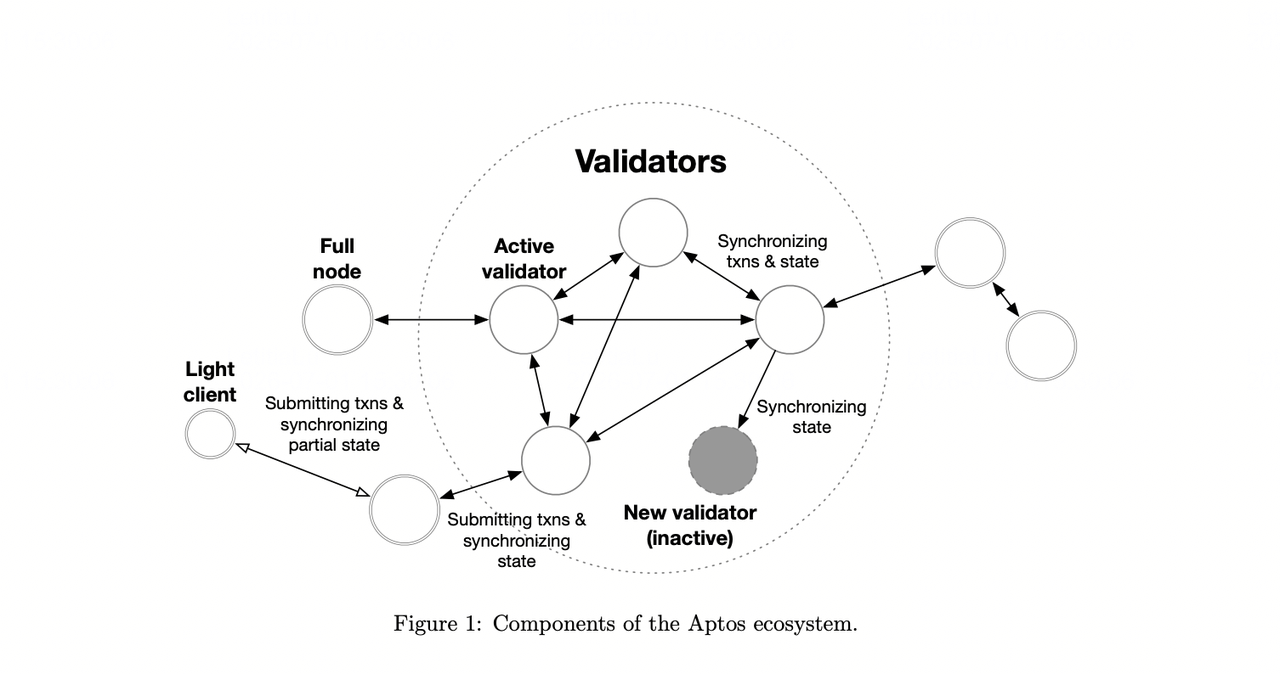
Source: Aptos Whitepaper
- Developers build with Move: Move is a programming language originally created for Meta's Diem project. It treats digital assets as resources that cannot be easily copied or accidentally destroyed, making it useful for financial applications where asset safety matters.
- Transactions run in parallel: Traditional blockchains often process transactions one by one. Aptos uses a parallel execution design that allows many transactions to run at the same time, then rechecks transactions that conflict. This helps the network handle more activity when users interact with different applications.
- Validators finalize transactions: Aptos uses a Byzantine Fault Tolerant (BFT) consensus design to confirm transactions. Once transactions are finalized, they are not meant to be reversed, giving the network fast and predictable settlement.
- APT secures the network: APT holders can stake tokens with validators to help secure the blockchain. In return, stakers can earn rewards, while validators help process transactions and maintain network reliability.
- Governance updates the protocol: Aptos uses Aptos Improvement Proposals, or AIPs, to update network parameters, tokenomics, and technical features. APT holders can participate in governance decisions through this process.
Aptos vs. Sui: Key Differences Between the Move-Based Layer 1 Blockchains
Aptos and Sui are often compared because both were built by teams with roots in Meta's Diem project and both use versions of the Move programming language. However, their design priorities are different. Aptos is more focused on institutional finance, payments, DeFi, and high-speed settlement, while Sui is more focused on consumer applications, gaming, NFTs, and object-based asset ownership.
|
Category |
Aptos |
Sui |
|
Core positioning |
Institutional finance, DeFi, payments, and RWA |
Consumer apps, gaming, NFTs, and on-chain assets |
|
Move model |
Account-based Move architecture |
Object-centric Move architecture |
|
Main technical focus |
Block-STM parallel execution and fast finality |
Object-based execution and asset ownership |
|
Ecosystem strength |
Institutional partnerships and DeFi integrations |
Developer activity, gaming, NFTs, and consumer dApps |
|
Key challenge |
Turning institutional partnerships into sustained on-chain activity |
Expanding beyond consumer and gaming use cases into deeper financial adoption |
The main difference is that Aptos treats Move as infrastructure for high-speed financial applications, while Sui uses Move to support more flexible object-based applications. For investors, the comparison comes down to adoption style: Aptos is betting on institutional finance and settlement, while Sui has stronger momentum in consumer-facing crypto applications.
Read More: What Are the Top Crypto Projects and dApps in the Sui Ecosystem in 2026?
Aptos Ecosystem in 2026: DeFi, Institutional Adoption, and Network Growth
Aptos has evolved from a Diem successor into a broader Layer 1 ecosystem focused on DeFi, payments, real-world assets, and high-speed settlement. Its 2026 adoption story is supported by lending protocol Aave's first non-EVM deployment, institutional finance integrations tied to BlackRock BUIDL and Franklin Templeton Benji, Mastercard's payment infrastructure partnership, and Aptos Labs's Decibel trading engine. These developments position Aptos as a Layer 1 network for financial applications, while still leaving room for stronger developer growth and deeper on-chain liquidity.
|
Timeline |
Key Development |
Why It Matters |
|
2017-2022 |
Diem origins and Aptos mainnet launch |
Aptos inherited Move and key execution research from Meta's Diem project before launching as an independent public Layer 1 network in October 2022 |
|
2025 |
DeFi and institutional RWA adoption |
Aave V3 deployed on Aptos in its first non-EVM expansion, while BlackRock BUIDL and Franklin Templeton Benji strengthened Aptos's institutional finance narrative |
|
March-April 2026 |
Payment, tokenomics, and privacy upgrades |
Mastercard's payment partnership, Proposal 183's tokenomics overhaul, and Confidential APT improved Aptos's positioning for financial use cases |
|
Q2 2026 and beyond |
Regulation and trading infrastructure |
APT's digital commodity classification reduced institutional uncertainty, while Decibel is designed to support on-chain spot, perpetuals, and margin trading |
Read More: Top 10 Aptos Ecosystem Crypto Projects and dApps (2026 Guide)
What Are the Aptos (APT) Tokenomics?
APT tokenomics changed significantly in March 2026 after Proposal 183. The update introduced a hard supply cap, reduced staking inflation, permanent gas fee burning, and a long-term Foundation lockup.
APT Token Utility and Supply Mechanisms
APT is the core economic asset of the Aptos network. It is used for gas fees, staking, validator security, and governance.
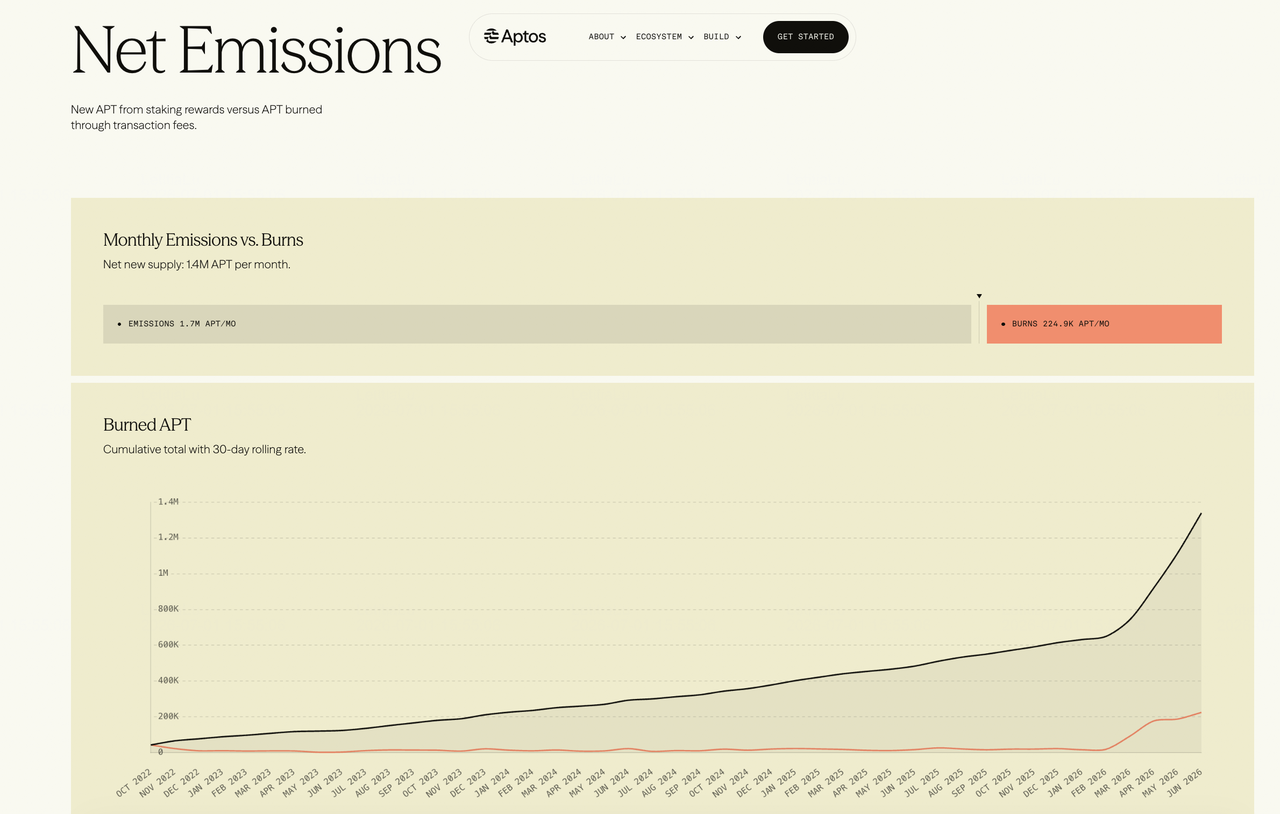
APT Monthly Emissions vs. Burns | Source: Aptos Network
- Gas fee payment: APT is used to pay transaction fees on the Aptos network. After Proposal 183, gas fees are permanently burned, linking network usage to supply reduction.
- Staking and security: APT holders can stake with validators to help secure the network and earn rewards. Proposal 183 reduced the staking reward rate from about 5.19% to around 2.6% annually.
- Governance: APT holders can vote on Aptos Improvement Proposals that affect protocol upgrades, fee structures, tokenomics, and network features.
- Hard supply cap: Proposal 183 introduced a 2.1 billion APT maximum supply, replacing the earlier inflationary model that had no fixed cap.
- Foundation lockup: The Aptos Foundation permanently locked and staked 210 million APT, reducing potential sell pressure from that allocation.
APT Token Allocation
|
Holder Category |
Initial Allocation |
Description |
|
Community and ecosystem |
51.02% |
Ecosystem grants, incentives, and community growth programs |
|
Core contributors |
19.00% |
Aptos Labs employees and early contributors under multi-year vesting |
|
Foundation |
16.50% |
Strategic reserve and operational funding |
|
Investors |
13.48% |
Early backers including a16z, Multicoin, Jump Crypto, and Franklin Templeton |
The October 2026 end of the four-year vesting schedule is one of the most important APT supply events to watch. In the short term, it could create selling pressure from vested holders. Over the medium term, it could reduce recurring monthly unlock pressure, especially when combined with the supply cap, lower staking inflation, and gas fee burning.
How to Trade Aptos (APT) on BingX
BingX offers two practical ways to gain exposure to Aptos, depending on whether the goal is direct ownership or short-term trading. Spot trading is better suited for users who want to buy and hold APT directly, while futures trading is designed for active traders who want long or short exposure to APT price movements.
Spot Trading: Buy and Own APT Directly
Spot trading is the most straightforward way to buy Aptos on BingX. When users buy APT on the spot market, they own the asset directly and can hold it in the BingX spot account, transfer it, or withdraw it to a self-custody Aptos wallet.
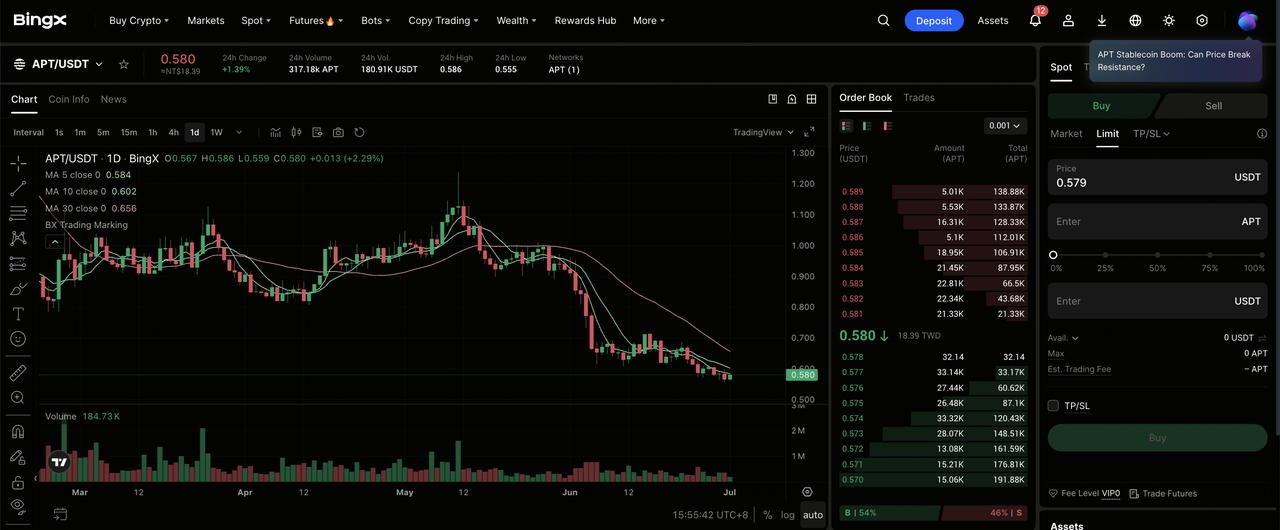
Step 1: Account setup and security. Sign up and log into your BingX account, complete the identity verification (KYC) required in your region, and enable two-factor authentication.
Step 2: Fund your spot account. Deposit USDT or another supported asset into your BingX spot account. Where available, users can also use supported fiat on-ramp options.
Step 3: Navigate to the spot market. Search for the APT/USDT trading pair.
Step 4: Place your order. Choose a market order to buy APT immediately at the current price, or use a limit order to set the price you want to pay.
Step 5: Manage your APT. Once filled, your APT appears in your spot account. You can keep it on BingX for convenience or withdraw it to an Aptos-compatible wallet such as Petra or Pontem for DeFi, staking, or governance participation.
Futures Trading: Trade APT Price Movements
For active traders, BingX offers USDT-margined APT perpetual futures. Futures allow users to trade APT price movements without holding the underlying asset, with the flexibility to open long positions if they expect APT to rise or short positions if they expect APT to fall.
Because futures involve leverage, they can amplify both gains and losses. This approach is more suitable for traders who already have a clear risk plan and understand liquidation risk, especially for an asset like APT that is sensitive to Layer 1 market sentiment, token unlocks, and institutional ecosystem updates.
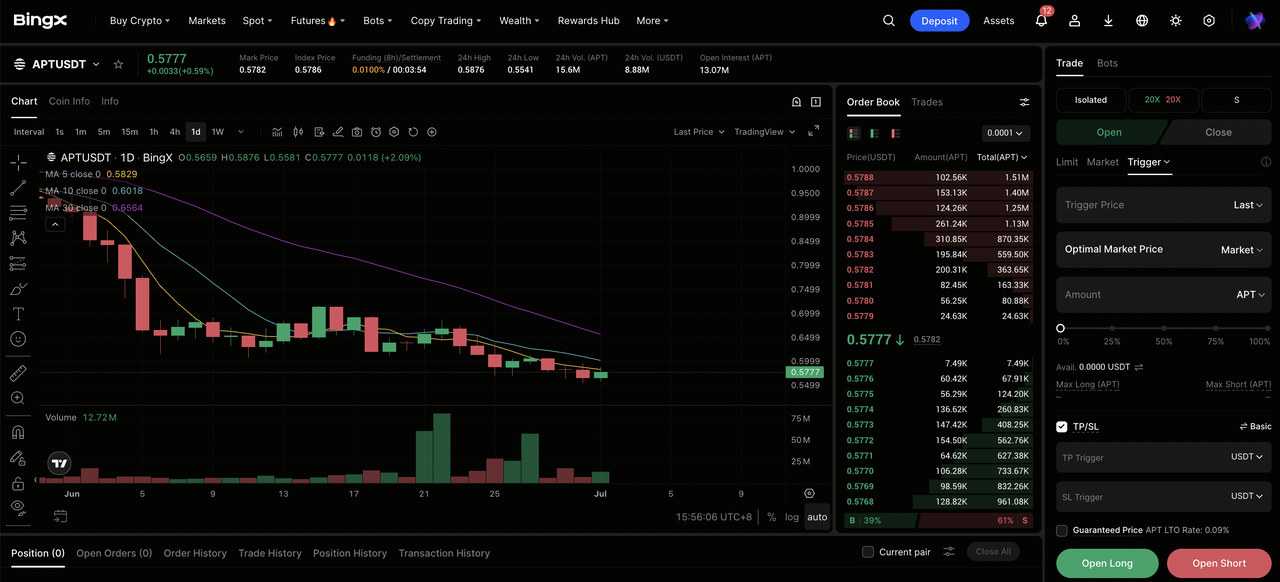
Step 1: Transfer collateral. Move USDT from your spot account into your futures account, where it will serve as margin.
Step 2: Select the contract. Search for the APT-USDT perpetual contract.
Step 3: Set direction and leverage. Open long if you expect APT to rise, or open short if you expect APT to decline. Choose leverage based on your risk tolerance and position size.
Step 4: Execute the trade. Enter the order amount and choose a market or limit order depending on your trading plan.
Step 5: Manage risk. Set stop-loss and take-profit orders before or immediately after entering the position. Profit and loss settle dynamically in USDT.
Risks and Considerations Before Investing in Aptos (APT)
Aptos has strong technology, institutional partnerships, and improved tokenomics. However, APT still carries risks tied to ecosystem activity, token supply, competition, and adoption timing.
- Developer activity lags Sui: Aptos has a smaller developer footprint than Sui, its closest Move-based competitor. If developers continue to favor Sui for consumer apps, gaming, and NFTs, Aptos may struggle to build a broader application ecosystem.
- TVL recovery remains incomplete: Aptos DeFi TVL peaked above $1 billion in late 2025 before falling sharply in early 2026. Recovery depends on stronger DeFi activity, new protocols, and whether products like Decibel can attract lasting liquidity.
- October 2026 vesting remains a supply event: The end of core contributor and investor vesting could create short-term sell pressure. While the end of vesting may reduce monthly unlock pressure later, the transition period could still be volatile.
- Institutional partnerships may take time to generate revenue: BlackRock, Franklin Templeton, Mastercard, and other integrations strengthen Aptos's credibility, but partnerships do not automatically translate into high transaction volume or fee revenue.
- Competition is intense: Solana has stronger consumer activity and liquidity, Ethereum has the deepest institutional settlement layer, and Sui has stronger momentum in some Move-based categories. Aptos must prove that its institutional focus can create real on-chain usage.
- APT has underperformed major peers: APT has traded far below its previous all-time high and has underperformed several major Layer 1 tokens. Tokenomics improvements help, but price recovery still depends on broader market conditions and ecosystem execution.
Final Thoughts: Should You Invest in Aptos (APT) in 2026?
Aptos is one of the more technically advanced Layer 1 blockchains, with a strong foundation in Move, Block-STM parallel execution, fast finality, and institutional-grade infrastructure. Its partnership set also gives it a clearer institutional finance narrative than many competing non-EVM chains.
The key question for 2026 is whether Aptos can turn that technical and institutional credibility into sustained on-chain usage. Developer activity, TVL recovery, Decibel adoption, tokenized asset growth, and the October 2026 vesting event will matter more than headline partnerships alone. For investors and traders, the most important metrics to watch are active developers, TVL, transaction volume, fee burns, token unlocks, and real institutional usage.
Related Reading
- What Are the Top Layer-1 (L1) Blockchains to Know in 2026?
- Top 10 Aptos Ecosystem Crypto Projects and dApps (2026 Guide)
- What Are the Top Crypto Projects and dApps in the Sui Ecosystem in 2026?
- What Is Hyperion Decentralized Exchange(DEX) on Aptos Blockchain?
- What Is DeFi (Decentralized Finance)? 8 Types of DeFi Protocols to Know
FAQs About Aptos (APT)
1. What makes Aptos different from other Layer 1 blockchains?
Aptos uses Move and Block-STM parallel execution, which are designed to improve smart contract safety and transaction throughput. Its main positioning is institutional-grade blockchain infrastructure for DeFi, payments, real-world assets, and high-speed on-chain trading.
2. Is Aptos built on Ethereum?
No. Aptos is an independent Layer 1 blockchain. It is not built on Ethereum and does not use the EVM as its core execution environment. Aptos uses Move, a programming language originally developed for Meta's Diem blockchain project.
3. Which wallets support Aptos (APT)?
APT can be stored in Aptos-compatible wallets such as Petra, Pontem, Martian, Fewcha, and other wallets that support the Aptos network. Users should always confirm that they are using the correct network before transferring APT.
